The digital marketing landscape is currently undergoing a fundamental transformation as artificial intelligence (AI) transitions from a peripheral technological novelty to a core component of the content production pipeline. As the demand for high-volume, search-engine-optimized (SEO) content continues to outpace the capacity of traditional human-led creative teams, the adoption of AI content generators has reached an inflection point. These tools, powered by advanced Large Language Models (LLMs) such as OpenAI’s GPT-3, are designed to enhance efficiency, reduce operational overhead, and maintain linguistic relevance across diverse digital mediums. In 2022, the market has seen a surge in specialized software solutions, each vying for dominance by offering unique feature sets tailored to bloggers, e-commerce specialists, and corporate marketing departments.
The Evolution and Market Context of Automated Writing
The trajectory of automated writing technology has moved with remarkable velocity over the past three years. While early iterations of text generation were often criticized for lack of coherence and repetitive syntax, the current generation of tools demonstrates a sophisticated understanding of context, tone, and intent. This evolution is driven by the increasing necessity for businesses to maintain a constant presence across multiple social and web platforms.

Market research suggests that the global AI software market is expected to expand significantly, with content creation being a primary driver. For organizations, the value proposition of these tools lies in their ability to eliminate "blank page syndrome"—the initial friction of starting a creative project. By generating drafts, headlines, and structured outlines in seconds, AI allows human editors to shift their focus from raw production to high-level strategy and refinement.
Analytical Overview of Leading AI Content Generation Platforms
To understand the current state of the industry, it is necessary to examine the primary platforms that have defined the market in 2022. These tools are categorized based on their technical capabilities, pricing structures, and specific target demographics.
1. Jasper AI: The Enterprise Standard for Long-Form Content
Formerly known as Jarvis, Jasper AI has established itself as a market leader, particularly for users requiring comprehensive long-form articles and blog posts. The platform’s "Boss Mode" is a notable feature, allowing users to issue direct commands to the AI, effectively treating the software as a collaborative writing partner.
Jasper utilizes sophisticated algorithms to identify the optimal sentence structures for specific mediums, whether it be a technical white paper or a casual social media update. While the platform sits at a higher price point—starting at approximately $99 per month for its most robust features—it provides extensive templates and integration capabilities that appeal to professional marketing agencies.
2. Copy.ai: Optimization for Marketing and Social Media
Copy.ai focuses heavily on short-form marketing copy. With over 90 specialized templates, it caters to the needs of social media managers and digital advertisers. The platform is designed to produce high-conversion "hook text," Facebook ad copy, and product descriptions. Its pricing model, which includes a free tier and a professional plan at $49 per month, makes it accessible to solopreneurs and small businesses. The tool is particularly lauded for its ability to generate multiple variations of a single prompt, allowing marketers to conduct A/B testing with minimal effort.
3. Frase AI: The Intersection of SEO and Generation
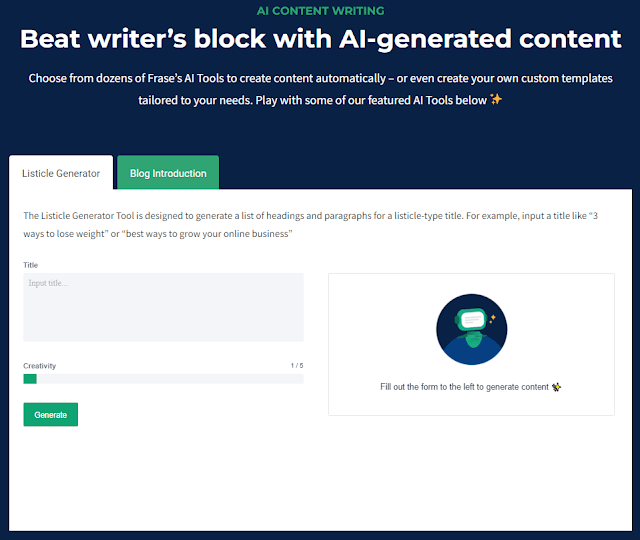
Frase distinguishes itself by merging content generation with SEO research. Unlike tools that focus solely on the creative aspect, Frase analyzes top-performing search engine results to provide users with a roadmap for content that is likely to rank highly on Google. This "research-first" approach ensures that the generated content is not only coherent but also strategically aligned with current search trends. Pricing for Frase is structured to accommodate various scales, ranging from solo plans at $14.99 per month to team-oriented subscriptions at $114.99 per month.

4. Article Forge: High-Efficiency Automated Drafting
Article Forge represents a different philosophical approach to AI writing. While other tools require constant human interaction, Article Forge is designed to generate complete, structured articles based on a single keyword. By utilizing deep learning models to research the topic automatically, it produces content that is intended to pass plagiarism checks like Copyscape. The platform offers a tiered pricing system based on word count, with a standard plan at $57 per month, positioning it as a solution for high-volume niche site owners.
5. Rytr: Affordability and User Accessibility
Rytr has gained traction as one of the most cost-effective solutions in the AI writing space. With a "Free Forever" plan and a "Saver Plan" starting at just $9 per month, it targets students, freelancers, and small-scale bloggers. Despite its lower price, it includes a built-in plagiarism checker and supports over 30 languages, making it a versatile tool for international content creators who require basic AI assistance without a significant financial commitment.
6. Writesonic: Multi-Functional Copywriting and Editing
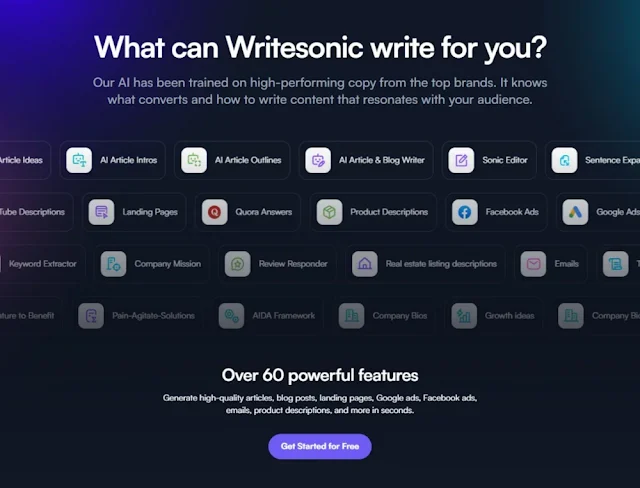
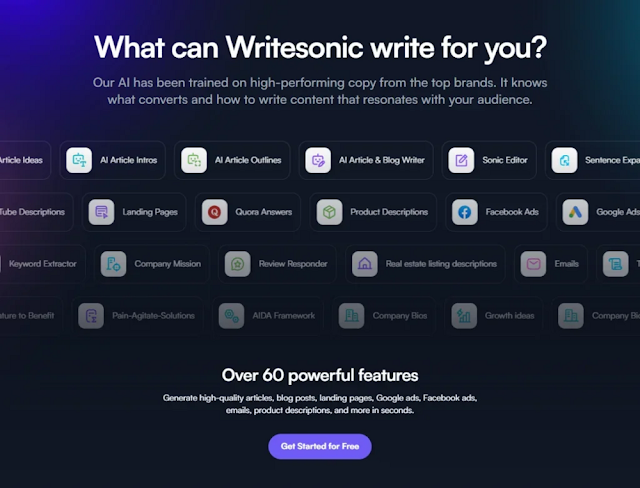
Writesonic is positioned as a comprehensive suite for marketing content, offering features that range from landing page generation to grammar and plagiarism checking. It provides a credit-based system, allowing users to pay for what they use, which is beneficial for businesses with fluctuating content needs. Its long-form writing assistant is particularly effective for creating structured blog posts that maintain a consistent narrative flow.
7. Copysmith: Enterprise Workflow Management
Copysmith is engineered for teams and e-commerce platforms that need to manage large-scale content projects. It offers integrations with popular platforms like Shopify and Google Ads, allowing users to push generated content directly to their storefronts. With a starter plan at $19 per month and customizable enterprise solutions, Copysmith focuses on the collaborative aspect of content creation, offering tools for bulk content generation and team brainstorming.
8. Hypotenuse.ai: Specialization in E-Commerce
As digital retail continues to expand, Hypotenuse.ai has carved out a niche by specializing in product descriptions and e-commerce copy. The tool is designed to take raw product attributes and transform them into persuasive, SEO-friendly descriptions. This focus on the retail sector makes it a preferred choice for companies managing thousands of Stock Keeping Units (SKUs) that require unique, non-repetitive descriptions.
9. Kafkai: Niche-Specific Training Models
Kafkai operates on a unique model where the AI is trained on specific niches rather than general web data. This allows it to produce content that is highly relevant to specialized industries such as health, finance, or technology. For SEO professionals managing "niche sites," Kafkai offers a way to generate industry-specific content at a low per-article cost, with plans starting at $29 per month for 100 articles.

10. Peppertype.ai: Streamlined Content for Small Businesses
Peppertype.ai emphasizes ease of use and speed. It is designed for business owners who may not have a background in copywriting but need to produce professional-grade emails, blog headers, and social media updates. The platform’s "Personal Plan" at $35 per month provides a straightforward interface that prioritizes quick output over complex customization.
Chronological Development and Technological Milestones
The rise of these tools can be traced through a specific timeline of technological breakthroughs.
- 2019: The release of GPT-2 by OpenAI demonstrated that AI could generate coherent paragraphs, though it often struggled with long-term logic.
- 2020: The debut of GPT-3 marked a radical shift. With 175 billion parameters, the model could mimic human styles with uncanny accuracy, leading to the founding of companies like Jasper (then Jarvis) and Copy.ai.
- 2021: The commercialization phase began, where developers built user-friendly interfaces (SaaS) on top of these AI models, tailoring them for specific business use cases.
- 2022: The current year represents the "Optimization Era," where tools are now integrating SEO data, plagiarism detection, and collaborative features to move beyond simple text generation.
Industry Response and Ethical Implications
The rapid adoption of AI writing tools has not been without controversy. Industry experts and search engine giants like Google have expressed varying stances on the proliferation of machine-generated text.

Search Engine Perspectives
In early 2022, Google’s Search Quality team clarified that content generated solely by AI without human oversight might be considered "spam" if its primary purpose is to manipulate search rankings. However, the consensus among SEO professionals has shifted toward a hybrid model: using AI for the "heavy lifting" of drafting while employing human editors to ensure factual accuracy, original insight, and brand voice.
Professional Displacement Concerns
The rise of AI has sparked a debate regarding the future of professional copywriting. While some fear job losses, many industry analysts argue that AI is a "force multiplier." Instead of replacing writers, it is evolving the role of the writer into that of a "content editor" or "AI prompter," where the human provides the strategic direction and the AI handles the linguistic execution.
Broader Impact and Future Outlook
The implications of AI content generation extend far beyond simple efficiency. As these tools become more sophisticated, the cost of content production will continue to decrease, leading to an even greater saturation of information online. This will likely place a higher premium on "human-verified" content and original research, as generic summaries become easily replicable by machines.
Furthermore, the integration of AI into creative workflows is expected to expand into multi-modal generation, where a single prompt could generate an article, a corresponding social media video script, and an accompanying image. The tools listed above represent the first generation of this new creative economy.
In conclusion, the emergence of AI content generators like Jasper, Copy.ai, and Frase represents a permanent shift in how digital information is constructed. For businesses and creators, the challenge lies not in deciding whether to use AI, but in determining which tool aligns most effectively with their specific operational goals and budgetary constraints. As the technology matures, the distinction between human-written and AI-assisted content will likely continue to blur, ushering in an era of unprecedented digital productivity.
About the Author