The International Chamber of Commerce (ICC) has announced the upcoming release of its 2026 Global Trade Intelligence Report, a comprehensive analysis designed to serve as the definitive benchmark for the trade and supply chain finance industry. Built upon a foundation of more than a decade of aggregated data, the forthcoming report integrates figures from 22 of the world’s leading global banks, covering an unprecedented $25.7 trillion in transactions. This initiative represents the evolution of the ICC’s long-standing "Trade Register," rebranded to reflect a broader scope of actionable intelligence and a deeper dive into the risk performance metrics that govern modern international commerce. As global markets grapple with geopolitical volatility, fluctuating interest rates, and a shifting regulatory landscape, the 2026 report is positioned to provide the empirical evidence necessary for financial institutions to optimize capital allocation and enhance risk management strategies.
The Strategic Importance of Trade Finance Intelligence
Trade finance serves as the backbone of the global economy, facilitating the movement of goods and services across borders by mitigating the inherent risks of international transactions. Despite its critical role, the industry has historically lacked a centralized, transparent data repository that quantifies risk with high precision. The ICC Global Trade Intelligence Report fills this void by providing a standardized framework for evaluating default and loss rates across various trade finance products, such as Letters of Credit (LCs), Standby Letters of Credit (SBLCs), and Supply Chain Finance (SCF) instruments.
The report’s utility extends beyond simple data collection; it is a strategic asset used by global financial institutions to support better-informed decision-making. By leveraging the world’s most comprehensive benchmark, banks can compare their internal portfolio performance against global and regional averages. This benchmarking is crucial for identifying emerging market opportunities and for justifying the low-risk nature of trade finance to internal stakeholders and external regulators. Historically, trade finance has demonstrated significantly lower default rates compared to traditional corporate lending, a fact that the ICC report continues to substantiate through rigorous data analysis.
A Chronology of Data-Driven Advocacy
The journey toward the 2026 report began over 15 years ago when the ICC recognized the need for a data-driven approach to advocate for fair regulatory treatment of trade finance. Following the 2008 financial crisis, the implementation of Basel III regulations threatened to impose higher capital requirements on trade finance products, potentially making them more expensive for businesses—particularly Small and Medium-sized Enterprises (SMEs).
In response, the ICC established the Trade Register in 2009 to collect objective data on the credit risk of trade finance. Over the years, the project has grown in both scale and sophistication. The transition from a "Register" to "Global Trade Intelligence" signifies a shift from retrospective data gathering to prospective market analysis. The 2025 cycle saw the integration of more advanced data modeling techniques, and the 2026 edition is expected to build on this by incorporating more granular regional data and a sharper focus on the impact of digitalization in the trade ecosystem. This chronology highlights the ICC’s commitment to providing a consistent and evolving narrative on the safety and viability of trade finance as an asset class.
Methodological Rigor and Strategic Partnerships
The high standard of the ICC Global Trade Intelligence Report is made possible through a strategic partnership between the ICC, Boston Consulting Group (BCG), and Global Credit Data (GCD). BCG brings its extensive expertise in strategic consulting and market analysis, while GCD provides the technical infrastructure and data-cleansing capabilities necessary to handle the vast datasets contributed by member banks.
This collaborative model ensures that the data is not only accurate but also anonymized and aggregated in a way that protects the proprietary information of participating institutions. The 2026 report will continue to utilize this methodology to analyze default rates (the probability that a borrower will fail to make payments) and Loss Given Default (LGD) rates (the actual loss incurred by the bank after recoveries). By providing these metrics, the report allows banks to refine their Credit Conversion Factors (CCFs), which are essential for calculating the amount of capital they must hold against their trade finance exposures.
What to Expect in the 2026 Edition
The 2026 Global Trade Intelligence Report will be released as a complete package, consisting of a Global Overview Report, regional data analysis, and product-specific deep dives. This tiered approach allows users to access insights tailored to specific business needs, whether they are focused on the emerging markets of Southeast Asia or the established corridors of Europe and North America. Key areas of focus for the 2026 report include:
- Risk Performance Trends: An updated look at how trade finance has fared amidst the inflationary pressures and interest rate hikes of the mid-2020s.
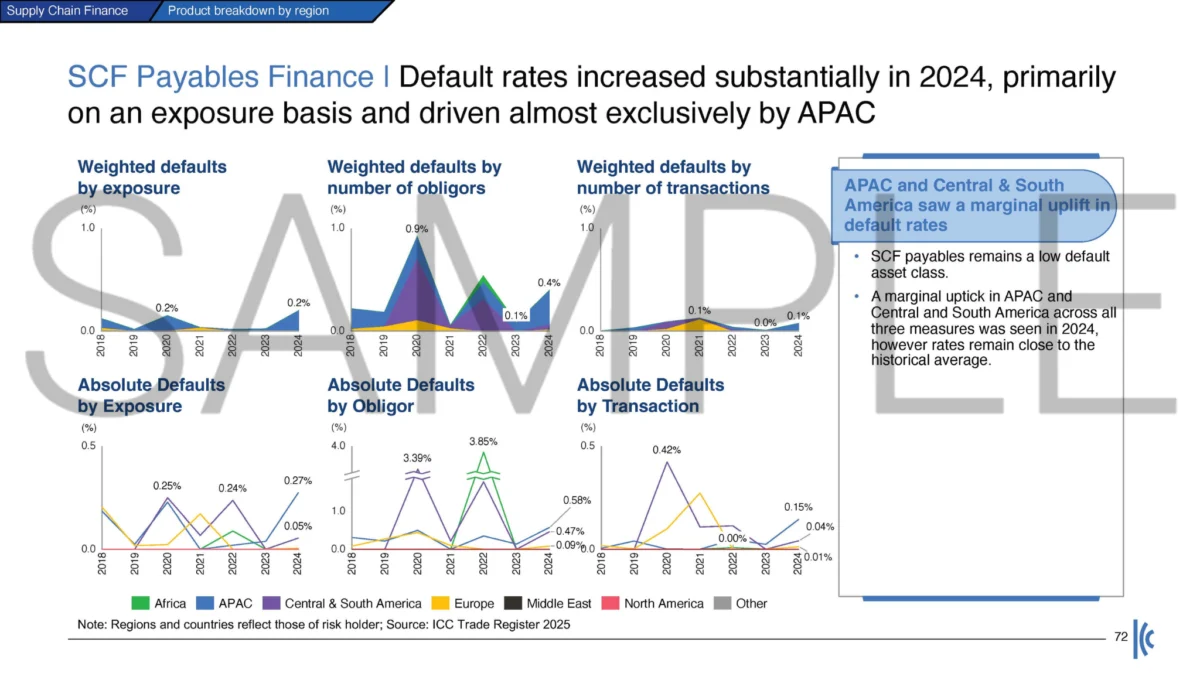
- Supply Chain Finance Evolution: As SCF becomes more prevalent, the report will provide specialized data on the performance of payables-based finance and its resilience during economic downturns.
- Digitalization and Fraud Prevention: Analysis of how the transition to electronic bills of lading and digital trade documents is impacting the risk profile of trade transactions.
- Regional Opportunity Mapping: Identification of high-growth regions where trade finance demand is outstripping supply, providing a roadmap for bank expansion.
Impact on the Global Trade Finance Gap
One of the most pressing issues in global commerce is the "Trade Finance Gap"—the difference between the demand for trade finance and the availability of credit. According to the Asian Development Bank, this gap has hovered around $2.5 trillion in recent years, disproportionately affecting SMEs in developing economies. The ICC Global Trade Intelligence Report plays a vital role in addressing this gap.
By providing empirical evidence that trade finance is a low-risk activity, the report encourages more banks to enter the market or expand their existing trade desks. Furthermore, the data helps non-bank financial institutions and institutional investors understand the risk-return profile of trade finance, potentially attracting new sources of liquidity to the market. When banks have the data to prove that trade finance is safe, they can offer more competitive pricing and extend credit to businesses that might otherwise be deemed too risky under traditional lending models.
Regulatory Implications and the Basel Framework
The 2026 report arrives at a critical juncture for banking regulation. As the "Basel III Endgame" and the transition toward Basel IV continue to be debated and implemented across various jurisdictions, the need for high-quality data is paramount. Regulators require evidence to support the preferential treatment of trade finance under capital adequacy rules.
The ICC’s data has historically been instrumental in convincing the Basel Committee on Banking Supervision (BCBS) that trade finance instruments, such as Letters of Credit, are self-liquidating and backed by physical goods, which justifies a lower risk weight. The 2026 report will provide the most current data set to support these ongoing dialogues, ensuring that regulatory frameworks do not inadvertently stifle global trade by imposing prohibitive capital costs on essential financing activities.
Membership and Collaborative Industry Leadership
The production of the report is a collective effort involving 22 of the world’s most influential financial institutions. These member banks not only contribute data but also gain access to exclusive benefits, including detailed peer-group benchmarking and participation in steering committees that shape the future direction of the research.
Membership in the ICC Global Trade Intelligence initiative allows institutions to have a "seat at the table" where the industry’s leading source of intelligence is crafted. For non-bank corporations and sponsors, the report offers a platform to raise visibility among senior decision-makers in the banking sector. The collaborative nature of the project fosters a sense of shared responsibility for the health and transparency of the global trade finance market.
Expert Analysis: The Road Ahead
Industry analysts suggest that the 2026 report will likely highlight a "normalization" of risk following the extreme disruptions caused by the COVID-19 pandemic and subsequent supply chain realignments. While the 2020-2023 period was characterized by volatility, the 2026 data is expected to show the enduring resilience of trade finance.
"The ICC report is more than just a collection of charts; it is a testament to the stability of trade as an asset class," says a senior trade analyst familiar with the project. "In an era of uncertainty, having $25.7 trillion worth of data points allows the industry to move away from anecdotes and toward evidence-based strategy. The 2026 edition will be particularly important as we see how digitalization and ESG (Environmental, Social, and Governance) factors are beginning to influence trade credit performance."
Conclusion: A Foundation for Future Growth
As the International Chamber of Commerce prepares to unveil the 2026 Global Trade Intelligence Report, the focus remains on empowering the financial community with the tools needed to navigate an increasingly complex global economy. By transforming raw data into actionable intelligence, the ICC continues to champion the cause of trade as a driver of economic development and stability.
The full report, which will be available in the coming months, is expected to be a cornerstone for strategic planning for the remainder of the decade. For global banks, regulators, and corporate treasurers, the insights contained within the 2026 edition will provide a clear-eyed view of the risks and rewards of international trade, ensuring that the wheels of global commerce continue to turn with efficiency and confidence.
About the Author