In the dynamic landscape of business expansion, the strategic scaling of a marketing team is often an afterthought, a critical oversight that can stunt growth and erode efficiency. The lean, agile unit that propels a startup to initial success is fundamentally ill-equipped to navigate the complexities of sustained expansion. This was a hard-learned lesson for many, including those who have operated as a sole marketing force, experiencing firsthand the detrimental effects of an undersized and unstructured team. As companies ascend through revenue milestones, from early-stage traction to enterprise-level operations, their marketing infrastructure must evolve in lockstep. Failing to adapt leads to overwhelmed personnel, compromised output quality, and missed strategic objectives. The question then becomes not if a marketing team needs to scale, but how to structure it effectively for robust, long-term growth.
The imperative for a well-defined and scalable marketing team structure is underscored by mounting evidence of organizational inefficiencies. A comprehensive McKinsey survey revealed that nearly 67% of organizations perceive themselves as overly complex and inefficient. This pervasive issue directly translates to slower decision-making, duplicated efforts, and a significant reduction in operational velocity. The root cause often lies in the misalignment between ambitious growth targets and the team’s capacity to achieve them. When revenue and growth objectives escalate, so too does the volume and complexity of marketing tasks. A marketing team’s size, roles, and responsibilities must accurately reflect these escalating demands. For instance, an aggressive content production goal necessitates a robust team of content creators and strategists, while a significant product launch demands the specialized expertise of a product marketing manager. The alternative—piling additional responsibilities onto already overburdened individuals—inevitably leads to burnout, decreased morale, and increased employee turnover.
Mark Roberge, co-founder of Stage 2 Capital and a former HubSpot executive, emphasizes this strategic imperative: "We have a long conversation with our founders out of the gate about their five-year scale plan and do a bottom-up analysis to understand the realistic inputs… That’s a critical strategic decision that determines everything—how many reps you’ll hire, how many support people, how many engineers, how much property." This perspective highlights that talent is a strategic resource, and its allocation must be meticulously planned to achieve desired outcomes. However, haphazardly increasing headcount without a clear organizational design is a recipe for dysfunction.
Common Pitfalls in Marketing Team Expansion
When marketing teams grow without intentional structural planning, several predictable patterns emerge, undermining overall performance. These common missteps include:
- Unclear Role Boundaries: A significant challenge is the lack of defined ownership and accountability. Gallup’s research indicates that only 46% of employees feel clear about their expectations, a decline from previous years. Ambiguous responsibilities lead to critical tasks falling through the cracks or team members duplicating efforts, resulting in missed deadlines and confusion. This was evident in situations where multiple individuals possessed overlapping expertise, leading to decision-making stalemates until clear lines of accountability were established.
- Leadership Bottlenecks: When decision-making authority is concentrated in a single individual, efficiency plummets. Teams can experience significant delays awaiting routine approvals, leading to missed opportunities and stalled projects. This is a direct consequence of unclear roles, as operational flow becomes dependent on a single point of contact.
- Disconnected Channels: As teams expand, interdepartmental communication can suffer, leading to silos. When content, demand generation, and product marketing operate independently without cross-team coordination, messaging can become inconsistent, negatively impacting campaign quality and brand coherence.
- Meeting Fatigue: In an effort to bridge communication gaps, organizations often rely heavily on meetings. However, this can lead to diminishing returns. Flowtrace data suggests that employees spend an average of 392 hours annually in meetings, equating to over 16 full workdays. Excessive meetings detract from productive execution time and can contribute to bottlenecks.
- Underutilized Talent: Hiring specialized roles prematurely, before core channels are validated, represents a significant waste of budget and creates positions without clear deliverables. This can result in expensive talent remaining idle, unable to contribute meaningfully to immediate business objectives.
These issues can compound rapidly, creating a cascade of inefficiencies. A well-conceived hiring plan, aligned with a phased growth strategy, is essential to mitigate and, ideally, avoid these detrimental outcomes.

A Phased Approach to Marketing Team Structuring
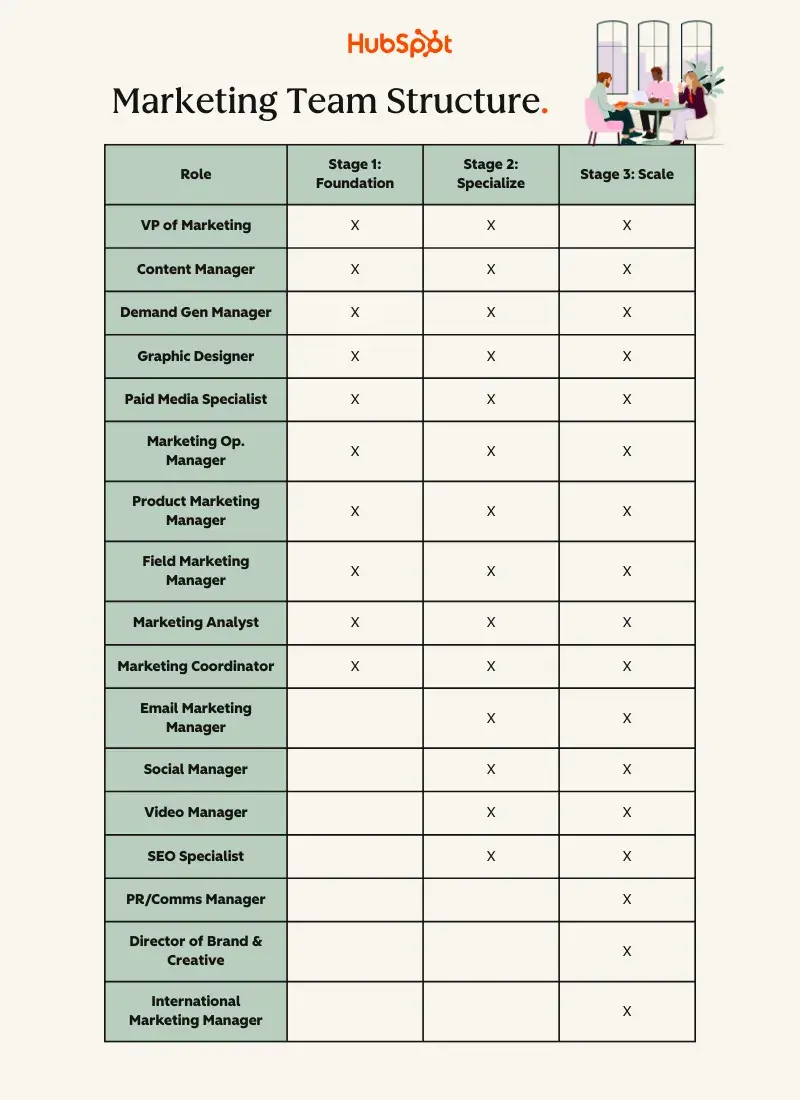
Sustaining rapid growth, often defined as tripling team size, requires a pragmatic approach to organizational design. Elad Gil, a prominent entrepreneur and advisor, suggests that organizations can effectively manage such hypergrowth by implementing appropriate organizational structures. This framework outlines three distinct phases for scaling a marketing team, guiding organizations from an initial team of five to a more comprehensive unit of twenty-five, with clear hiring priorities, role evolutions, and structural recommendations tied to revenue milestones.
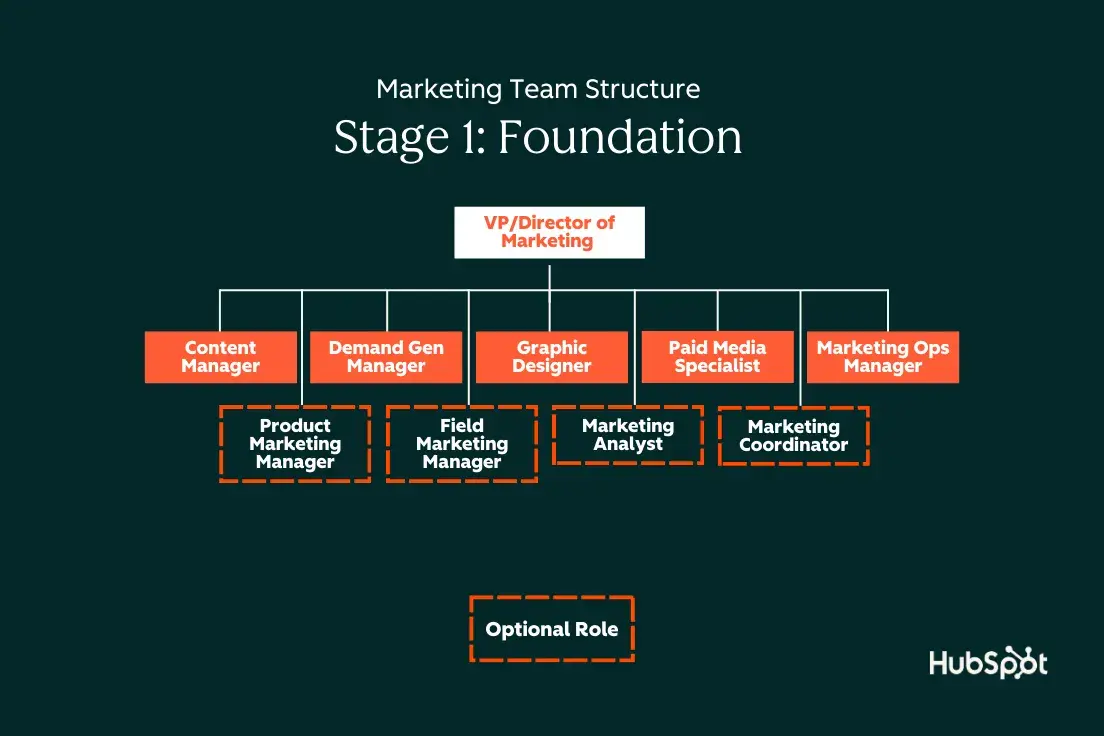
Phase 1: Foundation (5–10 People)
This initial phase is typically triggered when a company achieves between $5 million and $15 million in Annual Recurring Revenue (ARR) and has acquired over 100 customers. The primary focus is on establishing core marketing functions, implementing essential tools, and defining foundational processes. At this stage, hiring generalists with broad skill sets who can adapt to various responsibilities is paramount.
Foundational Marketing Roles:
- VP or Director of Marketing: This senior leader is responsible for overall marketing strategy, managing early hires, and aligning the team with overarching business objectives. They are the primary decision-maker and are accountable for key performance metrics. Key efficiency metrics include Return on Marketing Investment (ROMI), Customer Acquisition Cost (CAC), Marketing-Sourced Pipeline, and Marketing Efficiency Ratio (MER).
- Content Marketing Manager: This role spearheads content creation and Search Engine Optimization (SEO). They may produce various content formats themselves or manage external production. Efficiency metrics encompass publishing frequency, organic traffic growth, content-attributed Marketing Qualified Leads (MQLs), and first-30-day page traffic.
- Demand Generation Manager: This individual oversees lead acquisition and pipeline generation, focusing on driving conversions and delivering qualified leads to the sales team. Relevant metrics include MQLs, Sales Qualified Leads (SQLs), Cost Per Acquisition (CPA), marketing-sourced pipeline, and payback period.
- Graphic Designer: Responsible for creating visual assets across website materials, social media, and premium content, among other applications. Efficiency metrics include campaign consistency rate, turnaround time per asset, engagement uplift (CTR, social shares), and brand adherence audits.
- Paid Media Specialist: Manages advertising campaigns across various platforms, including paid social media. Key metrics are Impressions, CTR, Cost Per Click (CPC), CPA, and Return on Ad Spend (ROAS).
- (Optional) Marketing Operations Manager: Oversees marketing automation and reporting systems, working with platforms like HubSpot. Efficiency metrics include MER, campaign setup time, funnel conversion rates, and data accuracy scores.
- (Optional) Product Marketing Manager: Focuses on product messaging, positioning, and go-to-market strategies. Metrics include sales enablement usage, win rate uplift, sales cycle reduction, and product-qualified leads.
- (Optional) Event or Field Marketing Manager: Supports in-person events, crucial for B2B organizations. Metrics include leads generated per event, Cost Per Lead (CPL), event attendance rate, and pipeline sourced from events.
- (Optional) Marketing Analyst: Monitors, measures, and reports on marketing performance. Metrics include dashboard refresh cadence, attribution model coverage, forecast accuracy, and data insights generated.
- (Optional) Marketing Coordinator: Provides support for various execution needs. Efficiency metrics include task completion rate, campaign support accuracy, and coordination turnaround time.
During Phase 1, maintaining a flat organizational structure, with all team members reporting directly to the marketing leader, is often most effective. This streamlined hierarchy minimizes decision-making ambiguity and fosters collaboration in a smaller team. It is advisable to initially assign functional areas based on available time and skill sets, recognizing that roles can evolve. Generalists are crucial at this stage due to their agility, enabling them to adapt to shifting priorities and contribute across core channels. The expected impact of this phase is the establishment of a functioning funnel, foundational processes, and early pipeline traction. While AI can support some tasks, human oversight remains critical for refining outputs, especially in content generation. For early-stage teams, opting for local or in-office talent can simplify operations by avoiding the complexities of remote work, such as time zone differences and maintaining productivity.
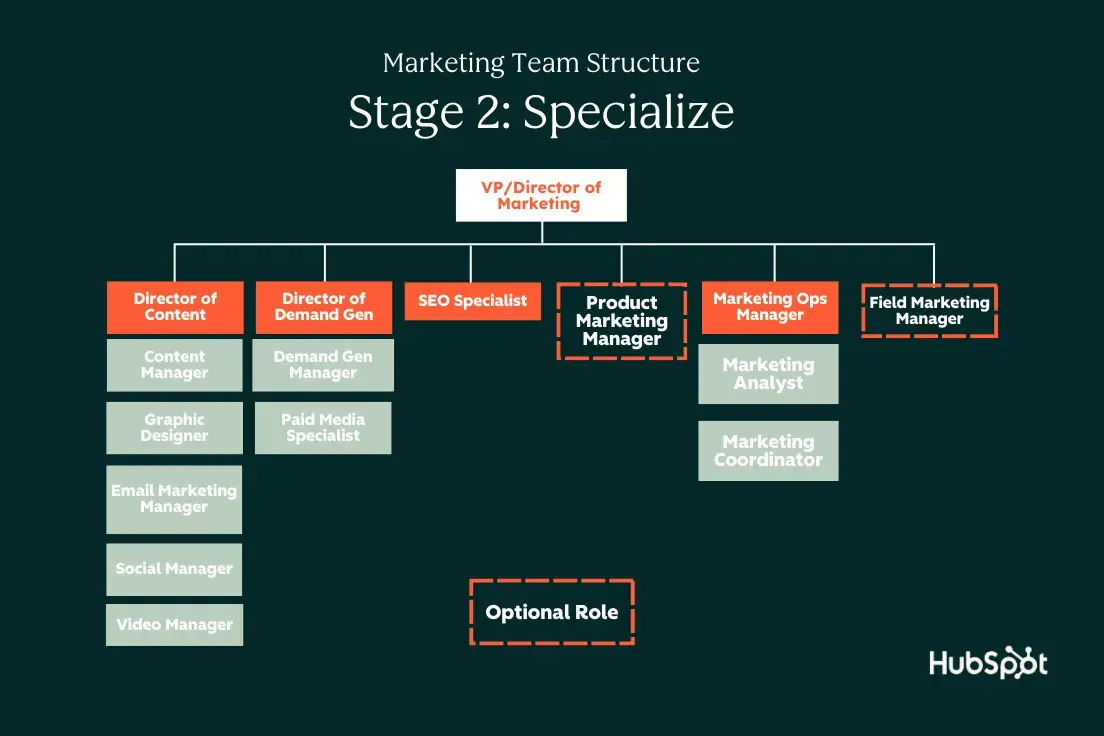
Phase 2: Specialization (11–17 People)
This phase is initiated when a company surpasses $15 million in ARR and has over 500 customers. The marketing landscape becomes more competitive and complex, necessitating greater sophistication to capture attention. Phase 2 introduces specialization and an additional layer of management, typically organized around channel ownership to enhance performance tracking, focus, and repeatable growth.
Specialized Marketing Roles:

- Director of Demand Generation: This role leads both paid and inbound efforts focused on driving conversions and sales, often managing the Demand Generation Manager. Efficiency metrics include leads generated and campaign support accuracy.
- SEO Specialist: As organic search visibility becomes critical, a dedicated SEO specialist moves beyond the content manager’s initial responsibilities to implement advanced strategies for improved search engine performance. Efficiency metrics include organic traffic growth and task completion rate.
- Email Marketing Manager: This role evolves from content marketing responsibilities to focus on lead nurturing and customer lifecycle communications, aiming to improve retention. Key metrics include the number of email campaigns launched and email open/conversion rates.
- Social Media Manager: With social media’s pervasive influence, this role becomes a full-time responsibility, managing brand presence and engagement across platforms.
- Videographer or Video Marketing Manager: Recognizing the importance of video content, especially on social media, this phase is ideal for investing in talent to build and scale video strategy. Efficiency metrics include the number of videos completed and campaign support accuracy.
In addition to these roles, further content writers may be needed to scale output, or a campaign manager might be appointed to coordinate cross-channel initiatives. This phase is also conducive to exploring remote or hybrid work structures, as established processes and tools can support distributed teams. Organizationally, the team should begin forming functional groups with clear leaders acting as middle managers, fostering channel-specific focus (e.g., content, search, demand). The analytics function should operate independently for enhanced objectivity and rigor. The expected impact is driving reliable, scalable performance across all channels and implementing efficient campaign processes.
Phase 3: Scale (18–25 People)
This final phase, typically triggered by reaching $40 million to $100 million in ARR and exceeding 1,000 customers, focuses on structuring the marketing team to support global operations and long-term scale. This involves a fully layered marketing organization with strategic and executional roles across functions and regions.
Marketing Roles for Scale:
- Director of Product Marketing: This role guides the go-to-market strategy and enablement, often managing a product marketing team.
- Director of Brand or Creative: Leads brand storytelling and visual identity, likely managing graphic designers.
- Account-Based Marketing (ABM) Manager: Focuses on marketing to key segments or individual accounts, bridging sales and marketing efforts.
- Conversion Rate Optimization (CRO) Manager: Works to improve on-site and funnel conversion rates.
- Marketing Automation Specialist: Supports backend workflows and integrations across marketing, operations, and web functions.
- Customer Marketing Manager: Drives customer engagement and retention, focusing on loyalty and satisfaction.
- PR/Communications Manager: Oversees media relations and external messaging to manage public perception, crucial for global brand building.
- International Marketing Lead: Manages localization and regional expansion efforts for global markets.
At this stage, the organizational structure should incorporate at least two layers of leadership, with Directors managing Managers and clearly defined functional areas such as Brand, Demand Generation, Product Marketing, and Operations. The expected impact is an enterprise-ready team capable of driving both pipeline and brand awareness across diverse markets, requiring alignment on global strategy and localized execution.
Strategic Steps for Scaling a Marketing Team
Building a scalable marketing team requires more than simply increasing headcount; it demands structured hiring and organizational design aligned with the company’s current growth phase and future aspirations. This involves a five-step process:
- Identify Your Growth Phase: Before hiring, accurately assess your company’s current growth stage based on ARR and customer count. Each phase (Foundation, Specialization, Scale) has distinct hiring priorities and structural needs. Utilize these to evaluate your team, pinpoint necessary roles, and establish revenue milestones as hiring checkpoints to prevent premature specialization or understaffing.
- Assess Current Marketing Abilities: Map your existing team’s skills, bandwidth, and effectiveness. Identify gaps between current output and what is required to achieve next-phase goals. This assessment guides decisions on areas needing improvement or new additions. For nascent marketing functions, this might mean building from scratch with generalists; for established teams, it involves identifying specialist needs.
- List Hiring Priorities: Rank potential roles based on current skill gaps, underperforming channels, operational strain, and revenue objectives. Prioritize roles that directly contribute to pipeline generation or alleviate operational friction, as these typically yield the most immediate results.
- Establish Clear Role Definitions, Metrics, and Expectations: Document responsibilities, success metrics, and reporting structures for each role. Ambiguous roles can foster overlap, confusion, and conflict, counteracting growth objectives. For scaling teams, establishing clear processes and guidelines is crucial for faster onboarding and consistent performance.
- Create Regular Structure Review Cadence: Ambitious organizations often restructure every 6-9 months to maintain alignment with business growth. Schedule regular reviews, at least quarterly, to assess if the current structure effectively serves evolving goals. Be prepared to adjust reporting lines, combine functions, or split teams as organizational complexity increases.
Prioritizing Roles During Marketing Team Scaling
In an ideal scenario, all desirable roles would be filled simultaneously. However, resource constraints necessitate strategic prioritization. The following five points can guide this decision-making process:
- Impact on Revenue: Prioritize roles that directly influence revenue generation, such as demand generation or product marketing.
- Operational Efficiency: Identify roles that can alleviate bottlenecks or streamline critical processes, freeing up existing team members.
- Skill Gaps: Address critical skill deficiencies that hinder performance in key marketing areas.
- Market Dynamics: Consider roles that respond to evolving market demands or competitive pressures.
- Scalability of Function: Evaluate which functions are most critical for sustained growth and require dedicated expertise.
In-house vs. Outsourcing Strategies
The decision of whether to build a role in-house or outsource it depends on specific goals and strategic imperatives.
Insourcing (Hiring Full-Time) is Recommended When the Work:
- Is core to the company’s competitive advantage and requires deep, ongoing expertise.
- Demands consistent, day-to-day execution and integration with internal teams.
- Involves strategic planning and long-term development of a function.
- Requires deep institutional knowledge and company-specific understanding.
- Offers opportunities for career development and retention of key talent, as employees often prioritize growth opportunities.
Outsourcing (Using Contractors/Agencies) is Beneficial When the Work:
- Is project-based, temporary, or requires specialized skills for a limited duration.
- Can be executed efficiently by external experts without requiring extensive onboarding or internal integration.
- Offers cost-effectiveness for tasks that are not consistently needed or do not align with core competencies.
- Provides access to a broader range of specialized skills or technologies that may not be feasible to maintain in-house.
Early-stage companies frequently utilize fractional CMOs, freelance writers, or design agencies to manage costs and gain access to specialized skills until budget and proven viability allow for full-time hires.
Essential Tools for Scaling Marketing Teams
A robust marketing technology (martech) stack is indispensable for enabling a scaling team.
Foundation (5-10 People)
At this stage, focus on core functionality that addresses multiple needs rather than specialized point solutions.
- CRM: HubSpot CRM, Salesforce Essentials
- Email Marketing: HubSpot Marketing Hub, Mailchimp
- Content Management System (CMS): WordPress, HubSpot CMS
- Analytics: Google Analytics
- Project Management: Asana, Trello
- Collaboration: Google Workspace, Microsoft 365
Budget consideration: Aim to keep total martech spend under $2,000 per month. Bundled solutions like HubSpot can offer cost-effectiveness and unified tools.
Specialization (11-17 People)
As the company matures, refine channels, and specialists join, invest in tools that deepen capabilities and improve attribution.
- Marketing Automation Platform: HubSpot Marketing Hub, Marketo Engage
- SEO Tools: SEMrush, Ahrefs
- Social Media Management: Buffer, Sprout Social
- Paid Media Management: Google Ads, Facebook Ads Manager
- Data Visualization: Tableau, Power BI (for advanced analytics)
Integration becomes critical at this phase. Native connections or tools like Zapier are essential to prevent manual data transfer. Collaborative platforms like Slack are also vital to prevent silos.
Scale (18-25 People)
Global scale requires enterprise platforms with advanced personalization, ABM capabilities, and multi-market support. Enterprise martech stacks can range from $50,000 to over $200,000 annually, with ROI justifying the investment for complex, global campaigns.
- Enterprise CRM: Salesforce Sales Cloud, Microsoft Dynamics 365
- Enterprise Marketing Automation: Adobe Marketo Engage, Pardot
- Customer Data Platform (CDP): Segment, Tealium
- ABM Platforms: Terminus, Demandbase
- Content Personalization Tools: Optimizely, Dynamic Yield
- Analytics & BI: Google Analytics 360, Tableau Enterprise
At the scale phase, consolidating tools can be beneficial. Platforms like HubSpot’s Enterprise tier or Adobe Experience Cloud can replace multiple point solutions, simplifying integration and improving data quality.
Tool Selection Best Practices:
- Alignment with Goals: Ensure tools directly support strategic objectives.
- Scalability: Choose platforms that can grow with the team.
- Integration Capabilities: Prioritize tools that connect seamlessly.
- User-Friendliness: Select tools that are intuitive and easy for the team to adopt.
- Vendor Support: Assess the quality of customer support and training resources.
Frequently Asked Questions About Scaling a Marketing Team
- What is the ideal leader-to-individual contributor ratio?
Begin with a ratio of 1 leader to 5 or 6 individual contributors. As complexity increases, Directors or middle managers should manage smaller groups of three to seven to avoid overburdening. - How can silos be prevented?
Introduce a management layer before teams become too large. Foster cross-functional meetings, establish shared metrics tied to revenue, and utilize collaborative tools like Slack and Google Docs to enhance communication and data sharing. - When should marketing specialists be hired?
Avoid hiring too many specialists prematurely. Specialist roles are typically introduced in Phase 2 (11-17 people, $15-20M ARR) when dedicated channel focus and deeper expertise are required, and foundational processes are in place. - Should full-time employees or contractors be prioritized?
Prioritize full-time hires for strategic or core functions (e.g., demand generation, product marketing). Contractors can be utilized for executional or temporary needs (e.g., design, video production), especially early on or for specialized, short-term projects. Creative hires should be made with a strong strategic plan in place.
Build to Scale, Not Just to Survive
Ultimately, a marketing organization is either a potent growth engine or a significant bottleneck. Structuring it for scale is not merely an option but a strategic necessity, particularly during periods of rapid expansion. Guesswork incurs too high a cost when growth is the objective. By adopting a structured framework, revisiting it regularly, investing in appropriate tools, and adapting to evolving strategies, marketing teams can transcend mere upkeep and actively lead the charge in driving business success. Growth is relentless, but with the right strategic blueprint, a marketing team can not only keep pace but set the pace.
About the Author