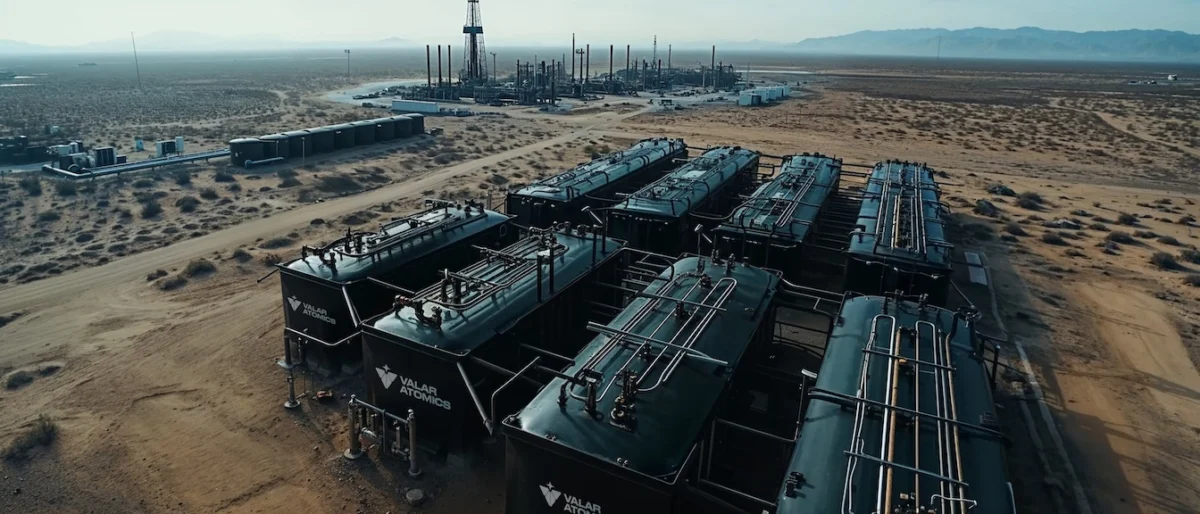
Valar Atomics, a three-year-old startup at the forefront of developing small modular nuclear reactors (SMRs), is reportedly in advanced discussions to secure a new round of capital, according to three sources intimately familiar with the company’s operations. The El Segundo, California-based firm is targeting an ambitious valuation of approximately $6 billion for this latest financing effort, with prominent venture capital firm Sequoia Capital anticipated to spearhead the deal. This move underscores the escalating investor confidence in nuclear fission technology, particularly as the global demand for reliable, high-capacity energy solutions intensifies, largely driven by the exponential growth of artificial intelligence (AI) infrastructure.
The funding discussions, which include an aim to raise a substantial $1 billion equity round, were initially brought to light by The Information. This new capital infusion would significantly augment Valar Atomics’ financial war chest as it strives to bring its innovative SMR technology to industrial scale, primarily targeting the burgeoning energy needs of data centers.
Navigating Complex Valuation Dynamics
The current funding landscape for deep technology and AI-adjacent ventures is characterized by sophisticated and often multi-stage capital raises. TechCrunch previously reported that Valar Atomics has already secured $450 million in capital, comprising $340 million in equity and $110 million in debt, at a prior valuation of $2 billion. This earlier raise, detailed in a Bloomberg report from March, highlights a growing trend in venture capital where deals are structured in multiple installments, sometimes executed at varying valuations. This approach, while providing startups with necessary capital as they hit successive milestones, can create a nuanced perception of a company’s valuation, as investors within the "same round" might technically acquire equity at different prices. Such distinctions are becoming increasingly pertinent as the market attempts to benchmark rapidly growing, capital-intensive startups against one another, especially in sectors experiencing hyper-growth fueled by AI. Both Sequoia and Valar Atomics have, consistent with typical practice during ongoing negotiations, declined to comment on the prospective funding round or valuation.
The Visionary Behind Valar Atomics
At the helm of Valar Atomics is Isaiah Taylor, a 27-year-old founder whose journey to the cutting edge of nuclear technology is anything but conventional. Taylor famously dropped out of high school at 16, demonstrating an early entrepreneurial drive that saw him launch two prior startups before embarking on Valar. His connection to nuclear science runs deeper than personal ambition; Taylor proudly shares that his great-grandfather was a nuclear physicist who contributed to the historic Manhattan Project, imbuing the company with a unique legacy. This blend of youthful audacity and historical lineage positions Valar Atomics as a compelling narrative within the broader energy transition. The company’s core mission is ambitious: to mass-produce hundreds of SMRs, essentially miniaturized, factory-built power plants, designed to be more cost-effective and faster to deploy than traditional, large-scale nuclear reactors. Valar’s proprietary technology is centered on a helium-cooled, high-temperature gas reactor, a design chosen for its inherent safety features, high thermal efficiency, and potential for process heat applications beyond just electricity generation.
The Insatiable Demand: AI’s Energy Crunch
Valar Atomics’ emergence and rapid ascent are playing out against a backdrop of an unprecedented global energy crunch, exacerbated significantly by the escalating demands of artificial intelligence. The sheer computational power required to train and run advanced AI models is translating into a voracious appetite for electricity. Data center electricity needs are projected to surge dramatically over the next several years, with some industry analysts forecasting a doubling or even tripling of consumption by 2030. For instance, the International Energy Agency (IEA) has warned that data centers, including those powering AI, could consume over 1,000 TWh globally by 2026, roughly equivalent to the entire electricity consumption of Japan.
Traditional utility providers in many regions are struggling to keep pace, facing years-long lead times to add sufficient new generation capacity and upgrade grid infrastructure. This looming supply-demand imbalance has spotlighted nuclear power – a source long plagued by public skepticism, exorbitant costs, and complex regulatory bottlenecks – as a potentially indispensable component of future energy grids. Within this renewed interest, SMRs are garnering particular attention as a more agile and scalable solution compared to their gigawatt-scale predecessors, positioning them as a critical element of the AI infrastructure boom. The promise of SMRs lies in their modularity, allowing for standardized design and factory fabrication, which could drastically reduce construction times and costs, thereby circumventing many of the financial and logistical pitfalls that have historically hampered large nuclear projects.
Strategic Alliances and Proof of Concept
A significant milestone for Valar Atomics earlier this month was the public demonstration that its nuclear reactor successfully provided a small amount of power to an Nvidia AI chip. This proof-of-concept event was accompanied by the announcement of a strategic partnership between Valar and Nvidia, a global leader in AI computing. The collaboration aims to explore and develop nuclear energy solutions specifically tailored to power future AI data centers. This partnership is more than just a technical demonstration; it represents a powerful endorsement from a major technology player, signaling the critical importance of reliable, high-density energy sources for the AI industry. For Nvidia, securing diverse and robust power supplies is becoming a strategic imperative to sustain its growth trajectory and ensure the operational continuity of its expanding AI infrastructure. For Valar, it provides invaluable validation, potential anchor customers, and a clear path to market adoption within one of the most demanding energy sectors.
A Competitive and Evolving Landscape
The SMR and advanced nuclear sector is attracting significant investment and innovation, reflecting a broader industry pivot towards cleaner, more resilient energy sources. Valar Atomics counts prominent figures like Palmer Luckey, the founder of defense technology company Anduril Industries, and Shyam Sankar, Palantir’s chief technology officer, among its early backers, underscoring the deep tech and national security implications of its work.
The competitive landscape includes several other notable players pursuing next-generation reactor designs aimed at tech and industrial customers. Kairos Power, for example, recently secured approval to build two small nuclear reactors, demonstrating tangible progress in regulatory navigation. TerraPower, backed by Microsoft co-founder Bill Gates, is another prominent contender developing advanced reactors, including a sodium-cooled fast reactor. NuScale Power stands out as the only SMR developer with U.S. regulatory design approval for its light-water SMR technology, having received approval last year for an upgraded, higher-output reactor design. NuScale’s achievement serves as a crucial benchmark for the industry, illustrating the rigorous and often protracted regulatory pathway that all SMR developers must navigate. While SMRs are theoretically poised to be more cost-effective to manufacture than traditional reactors due to standardization and economies of scale in factory production, the technology remains nascent, and the timeline for achieving deployment at industrial scale across various designs is still a subject of intense debate and development.
Navigating the Regulatory Labyrinth
Beyond technological development, Valar Atomics has adopted an assertive stance in shaping the regulatory environment for advanced nuclear technologies. Last year, the company joined several states and rival startups in filing a lawsuit against the Nuclear Regulatory Commission (NRC). The core of their argument is that the NRC’s existing licensing process, designed for full-size commercial nuclear power plants, is inappropriately and unduly applied to small test reactors. This litigation highlights a fundamental tension between the rapid pace of technological innovation in the SMR sector and the traditionally cautious, lengthy regulatory frameworks governing nuclear safety.
The plaintiffs contend that a streamlined, risk-informed approach is necessary for smaller, inherently safer designs to accelerate their development and deployment, which is crucial for addressing pressing energy and climate challenges. While the case has not yet been fully resolved, with both sides reportedly pausing litigation multiple times, this suggests that discussions for a potential settlement or a revised regulatory approach are underway. The outcome of this legal challenge could have significant implications for the speed at which advanced SMRs can move from concept to commercial operation, impacting not only Valar Atomics but the entire burgeoning industry.
Challenges and Future Outlook
Despite the significant investor interest and the compelling demand drivers, Valar Atomics, like all SMR developers, faces formidable challenges. The path from prototype to widespread commercial deployment is long, capital-intensive, and fraught with technical, regulatory, and public acceptance hurdles. Developing and deploying nuclear technology, even in modular form, requires immense engineering precision, robust safety protocols, and a resilient supply chain. The "factory-built" promise of SMRs needs to be rigorously proven, and the scalability of manufacturing must meet the ambitious targets set by companies like Valar.
Furthermore, public perception of nuclear power, though improving in some regions due to climate change concerns, remains a critical factor. Addressing waste management, decommissioning strategies, and ensuring community engagement will be paramount for widespread adoption. Valar Atomics’ bold valuation target and the backing of institutional investors like Sequoia underscore the immense potential seen in its technology and market strategy. However, the true measure of its success will ultimately lie in its ability to translate its innovative reactor design into tangible, operational power plants that can reliably and economically meet the soaring energy demands of the AI era and contribute significantly to a decarbonized future. The company’s trajectory will undoubtedly serve as a bellwether for the broader advanced nuclear industry and its capacity to revolutionize global energy infrastructure.
About the Author