
The pursuit of new customers is the lifeblood of any thriving business. While the axiom "you have to speculate to accumulate" holds true for marketing investments, a critical question remains for many businesses: what is the actual cost of acquiring a single potential customer? Without a clear understanding of this fundamental metric, the effectiveness of marketing and sales endeavors remains largely unquantifiable, leading to potentially wasted resources and missed opportunities. This is precisely where the calculation of Cost Per Lead (CPL) becomes indispensable.
This comprehensive analysis delves into the significance of CPL for optimizing business expenditures, outlines the methodology for its calculation, and provides actionable strategies for its reduction. By mastering CPL, businesses can refine their marketing strategies, enhance budget allocation, and ultimately drive more efficient growth.
What Constitutes Cost Per Lead?
Cost Per Lead (CPL) is a pivotal marketing metric that quantifies the total expenditure incurred in generating a single prospective customer for a business. It represents the monetary investment required to attract an individual who has demonstrated an interest in a company’s products or services. The definition of a "quality lead" can vary depending on the nature of the marketing campaign, but generally encompasses individuals who have:
- Downloaded a piece of content (e.g., an e-book, whitepaper)
- Filled out a contact form
- Subscribed to a newsletter
- Requested a demo or consultation
- Engaged with a social media advertisement
CPL serves as a robust indicator of the success or deficiency of digital marketing initiatives. It allows for the evaluation of individual campaigns across specific channels, as well as an assessment of the overall efficiency of marketing expenditures.
It is crucial to differentiate CPL from Cost Per Acquisition (CPA). While CPA measures the total cost of acquiring a paying customer or closing a deal, CPL focuses specifically on the expense associated with generating potential customers. Leads, in this context, are distinct from prospects, representing an earlier stage in the customer journey where interest has been identified but a deeper qualification process may still be required.
The Indispensable Role of Cost Per Lead in Business Strategy
Marketing often constitutes a substantial portion of a company’s overall business expenses. Therefore, rigorously measuring the efficacy of these efforts and identifying avenues for spending optimization is paramount. CPL is a cornerstone metric in this process, providing invaluable insights into the performance of sales and marketing campaigns.
By accurately determining the cost of generating each potential customer, businesses can strategically allocate their marketing budgets and refine their client management approaches. This granular understanding empowers them to compare the return on investment (ROI) of different channels and strategies, enabling them to invest more heavily in high-performing avenues while divesting from those that prove to be cost-ineffective.
Furthermore, when CPL data is analyzed in conjunction with other marketing metrics, it can reveal whether a particular campaign or channel is attracting the "wrong" leads – individuals with a low probability of converting into paying customers. This insight allows for timely course correction, saving both time and financial resources.
Beyond campaign performance, CPL plays a vital role in challenging ingrained assumptions. A high-profile campaign that garners significant attention and generates a large volume of leads might be perceived as highly effective. However, a deeper analysis might reveal that a less conspicuous campaign, despite generating fewer leads, yields a superior ROI due to lower operational costs. This nuanced perspective, facilitated by CPL analysis, ensures that marketing decisions are data-driven and strategically sound.
Defining a "Good" Cost Per Lead: A Contextual Analysis
The question of what constitutes a "good" CPL is not a straightforward one. There is no universally applicable benchmark that defines an optimal CPL across all businesses and industries. The cost per lead is influenced by a confluence of diverse factors, including:
- Industry: Highly competitive or high-value sectors, such as enterprise software or financial services, typically exhibit higher CPLs. This is often due to longer and more complex sales cycles, specialized target markets, and the inherent value of each lead. B2B lead generation, in particular, often sees higher CPLs due to these characteristics.
- Product/Service Value: The price point of a product or service significantly impacts what is considered an acceptable CPL. For instance, a CPL of $80 might be deemed unfavorable if the average product sale is only $20. Conversely, if the product sells for $2,000, an $80 CPL becomes highly attractive.
- Marketing Channels Used: Different marketing channels have varying cost structures. Paid advertising campaigns, while often effective for rapid lead generation, can incur higher costs per lead compared to organic strategies like content marketing and SEO, which may yield lower CPLs over time.
- Target Audience Specificity: Niche markets or highly specific customer profiles may require more targeted and, consequently, more expensive marketing efforts to reach.
- Competition: The intensity of competition within an industry can drive up advertising costs and bidding prices for keywords, thereby increasing the CPL.
- Economic Conditions: Broader economic factors can influence consumer spending habits and the overall cost of advertising, indirectly impacting CPL.
Ultimately, a "good" CPL is one that is lower than the anticipated revenue generated from an average lead. Conversely, a "bad" CPL occurs when the cost of lead generation exceeds the expected revenue, resulting in a net loss. The expected revenue per lead is itself a variable, dependent on the average customer spend and the business’s conversion rates.
Benchmarking against industry averages can provide valuable context, but it’s crucial to remember that a higher conversion rate can justify a higher CPL. Factors such as lead quality and the potential lifetime value of a customer also play a significant role in determining the true profitability of a lead.
Calculating Your Cost Per Lead: A Step-by-Step Approach

While leads can vary in their inherent value based on factors like demonstrated interest and potential for long-term customer relationships, for the purpose of CPL calculation, it is generally advisable to treat all generated leads as roughly equal in initial worth. Consistency in the chosen time period for calculations—whether monthly, quarterly, or annually—is paramount for accurate comparison and trend analysis.
The fundamental formula for calculating Cost Per Lead is straightforward:
Cost Per Lead = Total Cost of Lead Generation / Total Number of Leads Generated
Let’s illustrate with a basic example: If a business invests $3,000 in an email marketing campaign that successfully generates 200 leads, the CPL would be calculated as $3,000 divided by 200, resulting in a CPL of $15 per lead.
Deconstructing Lead Generation Costs
To accurately apply the CPL formula, a thorough accounting of all associated costs is necessary. This encompasses every investment made in a marketing campaign, including:
- Advertising Expenditures: This includes the direct spend on paid advertisements across various platforms (e.g., Google Ads, social media ads, print advertising).
- Content Creation and Marketing: Costs associated with developing blog posts, articles, videos, infographics, and other content designed to attract and engage potential customers.
- Software and Tools: Expenses for marketing automation software, CRM systems, analytics platforms, SEO tools, and other technologies that support lead generation efforts.
- Agency Fees and External Resources: Payments to marketing agencies, consultants, freelancers, or other third-party providers engaged for campaign execution, strategy, or creative development.
- Labor Costs: The portion of salaries and benefits for internal marketing and sales teams directly involved in lead generation activities. This includes time spent on campaign management, content creation, social media engagement, and data analysis.
Businesses often employ a combination of inbound and outbound marketing strategies. It can be beneficial to calculate CPL separately for each approach to understand their distinct cost efficiencies. Paid advertising typically incurs higher upfront costs, leading to a potentially higher CPL, while organic strategies, built over time through SEO and content marketing, tend to yield lower CPLs.
A practical approach to cost accounting involves breaking down expenses by the chosen time period:
Costs Per Period = Advertising Costs + Inbound Costs
Advertising Costs encompass direct ad spend and the associated management fees, whether from internal teams or external agencies:
Advertising Costs = Ad Spend + Ad Management Costs
Inbound Costs include expenses related to content creation, SEO, landing page development, and social media marketing, whether utilizing internal resources or outsourcing:
Inbound Costs = External Resources + Internal Resources
Summing these figures provides the total cost of lead generation for the specified period.
Quantifying the Number of Leads
Simultaneously, it is essential to accurately track the total number of leads generated from both paid and organic efforts. This involves aggregating leads from:
- Inbound Sources: Landing page submissions, social media followers who engage or express interest, form submissions on the website, referrals from blog content, and newsletter sign-ups.
- Outbound Sources: Leads generated directly from paid advertising campaigns, whether digital or traditional.
Total Leads = Inbound Leads + Outbound Leads
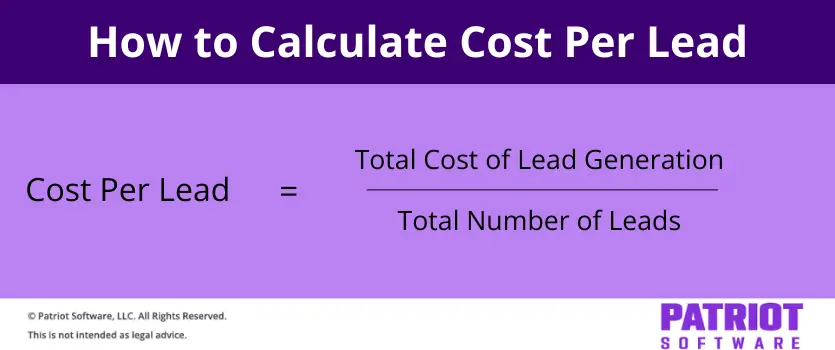
With these two core components—total cost and total leads—in hand, the CPL can be calculated using the primary formula.
Leveraging Cost Per Lead Data for Strategic Decision-Making
Once CPL is calculated, its true value lies in its application for informed decision-making. By comparing the CPL across various marketing channels and campaigns, businesses can identify the most cost-effective methods for reaching their target audience. This analysis extends beyond the overall business CPL to include:
- Channel-Specific CPLs: Analyzing CPL for individual channels like Google Ads, Facebook Ads, email marketing, content marketing, and organic search.
- Campaign-Specific CPLs: Evaluating the CPL of discrete marketing campaigns to understand their individual performance.
- Audience Segment CPLs: If audience segmentation is employed, calculating CPL for different demographic or psychographic groups to identify the most cost-efficient segments.
- Geographic CPLs: For businesses with a global or regional presence, understanding CPL variations by location can inform localized marketing strategies.
Continuous monitoring of CPLs over time is crucial for identifying emerging trends and opportunities. A consistent increase in CPL might signal a need to re-evaluate marketing strategies, optimize ad spend, or explore new channels.
Strategies for Reducing Cost Per Lead
Reducing CPL is a direct path to maximizing marketing budgets and increasing overall profitability. The most effective approach involves refining strategies to attract a higher volume of qualified leads, thereby lowering the cost associated with each individual lead.
-
Aligning with Business Needs and Market Position:
The optimal marketing spend and CPL are inherently tied to a business’s size, revenue potential, and market standing. Larger enterprises with higher revenue streams might be able to sustain higher overall ad spend and potentially a higher CPL if the projected ROI remains favorable. Conversely, smaller businesses may benefit from starting with a more conservative budget, meticulously analyzing campaign analytics to identify opportune moments for expansion and investment. -
Enhancing Audience Targeting:
Precision in audience targeting is a powerful lever for increasing lead quality and, consequently, reducing CPL. Implementing robust retargeting campaigns for individuals who initially showed interest but did not convert can bring them back into the sales funnel with tailored content and offers. If initial segmentation proves ineffective, refining demographic and psychographic targeting to focus on groups exhibiting higher engagement and conversion rates is essential. This necessitates an agile approach to sales planning, adapting templates to reflect these refined target segments. -
Website Optimization for Organic Visibility:
A well-optimized website significantly enhances organic reach, leading to a lower CPL. This involves strategic targeting of long-tail keywords—phrases used by searchers with high purchase intent—and consistently refreshing website content to maintain relevance and search engine rankings. Moreover, improving website navigation, reducing page loading speeds, and refining landing pages to clearly articulate value propositions are critical. Employing lead magnets that offer genuine value and incorporating clarifying questions into sign-up forms can effectively pre-qualify leads, weeding out less committed individuals and improving the quality of incoming leads. -
Strategic A/B Testing:
A/B testing is an invaluable tool for determining which marketing elements resonate most effectively with the target audience, leading to higher lead generation and a reduced CPL. This includes testing variations of landing page elements such as headlines, calls-to-action (CTAs), and imagery, as well as experimenting with different ad creatives and copy. Diversifying marketing channels and understanding their relative effectiveness is also crucial to avoid over-reliance on a single strategy. Testing can also optimize the timing of content publication and ad delivery, ensuring maximum reach during periods of peak audience activity. -
Adoption of Appropriate Tools and Automation:
Automating manual tasks through specialized software can significantly boost lead generation efficiency and reduce CPL by minimizing human resource allocation. While these tools represent an investment, the gains in efficiency and scalability often outweigh the initial cost. Essential tools include dedicated lead generation platforms, accounting software for meticulous expense tracking, marketing automation for email and social media campaigns, and Customer Relationship Management (CRM) systems for effective lead and customer data management. Ensuring that teams are adequately trained to leverage these tools is paramount for realizing their full potential. -
Continuous Performance Tracking and Analysis:
Regularly calculating and analyzing CPLs across different marketing methods, channels, and campaigns is non-negotiable. The marketing landscape is dynamic, influenced by economic shifts, competitive pressures, and evolving consumer behavior. Therefore, CPL must be evaluated within the broader context of other key performance indicators (KPIs), including conversion rates, Cost Per Acquisition (CPA), and Return on Investment (ROI). Supplementing quantitative data with qualitative feedback, such as customer satisfaction (CSAT) scores derived from post-campaign surveys, can provide a more holistic understanding of campaign success.
Conclusion: The Strategic Imperative of Cost Per Lead
Calculating and understanding Cost Per Lead is not merely an analytical exercise; it is a strategic imperative for any business aiming to maximize its marketing expenditures and ensure its budget is allocated to initiatives with the highest potential for success. By meticulously factoring in all advertising and inbound marketing costs, and by establishing clear benchmarks for what constitutes a "good" or "bad" CPL relative to the business’s unique context, companies can gain unparalleled clarity into their marketing performance.
The insights derived from CPL analysis empower businesses to identify and divest from underperforming campaigns, optimize their resource allocation, and refine their targeting strategies. By implementing the suggested methods for reducing CPL, businesses can streamline their marketing spend, attract more qualified leads, and ultimately foster more sustainable and profitable growth. The mastery of this metric is a fundamental step towards building a more efficient, effective, and data-driven marketing operation.
About the Author