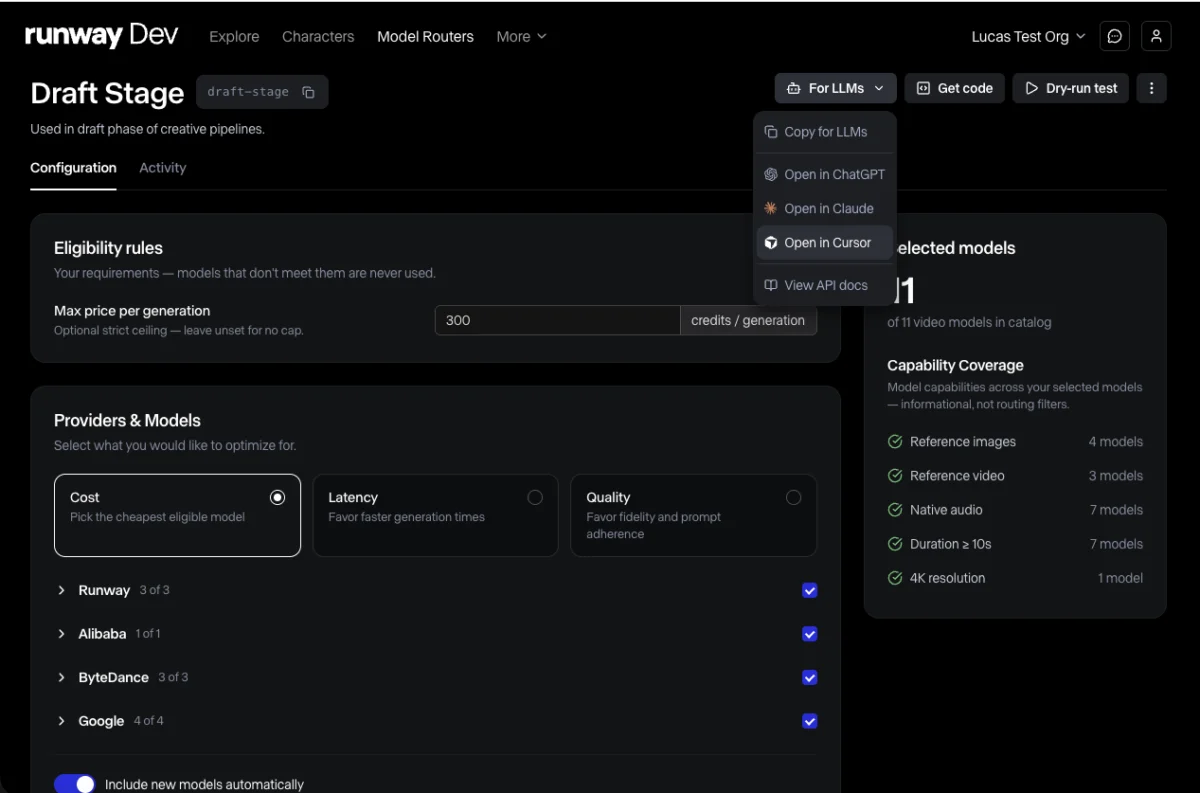
New York, NY – Runway, a pioneering force in the generative AI space, has announced a significant strategic pivot, launching its innovative Media Router through Runway Dev, its recently introduced developer platform. This move signals Runway’s ambition to transcend its origins as a creator of individual AI models, positioning itself instead as the foundational infrastructure layer for the burgeoning field of generative media. The Media Router, unveiled on Thursday, is designed to intelligently select the optimal image, video, or audio generation model for a given request, based on a developer’s prioritized criteria such as quality, speed, or cost. This marks a critical evolution, as while model routers have become increasingly common for large language models (LLMs), Runway asserts this is the first tailored specifically for the complex demands of generative media.
The launch, exclusively shared with industry publication TechCrunch, underscores Runway’s transformation from an AI video startup into a crucial infrastructure provider for companies building with generative media. Through the Runway Dev platform, major industry players including Adobe, Cloudflare, ElevenLabs, Expedia, Shutterstock, and Quora can now seamlessly integrate media generation capabilities directly into their own products via Runway’s API. This eliminates the need for their users to navigate to Runway’s proprietary application or website, streamlining workflows and offering a more integrated user experience.
Navigating the Fragmented Generative Media Ecosystem
The timing of the Media Router’s introduction is particularly pertinent, arriving amidst an exponential proliferation of generative media models. This rapid expansion has presented a significant challenge for developers, who face increasing difficulty and time consumption in evaluating, integrating, and managing new releases. The sheer volume of models, each with its unique strengths, weaknesses, and cost structures across various media types – from hyper-realistic image generation to complex multi-scene video synthesis and nuanced audio production – creates a formidable barrier to efficient development.
“Most developers are not spending the time to really understand the capabilities of each of these models and where they excel or differ based on various types of outputs across video, image, and audio,” explained Anthony Maggio, Runway’s chief product officer. He emphasized that the Media Router’s unique proposition lies in its “intelligence around what the best model is for each different use case, and meshing that with preference you apply around the context of your business.” This intelligent orchestration layer is designed to abstract away the complexity, allowing developers to focus on creative output rather than exhaustive model benchmarking.
The routing functionality extends beyond mere technical performance, incorporating business-critical preferences. Maggio highlighted the growing popularity of Chinese generative media models, but also acknowledged potential business discomfort with their integration. Developers could, for instance, set a preference for American model providers, a consideration that has gained increasing relevance as the Trump administration explores potential bans and sanctions against Chinese open AI models, reflecting broader geopolitical tensions impacting the technology sector. Such geo-fencing capabilities could become a standard feature in enterprise AI deployments.
Beyond geographical preferences, developers are primarily interested in optimizing for token pricing and output quality. The issue of token pricing has emerged as a significant concern in 2026, with many enterprises that enthusiastically adopted agentic AI solutions now grappling with unexpectedly high token bills. This economic reality has already driven the widespread adoption of model routing for cost optimization within the large language model domain, making a similar solution for generative media a logical and necessary evolution. Runway’s move to a token-based pricing model, replacing its previous unlimited subscription plans just weeks prior to the Media Router launch, drew some criticism from users but aligns with this broader industry trend towards granular resource management.
The Intelligence Layer: Decoding Generative Quality
Evaluating quality in generative media is considerably more nuanced than with language models, where metrics like coherence and factual accuracy are more straightforward. For generative media, quality involves intricate details specific to each medium: how video models handle complex motion, the fidelity of composition in image generation, or the precision of lip-syncing in voice models. This is where Runway’s proprietary "intelligence layer" comes into play. This sophisticated layer is built upon the extensive expertise developed by Runway’s in-house creative team, which has meticulously evaluated output across every conceivable media type and use case.
This intelligence layer is not a new invention for Runway. It leverages the same routing technology that the company developed for its own internal products, most notably for Runway Agent. Launched in May, Runway Agent is a conversational AI creative partner designed to transform text prompts into fully edited, multi-shot videos and comprehensive marketing campaigns. By packaging this battle-tested technology, Runway is now democratizing access to its advanced model orchestration capabilities for external developers.
Runway’s Strategic Pivot in a Hyper-Competitive Landscape
Runway’s strategic shift to an infrastructure provider reflects the intensely fragmented and competitive nature of the current generative media landscape. The company, once lauded for its cutting-edge individual AI models, faces formidable competition from tech giants and well-funded startups alike. Its last dedicated frontier video model release, Gen 4.5, in December, briefly topped leaderboards, outperforming similar offerings from incumbents like Google. In the same month, Runway also released its first world model, further cementing its reputation for innovation.
However, the pace of AI innovation is relentless. Aside from an upgrade to its video editing model, Aleph 2.0, in May, Runway has not released a new dedicated frontier video model in several months. While Aleph 2.0 remains among the leading video editing models according to Artificial Analysis, the company’s text-to-video and image-to-video models no longer command the top rankings. The current top 20 spots are increasingly populated by models from heavy hitters such as Google, China’s ByteDance (known for TikTok and CapCut), and Alibaba, demonstrating the sheer scale of investment and research being poured into this sector by global technology powerhouses.
In this rapidly evolving environment, asking developers to commit to a single model provider carries inherent risks, as the "best" model can quickly be surpassed. The Media Router addresses this directly by assuming that the optimal model will continue to change, thereby keeping Runway central to the generative media workflow. This positions Runway not just as a developer of leading AI models, but as an essential orchestration layer – a critical intermediary that ensures developers always have access to the best available tools, regardless of their origin.
Anastasis Germanidis, Runway’s co-founder and co-CEO, acknowledged that the startup has long been known primarily for its "end user piece." However, he stressed the necessity of building a comprehensive full stack to achieve this, encompassing a robust developer platform, a versatile creative tool suite, and a powerful inference layer underneath. Germanidis noted a growing demand from companies seeking Runway’s presence across every component of this stack. "You need great models underneath, but the orchestration increasingly matters a lot because people are building entire campaigns with those models, or they’re building entire finished multi-scene generations out of those models," Germanidis told TechCrunch. "It’s something that we increasingly had to build – that intelligence layer that comes on top of the pure pixel models. The router is one way in which the benefits of that come to users."
Broader Industry Implications and Runway’s Vision
Runway’s pivot toward becoming a foundational infrastructure layer holds significant implications for the broader generative AI industry. It suggests a maturation of the market, where the focus is shifting from simply creating impressive individual models to providing the tools and platforms that enable seamless integration and intelligent management of these models at scale. This mirrors the trajectory seen in cloud computing, where infrastructure providers like AWS, Azure, and Google Cloud became indispensable by offering scalable, managed services built atop raw compute power.
Industry analysts suggest that this strategic move by Runway could inspire similar orchestration layers from other platforms, potentially leading to a more specialized and efficient generative AI ecosystem. Developers, no longer burdened by the overhead of continuous model evaluation and integration, could accelerate their innovation cycles and bring more sophisticated AI-powered applications to market faster. This could also foster greater interoperability and standardization across the fragmented landscape of generative models.
The emphasis on preferences, particularly around cost and quality, speaks to the growing financial and performance pressures on enterprises adopting AI. As AI agents become more prevalent, the cumulative costs of token usage can quickly escalate, making intelligent routing a necessity for financial sustainability. The ability to dynamically switch between models based on real-time performance or pricing offers enterprises unprecedented control over their AI expenditures and output quality.
Furthermore, the geopolitical dimension highlighted by Maggio — the ability to prefer American over Chinese models — underscores a critical, emerging concern in AI deployment. As AI becomes a strategic national asset, businesses may increasingly seek to align their technology stack with specific geopolitical considerations, driven by regulatory pressures, data sovereignty concerns, or supply chain resilience. The Media Router provides a practical mechanism for addressing such complex requirements within the AI supply chain.
As Maggio succinctly put it, "If you zoom out at the one thing Runway has been doing since 2018, it’s that we’re deeply focused on research, while building for where we think the space is going at the same time." This long-term vision positions Runway to remain a pivotal player in the generative AI revolution, not just by pushing the boundaries of what AI can create, but by constructing the essential highways and bridges that allow developers to navigate and harness this powerful new frontier. By transitioning from a leading model provider to a crucial orchestration layer, Runway aims to ensure its relevance and indispensable value, regardless of which specific AI model temporarily holds the crown. This strategic evolution highlights a growing understanding within the AI industry: in a landscape defined by rapid change and fierce competition, the true value may increasingly lie in enabling, rather than simply creating, the next wave of innovation.
About the Author