The digital marketing landscape underwent a fundamental transformation throughout 2022 as generative artificial intelligence moved from a niche technological curiosity to a central pillar of corporate content strategy. This shift was largely driven by the maturation of Large Language Models (LLMs), specifically OpenAI’s GPT-3, which allowed software developers to create sophisticated interfaces capable of producing human-like text at unprecedented speeds. As businesses faced increasing pressure to maintain a constant presence across multiple digital channels, AI content generators emerged as the primary solution for scaling production without a proportional increase in overhead costs.

The Technological Shift in Content Production
The year 2022 served as a pivotal moment for the adoption of AI-driven automation in the creative sector. Industry data indicated that the global AI in marketing market, valued at approximately $15.84 billion in 2021, was projected to grow at a compound annual growth rate (CAGR) of nearly 30% through the mid-2020s. This growth was fueled by the demand for personalized marketing, high-volume SEO content, and the need for rapid turnaround times in social media management.
The emergence of these tools was not merely about speed; it represented a shift in the editorial workflow. The "human-in-the-loop" model became the standard operating procedure, where AI handled the initial drafting, research summaries, and structural outlines, while human editors focused on fact-checking, brand voice alignment, and strategic oversight.
Analysis of Leading AI Content Generation Platforms
The marketplace for AI writing assistants became highly competitive in 2022, with several key players establishing dominance through specialized features and unique user interfaces.
1. Jasper AI (Formerly Jarvis)
Jasper AI maintained its position as the industry leader throughout the year, particularly following its high-profile rebranding from "Jarvis" in early 2022. The name change was necessitated by trademark concerns raised by Disney, the owners of the Marvel Cinematic Universe. Despite this hurdle, Jasper secured significant venture capital, reflecting strong market confidence.

The platform’s "Boss Mode" became a benchmark for long-form content creation, allowing users to issue direct commands to the AI to write blog posts, white papers, and reports. By integrating with tools like SurferSEO, Jasper bridged the gap between creative writing and technical search engine optimization, making it a preferred choice for professional marketing agencies.
2. Copy.ai
While Jasper focused on long-form content, Copy.ai carved out a significant market share by specializing in short-form marketing copy. With over 90 templates, the tool was optimized for high-conversion tasks such as Facebook ad headlines, product descriptions, and email subject lines. Its low barrier to entry and generous free trial model made it a staple for solopreneurs and small business owners who required rapid creative iterations for social media campaigns.
3. Frase
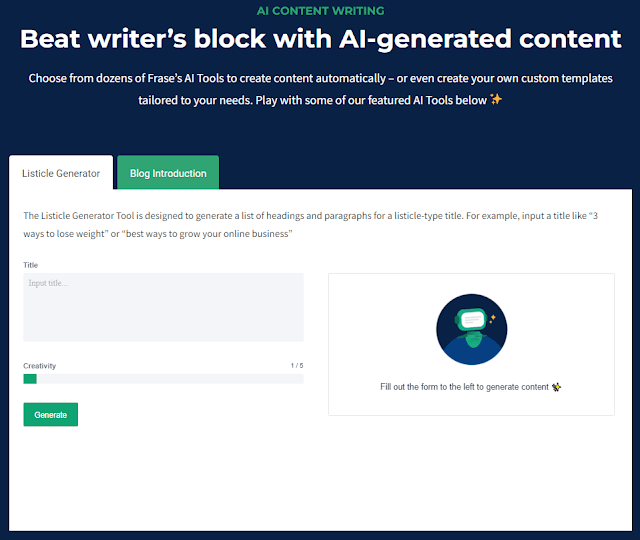
Frase distinguished itself by positioning its AI as a research and SEO optimization tool rather than just a text generator. Its primary value proposition in 2022 was its ability to analyze top-ranking search results for a specific keyword and automatically generate a content brief. This allowed writers to see exactly what topics competitors were covering, enabling them to produce more comprehensive and authoritative content. The platform’s ability to answer specific user questions found in search queries made it an essential tool for "Helpful Content" creation.
4. Article Forge
Article Forge represented a different philosophy in the AI writing space: complete automation. Unlike interactive assistants that require constant prompting, Article Forge was designed to generate an entire 1,500-word article based on a single keyword. Using a proprietary deep learning model, it researched and wrote articles from scratch. While this approach offered the highest level of efficiency, it also highlighted the ongoing debate regarding the balance between automated volume and the need for human editorial nuance.

5. Rytr
Rytr gained traction as a highly accessible, "freemium" AI writing assistant. Built on the GPT-3 framework, it offered a clean, mobile-friendly interface and support for over 30 languages. In 2022, Rytr became particularly popular among students and bloggers due to its affordability and the inclusion of a built-in plagiarism checker, which addressed one of the primary concerns regarding AI-generated text.
6. Writesonic
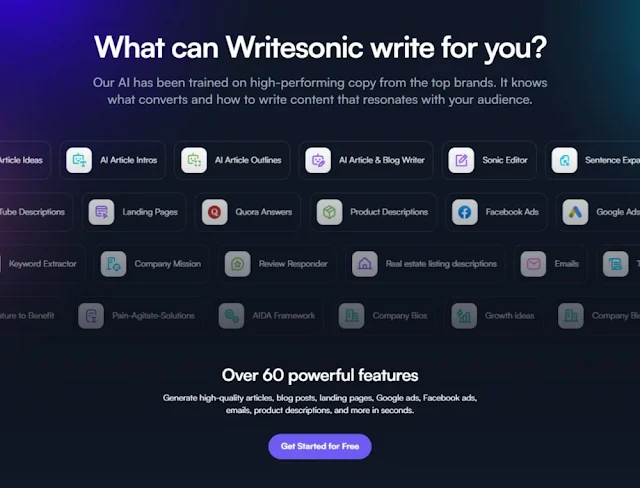
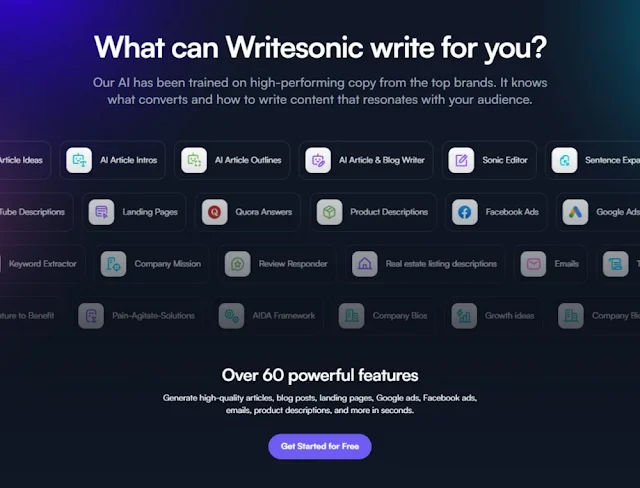
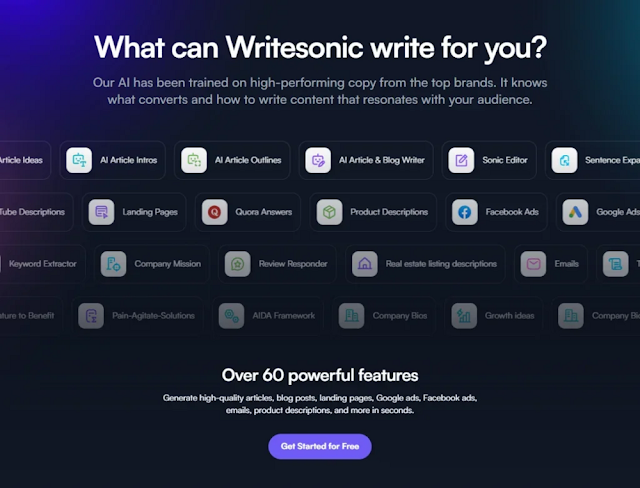
Writesonic focused on the intersection of content generation and technical writing quality. By integrating grammar and plagiarism checkers directly into the workflow, it targeted professional writers who needed to ensure the integrity of their output. Its "Photosonic" feature, an AI image generator, also signaled the trend toward multi-modal AI tools that could handle both text and visual assets within a single ecosystem.

7. Copysmith
Copysmith was built with the needs of large-scale e-commerce enterprises and marketing teams in mind. Its platform emphasized collaboration and bulk content generation. In 2022, Copysmith focused on integrations with platforms like Shopify, allowing e-commerce managers to generate thousands of unique product descriptions simultaneously, a task that would previously have taken weeks of human labor.
8. Hypotenuse.ai
Hypotenuse.ai specialized in a specific vertical: high-quality product descriptions and blog posts for lifestyle brands. By using a "workflow-based" approach, it allowed users to import product data and transform it into persuasive copy. Its focus on visual-to-text technology—where the AI could "see" a product image and write a description—marked a significant technological advancement in the sector.
9. Kafkai
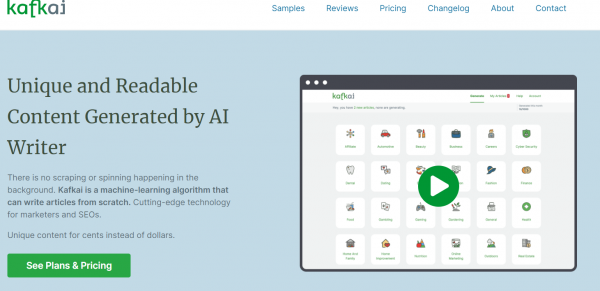
Kafkai remained a niche favorite for SEO professionals focused on high-volume, niche-specific content. Unlike general-purpose tools, Kafkai utilized models trained on specific industries, such as health, finance, or technology. This targeted training was intended to produce more accurate and relevant content for specialized affiliate marketing sites.
10. Peppertype.ai
Peppertype.ai emerged as a strong contender in the collaborative space. Part of the Pepper Content ecosystem, it was designed to function as an extension of a marketing team’s existing creative process. Its strength lay in its "content ideas" generator, which helped teams overcome creative blocks by providing dozens of potential angles for a single topic.

Market Data and Economic Impact
The rapid adoption of these tools was supported by compelling economic data. According to industry surveys conducted in late 2022, marketing departments using AI tools reported a 40% increase in content output without increasing their headcount. Furthermore, the cost per word for AI-generated drafts was estimated to be roughly 90% lower than that of traditional freelance writing rates, although this figure does not account for the necessary human editing time.
However, the rise of AI also led to market volatility. Freelance marketplaces like Upwork and Fiverr saw a shift in demand, with a decrease in "low-level" SEO writing tasks and an increase in demand for "AI Editors" and "Prompt Engineers." This transition indicated that the value was moving away from the act of writing toward the act of directing and refining AI output.

Industry Responses and Ethical Implications
The proliferation of AI content generators did not occur without significant pushback. In mid-2022, Google released its "Helpful Content Update," which many interpreted as a warning against the use of low-quality, automated content designed solely to manipulate search rankings. The search giant clarified that while AI-generated content was not inherently against its guidelines, content created primarily for search engines rather than humans would be penalized.
Ethical concerns regarding plagiarism and intellectual property also came to the forefront. Since LLMs are trained on existing internet data, questions arose regarding the "fair use" of the original creators’ work. In response, many of the top 10 tools mentioned above integrated advanced plagiarism detection software, such as Copyscape, to reassure users that their generated content was sufficiently original.
Chronology of Key Events in 2022
- January 2022: Jarvis AI rebrands to Jasper AI to avoid legal conflict with Disney.
- May 2022: OpenAI releases updates to the GPT-3 API, significantly improving the coherence of long-form generation.
- August 2022: Google’s "Helpful Content Update" begins rolling out, forcing AI tool developers to pivot toward "quality-first" features.
- October 2022: Jasper AI raises $125 million in Series A funding, valuing the company at $1.5 billion.
- November 2022: The release of ChatGPT (though a chatbot and not a dedicated marketing tool) brings mass public awareness to generative AI, further accelerating the adoption of specialized tools like Copy.ai and Writesonic.
Future Implications
As 2022 concluded, the consensus among industry analysts was that AI content generators had reached a point of no return. The tools were no longer viewed as optional luxuries but as essential infrastructure for digital competition. The focus for 2023 and beyond was predicted to shift toward "brand-specific AI," where companies would train models on their own proprietary data and historical brand voice to ensure that the output was indistinguishable from human-authored content.
The broader impact suggests a permanent change in the skill sets required for marketers. The ability to manage, prompt, and audit AI systems has become as critical as the ability to write. While the human element remains vital for strategy, empathy, and high-level creativity, the mechanical aspects of content production have been irrevocably handed over to the machine.
About the Author