Omaha, Nebraska – Berkshire Hathaway, the sprawling conglomerate built by legendary investor Warren Buffett, concluded its fourth quarter of 2025 with a notable decline in operating earnings, primarily attributed to softness within its vast insurance operations. This financial report marks a pivotal moment for the company, coinciding with the historic transition of the CEO role from Warren Buffett to Greg Abel, who officially took the helm at the start of 2026. The results, released alongside Abel’s inaugural annual letter to shareholders, underscore the challenges inherent in managing a diversified empire while navigating a shifting economic landscape and a monumental leadership change.
For the fourth quarter of 2025, Berkshire Hathaway reported operating earnings totaling $10.2 billion, a substantial decrease of over 29% compared to the $14.56 billion recorded in the year-earlier period. This downturn was largely driven by a significant contraction in the company’s robust insurance segment, which has historically been a cornerstone of Berkshire’s profitability and capital generation. The figures suggest a period of increased pressure on the conglomerate’s diverse portfolio of businesses, even as its long-term investment philosophy remains steadfast.
Deep Dive into Q4 Performance: Insurance Woes and Investment Impacts
The insurance business, encompassing a wide array of entities from GEICO to National Indemnity and various reinsurance operations, experienced a sharp decline in profitability. Insurance underwriting profits plummeted by 54%, falling to $1.56 billion from $3.41 billion in the fourth quarter of 2024. This significant drop can be attributed to a confluence of factors, including potentially higher catastrophe losses, increased claims frequency, competitive pricing pressures across various lines of business, and possibly adverse reserve development in certain segments. Industry analysts had been monitoring the insurance sector for signs of rising costs and diminished pricing power, and Berkshire’s results appear to reflect these broader trends.
Compounding the challenges in underwriting, insurance investment income also slid, decreasing by nearly 25% to $3.1 billion from $4.088 billion in the prior year’s fourth quarter. This component of insurance earnings is derived from the "float" – the premiums collected upfront that Berkshire holds before paying out claims. The float is then invested, and its income is highly sensitive to interest rates and the performance of the underlying investment portfolio. A decline in this income could indicate lower yields on new investments, a shift in the portfolio’s composition, or a slight reduction in the overall size of the float available for investment. Given the prevailing economic conditions and the Federal Reserve’s monetary policy trajectory through 2025, the exact drivers of this decrease would require a more granular breakdown of Berkshire’s investment strategies during the period.
Beyond the operational results, Berkshire Hathaway’s overall earnings, which incorporate gains or losses from its extensive stock market investments, also saw a slight dip in the fourth quarter, falling to $19.2 billion from $19.7 billion a year prior. However, this figure was notably impacted by a non-cash impairment charge of $4.5 billion related to Berkshire’s long-standing investments in Kraft Heinz and Occidental Petroleum. Impairments typically occur when the fair value of an asset falls below its carrying value on the balance sheet, signaling a potential long-term erosion of value or a re-evaluation of future prospects for these holdings. Despite this, the quarter still registered $13.5 billion in investment gains from other parts of the portfolio, illustrating the inherent volatility and diversity within Berkshire’s equity holdings.
Full-Year 2025 Performance: A Broader Context
Looking at the full fiscal year 2025, the trends observed in the fourth quarter were largely consistent. Operating earnings for the entire year totaled $44.49 billion, down from $47.44 billion in 2024. This annual decline underscores that the pressures experienced in Q4 were not isolated but rather indicative of broader operational challenges throughout the year.
Similarly, full-year profits from insurance underwriting came in at $7.26 billion, a reduction from $9 billion in 2024. Insurance investment income for the year eased to $12.5 billion from $13.6 billion in the prior year. These cumulative figures reinforce the narrative of a more challenging year for Berkshire’s insurance arm, which typically acts as a resilient and reliable source of capital for the conglomerate.
The full-year overall earnings, encompassing investment fluctuations, also saw a significant reduction, falling to $66.97 billion from $89 billion in 2024. While these figures include the aforementioned impairments and investment gains, it’s crucial to recall Warren Buffett’s consistent guidance to investors. He has repeatedly cautioned against placing too much emphasis on short-term investment gains or losses, labeling them as "meaningless" and potentially "extremely misleading" due to accounting rules that require unrealized gains and losses to be reported in net earnings. This philosophy encourages a focus on long-term intrinsic value creation and the performance of Berkshire’s underlying businesses, rather than quarterly stock market fluctuations.
The Historic Handover: Warren Buffett to Greg Abel
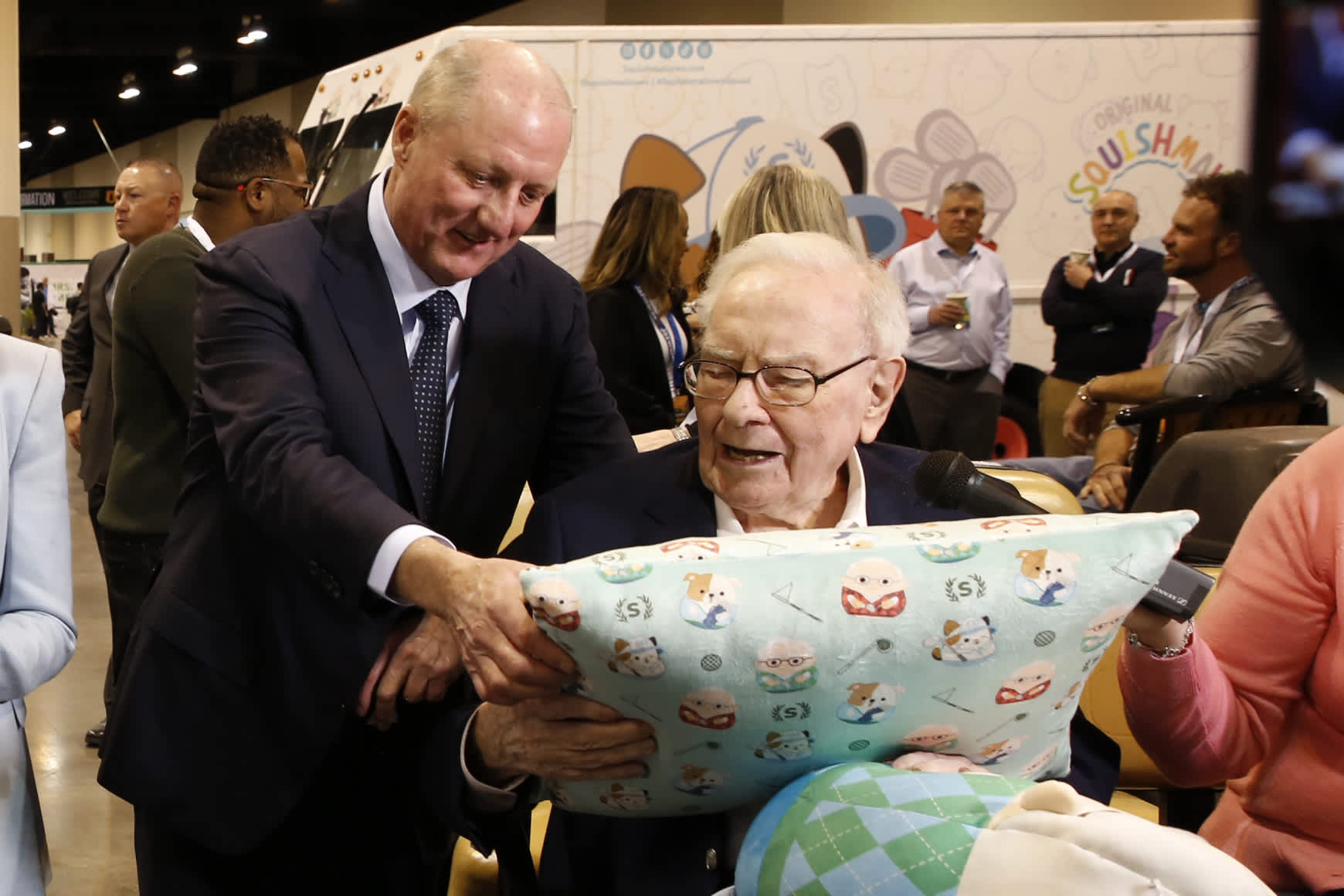
The release of these earnings results carries an added layer of historical significance. The fourth quarter of 2025 officially marked the final quarter under Warren Buffett’s extraordinary tenure as Chief Executive Officer, a role he held for over six decades. Buffett, often referred to as the "Oracle of Omaha," announced his intention to step down at the annual shareholders meeting in May 2025, setting the stage for a carefully orchestrated succession. The image of Buffett and Greg Abel walking through the shareholders meeting on May 3, 2025, now serves as a poignant visual marker of this impending transition.
Effective January 1, 2026, Greg Abel officially assumed the role of CEO, taking the reins of one of the world’s most valuable and complex companies. Buffett, while relinquishing the day-to-day leadership, remains actively involved as Chairman, a position from which he continues to oversee capital allocation, major investment decisions, and the preservation of Berkshire’s unique culture. This dual leadership structure aims to provide continuity and leverage Buffett’s unparalleled experience while empowering Abel to steer the conglomerate into its next chapter.
Greg Abel’s Mandate and Vision
In his inaugural annual letter to shareholders, which accompanied Saturday’s earnings report, Greg Abel wasted no time in articulating his commitment to the principles that have defined Berkshire Hathaway for generations. He vowed to uphold the "culture Buffett built of financial strength and capital discipline." This statement is not merely a formality; it is a strategic declaration designed to reassure investors, employees, and the market that the core tenets of Berkshire’s success – a long-term perspective, conservative financial management, a decentralized operational structure, and a relentless focus on intrinsic value – will remain intact.
Abel, who previously oversaw all of Berkshire’s non-insurance businesses, has long been groomed for this role. His track record demonstrates a deep understanding of Berkshire’s operational complexities and a keen eye for capital allocation. His challenge will be to maintain Berkshire’s exceptional performance and unique identity in a post-Buffett era, particularly given the sheer size of the company, which makes finding "elephant-sized" acquisitions increasingly difficult. The market will be closely scrutinizing his strategic decisions, portfolio adjustments, and overall vision for growth.
Capital Allocation, Cash Reserves, and Buyback Strategy
One of the consistent points of interest for Berkshire watchers is its substantial cash hoard. At the end of the fourth quarter, the conglomerate’s cash reserves stood at $373.3 billion, a slight dip from a record $381.6 billion reported in the third quarter. This enormous sum, often referred to as "dry powder," represents both a strategic asset and a challenge. It provides Berkshire with unparalleled flexibility to seize opportunities during market downturns or pursue significant acquisitions. However, deploying such a vast amount of capital efficiently in a market often characterized by high valuations remains a persistent hurdle.
Notably, despite the flat performance of Berkshire shares in Q4, Warren Buffett once again refrained from significant share buybacks. Berkshire’s policy is to repurchase shares when they trade below a conservative estimate of their intrinsic value. The decision not to engage in substantial buybacks in Q4 suggests that, in Buffett’s view, even with the modest stock performance, the shares may not have met the internal valuation threshold for aggressive repurchases, or other capital deployment opportunities were deemed more attractive. This disciplined approach to capital allocation is a hallmark of Berkshire’s philosophy, prioritizing long-term value creation over short-term market reactions.
Berkshire’s Market Performance: Short-term Lag, Long-term Dominance
In 2025, Berkshire Hathaway’s Class A shares posted a gain of 10%. While a respectable return in isolation, this performance lagged behind the broader market, with the S&P 500 advancing by 16.4% during the same period. This relative underperformance in a strong bull market is not unprecedented for Berkshire. Its defensive characteristics, immense scale, and often value-oriented investment approach mean it tends to outperform during market downturns or periods of uncertainty, while sometimes lagging during speculative rallies driven by high-growth technology stocks.
However, the short-term snapshot does little to diminish the company’s unparalleled long-term track record. As Greg Abel highlighted in his annual letter, the wealth creation under Buffett’s leadership has been nothing short of extraordinary. Since 1965, Berkshire Hathaway has achieved compounded annual gains of 19.7%, nearly double the S&P 500’s compounded increases of 10% over the same period. The cumulative impact of this sustained outperformance is staggering: overall gains for Berkshire exceed 6,000,000% over that period, while the S&P 500, including dividends, gained approximately 46,061%. These figures underscore the power of compounding and the enduring value of Buffett’s investment philosophy, setting an incredibly high bar for the new leadership team.
Analyzing the Insurance Sector Headwinds
The pronounced weakness in Berkshire’s insurance segment warrants deeper consideration. The 54% drop in underwriting profits is substantial and likely points to a combination of factors. The year 2025 may have seen an increase in natural catastrophe events, such as hurricanes, wildfires, or severe storms, which would directly impact claims payouts for its property and casualty insurers like National Indemnity and its reinsurance operations. Additionally, social inflation – the rising costs of claims due to factors like increased litigation, larger jury awards, and expanding definitions of liability – could have pressured profitability.
Furthermore, intense competition within the insurance market can lead to pricing pressures, making it difficult for insurers to raise premiums sufficiently to cover rising costs. While GEICO, Berkshire’s prominent auto insurer, has traditionally been a strong performer, it may have faced challenges related to increased repair costs, supply chain issues for parts, and a return to pre-pandemic driving patterns leading to higher accident frequencies. The decline in investment income from the insurance float also suggests a potential recalibration of investment strategies or a response to broader interest rate environments, even if rates were generally favorable for new investments.
Strategic Implications for Berkshire’s Future
The Q4 2025 earnings report, viewed through the lens of the leadership transition, offers several strategic implications for Berkshire Hathaway. First, it highlights the immediate operational challenges that Greg Abel inherits. While the long-term strategic direction remains consistent, the need to revitalize key segments like insurance will be a priority. Abel’s background in operations suggests a potential focus on optimizing efficiency and profitability across Berkshire’s diverse businesses.
Second, the substantial cash hoard continues to be a central strategic element. While providing stability, it also puts pressure on Abel to identify and execute value-accretive acquisitions that can meaningfully move the needle for a company of Berkshire’s size. His ability to deploy this capital effectively will be a key determinant of his success and the company’s future growth trajectory.
Finally, the transition underscores the ongoing importance of maintaining Berkshire’s unique culture. Buffett’s legacy is not just about financial returns but also about a distinctive approach to business and investing. Abel’s commitment to "financial strength and capital discipline" signals a clear intent to preserve this foundational ethos, ensuring that Berkshire remains a beacon of long-term value creation and ethical corporate governance.
Conclusion: The Road Ahead for the Post-Buffett Era
Berkshire Hathaway’s fourth-quarter and full-year 2025 results present a complex picture of operational headwinds, particularly within its critical insurance segment, set against the backdrop of a historic leadership change. While the immediate financial figures show a decline in operating earnings, the long-term perspective championed by Warren Buffett remains a guiding principle. As Greg Abel officially steps into the CEO role, he inherits a formidable enterprise with unparalleled financial strength and a deeply ingrained culture of prudent management. The market will undoubtedly watch closely as Abel navigates the challenges and opportunities of leading Berkshire Hathaway into its next chapter, striving to uphold the legacy of exceptional wealth creation while adapting to an ever-evolving global economic landscape. The journey ahead for Berkshire, while charting a new course under Abel, promises to remain anchored in the disciplined investment principles that have defined it for decades.
About the Author