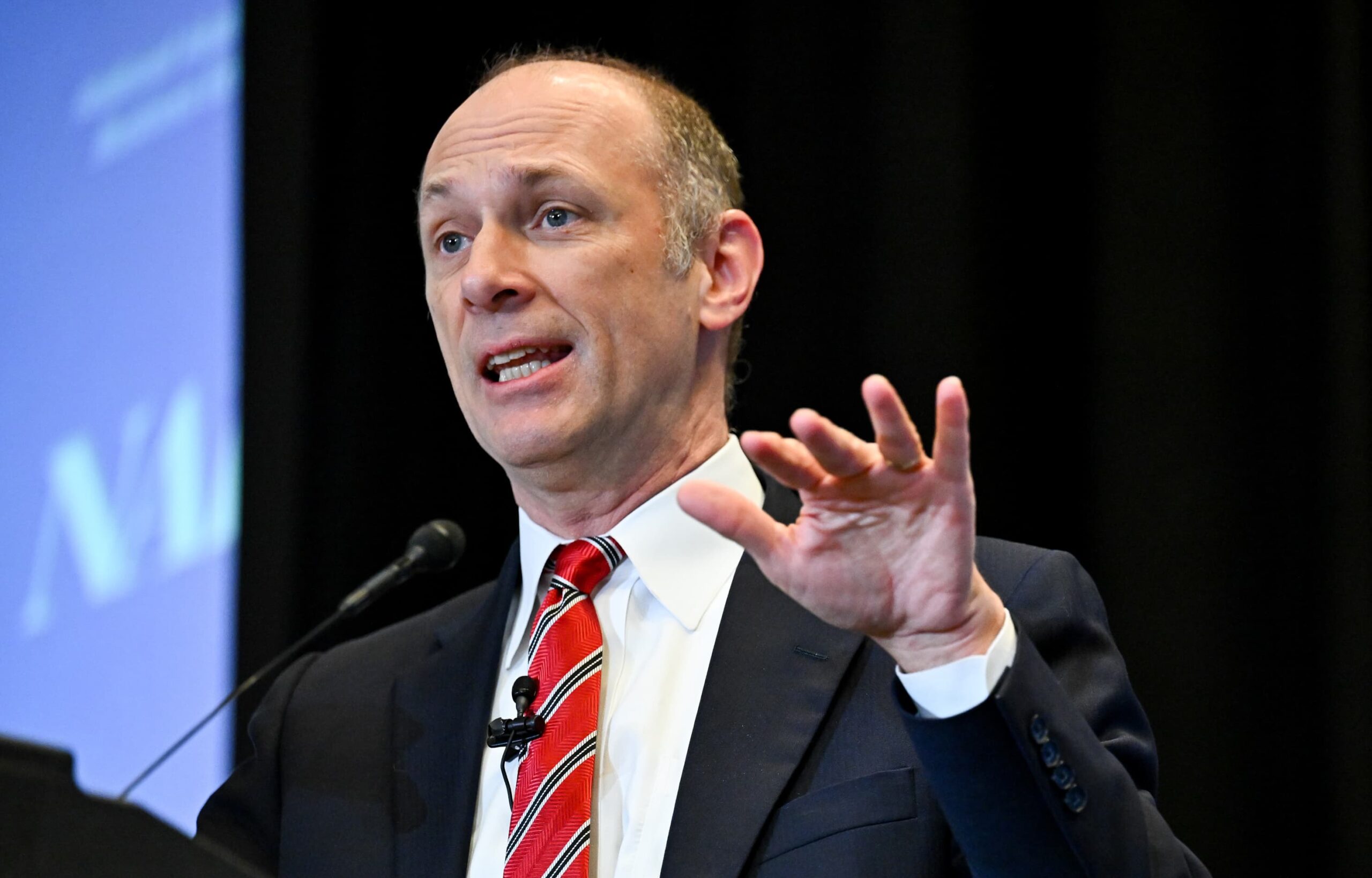
Washington, D. D. — Austan Goolsbee, President and Chief Executive Officer of the Federal Reserve Bank of Chicago, delivered a clear and resolute message on Tuesday, emphasizing that further interest rate cuts would be premature without more definitive evidence of inflation’s sustained descent towards the Federal Reserve’s target. Speaking before a prominent gathering of economists and business leaders at the National Association for Business Economics (NABE) economic policy conference, Goolsbee underscored the perils of premature easing, drawing lessons from past misinterpretations of inflationary pressures. His remarks were a stark reminder that while inflation has receded significantly from its peak, the journey back to the Fed’s mandated 2% target remains incomplete and fraught with complexities.
The Fed’s Vigilant Stance: Learning from History
Goolsbee’s address at the NABE conference, a critical forum for economic discourse, highlighted the Federal Reserve’s heightened vigilance in navigating the current economic landscape. He pointed to the painful lesson learned during the initial phase of the post-pandemic inflationary surge, when policymakers, including the Fed, were "burned by assuming transitory inflation." This historical context now informs a more cautious and data-dependent approach. "I feel that front-loading too many rate cuts is not prudent in that circumstance," Goolsbee stated, his voice resonating with the conviction of an institution determined not to repeat past errors. He articulated a core principle guiding current Fed thinking: "People express that prices are one of their most pressing concerns. Let’s pay attention. Before we cut rates more to stimulate the economy, let’s be sure inflation is heading back to 2%." This statement encapsulates the Fed’s dual mandate – achieving maximum employment and maintaining price stability – with a clear prioritization of the latter in the current environment.
The Federal Reserve, an independent central bank, operates with the primary goal of fostering a healthy economy. Its policy decisions, particularly on interest rates, have profound implications for consumers, businesses, and global financial markets. The Federal Open Market Committee (FOMC), comprising twelve members including the seven governors of the Federal Reserve System and five of the twelve Federal Reserve Bank presidents (on a rotating basis, with the New York Fed president always a voting member), is responsible for setting the federal funds rate. As a voting member of the FOMC this year, Goolsbee’s perspective carries significant weight and offers crucial insight into the committee’s prevailing sentiment.
Dissecting the Latest Inflation Data: A Mixed Picture
The most recent inflation data available at the time of Goolsbee’s speech, for December, painted a nuanced picture that reinforced the Fed’s cautious posture. The personal consumption expenditures (PCE) price index, the Fed’s preferred inflation gauge, showed core inflation – which strips out volatile food and energy prices to provide a clearer signal of underlying trends – running at 3%. This figure, while significantly lower than the highs observed in 2022, still stood a full percentage point above the Fed’s 2% target.
Moreover, the December core PCE rate represented an uptick of 0.2 percentage points from November, raising concerns about the disinflationary trajectory. This increase was attributed to a combination of factors, some of which were viewed as potentially temporary, such as the impact of certain tariffs. However, Goolsbee specifically highlighted the persistence of "underlying pressures in the service sector and areas not directly impacted by the duties," indicating a broader inflationary impulse that cannot be easily dismissed.
The Sticky Challenge of Housing Inflation
A particularly stubborn component of inflation that Goolsbee singled out was housing. He explicitly stated that stubbornly high housing inflation is "not tariff driven," underscoring its deep-rooted nature within the economy. Housing costs, encompassing rent and owner’s equivalent rent (OER), represent a significant portion of household budgets and exert substantial upward pressure on overall inflation metrics. The lag with which housing inflation reflects changes in market rents means that even if new rental agreements begin to cool, the measured inflation in this sector can remain elevated for an extended period. This structural stickiness in housing costs presents a significant hurdle for the Fed in achieving its 2% target, emphasizing the need for continued vigilance.
The 3% inflation rate, Goolsbee declared, "is not good enough – and it’s not what we promised when the Federal Reserve committed to the 2% target. Stalling out at 3% is not a safe place to be for a myriad of reasons we know all too well." His comments reflect the Fed’s recognition that prolonged periods of inflation, even at moderate levels, can erode purchasing power, create economic uncertainty, and distort investment decisions. The commitment to 2% is not merely an arbitrary number but a level deemed conducive to long-term economic stability and growth.
Market Expectations vs. Fed’s Measured Approach
Goolsbee’s remarks arrived at a critical juncture for financial markets, which have been eagerly anticipating the timing of the Fed’s next policy move. Futures traders, utilizing tools like the CME Group’s FedWatch gauge, have been pricing in significant probabilities for interest rate cuts in the coming months. Prior to Goolsbee’s speech, markets were placing roughly a 50-50 chance of a rate cut in June, with the probability rising to about 71% for a July reduction. These expectations suggest a market belief that the Fed would soon pivot towards a more accommodative monetary policy, especially following three quarter-percentage-point cuts enacted in the latter part of 2025.

However, Goolsbee’s cautious tone, coupled with similar sentiments from other Fed officials, indicates a potential disconnect between market optimism and the central bank’s more data-driven and patient approach. The Fed’s recent history of rate adjustments, including the aggressive hiking cycle that began in early 2020s to combat surging inflation and the subsequent modest cuts in late 2025, illustrates its responsiveness to evolving economic conditions. Yet, the current environment demands a more deliberate assessment, as the "last mile" of disinflation often proves to be the most challenging.
A Broader Dialogue: Waller’s Perspective on Labor and Tariffs
Goolsbee was not the only Fed official to offer insights at the NABE conference. On Monday, Fed Governor Christopher Waller, who has previously been seen as an advocate for lower rates, presented a more measured outlook. Waller acknowledged the potential for policymakers to "look through" the temporary impacts of tariffs on inflation. This perspective suggests a willingness to filter out short-term, supply-side shocks that do not reflect underlying demand pressures.
Crucially, Waller also touched upon the labor market, noting that recent data suggests it "may be in better shape than previously indicated," thereby mitigating the immediate need for further rate cuts. A robust labor market, characterized by low unemployment and solid wage growth, could sustain consumer demand and potentially fuel inflationary pressures, thus reducing the urgency for monetary easing. Waller, however, added a layer of caution, stating he wasn’t convinced that the January nonfarm payrolls data wasn’t "more noise than signal." This highlights the challenge policymakers face in distinguishing genuine shifts in economic trends from one-off statistical anomalies, especially in volatile data releases.
The January nonfarm payrolls report, for instance, might show a surprisingly strong job gain, but this could be influenced by seasonal adjustments or other temporary factors. A deeper dive into labor market indicators, such as the unemployment rate, labor force participation, wage growth across various sectors, and job openings, is essential for a comprehensive understanding. If the underlying trend of labor market strength continues, it would further lessen the case for aggressive rate cuts, as the Fed’s dual mandate also includes maximum sustainable employment.
The Week’s Active Fed Discourse: Governor Lisa Cook’s Input
The NABE conference served as an active platform for Federal Reserve officials to communicate their views and provide transparency into their thinking. Following Goolsbee’s and Waller’s remarks, Governor Lisa Cook was also scheduled to present later on Tuesday morning. Each official brings a unique perspective and expertise to the FOMC, and their collective statements help shape public and market understanding of the Fed’s policy trajectory. The confluence of these high-profile speeches within a short timeframe underscores the importance of the current policy juncture and the ongoing internal debate within the Fed regarding the optimal path forward.
Broader Economic Implications and the Path Ahead
The Fed’s cautious stance on interest rate cuts carries significant implications for various sectors of the economy. For businesses, a prolonged period of higher borrowing costs can dampen investment, particularly for small and medium-sized enterprises (SMEs) that rely heavily on credit. Consumers might face higher interest rates on mortgages, auto loans, and credit card debt, potentially impacting discretionary spending and slowing economic growth.
However, the Fed’s primary concern remains price stability. Allowing inflation to persist above target could lead to a de-anchoring of inflation expectations, making it even harder to bring prices under control in the future. The Fed is walking a tightrope: tightening too much risks pushing the economy into a recession, while easing too soon risks reigniting inflation. Goolsbee’s comments reflect a preference for a more patient approach, prioritizing the definitive vanquishing of inflation over an expedited return to lower rates.
The "last mile" of disinflation is notoriously difficult. The initial phase of bringing down inflation often involves unwinding supply chain disruptions and easing commodity prices. However, the final push requires addressing more entrenched elements, such as services inflation and wage growth, which are more closely tied to underlying economic demand. The Fed’s challenge is to identify when these underlying pressures have sufficiently abated to justify a shift in policy.
Looking ahead, the Federal Reserve will continue to closely monitor a broad array of economic data, including monthly inflation reports, labor market statistics, consumer spending figures, and business sentiment surveys. Each piece of data will be meticulously analyzed to assess the strength of the disinflationary trend and the overall health of the economy. While Goolsbee previously indicated his belief that the Fed would be able to cut rates later in the year, his current remarks underscore that the timing and magnitude of any future adjustments will be strictly contingent on the data, reinforcing the central bank’s commitment to its 2% inflation target before embarking on a more stimulative monetary policy. The road ahead remains one of careful calibration, guided by a steadfast commitment to price stability.
About the Author