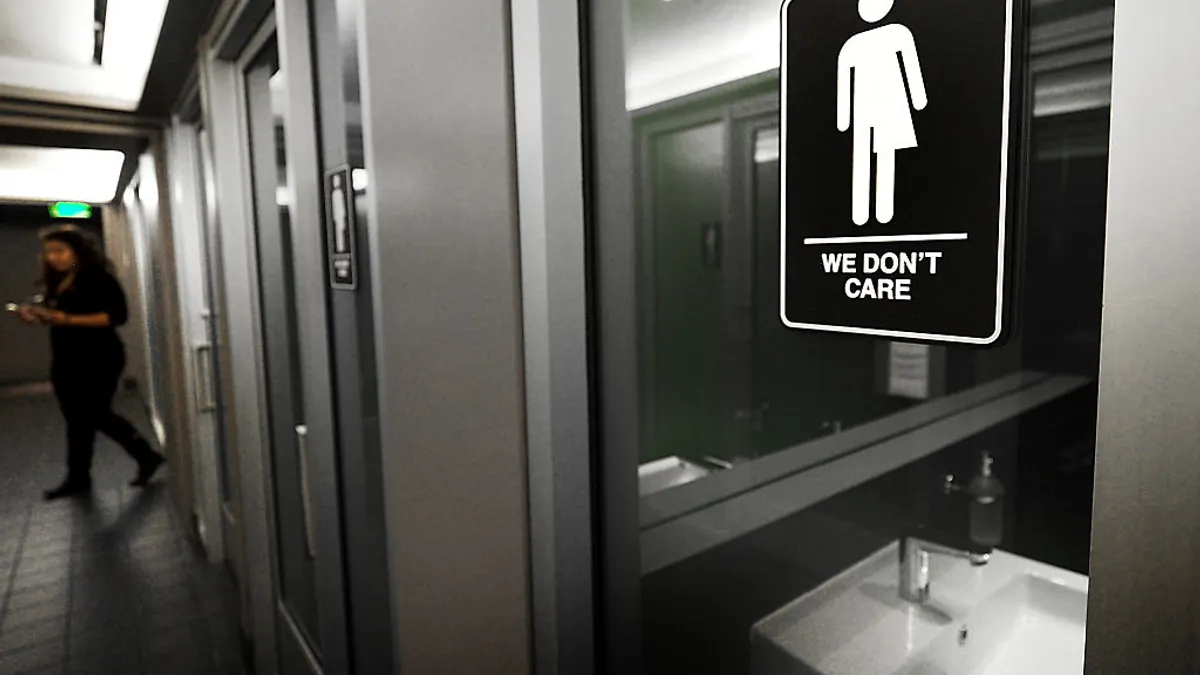
The U.S. Equal Employment Opportunity Commission (EEOC) has issued a significant ruling overturning a 2015 precedent that had prohibited federal agencies from banning transgender employees from using bathrooms consistent with their gender identities. This decision, published on February 27, 2026, fundamentally alters the landscape for federal workplace policies concerning transgender restroom access, sparking debate and raising questions about the future interpretation of anti-discrimination laws.
The landmark reversal stems from the case of Selina S. v. Driscoll, where the EEOC’s administrative complaint process was invoked. The commission’s majority opinion concluded that federal agencies are permitted to implement policies that require transgender employees to use bathrooms aligning with their sex assigned at birth. This decision directly contradicts the prevailing interpretation that had been in place for over a decade, stemming from the initial 2015 ruling.
Background and Precedent
The shift in the EEOC’s stance is rooted in a complex legal evolution, particularly concerning the interpretation of Title VII of the Civil Rights Act of 1964, which prohibits employment discrimination based on race, color, religion, sex, and national origin. For years, the application of Title VII to gender identity and sexual orientation has been a subject of ongoing legal discourse.
A pivotal moment in this discourse was the U.S. Supreme Court’s 2020 decision in Bostock v. Clayton County, Ga.. In Bostock, the Court held that discrimination based on sexual orientation or gender identity constitutes discrimination "because of sex" and is therefore prohibited under Title VII. This ruling was widely seen as a significant victory for LGBTQ+ rights, expanding protections for employees nationwide.
However, the Bostock decision explicitly stated that it did not definitively address all facets of the evolving legal landscape, specifically mentioning that issues such as bathroom and locker room policies were not authoritatively ruled upon. This ambiguity left a crucial question unanswered: could employers mandate that transgender employees use facilities corresponding to their sex assigned at birth without violating Title VII as interpreted by Bostock?
The EEOC’s decision in Selina S. v. Driscoll directly attempts to provide an answer to this unresolved question within the context of federal agencies. The commission stated its intention to "accurately predict how a responsible court would interpret the statute on this issue," effectively stepping into the void left by the Supreme Court’s pronouncement.
Key Arguments and Rationale
The EEOC’s majority opinion reasoned that the Bostock decision’s core finding—that discrimination against transgender individuals is sex-based discrimination—did not necessarily preclude employers from maintaining sex-segregated facilities. The commission differentiated the situation in Driscoll from the scenarios in Bostock, arguing that in Bostock, employers were found to have treated transgender workers worse than their non-transgender counterparts. In contrast, the agency in Driscoll was not found to have engaged in such disparate treatment, but rather to have maintained a policy based on biological sex.

A central tenet of the EEOC’s justification for permitting single-sex bathrooms revolves around the concept of privacy. The commission asserted that men and women are not "similarly situated" in the context of using bathrooms and that women, in particular, possess a "vital privacy interest" in using single-sex spaces free from the presence of men. This interest, the EEOC argued, is "especially heightened" for women attending to needs related to menstruation, pregnancy, or lactation. The commission’s statement emphasized, "No man will ever experience a period, bear a child, or nurse an infant, and we do not think it improper that female employees would expect to manage their unique needs in a space accessible only to other women." This rationale suggests that maintaining separate facilities for men and women serves to accommodate these distinct biological realities and associated privacy concerns, which the EEOC believes Title VII does not prohibit.
Dissenting Opinions and Criticisms
The EEOC’s decision has not been without significant criticism. Commissioner Kalpana Kotagal, in a dissenting opinion, argued that the EEOC majority had prematurely issued its ruling without awaiting further clarification from federal courts. She pointed to an ongoing case, Withrow v. U.S., before the U.S. District Court for the District of Columbia, as a potential venue for such legal clarification. Kotagal contended that by "rushing to issue this decision," the EEOC majority bypassed the natural development of case law and created unnecessary uncertainty.
Furthermore, Kotagal expressed concern that the majority’s decision "fails to grapple with the consequences that flow from it." She warned that agencies could face liability for denying transgender workers access to restrooms aligned with their gender identities, and that transgender individuals might be subjected to increased vulnerability and potential harm as a result of this ruling. The argument here is that while the Bostock decision established that discrimination based on gender identity is illegal, allowing segregated bathrooms could create new avenues for discriminatory practices and negatively impact the safety and well-being of transgender employees.
Broader Implications and Future Outlook
The EEOC’s decision in Selina S. v. Driscoll is expected to have ripple effects far beyond the federal sector. Sam Schwartz-Fenwick, a partner at Seyfarth Shaw, noted that while the ruling technically applies only to federal agencies subject to the EEOC’s administrative complaint process, its reasoning could influence broader interpretations of Title VII. This is particularly true given the decision’s engagement with the limits of the Bostock ruling on the sensitive issue of bathroom access.

Schwartz-Fenwick anticipates increased pressure on employers across various sectors to re-evaluate and potentially revise their inclusive bathroom policies. However, he strongly advises employers against making hasty changes. "This is one step in a long process of clarifying the law, so don’t make any rash decisions," Schwartz-Fenwick cautioned. He emphasized the importance of consulting with legal counsel before implementing any modifications to existing policies, as doing so without proper guidance could introduce new legal risks.
The Driscoll decision effectively tees up potential future challenges concerning the precise boundaries of the Bostock ruling. As legal experts and advocacy groups analyze the EEOC’s rationale, the debate over balancing non-discrimination principles with privacy concerns in public accommodations and workplaces is likely to intensify. The coming years will likely see further legal scrutiny and potentially more court cases seeking to definitively resolve the complex interplay between Title VII, gender identity, and restroom access. The EEOC’s latest pronouncement marks a significant, albeit controversial, development in this ongoing legal and social conversation.
Timeline of Key Developments
- 2015: The EEOC issues an initial ruling that prohibits federal agencies from banning transgender employees from using bathrooms consistent with their gender identities. This establishes a precedent for federal workplaces.
- 2020: The U.S. Supreme Court delivers its landmark decision in Bostock v. Clayton County, Ga., ruling that Title VII protects employees from discrimination based on sexual orientation and gender identity. However, the ruling does not explicitly address bathroom access policies.
- Ongoing: Federal courts begin to grapple with the implications of Bostock for various workplace issues, including restroom access. A case, Withrow v. U.S., is noted as being under consideration by the U.S. District Court for the District of Columbia.
- February 27, 2026: The EEOC publishes its decision in Selina S. v. Driscoll, overturning the 2015 ruling. The commission determines that federal agencies may require transgender employees to use bathrooms aligning with their sex assigned at birth, citing privacy interests and a distinction from the Bostock ruling’s direct application to disparate treatment. The decision includes a dissenting opinion from Commissioner Kalpana Kotagal.
- Post-Decision: Legal experts and employers begin to analyze the implications of the EEOC’s reversal, anticipating potential challenges and increased scrutiny of bathroom policies in both public and private sectors.
About the Author