
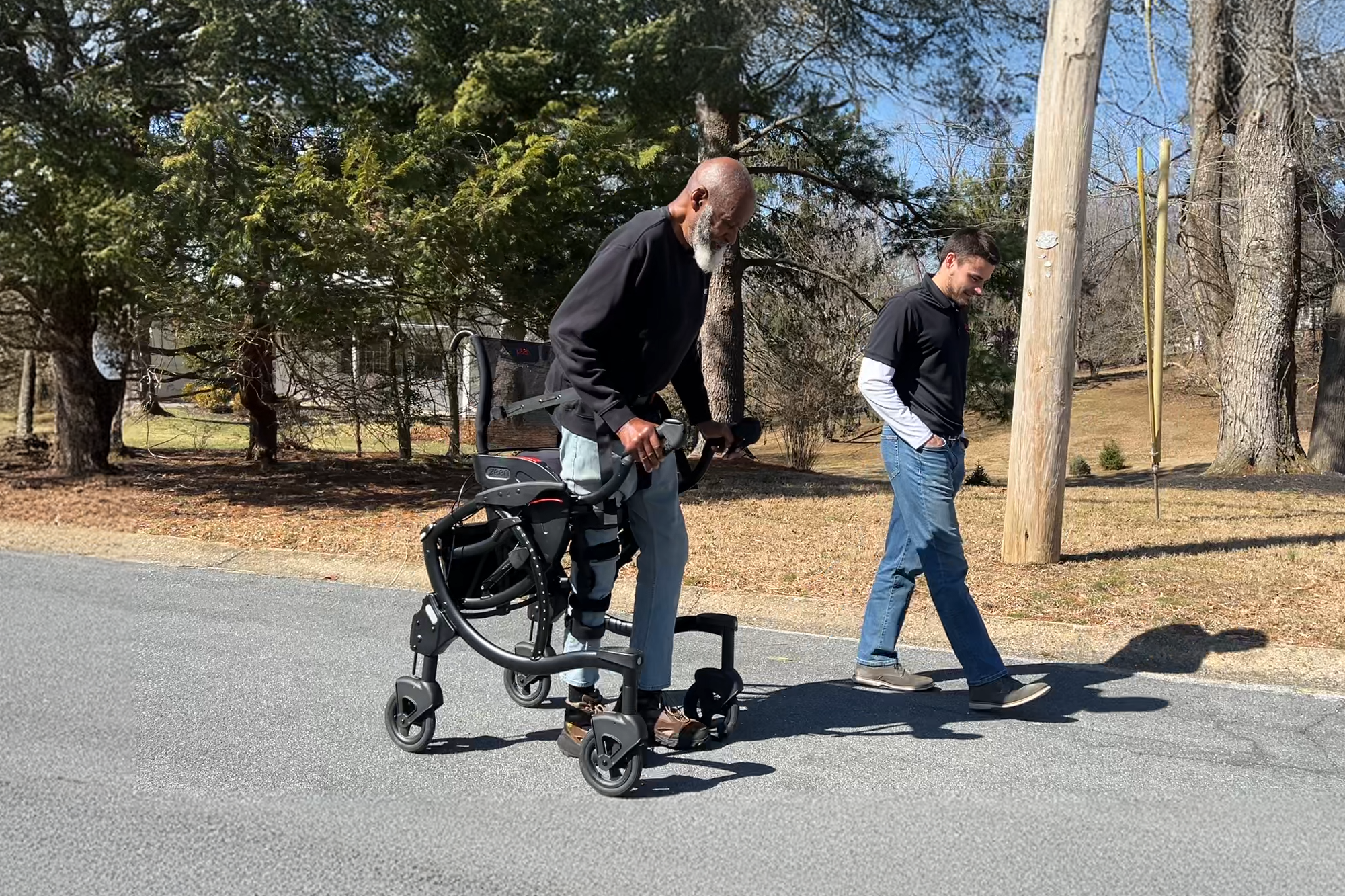
The landscape of assistive technology is undergoing a significant transformation as Exokinetics, a Delaware-based mobility innovation company, scales the distribution of its flagship device, the Zeen. Designed to address a critical "missing link" in the mobility spectrum, the Zeen offers a hybrid solution for the estimated 5.5 million Americans who rely on mobility aids to navigate their daily lives. Unlike traditional wheelchairs, which primarily facilitate seated transport, or standard walkers, which often provide insufficient support for those with fluctuating strength, the Zeen utilizes advanced mechanical engineering to allow users to transition seamlessly between sitting, standing, and walking without the need for electric motors or heavy batteries.
According to data from the Centers for Disease Control and Prevention (CDC), approximately 12.1 percent of U.S. adults have a mobility disability with serious difficulty walking or climbing stairs. For many of these individuals, the progression of mobility loss often necessitates a collection of various devices, including canes, rollators, manual wheelchairs, and eventually power scooters. The Disability Rights Education and Defense Fund (DREDF) reported in 2023 that a significant portion of mobility device users expressed dissatisfaction with their equipment’s inability to meet multifaceted needs, often citing the bulky nature of power chairs and the physical limitations of manual walkers. The Zeen aims to consolidate these needs into a single, motorless frame that prioritizes user agency and physiological health.
The Evolution of Movement: From Steadicam to Exokinetics
The origin of the Zeen is rooted in the high-stakes world of cinematography. Garrett Brown, the Academy Award-winning inventor of the Steadicam, co-founded Exokinetics after observing the mobility challenges faced by his aging father. Brown, whose Steadicam technology revolutionized filmmaking in the 1970s by allowing camera operators to achieve smooth, floating shots while moving, recognized a parallel between stabilizing a heavy camera and stabilizing the human body.

The Steadicam operates on the principle of isolation through a specialized arm and gimbal system that uses springs and counterweights to neutralize movement. Brown applied a variation of this logic to human mobility. His father required a device that could support his weight during the difficult "sit-to-stand" transition—a primary point of failure for many elderly individuals that often leads to debilitating falls. By 2013, the initial concepts for what would become the Zeen were being prototyped, focusing on a mechanical "lifting" assistance that did not rely on the sluggishness or weight of electric actuators.
The resulting device utilizes a proprietary air-piston system. These pistons are calibrated to the user’s specific body weight, effectively "unweighting" the person so they can rise from a seated position with minimal effort. This mechanical advantage allows the user to remain "active" in their movement, using their own leg muscles to coast or walk while the device provides a safety net against gravity.
Technical Specifications and the Mechanics of "Active" Support
The Zeen is categorized as an "active" mobility device, a term that distinguishes it from passive transport chairs. The core of its functionality lies in its five-level lift strength adjustment, which allows the device to be customized for individuals ranging from those with mild balance issues to those with significant lower-body weakness.
The device features a "saddle" or seat that remains in constant contact with the user, providing posterior support even when they are in a full standing position. This prevents the "drop" that occurs when a person loses their balance, as the device is designed to catch the user’s weight instantly. Because the system is motorless, it is significantly lighter than power wheelchairs, making it easier to transport in standard vehicles.

Rick Sherak, CEO of Exokinetics and a veteran of the U.S. Air Force, emphasizes that the lack of a battery is a strategic design choice rather than a limitation. "The air pistons are remarkably robust and reliable," Sherak noted. "By removing the motor, we remove the need for charging, we reduce the weight, and we eliminate the mechanical failures that often plague electric scooters. It’s about creating a tool that is always ready when the user is."
Chronology of Development and Market Integration
The trajectory of the Zeen has moved from niche invention to a recognized medical solution over the last decade:
- 2013–2018: Initial prototyping and engineering phases led by Garrett Brown and his team at Exokinetics.
- 2019–2021: Beta testing with various patient groups, including those with Parkinson’s disease, multiple sclerosis (MS), and spinal cord injuries.
- 2022: The Zeen was named one of TIME Magazine’s Best Inventions, bringing international attention to its unique "coasting" and "standing" capabilities.
- 2023: Expansion of the consumer direct-to-market strategy, allowing families to purchase the device for home use.
- July 2025: A landmark development occurred when Exokinetics was awarded a contract with the Department of Veterans Affairs (VA) Federal Supply Schedule. This agreement integrated the Zeen into the VA medical system, allowing physical therapists to prescribe the device to veterans with mobility impairments.
The VA contract represents a pivotal shift in the device’s accessibility. For many veterans dealing with the long-term effects of service-related injuries, the ability to remain upright is linked to both physical health—such as improved bone density and circulation—and psychological well-being.
Economic and Environmental Implications of Multi-Use Design
The financial burden of mobility impairment is a significant factor for American families. A standard wheelchair-accessible van, equipped with ramps and specialized tie-downs, can cost between $45,000 and $80,000. Furthermore, the maintenance of multiple devices—a walker for the bathroom, a manual chair for the house, and a power scooter for the mall—creates both a financial and spatial strain.

The Zeen’s multi-purpose nature offers a potential reduction in these costs. Because the device is foldable and relatively lightweight, many users find they no longer require specialized vans. Exokinetics reports instances where families were able to sell their modified vehicles after transitioning to the Zeen, as the user could stand up and walk into a standard car with minimal assistance.
From an environmental perspective, the "one device for life" philosophy addresses the growing issue of medical waste. In Massachusetts alone, the REquipment program—which refurbishes used medical gear—diverted 45 tons of equipment from landfills in 2023. By creating a device that can be adjusted with simple spring or piston changes as a child grows or as an adult’s condition changes, Exokinetics aims to reduce the cycle of "disposable" mobility aids.
Psychological Impact: The "In-Between" Stage of Mobility
Healthcare professionals often cite the "psychological cliff" that occurs when a patient is told they must transition from a walker to a wheelchair. This shift is frequently perceived as a loss of autonomy and a surrender to a sedentary lifestyle.
"The in-between stage is where people often fall, lose confidence, or stop moving altogether," Sherak explained. "The Zeen was designed specifically for that moment. It allows people to walk under their own power, rest when they need to, and move through their day with much less fear."

By maintaining the user at eye level with their standing peers, the Zeen also addresses the social isolation often felt by wheelchair users. The ability to stand at a kitchen counter, reach a high shelf in a grocery store, or maintain eye contact during a conversation provides a level of social integration that traditional seated devices cannot match.
Broader Impact and Future Outlook for Assistive Technology
The success of the Zeen reflects a broader trend in the "AgeTech" and "MedTech" sectors toward human-centric design. As the global population ages, the demand for devices that promote "aging in place" is expected to skyrocket. The United Nations predicts that by 2050, one in six people in the world will be over the age of 65.
Industry analysts suggest that the integration of the Zeen into the VA system may serve as a bellwether for private insurance and Medicare coverage. Currently, many insurance providers are hesitant to cover "hybrid" devices that do not fit neatly into established categories of "Durable Medical Equipment" (DME). However, as data continues to emerge regarding the Zeen’s role in fall prevention—falls being a leading cause of injury-related death among seniors—the long-term cost savings for insurers may become undeniable.
The Zeen’s development also signals a shift away from the "power-everything" trend. While electric exoskeletons and AI-driven wheelchairs garner headlines, the Zeen’s reliance on simple physics and high-quality materials offers a sustainable, low-maintenance alternative for the mass market. As Exokinetics continues to refine the design and expand its reach, the Zeen stands as a testament to the idea that sometimes the most sophisticated solution to a complex human problem is not a computer, but a well-engineered lever.
About the Author