
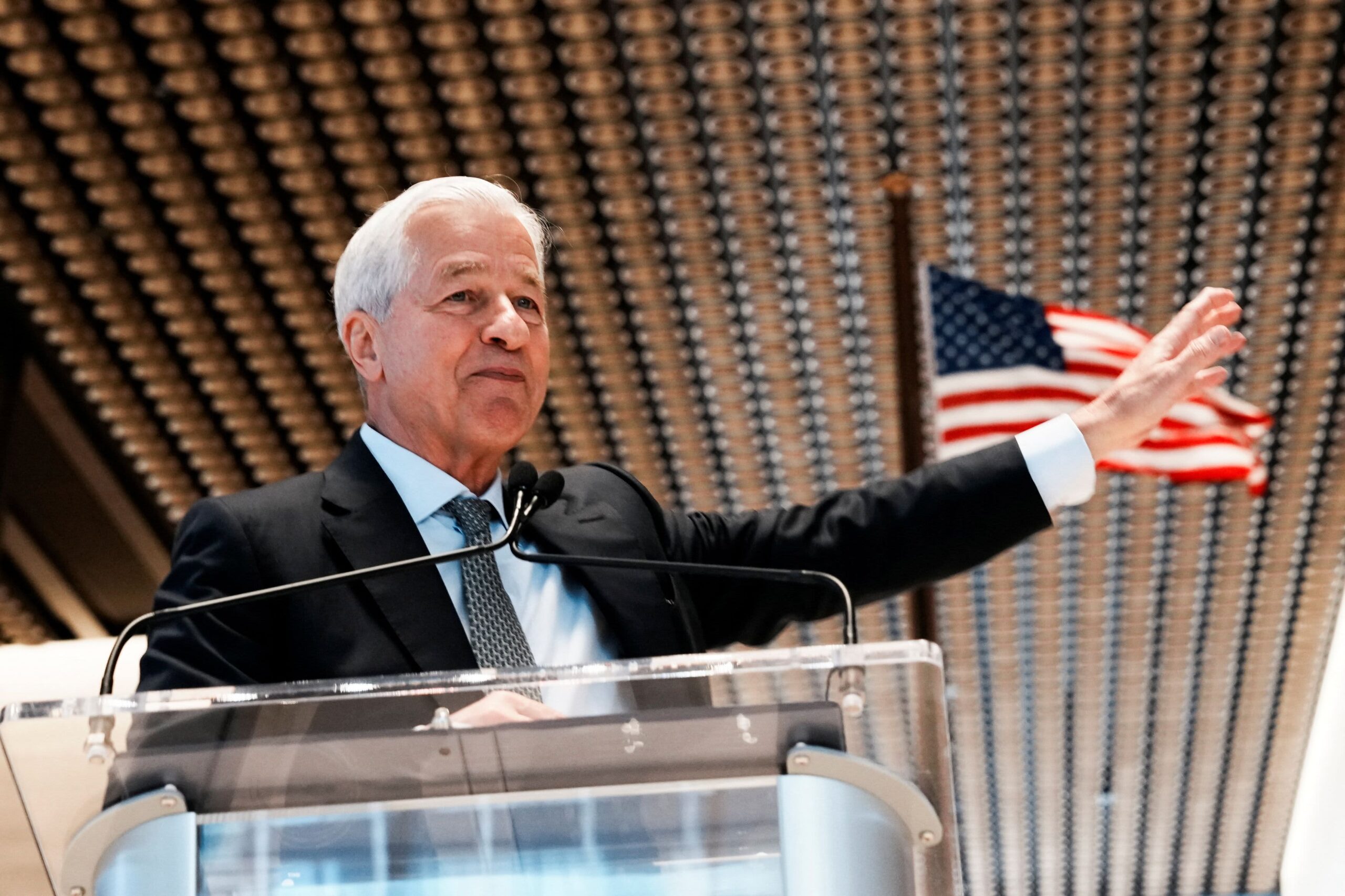
New York, NY – Jamie Dimon, Chairman and CEO of JPMorgan Chase, the world’s largest bank by market capitalization, has issued a powerful call for proactive societal planning to address the potentially profound and disruptive impact of artificial intelligence on the global workforce. Speaking at an investor meeting held late Monday, February 23, 2026, Dimon detailed JPMorgan’s internal strategies for managing AI-driven job displacement while simultaneously urging businesses and governments to collaboratively devise comprehensive solutions for what he described as a looming challenge to employment landscapes worldwide.
Dimon’s remarks underscore a growing recognition among global corporate leaders regarding the dual nature of AI: a transformative technology capable of unprecedented efficiency and innovation, yet also a potent force for job disruption. His comments come as JPMorgan Chase continues its ambitious agenda to become "fundamentally rewired" for the AI era, having invested nearly $20 billion annually in technology, a figure that leads the industry. The bank’s efforts to integrate advanced AI models, including those from OpenAI and Anthropic, into its operations are already yielding significant shifts in its workforce composition, offering a real-world preview of the future of work.
JPMorgan’s Internal Redeployment Strategy: A Corporate Blueprint
At the core of JPMorgan’s response is an explicit commitment to internal redeployment, a strategy Dimon elaborated on during the investor briefing. "We already have huge redeployment plans for [our] own people," Dimon stated. "In fact, we spoke about it today, and we have to up that a little bit so we can take people who are displaced – and we have displaced people from AI – and we offer them other jobs." This proactive approach highlights the bank’s recognition that AI will not merely automate tasks but will fundamentally alter job roles, necessitating a strategic shift in human capital management.
The bank’s head count, while remaining relatively stable at 318,512 over the past year, masks significant internal reallocations. A closer examination of JPMorgan’s internal data reveals a 4% reduction in operations staff and a 2% decrease in support roles. Concurrently, the firm bolstered client-facing and revenue-generating positions by 4%. This strategic pivot is directly enabled by AI and other technological advancements. For instance, the bank has leveraged technology to increase the number of accounts each operations employee can manage by 6%, effectively boosting productivity. Furthermore, AI-driven solutions have reduced the per-unit cost of dealing with fraud by an impressive 11%, while making the bank’s software engineers 10% more efficient.
Jeremy Barnum, JPMorgan’s Chief Financial Officer, elaborated on these developments at the same investor meeting, noting that the bank has doubled its use cases for generative AI this year. The primary focus areas for these advanced AI applications are customer service and enhancing the productivity of the firm’s technology workers. These internal shifts demonstrate a corporate strategy aimed at optimizing efficiency and re-skilling its existing workforce to meet the demands of an AI-powered future, rather than resorting to mass layoffs. However, a JPMorgan spokeswoman declined to provide further details on Dimon’s redeployment comments, indicating the sensitivity and ongoing development of these internal strategies.
Broader Societal Implications and the Call for Collective Action
Beyond JPMorgan’s internal maneuvers, Dimon expressed deep concern over the broader societal implications of rapid AI adoption, particularly the risk of widespread unemployment. When an analyst pressed him on this issue during the Monday meeting, referencing recent market volatility sparked by every new AI model update, Dimon reiterated the bank’s commitment: "We are going to deploy AI as best we can to do a better job for our customers." Yet, he quickly pivoted to a more expansive, sobering outlook.
Dimon, known for his frank assessments of economic and technological trends, has previously likened the transformative potential of AI to that of foundational innovations such as electricity, the printing press, and computers – a comparison he made in April 2024. This historical perspective underscores his belief that AI represents not just an incremental technological improvement but a paradigm shift with far-reaching consequences for human civilization.

His current concerns extend beyond individual corporations to entire professions. Dimon posited a thought experiment: "What if autonomous trucks were introduced overnight?" he asked, painting a vivid picture of potential widespread disruption. "Would you do it if you put 2 million people on the street? That next job is $25,000 a year, stocking shelves." This scenario highlights the core dilemma: the immense economic benefits of AI-driven automation versus the potential for severe social dislocation, particularly for those in roles susceptible to automation, who may find re-employment in lower-wage, less secure positions.
Dimon stressed the urgency for a collective, multi-stakeholder response. Businesses and governments, he argued, must begin planning for this risk now, with ideas including robust assistance and comprehensive training programs for displaced workers. "Society’s got to think through what it wants to do if this becomes that kind of problem," Dimon urged. "Now is the time to start thinking about it." This appeal positions AI’s impact not merely as a corporate HR challenge but as a fundamental societal question requiring policy innovation and strategic foresight.
Context and Chronology of AI’s Ascent in Finance
JPMorgan Chase has been a vocal proponent and early adopter of AI technologies within the financial sector. The formal opening of its new headquarters at 270 Park Avenue in New York on October 21, 2025, while primarily a real estate milestone, also symbolized the bank’s forward-looking vision, including its technological ambitions. Months prior, in September 2025, JPMorgan executives had publicly outlined their aggressive agenda to transform the bank into a "fully AI-connected megabank," signaling their intent to integrate AI across every facet of its vast operations. This commitment has been backed by the industry’s largest technology budget, far surpassing many of its peers.
The bank’s embrace of AI is part of a broader trend sweeping through the financial services industry. Investment banks and asset managers are increasingly deploying AI for tasks ranging from algorithmic trading and fraud detection to personalized client advice and regulatory compliance. However, JPMorgan’s scale and its CEO’s willingness to openly discuss the challenging aspects of AI adoption – particularly job displacement – sets it apart. Dimon’s consistent messaging, from his 2024 comparison of AI to electricity to his recent call for societal planning, demonstrates a long-term, strategic perspective on this technology’s evolution.
Analysis: The Dual-Edged Sword of AI and the Path Forward
Dimon’s remarks illuminate the central paradox of AI: its unparalleled potential for economic growth and efficiency gains, alongside its capacity to fundamentally reshape labor markets, potentially leaving significant segments of the workforce vulnerable. JPMorgan’s internal redeployment strategy offers a corporate model for mitigating displacement through retraining and internal mobility. This approach, however, requires substantial investment in human capital development, a commitment not all companies may be willing or able to make.
Economists and labor market experts have long debated the future of work in an era of increasing automation. Reports from institutions like the World Economic Forum and McKinsey & Company have consistently projected significant job disruption due to AI, particularly in routine, cognitive tasks. While new jobs are expected to emerge, the transition period and the skills gap between displaced workers and new opportunities present formidable challenges. Dimon’s "autonomous trucks" thought experiment resonates with these analyses, highlighting the potential for large-scale, industry-specific shocks that could overwhelm existing social safety nets and retraining infrastructure.
The call for societal planning implies a need for coordinated action from governments, educational institutions, and businesses. This could involve rethinking educational curricula to foster future-proof skills, expanding government-funded retraining programs, exploring new forms of social support like universal basic income (UBI) or adjusted social welfare systems, and incentivizing companies to invest in their workforce’s adaptability rather than simply replacing human labor with machines. It also raises ethical questions about corporate responsibility in an AI-driven economy: what is the obligation of companies that benefit immensely from AI to those whose livelihoods are disrupted by it?
Dimon’s stature as a leading voice in global finance lends significant weight to his warnings. His proactive stance, both in managing JPMorgan’s own workforce transitions and in advocating for broader societal foresight, signals that the era of AI-driven transformation is not a distant future but a present reality requiring urgent and thoughtful engagement from all sectors. As AI continues its rapid advancement, the dialogue initiated by leaders like Dimon will be crucial in shaping a future where technological progress serves humanity rather than creating insurmountable societal divisions.
About the Author