
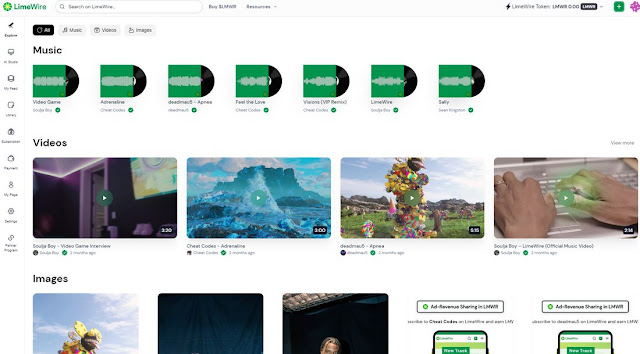
The digital landscape is witnessing a significant pivot for one of the most recognizable brands of the early internet era as LimeWire transitions from its legacy as a peer-to-peer file-sharing service into a comprehensive generative Artificial Intelligence (AI) and Web3 content platform. This transformation represents a strategic attempt to capture the intersection of generative technology and the creator economy, providing users with tools to not only generate high-fidelity digital assets but also to monetize them through blockchain-integrated systems. By combining advanced machine learning models with decentralized finance (DeFi) mechanisms, the new LimeWire seeks to establish a sustainable ecosystem for artists, musicians, and digital designers.
Historical Context and the Evolution of LimeWire
To understand the current trajectory of LimeWire, it is essential to examine its origins and the decade-long hiatus that preceded its current iteration. Originally launched in 2000 by Mark Gorton, LimeWire became the premiere client for the Gnutella network, facilitating the exchange of music, software, and video files. At its peak, the software was installed on an estimated 18% of all computers globally. However, after years of litigation with the Recording Industry Association of America (RIAA), a federal court injunction forced the service to shut down in 2010.
The brand remained dormant until 2022, when entrepreneurs Paul and Julian Zehetmayr acquired the rights to the LimeWire name and intellectual property. Unlike the original service, the new entity was designed from the ground up as a legal, blockchain-based marketplace. Initially focusing on Non-Fungible Tokens (NFTs) for the music industry, the platform secured partnerships with high-profile artists including Deadmau5, Sean Kingston, and Soulja Boy. In 2023, the company further expanded its scope by launching the LimeWire AI Studio, signaling a shift toward generative AI as the core of its value proposition.
Technical Infrastructure of the LimeWire AI Studio
The LimeWire AI Studio serves as a centralized hub for generative media, currently prioritizing image synthesis with plans to expand into audio and video. The platform does not rely on a single proprietary algorithm; instead, it integrates several of the industry’s most sophisticated open-source and commercial models.
Integration of Industry-Leading Models
At present, users can access and toggle between several foundational models:
- Stable Diffusion 2.1 and XL: These models are utilized for their high degree of user control and ability to interpret complex, multi-layered prompts. The XL variant, in particular, offers enhanced photorealism and better handling of text within images.
- DALL-E 2 and 3: Integrated via OpenAI’s API, these models provide intuitive prompt interpretation, allowing users with less technical expertise to generate coherent and artistically diverse results.
- Proprietary Developments: LimeWire has confirmed that it is in the process of developing its own internal AI models. This move is intended to reduce reliance on third-party APIs and offer unique stylistic outputs that cannot be replicated on competing platforms.
Advanced Editing and Customization Features
Beyond simple text-to-image generation, the studio includes a suite of editing tools. Users can adjust "samplers" to dictate how the AI iterates on an image, impacting the final quality and detail density. The platform also supports "Image-to-Image" workflows, where an existing upload serves as the structural basis for a new AI-generated variation. This functionality is particularly useful for designers looking to maintain brand consistency while experimenting with different aesthetic styles, such as cinematic, pixel art, or anime.
The Web3 Integration: Automated Minting and Ownership
A defining characteristic of the LimeWire ecosystem is the seamless bridge between content creation and blockchain ownership. When a user generates a piece of content in the AI Studio, the platform offers an automated pathway to "mint" that content as an NFT.
Blockchain Selection and Environmental Impact
LimeWire utilizes the Polygon and Algorand blockchains for its NFT infrastructure. The selection of these networks is a strategic decision based on two primary factors:
- Scalability and Cost: Both Polygon (an Ethereum Layer-2) and Algorand offer significantly lower "gas fees" compared to the Ethereum mainnet, making it economically viable for creators to mint large volumes of content.
- Sustainability: Both networks utilize Proof-of-Stake (PoS) consensus mechanisms, which consume a fraction of the energy required by Proof-of-Work systems, aligning the platform with modern ESG (Environmental, Social, and Governance) standards.
Digital Collectibles and Secondary Markets
By minting content as an NFT, the creator establishes an immutable record of authenticity. Fans and collectors can subscribe to a creator’s profile to receive exclusive access to these assets. Furthermore, the platform facilitates a secondary market where these digital collectibles can be traded. To ensure long-term sustainability for the artist, LimeWire implements a royalty system where the original creator receives a 2.5% fee on every subsequent trade of their work.
Economic Framework and Monetization Strategies
LimeWire has introduced a multi-faceted revenue model that distinguishes it from traditional social media and stock photo platforms. This model is built on the principle of ad-revenue sharing and the utility of the LMWR token.
The Ad-Revenue Sharing Program
In a departure from the "walled garden" approach of platforms like Instagram or Pinterest, LimeWire shares 70% of the advertising revenue generated by a piece of content with its creator. When a user’s image, music, or video is viewed by the public, the accumulated ad impressions are calculated, and the payout is distributed monthly. This provides a passive income stream for creators, incentivizing the production of high-engagement content.
The Utility of the LMWR Token
The LMWR token is the native cryptocurrency of the LimeWire ecosystem. It serves several critical functions:
- Payment for Services: Users can use LMWR to purchase additional generation credits or to tip their favorite creators.
- Incentive Rewards: Revenue share payouts are conducted in LMWR, which can be held within the platform or transferred to external exchanges such as Kraken, ByBit, or UniSwap for conversion into fiat currency or other digital assets.
- Governance: Token holders may eventually participate in governance decisions, influencing the future development of the platform’s features and model integrations.
Subscription Tiers and Accessibility
To accommodate a wide range of users, from hobbyists to professional design agencies, LimeWire employs a tiered subscription model.
- Free Tier: Offers 10 credits per day (equivalent to roughly 20 image generations) and a 50% ad revenue share. This tier is designed to lower the barrier to entry for new AI artists.
- Basic Plan ($9.99/mo): Increases the monthly credit limit to 1,000 and provides early access to new models.
- Advanced and Pro Plans ($29 – $49/mo): These tiers offer between 3,750 and 5,000 credits, with the ad revenue share increasing to 60% and 70%, respectively.
- Pro Ultra ($99/mo): Aimed at power users and enterprises, providing 11,250 credits and the highest priority for image generation speeds.
All premium tiers remove advertisements from the user interface and provide a "Pro" badge, enhancing the creator’s credibility within the community.
Broader Impact on the Creative Industry
The emergence of LimeWire as an AI powerhouse reflects a broader trend in the democratization of digital art. By removing the technical hurdles associated with local AI installations and the financial hurdles of high-cost minting, LimeWire allows a broader demographic to participate in the digital economy.
Industry Reactions and Market Analysis
Market analysts suggest that LimeWire’s pivot is a calculated move to capitalize on the "Generative AI boom," which is projected to become a multi-billion dollar industry by the end of the decade. While some traditional artists remain skeptical of AI-generated content due to copyright concerns, LimeWire’s model attempts to address these issues by creating a closed-loop ecosystem where ownership is clearly defined through blockchain records.
Legal experts note that the automated minting process provides a "digital paper trail" that could be crucial in future copyright disputes. However, the platform must navigate the evolving regulatory landscape surrounding AI-generated intellectual property, as courts in various jurisdictions continue to deliberate on whether AI-generated works can be copyrighted.
Future Outlook: Music and Video Generation
While the current focus is on imagery, LimeWire’s roadmap includes the imminent launch of AI-powered music and video generation tools. This expansion will likely leverage similar partnerships with foundational audio models, allowing users to generate short-form video content and original soundtracks.
As the platform evolves, the integration of these diverse media types into a single "Studio" could position LimeWire as a formidable competitor to traditional creative suites. By providing a holistic environment where content is conceived, generated, minted, and monetized, LimeWire is effectively attempting to build the "operating system" for the next generation of digital creators. The success of this venture will depend on the platform’s ability to maintain a high quality of output while navigating the complex ethical and legal questions inherent in the age of artificial intelligence.
About the Author