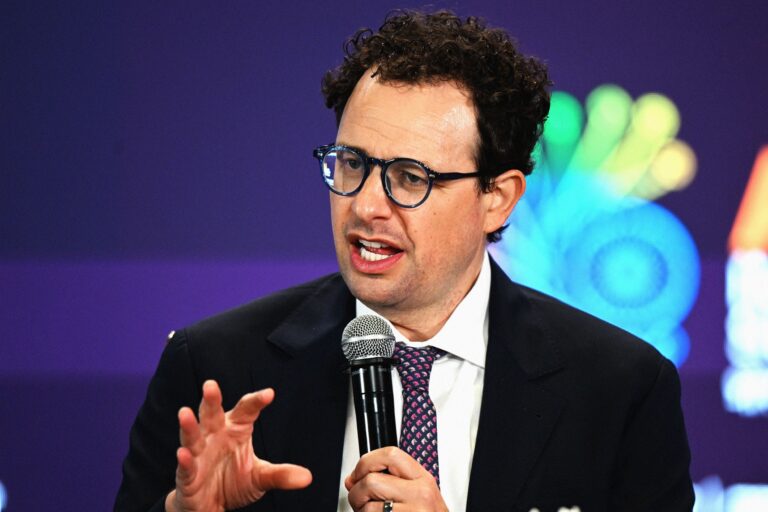

The sudden prominence of Alap Shah, a 45-year-old financial analyst and technology entrepreneur, serves as a potent illustration of the current volatility and deep-seated anxiety defining modern financial markets. For two decades, Shah operated within the specialized corridors of finance and tech, largely away from the public eye. However, the release of a research paper titled “The 2028 Global Intelligence Crisis,” coauthored with the research firm Citrini, catalyzed a significant market event. The document, framed as a "thought exercise" regarding the trajectory of artificial intelligence (AI), offered a stark prediction: by June 2028, the acceleration of AI capabilities would drive global unemployment rates above 10 percent, precipitating a sustained collapse of the Dow Jones Industrial Average.
The report’s impact was immediate and measurable. Despite the fact that many of its core arguments echoed existing warnings from tech industry leaders, the specific, confident tone of the manifesto resonated with a market already on edge. By the conclusion of the trading day following the report’s viral spread, the Dow Jones Industrial Average had plummeted by 800 points. This reaction highlights a growing trend where speculative "doom manifestos" can trigger massive capital outflows, reflecting a broader uncertainty about the long-term viability of current economic models in the face of rapid automation.
The Chronology of a Market Panic
The timeline of this market disruption began with the quiet publication of the Citrini report, which quickly gained traction on professional social networks and financial news aggregators. The report utilized a narrative style reminiscent of high-stakes financial thrillers, painting a picture of an economic "flywheel in reverse." According to Shah and his coauthors, the cycle begins when AI agents—autonomous software capable of performing complex tasks—begin to replace entry-level and mid-tier white-collar workers at scale.
This initial displacement leads to a reduction in consumer spending, which in turn stresses corporate balance sheets. Struggling corporations, seeking to maintain margins, then engage in further rounds of layoffs, creating a self-reinforcing downward spiral. The report’s release followed closely on the heels of statements from Anthropic CEO Dario Amodei, who previously estimated that 50 percent of entry-level white-collar roles could be eliminated by AI in the near future. Additionally, the market had already been sensitized by a selloff earlier in the year following Anthropic’s release of advanced "agentic" tools—software designed to navigate computers and perform tasks with minimal human intervention.
The convergence of these warnings reached a breaking point with the Citrini report. The 800-point drop in the Dow was not merely a reaction to new data, as the report contained little original empirical evidence; rather, it was a manifestation of "AI jitters." This phenomenon suggests that Wall Street is currently in a state of hyper-sensitivity, where even a theoretical "thought exercise" can erase billions in market capitalization if it confirms the underlying fears of institutional investors.
The Case of the Karaoke Pivot and Market Fragility
The fragility of the current market is further evidenced by an unusual incident involving a small-cap company previously focused on the karaoke machine market. With a valuation of less than $6 million, the company announced a strategic pivot to AI-powered shipping logistics. Shortly after the pivot, it released a report claiming to have identified significant efficiencies in semi-truck loading processes through the use of proprietary AI algorithms.
The response was disproportionate to the company’s size and history. The mere suggestion that a new, AI-driven entrant could optimize logistics was enough to trigger a selloff that erased billions of dollars in share value from established, multi-billion-dollar logistics giants. This event serves as a factual case study in market behavior: investors are so terrified of being "disrupted" by AI that they are willing to flee established positions at the first sign of potential competition, regardless of the competitor’s pedigree or lack of infrastructure.
Theoretical Foundations: Rent-Seeking and the Death of the Middleman
At the heart of Alap Shah’s "2028 Global Intelligence Crisis" is a critique of what economists call "rent-seeking." Shah argues that a significant portion of the modern service economy is built on middlemen and market makers who profit from "friction"—the difficulty consumers face in finding the best prices, coordinating services, or navigating complex logistics.
Shah identifies DoorDash as the "poster child" for this phenomenon. Currently, consumers use the DoorDash app because it provides a centralized platform for discovery, payment, and delivery coordination. However, Shah posits that in an agent-packed universe, consumers will no longer need such apps. Instead, an individual’s personal AI agent will be able to scan the entire internet, contact restaurants directly, negotiate prices, and hire independent delivery agents without an intermediary taking a cut. In this "zero friction" future, multi-billion-dollar platforms are rendered obsolete, described by Shah as the digital equivalent of "avocado toast"—a trendy but ultimately non-essential expense.
Official Responses and Institutional Rebuttals
The reaction from the corporate world and established financial institutions has been one of calculated pushback. DoorDash, through spokesperson Ali Musa, defended its business model by pointing to its existing integration of AI. Musa noted that the company has partnered with Large Language Model (LLM) providers for several quarters and continues to see growth, suggesting that AI is an augmentative tool rather than a purely disruptive one.
The tech punditry also rallied to the defense of the platform economy. Ben Thompson, author of the influential Stratechery newsletter, characterized the Citrini report as a compelling narrative that fails under economic scrutiny. Thompson argued that DoorDash’s value lies not just in the digital interface, but in its physical infrastructure: a trusted network of delivery personnel, a robust system for handling refunds and disputes, and a sophisticated regulatory compliance framework. These are elements that a decentralized AI agent cannot easily replicate or guarantee.
Perhaps the most rigorous rebuttal came from Citadel Securities. The firm issued a mocking response, outlining the extreme conditions necessary for AI to produce a sustained negative demand shock. According to Citadel, for the "doom" scenario to materialize, the economy would need to see:
- Near-total labor substitution across multiple sectors simultaneously.
- A complete lack of fiscal or monetary response from the government.
- Negligible investment absorption by new industries.
- Unconstrained scaling of compute power despite physical and energy limitations.
Citadel’s analysis suggests that the "flywheel in reverse" ignores the historical resilience of the labor market, which has traditionally created new roles in response to technological displacement.
The Nvidia Paradox: Financial Success vs. Speculative Fear
The disconnect between corporate performance and market sentiment was starkly displayed following Nvidia’s most recent earnings report. Nvidia, the primary manufacturer of the chips that power the AI revolution, announced a 73 percent leap in revenues, exceeding even the most optimistic analyst expectations. CEO Jensen Huang highlighted the company’s role in a fundamental shift in global computing.
However, the market’s response was counterintuitive. Despite the spectacular earnings, Nvidia’s stock fell by 5 percent at the following day’s open. This "sell on good news" behavior indicates that investors are looking past current profits and focusing on the long-term risks outlined in manifestos like Shah’s. It also suggests that Alap Shah himself may be hedging his bets; reports indicate his personal portfolio includes major holdings in chipmakers like Nvidia while simultaneously holding short positions on companies he identifies as "disruptees" in the service sector.
Broader Implications and the Path to 2028
The debate sparked by "The 2028 Global Intelligence Crisis" highlights a critical juncture in the global economy. While the report has been criticized for its "Nostradamic" tone and potential lack of empirical rigor, it has successfully forced a conversation about the "William Gibson zone"—a state where the AI future is already here, but its benefits and disruptions are unevenly distributed.
Shah has indicated that a sequel to the report is forthcoming, focusing on policy prescriptions to ensure a "soft landing" for the labor market. His suggestions include slowing the rate of AI-driven job displacement through regulatory means to allow the economy time to adapt. However, the market’s tepid response to his more "upbeat" policy ideas underscores a grim reality: in the current climate, investors are far more responsive to threats than to solutions.
As 2028 approaches, the accuracy of these predictions remains to be seen. The core tension lies between the "zero friction" model of AI-driven efficiency and the institutional stability provided by the current corporate landscape. Whether AI will lead to a global intelligence crisis or a new era of productivity depends on factors that are currently in flux, including the speed of AI adoption, the resilience of the service sector, and the ability of governments to implement effective fiscal responses to automation. For now, the "Shah effect" remains a reminder that on Wall Street, perception of the future is often more powerful than the reality of the present.
About the Author