
The digital marketing world is undergoing a significant transformation as businesses increasingly navigate the burgeoning landscape of Answer Engine Optimization (AEO). This shift is underscored by major industry moves, such as HubSpot’s recent acquisition of Xfunnel, which signals a deep integration of AI search optimization directly into Customer Relationship Management (CRM) ecosystems, where crucial attribution and revenue tracking occur. As audiences flock to AI-powered search engines like ChatGPT, Perplexity, and Google’s AI Overviews, marketers are tasked with finding the most effective tools to ensure their content is discoverable. Two platforms, Profound and Scrunch, are rapidly gaining traction, each offering distinct approaches to mastering this new frontier. This article delves into a comparative analysis of Profound and Scrunch for AEO, exploring their functionalities, strengths, and ideal use cases to help businesses make informed decisions.
The Rise of AEO: A New Paradigm for Discoverability
For years, Search Engine Optimization (SEO) has been the cornerstone of online visibility. However, the advent of sophisticated AI chatbots and generative AI models has introduced a new layer of complexity. These AI engines don’t just crawl and index web pages; they synthesize information, engage in conversational queries, and provide direct answers, often citing their sources. This fundamental change necessitates a new approach: Answer Engine Optimization (AEO). AEO focuses on optimizing content not just for traditional search algorithms but for the way AI models understand, process, and present information.
The implications of this shift are profound. Brands that fail to adapt risk becoming invisible in AI-driven search results, potentially losing significant traffic and customer engagement. The challenge lies in understanding how these AI engines operate, what types of content they prioritize, and how to technically ensure that websites are accessible and understandable to AI crawlers. This is precisely where platforms like Profound and Scrunch aim to provide solutions.
Understanding Profound: The Content Creation Powerhouse
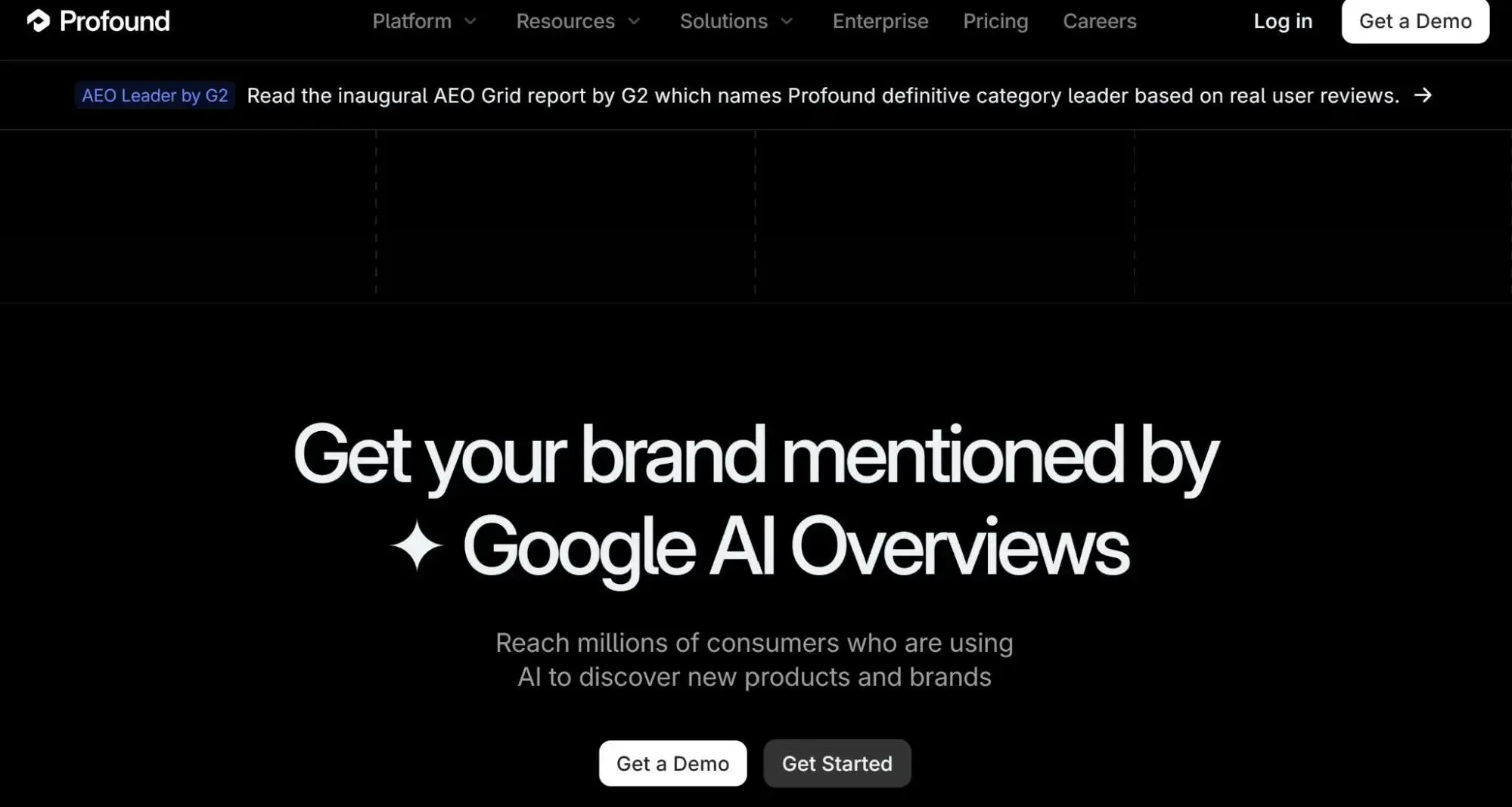
Profound positions itself as an enterprise-grade Answer Engine Optimization platform designed to enhance brand discoverability across a wide array of AI-powered search engines. Its capabilities extend to platforms such as ChatGPT, Perplexity, Claude, and Google AI Overviews. Profound’s strategy is two-pronged: it offers comprehensive monitoring across more than nine AI engines and provides powerful content creation tools called "Agents." These Agents are designed to enable marketing teams to produce AI-optimized content at scale, addressing a key bottleneck in content production for the AI era.
A notable feature of Profound is its "Prompt Volumes" tool, which claims to be the first of its kind to reveal actual search volume data for AI conversations. This offers a crucial insight analogous to traditional keyword research, allowing marketers to prioritize topics based on demonstrated demand within AI interactions. Furthermore, Profound offers specialized optimization capabilities for e-commerce brands through "ChatGPT Shopping," an increasingly relevant feature as AI begins to influence product discovery and purchasing decisions.
Profound’s Strengths:
- Content Creation at Scale: The "Agents" feature allows for the rapid generation of AI-optimized content, addressing the need for high-volume content production.
- Prompt Volume Data: The unique "Prompt Volumes" feature provides valuable insights into the demand for specific topics within AI conversations, aiding content strategy.
- E-commerce Focus: Dedicated "ChatGPT Shopping" optimization is a significant advantage for online retailers.
- Comprehensive Monitoring: Tracks visibility across a broad range of AI engines.
Understanding Scrunch: The Technical Optimization Specialist
In contrast, Scrunch defines itself as an AI Customer Experience Platform with a primary focus on technical optimization. Its core mission is to help brands control how AI agents interpret and cite their content. Rather than emphasizing content creation, Scrunch delves into the technical barriers that might prevent AI crawlers from accessing a website. It analyzes which sources AI engines prefer to cite and offers actionable recommendations to improve visibility.
A standout feature of Scrunch is its Agent Experience Platform (AXP). This innovative tool creates parallel, AI-optimized versions of web pages specifically designed for AI consumption. The goal is to dramatically improve the effectiveness with which AI systems can process and reference a brand’s content. Scrunch’s approach is rooted in ensuring that existing content is technically sound and readily accessible to AI, rather than generating new content from scratch.
Scrunch’s Strengths:
- Technical Optimization: Excels at identifying and resolving technical barriers that hinder AI crawler access.
- Agent Experience Platform (AXP): A unique feature that serves AI-optimized content versions to AI bots, significantly enhancing processing efficiency.
- Granular Insights: Offers detailed analysis of AI crawler activity and citation patterns.
- Actionable Recommendations: Provides specific, technical guidance for improving AI visibility.
Profound vs. Scrunch: A Detailed Comparison
To fully appreciate the distinct value propositions of Profound and Scrunch, a detailed feature-by-feature comparison is essential.
AI Visibility Monitoring & Dashboards
Profound’s Approach: Profound’s "Answer Engine Insights" dashboard provides a central hub for tracking brand visibility across AI search engines. It offers a primary visibility score that trends over time, with options for 7-day, 30-day, or custom reporting periods. The platform includes competitive benchmarking, allowing users to see their industry ranking against direct competitors, with weekly performance trends for each. Data can be filtered by AI model or region, offering flexibility in understanding performance. Profound also stores screenshots of AI responses, which serves as a valuable audit trail for citation patterns.
Scrunch’s Approach: Scrunch’s dashboard is characterized by its clean, modern design, emphasizing prompt-level analysis. Instead of a single visibility score, Scrunch displays mention frequency, share-of-voice percentages, and sentiment analysis for each tracked prompt. Its competitive benchmarking is robust, showing competitor mentions alongside AI responses for direct comparison. A key differentiator is Scrunch’s real-time AI crawler feed, which meticulously logs when AI bots visit a site, which pages they access, and traffic trends. This granular visibility is invaluable for technical teams diagnosing crawling issues. The platform offers extensive filtering by topic, persona, funnel stage, AI model, and custom tags, catering to diverse tracking needs.
Winner for Monitoring: Scrunch takes the lead for teams requiring granular, prompt-level insights and real-time crawler monitoring. Profound is better suited for enterprise teams prioritizing executive-level visibility scores and comprehensive documentation.
Prompt Analytics & Search Volume Data
Profound’s Approach: Profound’s "Prompt Volumes" feature is a significant innovation, providing actual search volume data for AI conversations. Similar to traditional keyword research tools, it quantifies how frequently topics are discussed across platforms like ChatGPT, Perplexity, and Copilot. This data empowers traditional SEO-style content planning, allowing teams to prioritize topics based on demand. The "Conversation Explorer" allows users to drill down into specific prompts, view AI responses, and extract context around brand mentions. Users can customize, disable, or add prompts to align with their brand strategy.
Scrunch’s Approach: Scrunch employs a different methodology. It converts keywords into "synthetic tracking prompts," meaning it monitors structured questions generated by the system based on industry and target keywords, rather than actual user queries. The Starter plan includes pre-built industry prompts organized by topic, along with a set of custom prompts. These prompts are run across multiple AI platforms, capturing responses and highlighting brand mentions and competitor citations. While Scrunch tracks prompt trends, user feedback suggests its trend data is less comprehensive than Profound’s volume insights.
Winner for Prompts: Profound decisively wins in this category. For marketing teams where understanding the demand and potential opportunity for specific topics is paramount, "Prompt Volumes" offers unparalleled data. Scrunch’s synthetic prompts are useful for monitoring but do not address the "how big is the opportunity?" question.
Content Creation & Optimization
Profound’s Approach: Profound’s "Agents" feature is a comprehensive content production system built for AI optimization. It offers numerous templates for formats like listicles, how-tos, and comparison articles, all pre-optimized with structural elements to increase the likelihood of AI citation. The workflow allows for audience targeting, topic selection, and integration with existing CMS and workflow tools. Human-in-the-loop checkpoints ensure quality control while accelerating production, with claims of AI-optimized content being created in minutes. While Profound offers optimization insights for existing content, some users report occasional "no recommendations found" messages.
Scrunch’s Approach: Scrunch deliberately avoids focusing on content creation. Instead, it assumes brands have quality content and require technical optimization to make it AI-accessible. Its "Insights" module provides actionable recommendations, such as "Update FAQ" or "Add structured data," but these are diagnostic rather than generative. The site audit feature allows individual URL checks, providing content quality scores and improvement checklists. However, manual auditing is not scalable for large websites. Scrunch identifies content gaps but does not provide tools for text generation or editing, requiring users to implement recommendations using separate platforms.
Winner for Content: Profound is the clear winner if content creation is a priority. Scrunch is more suitable for businesses with existing, high-quality content that needs technical refinement.
Technical Optimization & Crawler Management
Profound’s Approach: Profound’s "Agent Analytics" provides technical insights into AI crawler interactions. It integrates with major CDN providers (Cloudflare, Vercel, Netlify, Fastly, Akamai, Amazon CloudFront, GCP Cloud CDN, and WordPress) to track AI bot access, visit times, and crawl frequency. Profound verifies AI identity by cross-referencing IP addresses with published ranges from AI providers. It offers analysis to ensure AI indexing and retrieval optimization and includes GA4 integration for measuring AI-driven human traffic. However, it offers less proactive error detection or remediation guidance compared to technically focused platforms.
Scrunch’s Approach: This is where Scrunch truly excels. Its error detection feature automatically identifies when AI bots cannot properly crawl a site and provides specific, actionable fixes for issues like JavaScript rendering problems, robots.txt misconfigurations, or page speed issues. The real-time AI crawler feed offers a live log of bot visits, categorized into "Citations," "Training," and "Indexing," helping teams understand domain activity and prioritize efforts. The "Agent Experience Platform (AXP)" is Scrunch’s most advanced technical feature. AXP operates at the CDN level, serving AI-optimized, code-light versions of pages (reducing file size drastically) to AI crawlers, thereby improving processing and citation efficiency without altering the human-facing site.
Winner for Technical: Scrunch is the undisputed winner for technical optimization. Its comprehensive error detection, real-time crawler monitoring, and the innovative AXP make it the superior choice for technically sophisticated teams.
Citation Analysis & Competitive Intelligence
Profound’s Approach: Profound’s citation tracking reveals which external websites AI engines reference when discussing a brand or industry topics. This intelligence is valuable for link-building strategies and identifying content partnerships. The competitive benchmarking module displays brand visibility scores against rivals, with weekly trend data. Sentiment analysis is also provided, indicating the tone of AI mentions.

Scrunch’s Approach: Scrunch provides granular citation analysis by displaying actual AI responses with highlighted brand mentions, context, and cited sources. It allows for side-by-side comparison of competitor mentions within the same responses. The competitive insights dashboard shows share-of-voice percentages per prompt, pinpointing areas of competitor dominance. Scrunch’s persona-based analysis is particularly advanced, enabling tracking of how AI presents a brand to different audience segments (e.g., CTOs vs. developers). Customer testimonials highlight how Scrunch’s insights have helped companies increase their citations significantly.
Winner for Citations: Scrunch offers more actionable citation intelligence through its context-rich responses and persona segmentation. Profound provides solid competitive benchmarking but with less granular detail.
E-commerce & Shopping Optimization
Profound’s Approach: Profound stands out with dedicated "ChatGPT Shopping" optimization features. As AI-powered shopping experiences evolve, this capability is crucial for e-commerce brands. It tracks product visibility in ChatGPT Shopping results, monitors shopping triggers, analyzes response patterns, and provides product-level analytics, including retailer and review data. This specialized functionality could be a deciding factor for e-commerce businesses.
Scrunch’s Approach: While user reviews indicate Scrunch has features to track SKU appearance in ChatGPT responses, it does not emphasize shopping optimization as prominently as Profound. Its standard monitoring and citation analysis can be applied to e-commerce, but it lacks the specialized, shopping-centric insights offered by Profound.
Winner for E-commerce: Profound is the clear winner for e-commerce brands focused on AI shopping optimization. Its purpose-built features are currently unmatched by Scrunch in this specific area.
Integration Capabilities & Data Access
Profound’s Approach: Profound emphasizes integration with existing content technology stacks, connecting with CMS and content planning tools. For enterprise deployments, it supports custom integrations with dedicated CSM support. It includes GA4 integration for attributing AI search traffic and conversions. However, CRM integration typically requires custom API work. HubSpot users might expect significant integration time. Data export options are standard, but some users find exporting for external analysis challenging.
Scrunch’s Approach: Scrunch’s Data API is a major advantage, offering robust access for integration with CRMs, BI tools, and custom dashboards. This enables sophisticated attribution models and connection of AEO performance to business metrics. It also supports standard data exports. For HubSpot users, the Data API generally leads to a more straightforward implementation than Profound’s custom approach.
Winner for Integration: Scrunch is superior for organizations with technical resources or marketing operations teams capable of leveraging its Data API. Profound is better for those seeking dedicated enterprise integration support but are willing to invest more resources.
The HubSpot Advantage: HubSpot’s acquisition of Xfunnel highlights the growing importance of AEO. Native HubSpot integration promises a seamless path to connecting AEO performance with revenue, making AI search optimization as integral to the marketing stack as email or traditional SEO.
User Experience & Learning Curve
Profound’s Approach: Profound’s interface prioritizes comprehensive data analysis, leading to a steeper learning curve. User reviews often describe it as data-heavy and potentially overwhelming for new users. However, this complexity allows for highly customizable dashboards and reports, empowering advanced users. Its frequent feature releases mean the interface evolves, requiring continuous adaptation. Enterprise customers benefit from premium support.
Scrunch’s Approach: Scrunch consistently receives praise for its clean, modern, and intuitive interface. Onboarding is quick, with guided setup for prompts and competitors. Navigation is straightforward, with clear dashboards accessible to team members without deep technical expertise. Its filtering capabilities are easy to use. While it excels at identifying optimization opportunities, the interface might not guide users through fixes as comprehensively as some might prefer.
Winner for UX: Scrunch is the clear winner for user experience. Its intuitive interface significantly reduces the learning curve, making it more accessible for broader team adoption. Profound is better suited for power users who value extensive customization over ease of use.
Platform Coverage & Geographic Support
Profound’s Coverage: Profound monitors 9 major AI platforms, including ChatGPT, Perplexity, Claude, Google AI Overviews, Copilot, Bing Chat, You.com, Brave Search, and DeepSeek.
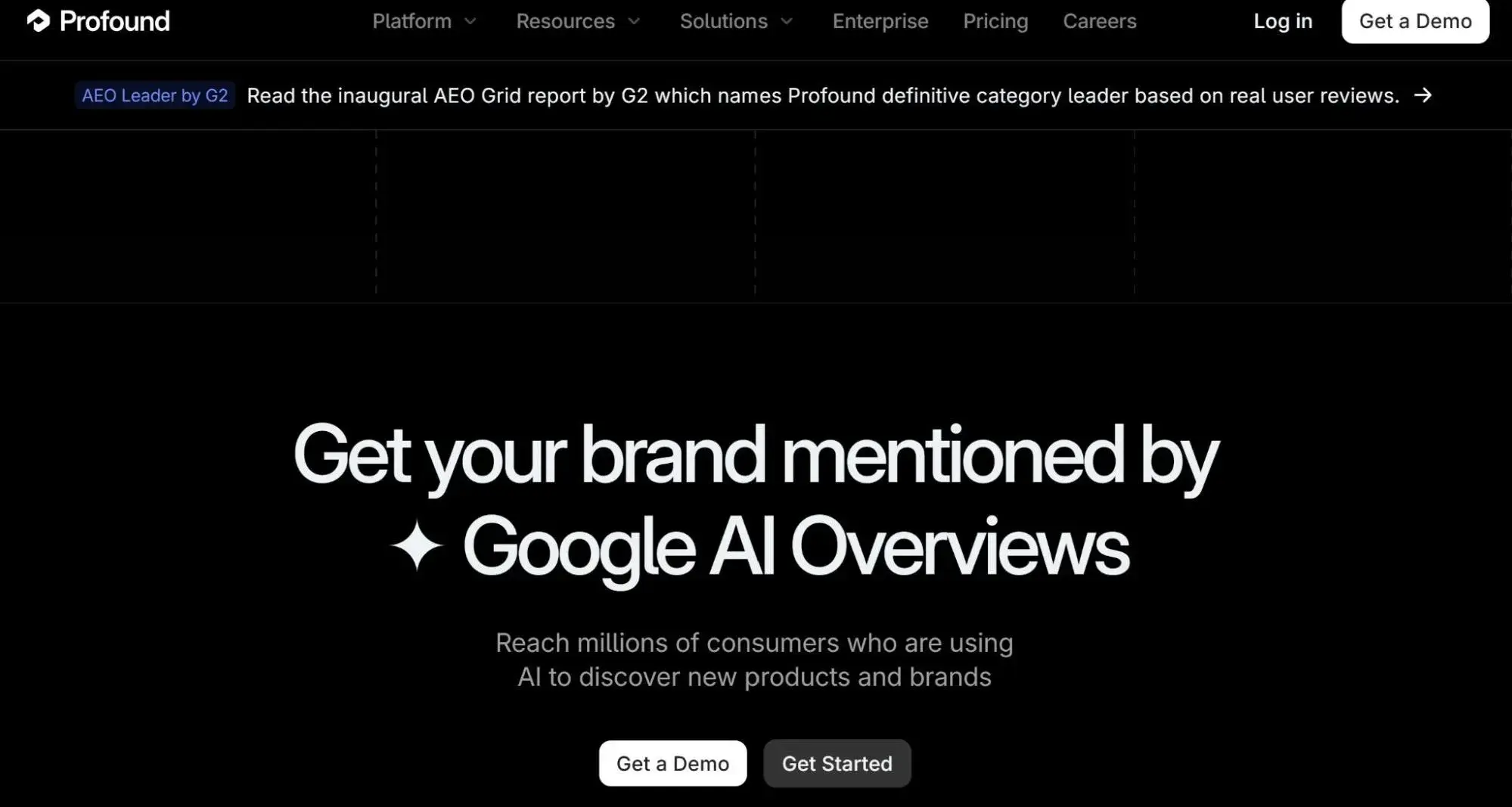
Scrunch’s Coverage: Scrunch tracks at least 7 platforms, including ChatGPT, Perplexity, Claude, Google AI Overviews, Copilot, Bing Chat, and You.com.
Winner for Coverage: Profound has a slight edge with a higher total count of AI engines monitored, which can be advantageous as newer platforms gain traction. Both cover the most significant engines driving current AI search volume.
Support, Security & Compliance
Profound’s Enterprise Readiness: Profound is SOC 2 Type II compliant, offers SSO support, and positions itself for Fortune 500 companies, emphasizing robust security and compliance measures. It provides dedicated CSM support for enterprise clients.
Scrunch’s Enterprise Readiness: Scrunch is also SOC 2 Type II compliant, ensuring a high level of data security. It offers role-based access control (RBAC) for granular permission management within complex team structures.
Winner for Enterprise Security: Both platforms meet stringent enterprise security requirements. Profound has a slight edge with explicit SSO support, while Scrunch offers more granular RBAC.
Conclusion: Which Tool is Right for Your Business?
Both Profound and Scrunch offer compelling solutions for the evolving AEO landscape, but their ideal users differ based on business needs, budget, and technical sophistication.
Choose Profound if:
- Content creation is a primary bottleneck, and you need to scale AI-optimized content production rapidly.
- Understanding AI search volume data ("Prompt Volumes") is critical for your content strategy.
- You are an e-commerce brand prioritizing optimization for AI shopping experiences.
- Your organization requires enterprise-level analytics, comprehensive brand sentiment tracking, and extensive data retention.
- You prefer a platform with a broad range of AI engine coverage.
Choose Scrunch if:
- Your existing content is strong, and your primary need is technical optimization to improve AI accessibility.
- Granular, real-time AI crawler monitoring and detailed technical error detection are essential.
- You require advanced citation analysis and competitive intelligence with context-rich insights.
- Your team has the technical capacity to leverage a robust Data API for deep CRM and BI integration.
- User experience and rapid onboarding are high priorities, especially for teams without dedicated AEO specialists.
- Budget is a significant consideration, as Scrunch offers more transparent pricing and a free trial.
The landscape of digital marketing is continuously shaped by technological advancements. As AI search engines become more integrated into daily life, mastering Answer Engine Optimization is no longer optional but a strategic imperative. Platforms like Profound and Scrunch are at the forefront of this evolution, providing the tools necessary for businesses to thrive in the AI-driven future of information discovery. The choice between them hinges on a clear understanding of your specific goals and operational capabilities.
About the Author