The digital marketing landscape underwent a fundamental transformation throughout 2022 as artificial intelligence moved from a niche experimental technology to a core component of the content creation workflow. As businesses faced increasing pressure to produce high volumes of search-engine-optimized (SEO) content, social media updates, and marketing copy, a new generation of AI-powered writing assistants emerged to bridge the gap between human creativity and algorithmic efficiency. These tools, largely built upon large language models such as OpenAI’s GPT-3, have redefined the economics of content production, allowing for the generation of thousands of words in a fraction of the time traditionally required by human writers.
The Evolution of Artificial Intelligence in Content Creation
The trajectory of AI in the creative sector began decades ago with simple rule-based grammar checkers, but the catalyst for the current revolution was the 2020 release of GPT-3. By 2022, the commercialization of this technology reached a fever pitch. Software developers integrated these neural networks into user-friendly interfaces, tailoring them for specific business needs such as blog writing, email marketing, and product descriptions.
The adoption of these tools is supported by significant market data. According to industry reports from 2022, the global artificial intelligence market was valued at approximately $136.55 billion, with a projected compound annual growth rate (CAGR) of 37.3% through 2030. In the marketing sector specifically, over 60% of marketers reported using some form of AI in their operations, citing "increased productivity" and "improved content relevance" as primary drivers for implementation.
Comprehensive Review of the Leading AI Content Generators of 2022
To navigate this rapidly expanding market, stakeholders have identified ten primary platforms that set the standard for performance, versatility, and cost-effectiveness during the 2022 calendar year.
1. Jasper AI (Formerly Jarvis)
Jasper AI established itself as the market leader in 2022, particularly for long-form content. The platform rebranded from Jarvis early in the year following trademark discussions with Disney, yet its market dominance remained unshaken. Jasper utilizes a proprietary blend of language models to identify the most effective sentence structures for specific mediums.
Key Features and Pricing:
Jasper’s "Boss Mode" became the industry standard for bloggers, offering a Google Docs-style editor that allows users to write long-form articles with AI assistance. At a price point of $99 per month for the premium tier, it targeted professional agencies and high-volume creators. The platform’s ability to integrate with SEO tools like SurferSEO provided a competitive edge for digital marketers focused on search rankings.
2. Copy.ai
Copy.ai focused its value proposition on the "blank page syndrome" that plagues many marketers. With over 90 templates, it specialized in short-form copy, including social media posts, digital ads, and email subject lines.
Functional Analysis:
The tool is built for speed and ease of use. Its "Pro Plan," priced at $49 per month (or $35 per month billed annually), offered unlimited runs, making it an attractive option for social media managers. In mid-2022, Copy.ai expanded its capabilities to include more robust blogging tools, signaling a shift toward more comprehensive content support.

3. Frase.io
Frase differentiated itself by merging AI writing with deep SEO research. Rather than just generating text, Frase analyzes the top-performing results on Search Engine Results Pages (SERPs) to create content briefs and optimize existing articles.
Strategic Utility:
Frase’s "Solo Plan" at $14.99 per month made it accessible to individual freelancers. The platform’s unique "SEO Add-on" ($35/month) provided data-backed insights into keyword density and competitor gaps, representing a more analytical approach to AI content generation compared to its competitors.
4. Article Forge
Article Forge operates on a different philosophical framework than Jasper or Copy.ai. While other tools act as "assistants" requiring human intervention, Article Forge aims for complete automation. By entering a single keyword, the tool generates a full article from scratch.
Performance Standards:
The software utilizes deep learning models to research and write articles in over seven languages. Pricing in 2022 was structured into a "Basic Plan" ($27/month for 25,000 words) and a "Standard Plan" ($57/month for 250,000 words). A key selling point for Article Forge was its guarantee that generated content would pass Copyscape plagiarism checks, addressing a major concern in the automated writing industry.
5. Rytr.me
Rytr emerged as the preferred choice for budget-conscious creators and students. Its streamlined interface and mobile-friendly design allowed for quick content generation on the go.
Economic Impact:
Rytr’s "Free Plan" allowed for 5,000 characters per month, providing a low-risk entry point for new users. Its "Saver Plan" ($9/month) and "Unlimited Plan" ($29/month) were among the most competitive in the industry, proving that high-quality AI assistance did not necessarily require a large financial investment.

6. Writesonic
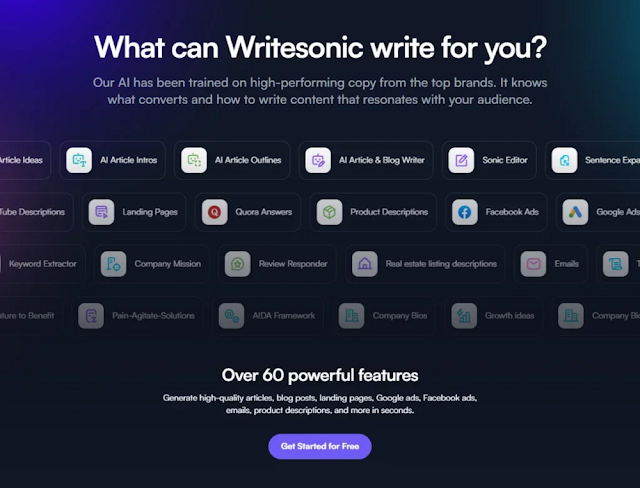
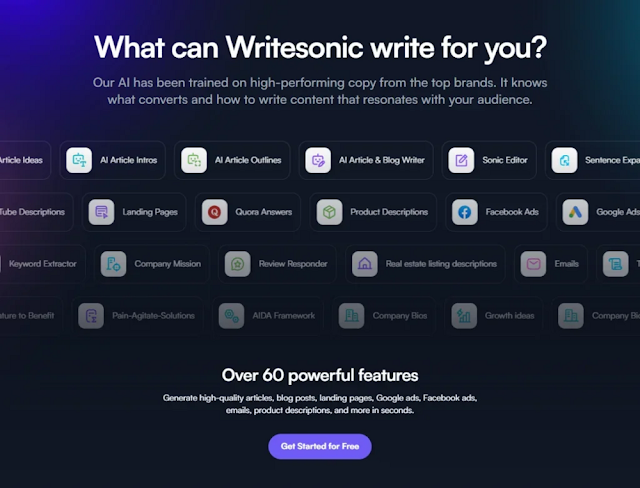
Writesonic gained traction by offering a specialized "AI Article Writer 3.0" that guided users through a step-by-step process: generating ideas, then an outline, and finally a full post.
Technical Features:
The platform includes a built-in grammar checker and readability analyzer. Its pricing model in 2022 was credit-based, with a "Short-form" plan starting at $15 per month and a "Long-form" plan at $19 per month. Writesonic’s focus on landing page copy and SEO-friendly descriptions made it a favorite for e-commerce entrepreneurs.
7. Copysmith
Copysmith was designed with teams and e-commerce enterprises in mind. It offers robust integrations with platforms like Shopify, Google Ads, and Frase.

Enterprise Focus:
The "Starter Plan" ($19/month) and "Professional Plan" ($59/month) provided tools for content rewriting and bulk generation. For large-scale operations, Copysmith’s "Enterprise" tier allowed for custom workflows, highlighting the tool’s scalability for corporate environments.
8. Hypotenuse.ai
Hypotenuse.ai carved out a niche in the e-commerce sector by focusing on high-quality product descriptions and blog posts that require a specific brand voice.
User Experience:
The platform’s "Starter Plan" ($29/month) and "Growth Plan" ($59/month) focused on reducing the time spent on repetitive catalog descriptions. Its ability to batch-process thousands of products simultaneously saved retailers hundreds of man-hours during peak shopping seasons.
9. Kafkai
Kafkai utilizes a unique niche-based training model. Unlike general-purpose AI, Kafkai was trained specifically on several dozen popular niches, such as health, finance, and technology.
Niche Optimization:
By operating on a per-article pricing model—ranging from $29/month for 100 articles to $199/month for 2,500 articles—Kafkai targeted SEO professionals who needed to populate private blog networks (PBNs) or niche-specific affiliate sites with unique content.
10. Peppertype.ai
Peppertype.ai, built on top of the Pepper Content ecosystem, focused on the quality of output over sheer quantity. It positioned itself as a virtual content assistant that understands the nuances of different industries.

Collaborative Tools:
With a "Personal Plan" at $35/month and a "Team Plan" at $199/month, Peppertype provided features like content audits and collaboration folders, aiming to be a central hub for marketing teams rather than just a text generator.
Industry Reactions and Ethical Considerations
The rapid proliferation of these tools in 2022 sparked a significant debate among search engines, creative professionals, and ethicists. In April 2022, Google’s Search Advocate John Mueller stated that content automatically generated with AI tools is considered "spam" according to the Webmaster Guidelines if its primary purpose is to manipulate search rankings. However, by late 2022, the conversation shifted toward "helpful content," with search engines focusing more on the value provided to the user rather than the method of production.
Professional writers expressed mixed reactions. While many adopted AI as a "co-pilot" to handle research and drafting, others raised concerns regarding the potential for mass-produced, low-quality content to saturate the internet. The consensus among industry leaders at the end of 2022 was that AI should be used to augment human intelligence rather than replace it entirely.

Broader Impact and Future Implications
The data from 2022 suggests that AI content generators have permanently altered the cost structure of digital marketing. The ability to produce a 1,000-word blog post for less than $1.00 in computing costs—compared to $50 to $200 for a human freelancer—has forced agencies to rethink their value propositions.
Looking forward, the integration of these tools into standard office software (such as Microsoft Word and Google Docs) appears inevitable. The focus is now shifting toward "Prompt Engineering," a new skill set where humans learn to effectively communicate with AI to achieve the desired creative output. As these models become more sophisticated, the distinction between human-written and AI-generated text will continue to blur, placing a premium on factual accuracy, unique personal insights, and editorial oversight.
In conclusion, the top 10 AI content generators of 2022 represent more than just a technological trend; they signify a shift toward a collaborative era of "augmented creativity." For businesses and creators, the challenge lies not in deciding whether to use AI, but in determining which tool best aligns with their specific operational goals and ethical standards. Jasper AI, Copy.ai, and their contemporaries have laid the groundwork for a future where the limitation of content production is no longer time or labor, but the quality of the ideas behind the prompt.
About the Author