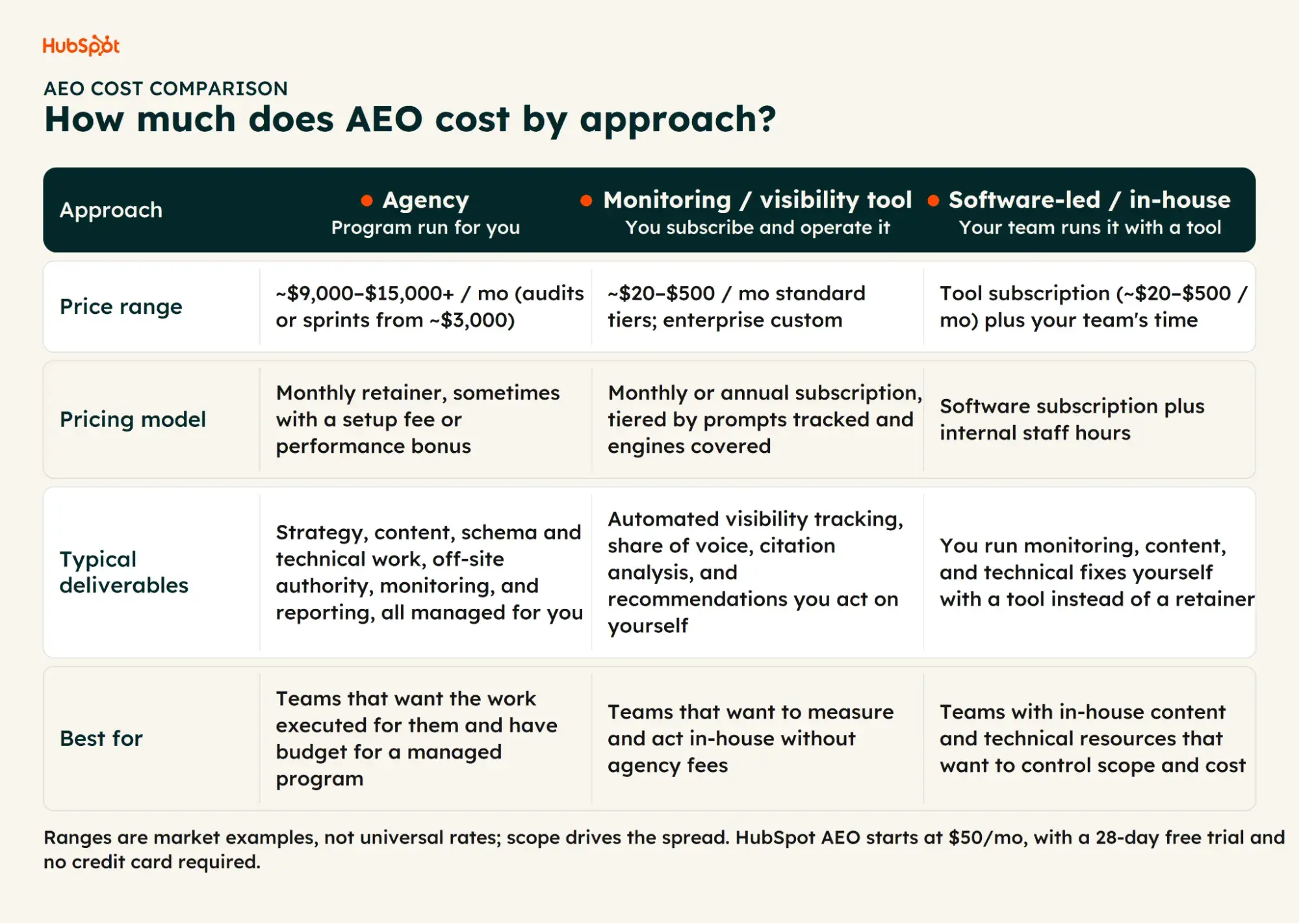
The burgeoning field of AI-Enabled Optimization (AEO) presents businesses with a dynamic new frontier for visibility and customer engagement. Understanding the financial investment required for effective AEO is crucial for strategic planning. Costs can range significantly, from approximately $30 per month for self-managed monitoring tools to upwards of $15,000 per month for comprehensive, full-service agency programs. This broad spectrum reflects the varying degrees of service, scope, and execution that businesses choose to implement, with a multitude of options available in between.
The primary determinant of where a business falls within this cost range is the extent to which they outsource or internalize AEO tasks. Simpler solutions, such as tools that solely monitor a brand’s visibility within AI-generated answers, represent the lower end of the investment spectrum. Conversely, programs that encompass strategic development, content creation, and off-site authority building command higher price points. Engaging a managed service that handles all facets of AEO positions a company at the upper echelon of expenditure. This comprehensive guide aims to demystify AEO costs by dissecting them based on approach, budget tier, and the realistic investment for a pilot program, enabling organizations to align their spending with their specific needs and objectives.
Understanding the Spectrum of AEO Costs: Agencies, Tools, and Software
The financial commitment to AEO varies considerably, from accessible monitoring tools priced in the tens of dollars monthly to high-end agency services costing thousands. For instance, HubSpot’s AEO monitoring tool is available for approximately $50 per month, offering a foundational level of visibility tracking. On the other end of the spectrum, agencies like RevenueZen offer comprehensive packages, such as their "Total Market" offering at $15,000 per month, which aims to manage all aspects of AEO. Custom agency packages can incur even greater costs, reflecting the tailored nature of the services provided.
The core principle governing AEO expenditure is the scope of work being procured. Businesses opting for basic visibility tracking in AI answers will incur lower costs. As the scope expands to include strategic planning, content production, and the crucial element of off-site authority building, the investment naturally increases. Engaging a full-service agency to manage these components positions a business at the highest end of the pricing scale. It is important for organizations to first understand their overall AI budget, including the costs associated with various AI models and tools, before allocating specific funds to AEO initiatives.
Most organizations evaluating AEO investments typically consider three primary approaches, each with distinct cost structures, billing models, and included services:
-
Agency Services: These engagements typically involve a one-time audit or a focused "sprint" starting around $3,000, with ongoing programs ranging from $9,000 to $15,000 or more per month. Payment is usually structured as a monthly retainer, sometimes accompanied by an initial audit or setup fee, or a hybrid model combining retainers with performance-based incentives. Services often include comprehensive strategy development, content creation and optimization, technical SEO elements like schema markup, off-site authority building through backlinks and citations, continuous monitoring, and detailed reporting, all managed by the agency. This option is best suited for teams that prefer to delegate execution and possess the financial capacity for a managed service.
-
Monitoring or Visibility Tools: These self-serve solutions typically range from $29 to $489 per month for standard tiers, with pricing often metered by the number of prompts analyzed and the AI engines covered. Enterprise plans are generally custom-quoted. Billing is usually on a monthly or annual subscription basis, tiered according to usage metrics. Included features typically involve automated tracking of brand appearance in AI answers, competitive share of voice analysis, citation tracking, and actionable recommendations that the user implements themselves. Examples include HubSpot AEO at $50/month for three engines, and Profound, which starts at $99/month for basic ChatGPT tracking, with multi-engine plans beginning at $399/month. Peec AI is another option, starting at $95 per month. This approach is ideal for teams aiming to measure and act on AEO insights internally without incurring agency fees.
-
Software-Led or In-House Execution: This model combines the cost of a software subscription (as described above) with the internal resources and time investment of a company’s team. The payment structure involves the software subscription alongside the allocation of internal staff hours dedicated to AEO tasks. The company undertakes monitoring, content creation, and technical optimization using the chosen tool. HubSpot’s AEO, for instance, is integrated into its Marketing Hub Professional and Enterprise tiers or can be purchased as a standalone product. This approach is most suitable for teams that possess in-house content and technical expertise and wish to maintain granular control over their AEO strategy and associated costs.
The significant price disparity across these options is largely attributable to the breadth and depth of the services offered, rather than a simple markup by the vendor. The following section delves into the specific factors that contribute to these variations in AEO pricing.
The Multifaceted Drivers of AEO Pricing Variability
The substantial range in AEO costs stems from the degree to which businesses engage in various aspects of the optimization process and the scale of their existing content libraries. Several key factors fundamentally influence these pricing models:
-
Scope of Work: The most significant driver of cost is the comprehensiveness of the AEO strategy implemented. A basic monitoring service will naturally be less expensive than a full-service package that includes content audits, strategic planning, content creation, technical optimization, and off-site link building.
-
Content Volume and Complexity: The number of content pieces that require optimization, the complexity of the topics they cover, and the need for new content creation all directly impact labor and resource costs. Larger content libraries necessitate more extensive analysis and ongoing management.
-
AI Engine Coverage: Different AI models and search engines (e.g., ChatGPT, Gemini, Perplexity) operate with unique algorithms and data sources. The number of engines a business wants to track and optimize for will influence the sophistication and cost of the monitoring tools and the breadth of the analysis.
-
Off-Site Authority Building: Establishing and maintaining off-site authority through citations, backlinks, and reputable mentions is a labor-intensive process. The extent to which this is pursued, including outreach, relationship building, and content syndication, significantly adds to the overall AEO investment.

-
Reporting and Analytics Depth: The level of detail and customization in reporting can also affect pricing. Businesses requiring in-depth, tailored analytics that connect AEO performance to broader business objectives will generally incur higher costs than those satisfied with standard reporting dashboards.
These fundamental drivers explain the wide financial spectrum observed in AEO services. The subsequent section will explore the various pricing models employed by AEO providers, offering clarity on how these costs are structured and billed.
Deconstructing AEO Pricing Models: Understanding the Invoices
The AEO support landscape is characterized by four primary pricing models, each offering a distinct value proposition and billing structure. Understanding these models is essential for accurately comparing quotes and ensuring that the chosen service aligns with a business’s investment strategy and expected outcomes.
-
Retainer-Based Pricing: This is a common model for agency services, where clients pay a fixed monthly fee for a defined set of services. The retainer covers ongoing work, strategic oversight, content management, and regular reporting. The scope of services included in the retainer can vary widely, from limited support to comprehensive management. This model offers predictability in budgeting but requires clear definition of deliverables to avoid scope creep.
-
Project-Based or One-Time Fees: This model is often used for initial AEO audits, strategy development, or specific campaign execution. Clients pay a one-time fee for a defined project with clear deliverables and a set timeline. This is useful for businesses that want to address specific AEO needs or test the waters before committing to an ongoing relationship.
-
Subscription-Based Software Tiers: Monitoring tools and software platforms typically employ a tiered subscription model. Pricing is based on factors such as the number of AI engines covered, the volume of prompts analyzed, the number of users, and the depth of features offered. Tiers often range from basic plans for smaller businesses to enterprise solutions for larger organizations. This model offers scalability and access to specific tools and features.
-
Performance-Based or Hybrid Models: Less common but increasingly seen, these models link a portion of the AEO investment to measurable results. This could involve a lower base retainer with performance bonuses tied to key metrics like increased AI citations or improved share of voice. Hybrid models might combine a base retainer with project-based fees for specific initiatives. This approach aligns provider and client incentives, focusing on tangible outcomes.
By comprehending these distinct pricing methodologies, businesses can more effectively evaluate proposals, negotiate terms, and select an AEO investment strategy that best suits their financial capacity and strategic objectives.
Navigating AEO Investment Tiers: What Your Budget Buys
AEO investment can be broadly categorized into three approximate spend tiers, each offering a different level of service and engagement. The primary differentiator between these tiers is the extent to which a business outsources the critical functions of content optimization, off-site authority building, and comprehensive reporting.
-
Lean Tier (Budget-Friendly): At this entry-level, businesses typically invest in monitoring tools and perhaps a one-time diagnostic audit. This tier focuses on understanding current AI visibility and identifying immediate opportunities. Costs can range from approximately $30 to $100 per month for monitoring software. The primary value lies in data acquisition and self-directed analysis. This tier is ideal for small teams with limited budgets or those in the initial stages of exploring AEO’s potential. It allows for measurement and initial insights without significant financial commitment.
-
Mid-Tier (Balanced Investment): This tier usually involves a combination of a robust monitoring tool subscription and some level of outsourced support for content optimization or technical SEO. The monthly cost might range from $200 to $2,000. This could include a more advanced software package and perhaps a retainer for a specialist agency to assist with specific content audits, schema implementation, or foundational off-site citation building. This tier offers a balance between cost control and expert assistance, enabling teams to leverage external expertise for critical tasks while managing day-to-day operations internally.
-
Comprehensive Tier (Full-Service Engagement): At the highest end, businesses opt for full-service agency programs, with monthly costs typically ranging from $9,000 to $15,000 or more. This tier encompasses end-to-end AEO management, including in-depth strategy, extensive content creation and optimization, advanced technical SEO, aggressive off-site authority building, and detailed performance reporting. This is best suited for organizations that want a complete, managed solution, freeing up internal resources to focus on core business operations.
It is important to note that AEO investment is most effective when it complements, rather than replaces, existing Search Engine Optimization (SEO) efforts. Understanding the nuances of SEO pricing and its synergy with AEO is crucial for a holistic digital marketing strategy.
AEO vs. SEO: Understanding the Synergies and Divergences
Before allocating significant budget to AEO, it is crucial for businesses to grasp the relationship between AEO and traditional SEO. While they share a common foundation, their objectives and measurement metrics diverge, necessitating a nuanced approach to budgeting and strategy.
At their core, both SEO and AEO rely on delivering clear, credible, and technically sound content to the right audience. However, their primary arenas of operation differ. SEO aims to secure high rankings within traditional search engine results pages (SERPs), driving organic traffic through links and providing measured outcomes like ranking improvements, click-through rates, and impressions. AEO, on the other hand, focuses on ensuring a brand’s presence and citation within AI-generated answers. Its success is measured by metrics such as brand mentions, share of voice among AI responses, and the number of authoritative citations.

The interplay between the two is significant. Pages that perform exceptionally well in traditional Google searches often become the authoritative sources that AI models cite in their generated answers, although this is not a guaranteed outcome. Consequently, diminishing SEO efforts to fund AEO initiatives could inadvertently weaken the very foundation that supports AI citations. Therefore, a strategic approach recognizes that AEO serves as a complementary discipline, enhancing brand visibility within AI conversational interfaces rather than superseding established search optimization practices.
The growing adoption of AI in information retrieval underscores the need for both. While AI-generated referrals have seen substantial growth, they still represent a small fraction of overall referral traffic, according to industry research. This overlap highlights the importance of maintaining a strong SEO presence, as it directly influences a brand’s credibility and inclusion in AI-generated content. It is also important to be aware that some vendors may conflate standard SEO services with AEO, which can be a red flag when evaluating pricing and service offerings.
Navigating AEO Pricing Pitfalls: Red Flags to Watch For
As AEO is a nascent field, standardization in pricing and service offerings is still evolving. This presents an opportunity for businesses to identify and avoid potential pitfalls. Awareness of common pricing red flags is crucial for making informed investment decisions.
-
Vague Deliverables and Unrealistic Guarantees: Be wary of proposals that promise "full optimization" or "guaranteed top rankings" without clearly defining the specific deliverables, timelines, and measurement criteria. A concrete statement of work should detail tracked prompts, engines covered, content production volume, technical work scope, and reporting cadence.
-
Lack of Transparency in Methodology: A reputable AEO provider should be able to clearly articulate their methodology for content analysis, citation building, and AI answer optimization. If their approach is opaque or relies on proprietary "secret sauce" without explanation, it warrants caution.
-
Bundling of Unrelated Services: Some providers may bundle AEO with unrelated services or attempt to pass off standard SEO tasks as AEO. Ensure that the services being offered are genuinely focused on AI-driven visibility and that the pricing accurately reflects the specialized nature of AEO.
-
Absence of Performance Metrics or Reporting: A key component of any AEO strategy is robust tracking and reporting. If a proposal lacks a clear plan for measuring key AEO metrics (brand mentions, share of voice, citations) or a defined reporting schedule, it indicates a potential lack of accountability.
-
Unreasonable Contract Terms: Be mindful of excessively long contract terms, particularly for new or unproven services. Many agencies require a minimum commitment, but understand the flexibility and exit clauses within the agreement.
By carefully scrutinizing proposals and seeking clarity on these points, businesses can better discern genuine AEO value from inflated or misleading offers, ensuring their investment is directed towards effective and measurable strategies.
Budgeting for a Focused AEO Pilot Program (60-90 Days)
To effectively gauge the impact of AEO on a brand’s visibility and business objectives before committing significant resources, a focused 60-to-90-day pilot program is an indispensable strategic step. This approach allows for a realistic assessment of AEO’s efficacy and builds a compelling business case for broader adoption. The key to a successful pilot lies in maintaining a lean, yet honest, scope that allows for trustworthy results within the specified timeframe.
Strategic Focus for the Pilot:
The pilot should be anchored in the leanest tier of AEO investment. This typically involves acquiring a monitoring subscription, which can range from the low tens to approximately $50 per month. Optionally, this can be augmented with a one-time diagnostic audit to provide a foundational understanding of the current landscape. It is advisable to defer extensive content production and off-site authority building during this initial phase. These are inherently long-term investments, and a two-to-three-month window is insufficient to yield meaningful, conclusive results for such efforts.
Prioritization for Small Teams:
For teams operating with limited resources, a structured prioritization is essential:
- Baseline Measurement: Establish a clear baseline of current AI visibility metrics in the first week. This involves identifying key performance indicators (KPIs) and capturing initial data points.
- Identify and Address Low-Hanging Fruit: Focus on quick wins and high-value opportunities identified through the initial audit or monitoring data. This might include optimizing existing content for specific AI prompts or addressing minor technical schema issues.
- Track Key Metrics: Continuously monitor brand mentions, competitive share of voice, and citation volume throughout the pilot.
Measurement and Analysis:
The success of an AEO pilot hinges on the accurate measurement of specific, relevant metrics. The core metrics to track include brand mentions within AI answers, the brand’s share of voice relative to key competitors, and the number of authoritative citations. It is crucial to establish a solid baseline in the first week of the pilot. Subsequently, these metrics should be compared against the baseline at the 60-day and 90-day marks. The focus should be on observing trends rather than relying on single snapshots, acknowledging that AI-generated results can exhibit variability between different prompt executions.
Budgetary Considerations for Small Teams:
Leveraging free trials can significantly mitigate costs during the initial validation phase. HubSpot AEO, for example, offers a 28-day free trial that tracks 25 prompts across major AI engines like ChatGPT, Gemini, and Perplexity without requiring credit card information. This trial period can effectively cover a substantial portion of the monitoring costs for a short pilot. With HubSpot AEO, businesses can gain comprehensive insights into their AI visibility, including brand mentions and citation trends, without the burden of enterprise-level pricing.
A three-month optimization pilot, utilizing HubSpot AEO at its standard rate of $50 per month (or $45 per month when billed annually), represents a total out-of-pocket expense of approximately $100 to $150. This provides continuous visibility into brand mentions and citation trends at a highly accessible price point. Should the pilot yield positive results, AEO can then be seamlessly integrated into the recurring SEO budget planning, moving beyond a standalone experimental initiative.
Integrating HubSpot AEO into the Cost Conversation
Once a pilot program demonstrates the tangible value of AEO, the recurring challenge for businesses becomes scaling their efforts and continuously measuring their impact. The critical questions revolve around how to effectively track brand visibility, identify competitive advantages in AI citations, and ultimately, demonstrate the return on investment (ROI) of AEO initiatives.
This is precisely where a software-led approach, such as HubSpot AEO, provides a robust solution. HubSpot AEO is designed to monitor a brand’s visibility across prominent AI platforms, including ChatGPT, Gemini, and Perplexity. It proactively flags instances where competitors gain citations that your brand is missing, thereby highlighting competitive gaps. Furthermore, the platform analyzes the domains and content types that AI engines frequently cite within a given industry. This analysis generates a prioritized list of actionable recommendations for businesses to implement. This measurement-first methodology mirrors the internal approach HubSpot employed to develop its own AEO capabilities, the details of which are documented in a comprehensive CRM AI-search case study.
HubSpot AEO is accessible as a standalone product for $50 per month. This offering includes essential features such as visibility tracking, citation analysis, competitor benchmarking, and the generation of prioritized recommendations. For businesses already utilizing HubSpot’s Marketing Hub Professional or Enterprise tiers, AEO is integrated at no additional cost. This integration allows for seamless connection of AEO recommendations with existing CRM data and content management tools, fostering a more cohesive and data-driven marketing strategy.
Frequently Asked Questions About AEO Costs and Implementation
Is AEO distinct from SEO, and are both necessary?
Yes, AEO and SEO serve different but complementary functions. SEO focuses on ranking web pages in traditional search engine results, while AEO aims to secure brand citations within AI-generated answers. Both rely on high-quality, structured content. Given that well-ranking pages often serve as sources for AI answers, diminishing SEO efforts in favor of AEO can be counterproductive. Most businesses benefit from pursuing both disciplines concurrently.
Can I manage AEO independently using only monitoring tools?
Partially. Monitoring tools are invaluable for identifying where a brand appears in AI answers and highlighting areas for improvement. However, they do not execute the necessary optimizations. Content creation, schema markup, and off-site citation building still require human intervention. Tools like HubSpot AEO provide analysis and recommendations, but the implementation of these recommendations typically falls to the business’s in-house team or an outsourced agency.
What is a realistic timeframe for observing AEO results?
Initial indicators of AEO success can typically be observed within 60 to 90 days. A focused pilot program may reveal improvements in visibility and share of voice. However, the full impact of content and off-site optimization efforts often takes longer to materialize. Due to the non-deterministic nature of AI answer engines, results can vary with each query. Therefore, tracking trends over time is more informative than relying on isolated data points.
What essential components should be included in an AEO statement of work (SOW)?
A comprehensive SOW should clearly define specific deliverables rather than making broad promises of "full optimization." Key elements to look for include the number of AI prompts to be tracked, the specific AI engines to be covered, the volume of content to be produced or revised, details of schema and entity work, any scope related to off-site authority building, and the frequency of reporting. It is also important to confirm the contract term length, as some agencies require a minimum commitment of three months.
How can small teams effectively budget for AEO?
For smaller teams, the most prudent approach is to start lean. Monitoring subscriptions typically range from tens to around $50 per month. A one-time diagnostic audit can also provide valuable initial insights. It is advisable to defer significant investments in high-volume content creation and extensive off-site initiatives until initial AEO efforts demonstrate positive traction. Prioritizing quick, high-value fixes based on baseline data is recommended. HubSpot AEO offers a 28-day free trial, tracking 25 prompts across ChatGPT, Gemini, and Perplexity at no cost, providing a valuable opportunity for initial validation.
About the Author