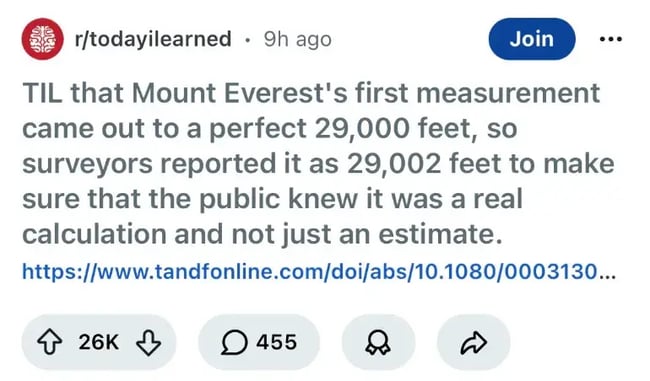
The seemingly minor addition of two feet to the official measurement of Mount Everest, elevating its height from a neat 29,000 feet to a specific 29,002 feet, was not an arbitrary decision by the British Royal Geographical Society. This seemingly small adjustment, made during the grand trigonometric survey of India in the mid-19th century, was a calculated move rooted in a sophisticated understanding of human psychology, a principle that continues to influence how we perceive accuracy and trustworthiness today. Far from being a simple rounding error, this detail highlights a fundamental human bias towards specific numbers, a phenomenon that has been repeatedly explored and validated by scientific studies across various domains, from charitable giving to high-stakes negotiations.
The Genesis of an Imprecise Precision: Surveying the Roof of the World
The monumental task of accurately measuring the world’s highest peak was undertaken as part of the Great Trigonometrical Survey of India, a project initiated by the East India Company in 1802 and continuing for decades. This ambitious undertaking aimed to map the Indian subcontinent with unprecedented accuracy, employing advanced surveying techniques of the era. The survey, which began in the early 19th century, involved a vast network of triangulation, meticulously calculating distances and angles across thousands of miles.
The team responsible for measuring Mount Everest, known then as Peak XV, faced immense logistical and technical challenges. Operating in remote and often treacherous Himalayan terrain, surveyors relied on instruments like theodolites, which were used to measure angles with remarkable precision. However, the sheer scale of the mountain, coupled with atmospheric distortions and the limitations of 19th-century technology, meant that measurements were inherently subject to a degree of uncertainty.
When the initial calculations for Peak XV were compiled, they consistently pointed towards an elevation of approximately 29,000 feet. However, according to historical accounts and the prevailing understanding of the time, the surveyors and the Royal Geographical Society recognized a crucial psychological element. A perfectly round number like 29,000 feet, while mathematically convenient, could easily be perceived as an approximation, a rounded figure lacking true scientific rigor. To counter this perception and imbue the measurement with a greater sense of accuracy and credibility, the decision was made to add two feet, settling on the official height of 29,002 feet. This strategic imprecision was, in essence, a deliberate act of precision signaling.

The "Pique Technique": Disrupting Mindless Refusal Through Specificity
The idea that specific, seemingly arbitrary numbers can elicit greater compliance or trust is not a modern marketing invention; it has a solid foundation in behavioral psychology. One of the most compelling demonstrations of this principle is the "pique technique," a persuasion strategy that hinges on disrupting habitual or "mindless" responses by presenting an unusual or specific request.
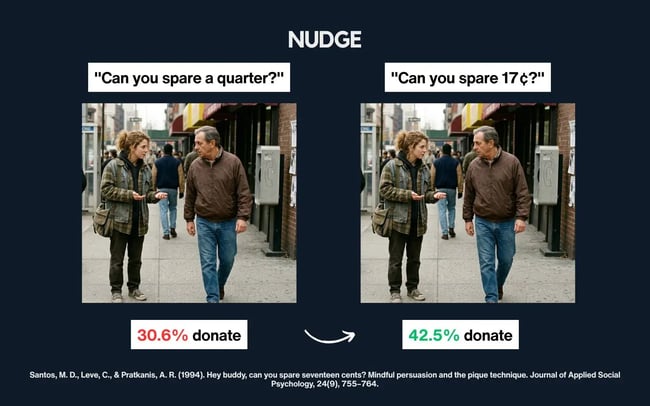
A seminal study in this area was conducted in 1994 by researchers Michael D. Santos, Craig Leve, and Anthony R. Pratkanis from the University of California, Santa Cruz, and published in the Journal of Applied Social Psychology. The researchers sought to test the pique technique by having actors approach 289 adults in public spaces and ask for monetary donations. The critical variable was the specificity of the request.
In one condition, the actors asked passersby, "Can you spare 17¢ (or 37¢)?" In the control group, the request was more general: "Can you spare a quarter (or any change)?" The findings were striking. Participants who were asked for a specific, odd amount of money were significantly more likely to comply and donate change than those who received a general request. The unusual specificity of "17 cents" or "37 cents" disrupted the automatic "no" response that people might otherwise give to a generic plea for money. This disruption forced individuals to pause, consider the request more deliberately, and in doing so, increased their inclination to help.
The researchers theorized that the odd, precise numbers acted as a cognitive disruptor. They deviated from the norm, prompting individuals to engage with the request on a more conscious level. This engagement, in turn, made them more receptive to the appeal. The implication is that the perceived effort behind such a specific request lends it an air of authenticity and legitimacy.
Extending the Principle: Time, Trust, and the 37-Second Survey
The efficacy of the pique technique in eliciting donations suggested that its principles might extend beyond monetary requests. This hypothesis was put to the test in a 2015 study by Nicolas Guéguen, a professor of behavioral sciences at the University of Southern Brittany in France. Published in Research Gate, this experiment investigated whether specific timeframes could similarly influence compliance in a non-monetary context.

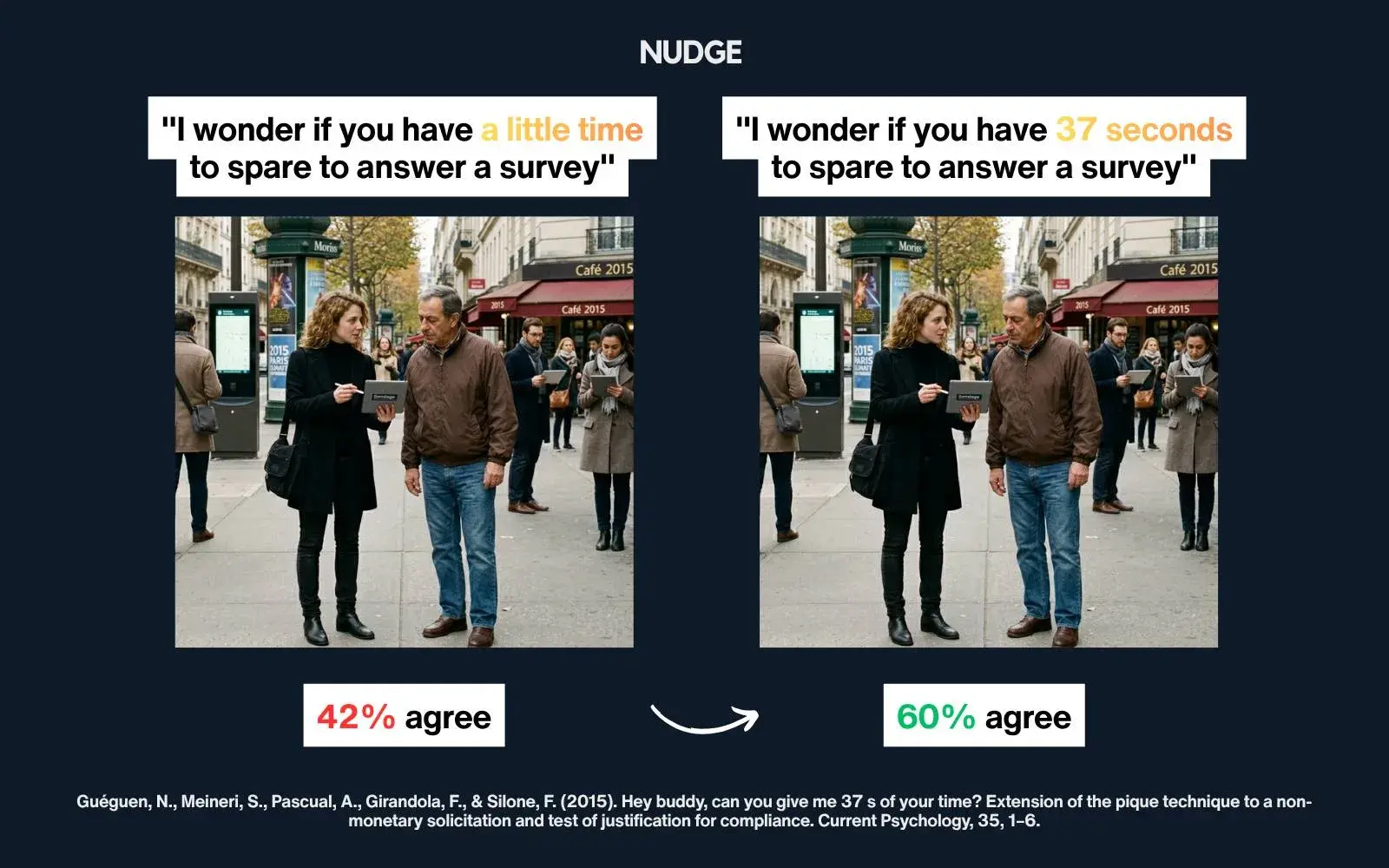
Guéguen and his colleagues recruited four female actors, uniformly dressed, to approach 300 individuals (150 men and 150 women) and ask them to complete a survey. Similar to the earlier study, the request was varied. One group was asked, "I wonder if you have a little time to spare to answer a survey." The other group was presented with a more precise timeframe: "I wonder if you have 37 seconds to spare to answer a survey."
The results mirrored the findings from the monetary donation study. Of the 150 people asked to spare "a little time," only 63 agreed to participate in the survey. However, when the request was for a specific "37 seconds," 90 individuals complied. This represented a substantial increase in compliance, with the specific request boosting participation by an impressive 42.9%.
This study provided robust evidence that the principle of specific numerical requests is not limited to financial solicitations. By framing the request in terms of a precise, albeit short, duration, the researchers leveraged the same psychological mechanism: disruption of mindless refusal and an enhanced perception of legitimacy. The unusual specificity of "37 seconds" made the request seem more considered and less burdensome, encouraging a greater willingness to engage.
The Psychology of Precision in Negotiations and Purchases
The impact of precise numbers on perceived trustworthiness and compliance extends into the realm of commerce and negotiation. A 2013 study published in the Journal of Experimental Social Psychology by researchers Daniel R. Horne, Jason M. Romero, and Steven R. Neely explored how precise pricing strategies influence negotiation outcomes.
In one of their experiments, hundreds of participants were tasked with negotiating the hypothetical sale of a used car. Buyers were instructed to initiate the negotiation with either a rounded price (e.g., $2,000) or a precise price (e.g., $1,865 or $2,135). The researchers then observed the subsequent counter-offers made by the sellers.
The findings indicated a significant difference in negotiation behavior based on the precision of the initial offer. When buyers presented a precise starting price, sellers tended to make smaller adjustments in their counter-offers compared to when the initial price was a round figure. The use of specific numbers, such as $1,865 or $2,135, lent the offer an appearance of careful calculation and justification. This perception of accuracy made the price seem more reasonable and less arbitrary, which, in turn, led to less aggressive haggling and ultimately, higher final selling prices for the car.
This phenomenon can be explained by the cognitive shortcut humans often take: specific numbers signal that a calculation has been performed, implying a level of research and consideration. A round number, conversely, can suggest an estimation or an arbitrary starting point. In a negotiation, this can translate into a perception of the offer’s validity. When a price appears well-researched and justified, it is perceived as more trustworthy, making it harder for the other party to dismiss it outright.
Broader Implications: Trust, Credibility, and the Art of Persuasion
The consistent findings across these diverse studies—from mountaineering surveys to charitable appeals and car negotiations—underscore a fundamental aspect of human cognition: we tend to believe specific numbers more than rounded ones. This is not necessarily because specific numbers are inherently more accurate, but because they appear to be.
Implications for Marketing and Communication:
- Enhanced Credibility: Marketers and communicators can leverage this principle to enhance the credibility of their claims. Instead of using vague statements, providing specific, even if seemingly minor, numerical details can make messages more persuasive. For instance, stating that a product "saves you over 20% energy" might be less impactful than "saves you precisely 22.7% energy."
- Increased Engagement: In fundraising or public service announcements, using specific figures can lead to higher response rates. A campaign asking for "$17.50" to feed a child for a week might be more effective than one asking for "$20."
- Negotiation Strategies: In business and personal negotiations, starting with a precise figure can anchor the discussion and influence the perceived value of an offer, potentially leading to more favorable outcomes.
The "Why" Behind the Bias:
The underlying reason for this bias likely stems from our evolutionary need to assess information critically. In a world where misinformation can have significant consequences, we develop heuristics or mental shortcuts to quickly evaluate the trustworthiness of claims. A precise number suggests that someone has taken the time to measure, calculate, or verify, implying a greater degree of accuracy and effort. Conversely, a round number can feel like a convenient guess or an oversimplification, raising subtle doubts about its veracity.
This psychological principle, the "precise number effect," highlights how seemingly minor details can profoundly influence perception and behavior. The enduring legacy of Mount Everest’s 29,002-foot elevation serves as a historical testament to this effect, demonstrating that even in the grandest endeavors, a nuanced understanding of human psychology can be as crucial as the scientific instruments employed. As marketers, communicators, and individuals navigating a world saturated with information, recognizing and applying this principle can lead to more effective persuasion and a greater ability to build trust. The two feet added to Everest’s height were not just numbers; they were a strategic investment in credibility, a lesson in the power of specificity that continues to resonate centuries later.
About the Author