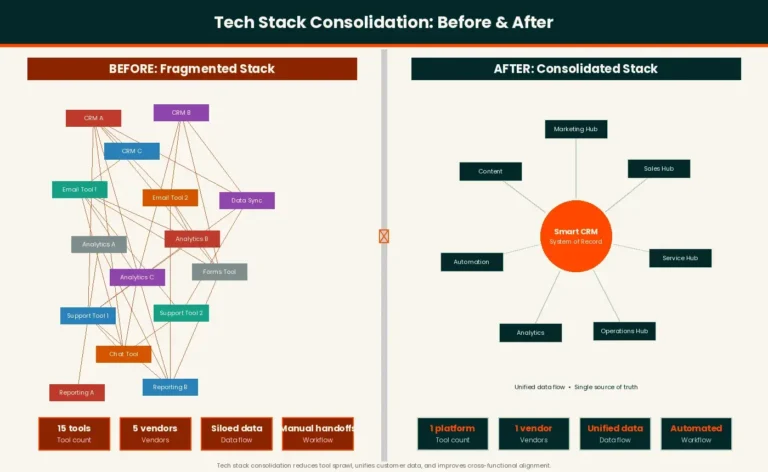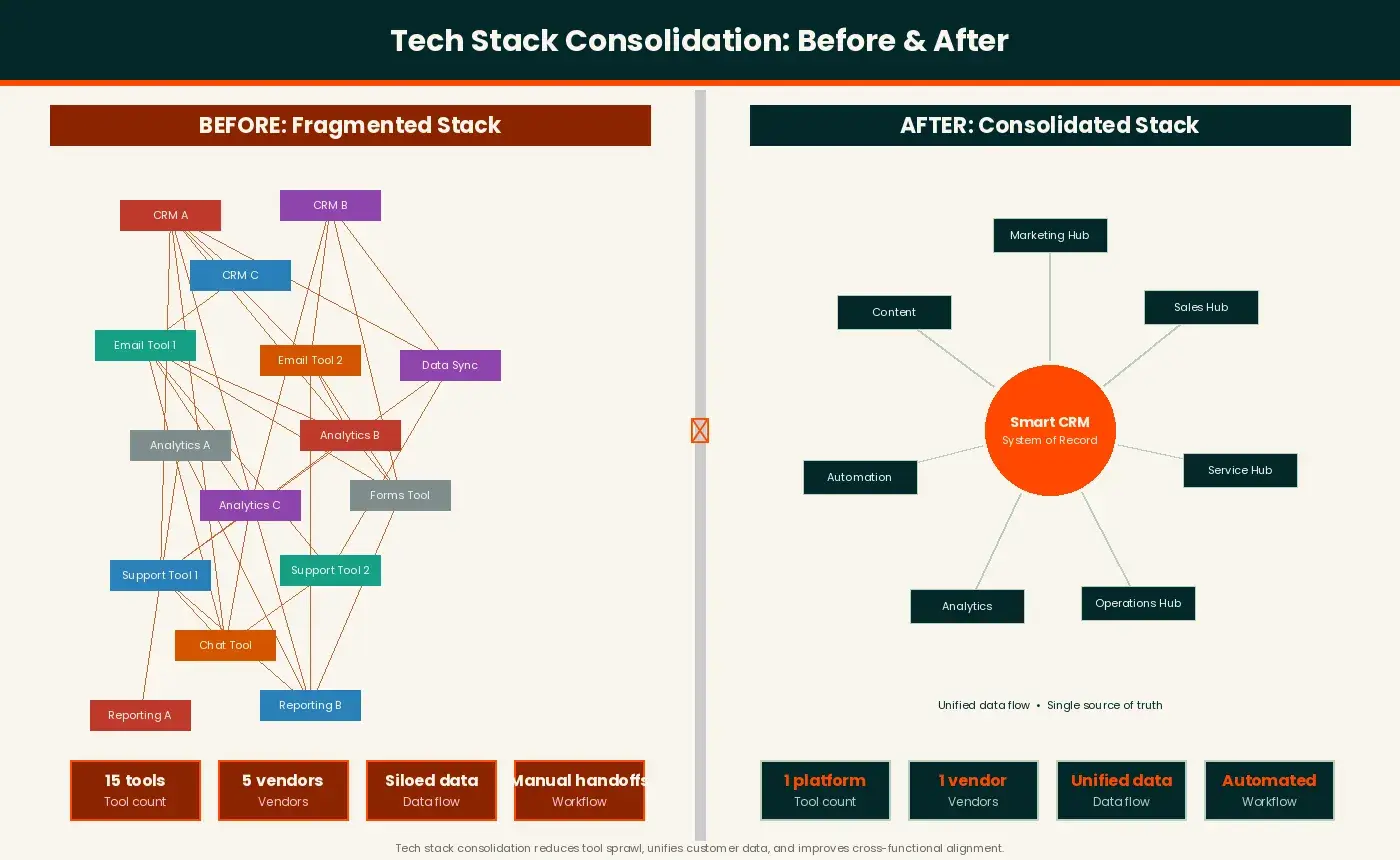
Tech stack consolidation, the strategic process of reducing the number of software tools an organization utilizes and standardizing operations on a more integrated, streamlined set of systems, is emerging as a critical initiative for businesses seeking to optimize efficiency and drive growth. Beyond the immediate appeal of cost savings, this approach offers a profound transformation in how data is managed, how teams collaborate, and ultimately, how effectively customer relationships are cultivated and maintained. The core principle lies in establishing a unified "system of record," typically a robust Customer Relationship Management (CRM) platform, which acts as the central repository for all customer data, powers automated workflows, and provides a single source of truth for every department that interacts with clients.
The imperative for tech stack consolidation stems from the pervasive issue of "tool sprawl," a phenomenon where organizations accumulate a multitude of often redundant or poorly integrated software applications. This not only leads to increased subscription costs but also fosters data silos, creates inefficiencies, and hinders a cohesive understanding of the customer journey. When data is fragmented across disparate systems, customer-facing teams struggle with inconsistent reporting, inefficient handoffs between marketing, sales, and service departments, and the constant, time-consuming effort of rebuilding context for each customer interaction.
The Business Case Beyond Cost Reduction
While the reduction of redundant software subscriptions is an undeniable financial benefit, the true value of tech stack consolidation lies in its operational and strategic advantages. When customer data resides in a single, accessible location, it empowers marketing teams to achieve more accurate attribution modeling by tracking every touchpoint across the entire funnel. Sales representatives gain a comprehensive view of prospect history, eliminating the need to toggle between multiple applications to understand a lead’s journey, thereby improving pipeline management and forecasting accuracy. Similarly, customer service agents can access complete customer profiles, including purchase history and past interactions, without leaving their primary support platform, leading to faster resolution times and a more seamless customer experience.
According to recent industry analyses, including reports from Gartner, software spending has continued to escalate even as organizations have increased the number of tools in their arsenal. This highlights a critical disconnect where increased investment is not necessarily translating into proportional gains in productivity or efficiency. The most significant returns from consolidation are realized not just through cost avoidance but by reinvesting the operational efficiencies gained – such as improved data accuracy, accelerated workflows, and reduced integration failures – into core business execution and innovation.
Identifying the Need for Consolidation
Several indicators signal that an organization may be ripe for tech stack consolidation. These include:
- High Software Spend with Questionable ROI: When the aggregate cost of software subscriptions appears disproportionately high relative to demonstrable business impact or when a significant portion of the budget is allocated to tools with low or unmeasured utilization.
- Data Silos and Inconsistent Reporting: Frequent discrepancies in customer data across different departments, leading to conflicting reports and a lack of a unified view of business performance.
- Inefficient Cross-Departmental Handoffs: Delays, misunderstandings, or a need for manual data re-entry when a customer moves between marketing, sales, or customer service functions.
- Significant Time Spent on Data Reconciliation: Employees dedicating substantial time to merging, cleaning, or verifying data from multiple sources rather than focusing on strategic tasks.
- Difficulty in Automating Customer Journeys: Challenges in creating end-to-end automated workflows that span the entire customer lifecycle due to fragmented data and disconnected systems.
- High Integration Costs or Frequent Integration Failures: Ongoing expenses and technical challenges associated with connecting disparate software applications, or a recurring pattern of integration breakdowns that disrupt operations.
- Proliferation of "Shadow IT": Departments independently acquiring and using software solutions without central IT oversight, leading to unmanaged subscriptions and security risks.
If three or more of these conditions are present, tech stack consolidation should be considered an essential operational improvement rather than a mere optional enhancement. The trigger for consolidation is not necessarily a specific number of tools, but rather the point at which the existing technology stack creates more friction and inefficiency than the value it provides.
A Phased Approach to Tech Stack Consolidation
Successfully implementing tech stack consolidation requires a structured, step-by-step approach, moving beyond simply canceling subscriptions to a fundamental re-evaluation and restructuring of the technology ecosystem.
Step 1: Comprehensive Audit of the Current Stack
The foundational step involves creating a complete inventory of every software tool currently in use, including those procured outside of central procurement channels ("shadow IT") and departmental purchases. For each tool, critical information must be documented, including:
- Purpose and Functionality: What specific business problem does this tool address?
- Ownership: Which department or individual is primarily responsible for its use and management?
- Cost: Annual subscription fees, implementation costs, and any associated maintenance expenses.
- Renewal Date: When does the contract expire?
- Utilization Metrics: How frequently is the tool used, and by how many users? Are licenses being fully utilized?
- Data Flows and Integrations: What data does this tool ingest and export, and how does it connect with other systems?
- Contractual Obligations: Any specific terms or limitations within the vendor agreement.
The key deliverable from this phase is a master tool inventory that provides a clear, centralized view of the organization’s entire technology footprint, including ownership, costs, renewal timelines, utilization rates, and interdependencies.
Step 2: Prioritize Categories and Identify Quick Wins
Once the inventory is compiled, tools should be grouped into logical categories (e.g., CRM, marketing automation, project management, HRIS, communication). Within these categories, the organization should identify:
- Redundant Tools: Applications that perform similar functions, allowing for the retirement of less effective or more costly options.
- Core System of Record Candidates: Tools that are best positioned to serve as the central hub for critical business data, such as customer information.
- Quick Wins: Tools that can be retired or consolidated with minimal disruption and immediate cost savings, building momentum and stakeholder buy-in for the larger initiative.
Focusing on quick wins can demonstrate tangible progress early on, freeing up budget and resources for more complex consolidation efforts.
Step 3: Define the System of Record and Data Standards
A critical decision point is to designate a primary "system of record" for key data domains, most notably customer data. This is typically a CRM system. Establishing a CRM as the system of record ensures:

- Unified Customer View: All interactions, from marketing engagement to sales opportunities and service requests, are logged in a single, accessible profile.
- Data Integrity: A single source of truth minimizes discrepancies and ensures all teams are working with the most up-to-date information.
- Workflow Automation: Enables seamless automation of processes across the entire customer lifecycle.
- Improved Reporting and Analytics: Facilitates accurate and comprehensive insights into customer behavior and business performance.
Alongside the system of record, establishing clear data standards is paramount. This includes defining consistent field naming conventions, standardized lifecycle stage definitions for customers and prospects, and robust deduplication rules. These standards are essential for maintaining data quality, ensuring predictable integrations, and preventing data degradation during migration processes.
Step 4: Select Tools for Retention and Retirement
Each remaining tool should be evaluated against a consistent set of criteria, including:
- Strategic Alignment: Does the tool support core business objectives and the defined system of record?
- Functionality and Fit: Does it meet essential business needs more effectively than alternative solutions?
- Integration Capabilities: How well does it integrate with the system of record and other critical tools?
- User Experience and Adoption: Is it intuitive and likely to be adopted by users?
- Vendor Viability and Support: Is the vendor financially stable and does it provide adequate support?
- Total Cost of Ownership (TCO): Beyond subscription fees, consider implementation, training, and maintenance costs.
Tools that do not meet these criteria should be slated for retirement. The evaluation should be driven by tangible business outcomes rather than perceived utility.
Step 5: Plan and Execute Migrations Strategically
Before retiring any tool, a detailed migration plan is essential to minimize disruption. This involves:
- Data Migration Strategy: Planning how data will be transferred from the retiring tool to the new or consolidated system, ensuring data integrity and completeness.
- Workflow Redesign: Adapting existing workflows to leverage the capabilities of the consolidated stack.
- User Training and Enablement: Providing comprehensive training to users on the new tools and processes.
- Phased Rollouts: Implementing changes in stages, perhaps by department or by specific use case, to identify and address issues early.
Step 6: Enable Teams and Measure Adoption
The success of consolidation hinges on user adoption. This requires:
- Ongoing Training and Support: Providing continuous learning opportunities and accessible support channels for users.
- Change Management Communications: Clearly communicating the benefits of the consolidated stack and addressing user concerns.
- Adoption Metrics: Tracking key performance indicators (KPIs) such as active user rates, feature utilization, and workflow completion rates to gauge successful adoption.
Measuring adoption should extend beyond simple login counts to encompass the impact on business outcomes, such as improvements in data completeness, increased automation trigger rates, and higher workflow completion success.
Step 7: Establish Governance to Prevent Re-Sprawl
To ensure the long-term success of consolidation and prevent the recurrence of tool sprawl, robust governance mechanisms are crucial. These include:
- Intake Process for New Software: Implementing a standardized process for evaluating and approving all new software requests, ensuring they align with the existing strategy and do not introduce redundancy.
- Category Ownership: Assigning clear owners to each software category responsible for managing renewals, reviewing utilization, and evaluating new solutions.
- Renewal Review Cadence: Establishing regular reviews of all software contracts, particularly around renewal periods, to assess ongoing necessity and utilization.
- Documented Standards and Policies: Maintaining readily accessible documentation of data standards, integration requirements, and approved vendor lists.
- Living Tool Inventory: Continuously updating the master tool inventory to reflect current usage, purchases, and retirements, serving as the baseline for future consolidation efforts.
Addressing Common Challenges and Implementing Solutions
The path to tech stack consolidation is not without its obstacles. Organizations frequently encounter:
-
Stakeholder Resistance: Teams may be reluctant to relinquish tools they have become accustomed to, often due to established workflows or perceived loss of functionality.
- Fix: Proactive communication, involving stakeholders in the decision-making process, demonstrating the benefits of the new system, and providing comprehensive training and support can mitigate resistance. Highlighting how the consolidation will empower them and improve their work can be effective.
-
Legacy Edge Cases: Certain tools may address highly specific, niche workflows that are not easily replicated in consolidated platforms.
- Fix: Carefully evaluate the true necessity and utilization of these edge-case tools. If they serve a genuine, high-impact purpose and integrate cleanly, they may be retained as deliberate exceptions. However, if the "edge case" represents low utilization or can be addressed with workarounds in the core platform, it may be more efficient to retire the specialized tool.
-
Integration Gaps: Unexpected complexities can arise when attempting to integrate systems, leading to the need for custom development.
- Fix: Thoroughly map data flows and integration dependencies during the audit phase. Prioritize platforms with robust APIs and a strong partner ecosystem. Clearly define integration requirements and budget for potential custom work, but strive to leverage native integrations where possible.
-
Contractual Timing: Decisions to retire a tool may conflict with existing contract renewal dates.
- Fix: Factor in contract renewal timelines when prioritizing consolidation efforts. While immediate retirement may not be feasible, plan for the transition as contracts approach their end. Negotiate early termination clauses where possible or explore options for early renewal of preferred tools.
-
"Dirty" Data Migration: Migrating poor-quality data into a new, clean system simply transfers the problem.
- Fix: Data cleansing and standardization should be a prerequisite to migration. Implement data validation rules and deduplication processes before transferring data to the new system of record.
-
Lack of Alignment with Procurement, Security, and Finance: Decisions made in isolation can create downstream issues with these critical departments.
- Fix: Involve procurement, security, and finance stakeholders from the outset. Their input is vital for contract negotiations, security compliance, and accurate financial forecasting.
Preventing SaaS Sprawl Post-Consolidation

The success of tech stack consolidation is measured not only by the initial streamlining but by the ability to prevent the return of SaaS sprawl. Key strategies include:
- Streamlined Intake Process: Implement a clear, mandatory process for evaluating all new software requests. This process should include a business case, cost justification, integration requirements, and a check for existing solutions.
- Defined Category Ownership: Assigning specific individuals or teams to oversee particular software categories ensures accountability for renewals, utilization reviews, and the evaluation of new solutions. This eliminates gaps where tools can proliferate unnoticed.
- Renewal-Based Review Cadence: Establish a regular cycle (e.g., quarterly) for reviewing software utilization against licensed seats, particularly for tools approaching their renewal dates. Flagging low-adoption tools can preempt unnecessary renewals.
- Accessible Documented Standards: Ensure that data standards, integration requirements, and approved vendor lists are not buried in obscure folders but are easily accessible and integrated into onboarding processes for relevant teams (e.g., IT, Operations, Marketing).
- Maintain a Living Tool Inventory: Treat the master tool inventory created during the audit phase as a dynamic document. Keep it updated with every new purchase and retirement. This inventory serves as a crucial governance record and a baseline for future optimization cycles.
Avoiding Common Tech Stack Consolidation Pitfalls
Several common mistakes can derail consolidation efforts:
- Focusing solely on cost reduction: Overlooking the strategic benefits of unified data and improved workflows.
- Skipping the audit phase: Rushing into tool selection without a clear understanding of the current landscape.
- Underestimating the complexity of data migration: Failing to allocate sufficient resources for data cleansing and migration.
- Neglecting user training and adoption: Assuming users will seamlessly transition to new tools without adequate support.
- Failing to establish governance: Allowing new tools to be adopted without a clear process, leading to re-sprawl.
- Not involving key stakeholders: Making decisions without input from IT, security, finance, and end-users.
A 90-Day Plan for Initiating Consolidation
A structured 90-day plan can provide a roadmap for initiating tech stack consolidation:
-
Days 1-30: Audit and Align:
- Week 1: Collect initial tool inventory data from finance, IT, and department heads.
- Weeks 1-2: Enrich the inventory with utilization, renewal dates, data flows, and owner information.
- Weeks 2-3: Map data flows and identify integration dependencies.
- Week 3: Present audit findings to leadership and align on consolidation goals.
- Week 4: Define a candidate for the system of record and establish initial data standards.
-
Days 31-60: Prioritize and Plan:
- Week 5: Score tools against defined criteria and identify initial quick wins.
- Week 6: Finalize the selection of the system of record and validate key integrations.
- Week 7: Develop a detailed migration plan for the first set of quick-win consolidations.
- Week 8: Communicate the consolidation plan to affected teams and set go-live dates.
-
Days 61-90: Execute Pilot and Govern:
- Week 9: Conduct a pilot migration for the first consolidated tool.
- Week 10: Train affected teams on the new workflows and tools.
- Week 11: Go live with the first tool retirement and begin tracking adoption metrics.
- Week 12: Establish formal governance processes, including the intake form, category owners, and review cadences.
Beyond the initial 90 days, consolidation efforts typically transition into ongoing review cycles to maintain efficiency and prevent the resurgence of tool sprawl.
Frequently Asked Questions About Tech Stack Consolidation
-
How long does tech stack consolidation take?
The duration can vary significantly, typically ranging from three to twelve months, depending on the size of the existing stack, the complexity of integrations, and the volume of data requiring migration. For organizations with extensive software portfolios or multiple business units, consolidation may occur in waves over 12-18 months. -
How do I avoid vendor lock-in during consolidation?
Prioritize platforms with open APIs and a well-established partner ecosystem. Avoid proprietary data formats and negotiate data portability terms into enterprise contracts. Maintaining a flexible integration layer between the system of record and other tools can also ensure each component remains replaceable. -
Can smaller teams benefit from consolidation?
Yes, smaller teams often experience even more immediate and impactful benefits. The overhead of managing multiple tools is proportionally higher for smaller organizations, making time savings and cleaner data particularly valuable. Consolidating onto platforms that natively cover multiple functions can eliminate the integration burden entirely. -
What metrics should be used to confirm consolidation is working?
Success should be measured across four key areas: Cost (total software spend and cost per user), Data Quality (record completeness, duplicate counts, standardization), Adoption (active users and feature utilization), and Business Outcomes (conversion rates, sales cycle velocity, customer satisfaction). Baselines should be established before migration and tracked at regular intervals post-implementation. -
How should edge-case tools be handled?
Edge-case tools should be retained if they address a genuine, high-utilization workflow and integrate cleanly with the system of record. Document these as deliberate exceptions. If an "edge case" is found to be low-utilization or can be replicated within the core platform, it is more efficient to retire the specialized tool and invest in a workaround.
The strategic imperative for tech stack consolidation is clear: to move beyond fragmented systems and cultivate a unified, efficient operational environment that drives better business outcomes. By adopting a structured approach, addressing potential challenges proactively, and establishing robust governance, organizations can unlock significant value, enhance customer relationships, and build a sustainable foundation for future growth.
About the Author