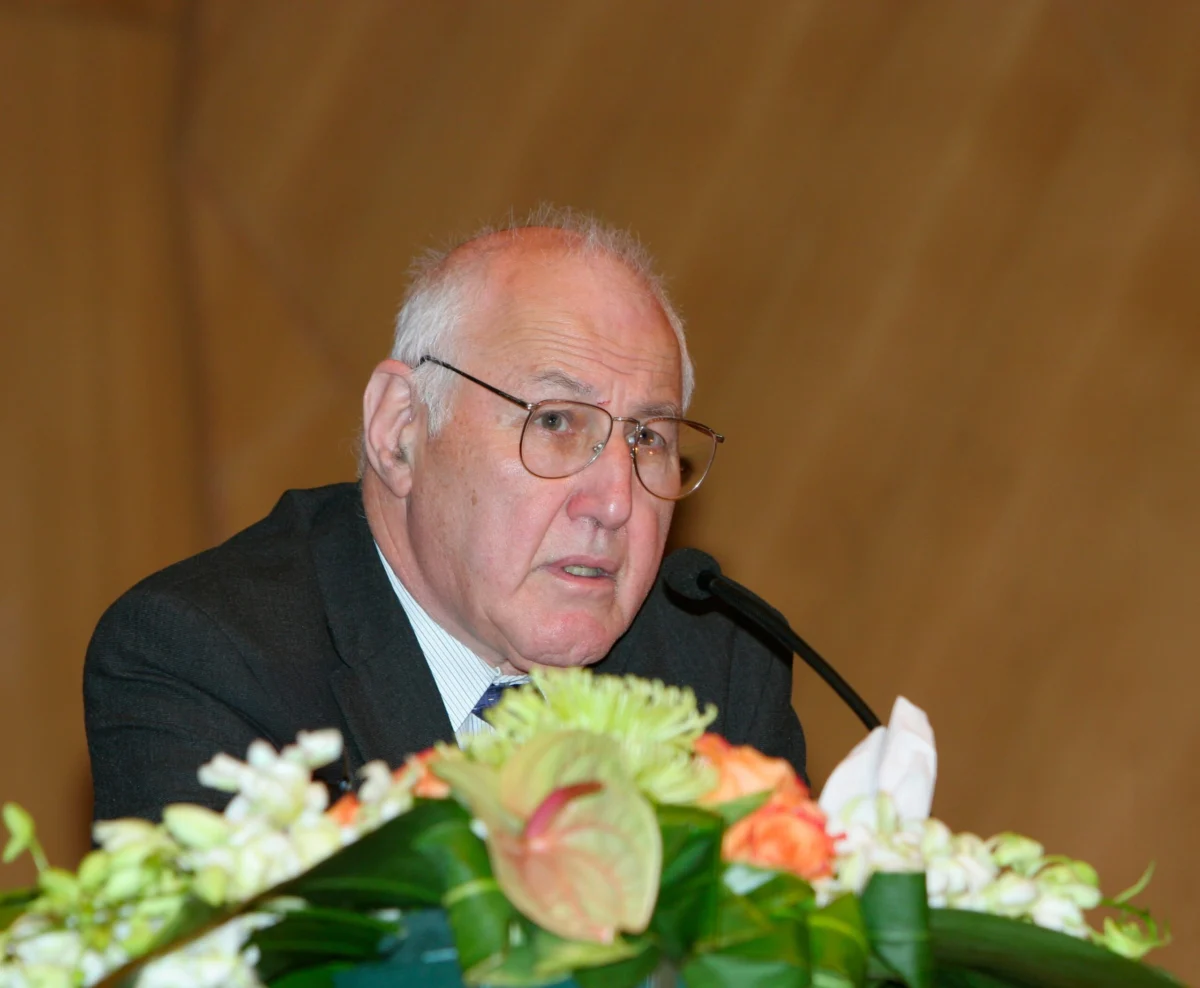
The international legal community and the global trade finance sector are mourning the loss of Sir Roy Goode, an Emeritus Professor of Law at the University of Oxford and a Fellow of the British Academy, whose work fundamentally reshaped the landscape of international commercial law. Recognised as one of the most influential legal minds of the 20th and 21st centuries, Sir Roy’s passing marks the end of an era for the International Chamber of Commerce (ICC), where he served with distinction for over three decades. His contributions were not merely academic; they provided the practical, structural framework upon which modern international trade and banking rules currently operate. As a scholar, practitioner, and mentor, Sir Roy Goode bridged the gap between complex legal theory and the pragmatic requirements of global commerce, ensuring that disparate legal systems could find a common language in the pursuit of economic stability and growth.
A Life Dedicated to the Harmonization of Global Trade
Sir Roy Goode’s career was defined by a singular pursuit: the harmonization of commercial law across international borders. In an era where global trade grew exponentially, the friction between different national legal systems often created significant barriers to entry for businesses. Sir Roy addressed these challenges by developing frameworks that prioritized "commercial common sense," a term frequently used by his colleagues to describe his ability to simplify complex disputes into workable, universal rules.
His influence was particularly profound within the ICC, the institutional representative of more than 45 million companies in over 100 countries. Sir Roy served as the Chair of the ICC Global Commercial Law and Practice Commission, where he oversaw the development of standards that govern billions of dollars in daily transactions. His leadership was instrumental in the ICC’s mission to promote international trade and investment while fostering a standardized legal environment. Beyond his chairship, he was a founding member of the ICC Task Force on Guarantees, a role that allowed him to directly influence the mechanisms of trade finance that sustain the global supply chain.
The Evolution of Demand Guarantees and URDG 758
Perhaps Sir Roy’s most enduring technical legacy lies in his work on demand guarantees. In international trade, a demand guarantee serves as a critical security instrument, ensuring that a seller or contractor fulfills their obligations. Sir Roy’s scholarship transformed these instruments from varied national practices into a cohesive global standard. He was the primary architect and author of the authoritative "Guide to the Uniform Rules for Demand Guarantees" (URDG 758).
Under his guidance, URDG 758 became the gold standard for demand guarantees worldwide. These rules are currently incorporated into hundreds of billions of dollars’ worth of trade contracts annually. Sir Roy famously described demand guarantees as "abstract payment undertakings," a definition that underscored their independence from the underlying commercial contract. This distinction is vital for the liquidity of international markets, as it ensures that payment is made upon the presentation of a complying demand, regardless of disputes regarding the performance of the primary contract. By codifying these principles, Sir Roy provided the legal certainty necessary for banks and corporations to engage in high-value cross-border projects, particularly in the construction and infrastructure sectors.
A Chronology of a Distinguished Career
Sir Roy Goode’s journey to the pinnacle of international law was marked by a series of landmark achievements that spanned over sixty years.
- 1933: Born in London, Royston Miles Goode began his journey into the law not in the ivory towers of academia, but as a practicing solicitor.
- 1971: After years in practice, he transitioned to academia, becoming a Professor of Law at Queen Mary College, University of London.
- 1980: Sir Roy founded the Centre for Commercial Law Studies (CCLS) at Queen Mary University of London. Today, the CCLS is one of the world’s leading institutions for commercial law research and postgraduate studies.
- 1982: He published the first edition of Commercial Law, a textbook that remains the definitive reference for students and practitioners alike.
- 1990: Sir Roy was appointed the Norton Rose Professor of English Law at the University of Oxford, a position he held until his retirement, after which he became Emeritus Professor.
- 2000s: His work with the ICC intensified, leading to the 2010 revision of the URDG (URDG 758), which saw immediate and widespread adoption by the World Bank and various national banking associations.
- International Recognition: Throughout his career, he was knighted for his services to academic law and received numerous honorary doctorates and awards from institutions across the globe.
Bridging the Gap Between Academia and Practice
What separated Sir Roy from many of his contemporaries was his dual identity as a world-class academic and a pragmatic legal reformer. He did not view law as a static set of rules to be studied in isolation, but as a dynamic tool for facilitating human enterprise. This perspective was evident in his involvement with UNIDROIT (the International Institute for the Unification of Private Law) and UNCITRAL (the United Nations Commission on International Trade Law).
Working with these organizations, Sir Roy was a key figure in the drafting of the Cape Town Convention on International Interests in Mobile Equipment. This treaty is widely regarded as one of the most successful international commercial law treaties in history. It created a standardized legal regime for the registration of interests in high-value mobile assets, such as aircraft, railway rolling stock, and space assets. By reducing the risks for lenders, the Cape Town Convention significantly lowered the cost of financing for airlines and transport companies globally, contributing billions of dollars in economic value to the global aviation industry.
Global Reactions and Tributes
The announcement of Sir Roy’s passing has prompted a wave of tributes from the highest levels of the legal and financial sectors. Tomasch Kubiak, ICC Policy Manager, emphasized Sir Roy’s personal qualities alongside his professional achievements. "Sir Roy will be remembered not only for his unparalleled expertise, but also for his generosity, intellectual rigor, and steadfast commitment to excellence," Kubiak stated. "His legacy will continue to shape ICC’s work and the global trade finance community for years to come."
Georges Affaki, Chair of the ICC Banking Commission Legal Committee and a long-time collaborator, described Sir Roy as a "towering legal mind." Affaki noted that for more than 35 years, they worked together on various international projects. "I never ceased to admire his gift for making all legal traditions speak the same language of commercial common sense," Affaki remarked. This sentiment reflects Sir Roy’s unique ability to find common ground between the Common Law and Civil Law traditions, a feat that few other jurists have managed so successfully.
Colleagues at the University of Oxford and Queen Mary University of London have also expressed their grief, noting that Sir Roy mentored generations of lawyers who now occupy senior positions in judiciaries, law firms, and international organizations. His teaching style was characterized by a demand for precision and a deep-seated belief that the law must serve the needs of the marketplace.
Analysis of Long-Term Impact on International Trade
The impact of Sir Roy Goode’s work can be quantified through the stability of the global trade finance market. Trade finance is the "oil" of global commerce, with the World Trade Organization (WTO) estimating that 80-90% of world trade relies on trade credit and guarantees. Without the clear, standardized rules that Sir Roy helped author, the risk premium on cross-border transactions would be significantly higher, particularly for emerging markets.
By providing the "Guide to the Uniform Rules for Demand Guarantees," Sir Roy reduced the incidence of litigation in international trade. The clarity of the URDG 758 rules means that parties from different countries and legal backgrounds have a clear roadmap for their obligations. This predictability is essential for the "abstract payment undertakings" that Sir Roy championed, as it prevents the "freeze" of funds during disputes, allowing the global economy to remain fluid.
Furthermore, his work on corporate insolvency law—specifically his seminal text Principles of Corporate Insolvency Law—provided a framework for how businesses could be restructured rather than simply liquidated. This has had a lasting effect on how modern insolvency regimes are designed, focusing on value preservation and the fair treatment of creditors.
Conclusion: A Legacy of Intellectual Rigor
Sir Roy Goode’s contribution to the world was not just in the books he wrote or the rules he drafted, but in the spirit of international cooperation he fostered. He believed that through the harmonization of law, nations could trade more effectively, thereby reducing conflict and promoting prosperity. His work at the ICC, UNIDROIT, and the University of Oxford created a foundation that will support the global economy for decades.
As the ICC extends its deepest condolences to Sir Roy’s family, friends, and colleagues, the organization also reaffirms its commitment to upholding the standards he spent his life building. Sir Roy Goode was a man who understood that while the world is divided by borders and languages, it is united by the common pursuit of commerce. By giving that pursuit a clear, fair, and rigorous legal framework, he became one of the true architects of the modern world. His passing is a significant loss, but his "commercial common sense" remains an indelible part of the fabric of international law.
About the Author