The International Chamber of Commerce (ICC) has announced the forthcoming release of its 2026 Global Trade Intelligence Report, a definitive benchmark for the global trade and supply chain finance industry. Built upon more than a decade of longitudinal data and backed by an unprecedented database of over $25.7 trillion in transactions, the report is poised to provide financial institutions, policymakers, and corporate treasurers with a granular view of the current risk landscape. This annual publication, which has evolved from the formerly known ICC Trade Register, remains the most comprehensive source of empirical evidence regarding the low-risk nature of trade finance assets, serving as a critical tool for regulatory advocacy and strategic institutional decision-making.
The Evolution of Trade Finance Intelligence
The 2026 report represents the culmination of a multi-year effort to modernize the way trade data is captured and analyzed. Originally established as the ICC Trade Register in the wake of the 2008 financial crisis, the initiative was born out of a necessity to demonstrate to global regulators—specifically the Basel Committee on Banking Supervision—that trade finance is a fundamentally safe and short-term asset class. Over the last 15 years, the project has expanded from a nascent data collection exercise into a sophisticated intelligence platform.
The transition to the "Global Trade Intelligence" branding reflects a broader scope that goes beyond mere default rates. While the core of the report remains its analysis of credit risk, the 2026 edition will integrate deeper insights into emerging market opportunities, supply chain resilience, and the impact of digitalization on transaction security. By leveraging data contributed by 22 of the world’s leading global member banks, the ICC provides a level of transparency that individual institutions cannot achieve in isolation.
Chronology of the ICC Trade Register and Intelligence Framework
The development of this intelligence framework has followed a rigorous timeline, marked by increasing collaboration between the private sector and international bodies:
- 2009–2011: The ICC launches the Trade Register Project to collect data on default and loss rates for trade finance products. The goal was to provide empirical evidence for the Basel II and III negotiations.
- 2015–2019: The project scales significantly, reaching over $10 trillion in observed transaction volume. The partnership with the Boston Consulting Group (BCG) and Global Credit Data (GCD) is solidified to ensure academic-grade data cleaning and analysis.
- 2020–2023: During the global pandemic, the Trade Register becomes a vital tool for monitoring the resilience of global supply chains. The data confirms that despite massive economic disruptions, trade finance default rates remained remarkably stable compared to other asset classes.
- 2024–2025: The ICC announces the rebranding to the Global Trade Intelligence Report, incorporating advanced analytics and a more user-friendly digital interface for member banks.
- 2026 (Forthcoming): The scheduled release of the most comprehensive report to date, featuring regional deep-dives and product-specific risk profiles.
Supporting Data: A 25.7 Trillion Dollar Foundation
The sheer scale of the data underpinning the 2026 report is its most significant feature. With $25.7 trillion in transactions analyzed over the past decade, the ICC has created a statistically significant map of global trade risk. This data is not merely historical; it provides a predictive look at how trade finance assets perform under various economic conditions.
Historically, the ICC’s findings have shown that the probability of default for trade finance products—such as Letters of Credit (LCs), Import/Export Loans, and Performance Bonds—is significantly lower than that of general corporate loans. For instance, previous iterations of the report have indicated that the transaction default rate for LCs often hovers below 0.1%, a figure that has been instrumental in convincing regulators to apply more favorable capital treatment to these instruments.
The 2026 report will continue to track these metrics across various categories, including:
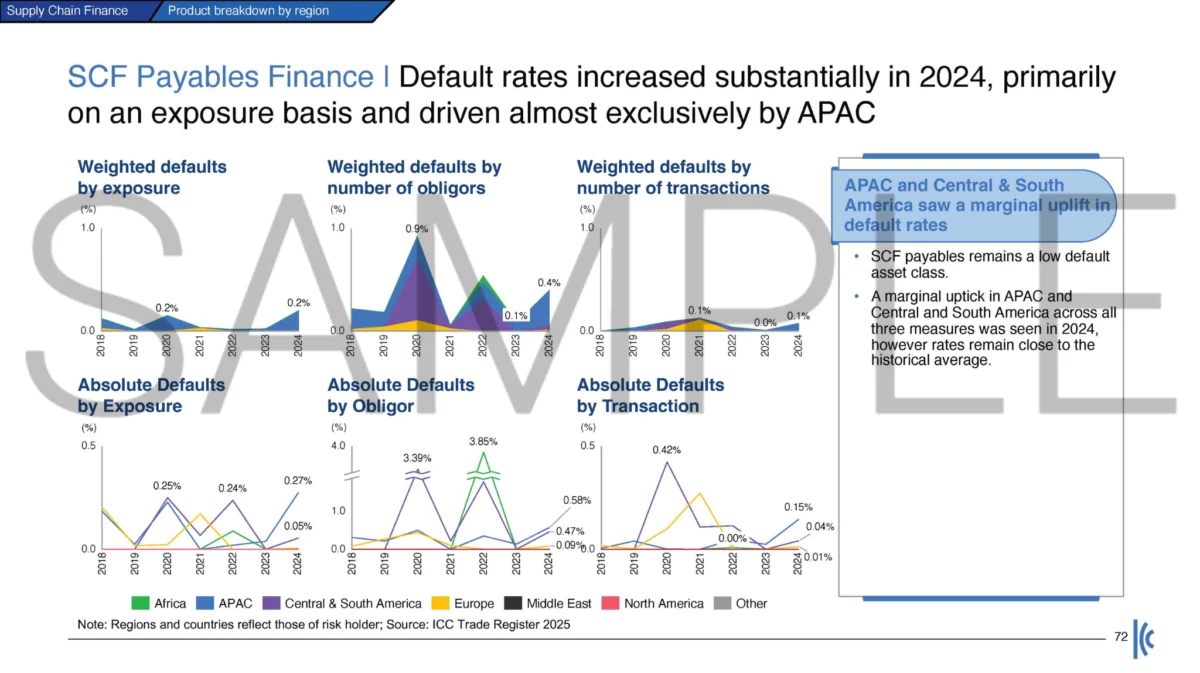
- Product Risk: Analyzing the variance between traditional trade finance (Documentary Credits, Guarantees) and Supply Chain Finance (SCF) products like payables discounting.
- Regional Risk: Examining how default rates fluctuate across Asia-Pacific, EMEA, and the Americas, particularly in emerging markets where the "trade finance gap" is most pronounced.
- Sectoral Risk: Identifying which industries—from commodities to high-tech manufacturing—exhibit the highest levels of resilience in their financing structures.
Strategic Partnerships and Methodology
The integrity of the ICC Global Trade Intelligence Report is maintained through a strategic partnership with the Boston Consulting Group (BCG) and Global Credit Data (GCD). This collaboration ensures that the data provided by the 22 member banks is anonymized, aggregated, and subjected to rigorous stress-testing.
Global Credit Data, a non-profit association owned by over 50 member banks, provides the methodology for calculating "Loss Given Default" (LGD) and "Probability of Default" (PD). This allows the report to meet the stringent requirements of the Internal Ratings-Based (IRB) approach used by major banks for capital adequacy reporting. BCG contributes its strategic consulting expertise to interpret the data, turning raw numbers into "actionable intelligence" that can guide a bank’s credit committee or a corporate CFO’s risk management strategy.
Official Responses and Industry Implications
While official statements regarding the specific findings of the 2026 report will be reserved for the launch, industry leaders have long signaled the importance of this initiative. Representatives from the ICC’s Banking Commission have frequently noted that without this data, the global trade finance gap—currently estimated by the Asian Development Bank to be around $2.5 trillion—would likely be much wider.
"The Global Trade Intelligence Report is more than just a document; it is a pillar of the global financial architecture," a senior trade finance executive from a member bank noted during a preliminary briefing. "It provides the objective proof we need to argue that trade finance is a safe, reliable, and essential component of the global economy. As we move into 2026, the inclusion of more regional and product-specific data will allow us to fine-tune our risk models and potentially expand credit to underserved markets."
For non-bank corporations, the report serves as a benchmark to compare their own trade finance costs and risks against global standards. It also offers a platform for visibility, as sponsorship opportunities allow corporations to align themselves with the leading voices in trade intelligence.
Broader Impact: Addressing the Trade Finance Gap
One of the most critical implications of the 2026 report is its role in narrowing the trade finance gap. Small and Medium-sized Enterprises (SMEs) are disproportionately affected by the lack of available trade credit, as banks often view them as higher-risk prospects. By providing granular data on default rates within the SME sector, the ICC hopes to encourage more banks to develop specialized trade finance programs for smaller businesses.
Furthermore, the 2026 report is expected to touch upon the burgeoning field of Sustainable Trade Finance. As ESG (Environmental, Social, and Governance) criteria become mandatory for many financial institutions, the ICC is working to incorporate metrics that track the risk performance of "green" trade loans versus traditional ones. This could pave the way for a new era of "Intelligence" where environmental impact is weighed alongside credit risk.
Access and Membership Structure
The ICC Global Trade Intelligence Report is a yearly publication, but its benefits extend year-round for the 22 member banks that contribute data. Membership in the ICC Trade Intelligence community provides institutions with:
- Early access to regional and product-specific data slices.
- The ability to benchmark their own portfolio’s performance against the global average.
- Participation in the technical committees that shape the report’s methodology.
- Direct access to experts from BCG and GCD for bespoke analysis.
The complete 2026 package will consist of a Global Overview Report, complemented by regional data analysis and product-specific reports. These components are designed to be tailored to different business needs, whether it is a regulatory compliance team looking for LGD data or a front-office trade head looking for growth opportunities in Southeast Asia or Sub-Saharan Africa.
Conclusion: A Roadmap for 2026 and Beyond
As the global economy faces headwinds from geopolitical tensions and shifting trade corridors, the ICC Global Trade Intelligence Report stands as a vital roadmap for navigating uncertainty. By grounding trade finance in hard data rather than perception, the ICC continues to champion the stability and necessity of the mechanisms that keep global goods moving.
The upcoming 2026 report will not only be a look back at a decade of performance but a forward-looking guide for the next generation of trade finance. With the integration of digital transaction data and a renewed focus on regional nuances, the report remains the "gold standard" for the industry, ensuring that institutions have the intelligence they need to act decisively in an ever-changing global market. Full access to the report will be made available through the ICC’s digital platform, with a formal launch event expected to draw representatives from the world’s largest financial institutions and regulatory bodies.
About the Author