The digital marketing and search landscape is undergoing a profound transformation, driven by the rapid integration of artificial intelligence into search engines and conversational AI platforms. This shift means that visibility, once primarily measured by traditional Search Engine Optimization (SEO) rankings, is now increasingly determined by how prominently a brand appears within AI-generated answers. An Answer Engine Optimization (AEO) checker serves as a critical tool for businesses to navigate this new terrain, ensuring their brand is not only found but also accurately represented in the synthesized responses provided by platforms like ChatGPT, Perplexity, and Google’s AI Overviews.
As consumers increasingly rely on AI chatbots and generative search features for quick answers, the traditional click-through model is being challenged. Users often receive a direct, comprehensive answer without needing to navigate to external websites. This phenomenon renders traditional search engine rankings insufficient for gauging brand visibility. An AEO checker addresses this by monitoring how often and how accurately a brand’s content is cited or mentioned within these AI-generated responses. It provides crucial insights into which queries surface a brand’s content, which ones favor competitors, and where AI engines might be misrepresenting a brand’s information. The effectiveness and methodology of these checkers can vary significantly, necessitating a clear understanding of their capabilities and how to best utilize them.
This guide delves into the core functions of an AEO checker, outlines practical methods for conducting manual checks across prominent AI platforms, and offers a comparative analysis of leading AEO tools to aid businesses in selecting the most suitable solution for adapting to this new era of search.
What is Answer Engine Optimization (AEO)?
Answer Engine Optimization (AEO) is the strategic practice of enhancing a brand’s presence and accuracy within the AI-generated answers delivered by conversational AI tools and generative search engines. This includes platforms such as ChatGPT, Perplexity, and Gemini, as well as Google’s AI Overviews, which was launched in May 2024. These "answer engines" function differently from traditional search engines by synthesizing information from multiple sources to provide a single, comprehensive answer, often resolving user queries before any links are clicked. This represents a significant shift in user search behavior, as detailed in broader discussions on generative engine optimization.
![AEO checker tools that measure answer engine visibility [2026]](https://53.fs1.hubspotusercontent-na1.net/hubfs/53/aeo-checker-1-20260903-3858273.webp)
AEO and SEO are not competing disciplines but rather complementary strategies addressing different facets of online visibility. While SEO focuses on improving a website’s ranking within a list of search results (links), AEO aims to ensure that a brand’s content is not only discoverable but also cited and accurately represented within the AI’s synthesized answer. Robust SEO practices remain foundational for AEO, as the crawlability, authority, and trustworthiness of a website’s content are key signals that AI engines rely on when selecting sources to cite. The content that AI engines prioritize for citation is typically well-structured, directly answers user questions, and supports its claims with verifiable primary sources.
The Functionality of an AEO Checker
An AEO checker is designed to quantify a brand’s visibility across various answer engines and translate this data into actionable recommendations for improvement. These tools typically perform several key functions:
- Visibility Measurement: They track how frequently a brand’s content is cited or mentioned in response to specific queries across different AI platforms.
- Competitive Analysis: They identify which competitors are appearing in AI answers for relevant queries, highlighting opportunities and threats.
- Accuracy Assessment: They flag instances where AI engines might misinterpret or misrepresent a brand’s information, ensuring factual integrity.
- Content Gap Identification: They pinpoint specific queries or topics where a brand is underrepresented or absent in AI answers, even when competitors are present.
- Prioritization of Actions: Based on the analysis, AEO checkers rank the most impactful areas for improvement, suggesting content updates, schema markup enhancements, or entity optimization strategies.
By providing this comprehensive diagnostic, an AEO checker empowers businesses to proactively manage their digital presence in an AI-driven search environment.
Manual AEO Checks: Navigating AI Overviews, ChatGPT, and Perplexity
While automated tools offer scalability, understanding the manual process of checking AEO provides valuable foundational knowledge.
Manual AEO Checks in Google AI Overviews
Google’s AI Overviews (AIOs) present a unique challenge as they are selectively displayed only when Google’s systems deem a summary to be "additive" beyond standard search results. This means AIOs do not appear for every query and can vary between search sessions.
![AEO checker tools that measure answer engine visibility [2026]](https://no-cache.hubspot.com/cta/default/53/9dd5e54b-fbef-4dd0-bc44-1689feb1ea18.png)
Step 1: Define Priority Queries
Compile a list of critical search terms, including brand names, branded product terms, and common informational questions your target audience asks.
Step 2: Conduct Live Searches
Perform searches using these queries in an incognito or signed-out browser session to simulate a neutral user experience. Observe whether an AI Overview appears. If it does, carefully examine the inline source links provided within the overview. Note whether your domain is cited, and record any specific claims made about your brand or offerings. It is crucial to sample across multiple sessions, as AIOs can fluctuate.
Step 3: Interpret and Analyze Results
Compare queries where AIOs appear and cite your brand against those where AIOs are present but cite competitors. The latter group represents your "content gap" list. Treat a single absence of your brand as a prompt to re-evaluate rather than definitive proof of lost visibility, given the dynamic nature of AIOs.
Step 4: Build a Reporting Framework
Document each result with the query, date, and location. This creates a verifiable record of your brand’s visibility. It’s important to note that Google Search Console’s standard performance reports currently roll AI Overview activity into the general "Web" search type, rather than isolating it. A dedicated generative AI performance report was introduced in June 2026, but it initially focused on impressions and had limited reach. Manual checks are effective for small query lists but become impractical at scale due to the volume and volatility of AIOs.
Manual Checks for ChatGPT and Perplexity Citations
Both ChatGPT and Perplexity provide mechanisms for citing their sources, making manual citation checks feasible.
![AEO checker tools that measure answer engine visibility [2026]](https://53.fs1.hubspotusercontent-na1.net/hubfs/53/aeo-checker-2-20260903-852936.webp)
Step 1: Execute Practical Citation Checks
Using your defined priority queries, interact with ChatGPT and Perplexity. For each query, verify two key aspects:
- Does your domain appear among the cited sources?
- Is your brand explicitly named within the answer text?
A citation and a direct mention are distinct forms of visibility, and both are valuable.
Step 2: Optimize Prompts for Retrieval
To ensure ChatGPT utilizes web search and provides inspectable sources, phrase prompts that clearly benefit from current information. Use direct, timely questions, such as "best [category] tools for [use case]," to encourage the engine to access live web data. Perplexity, by default, attaches citations to most answers and often displays a comprehensive list of sources in a side panel, facilitating easier review.
Step 3: Log and Actionable Insights
Record the engine, prompt, date, citation status, brand mentions, and any competitor appearances for each interaction. Given that sources can vary between queries and even sessions, running each prompt multiple times across fresh sessions is recommended. This log will highlight inconsistencies (e.g., being cited in one session but not another, or being cited by Perplexity but not ChatGPT). Each instance of absence or competitor presence should be converted into a task, such as refining content or improving its structure, followed by re-testing after updates are published.
Key Criteria for Selecting an AEO Checker Tool
As manual checks become cumbersome for larger datasets, investing in an AEO checking software is essential for continuous and automated monitoring. When evaluating these tools, consider the following criteria:
![AEO checker tools that measure answer engine visibility [2026]](https://53.fs1.hubspotusercontent-na1.net/hubfs/53/aeo-checker-3-20260903-8904553.webp)
- Breadth of Engine Coverage: Does the tool monitor visibility across the AI platforms most relevant to your audience (e.g., Google AI Overviews, ChatGPT, Perplexity, Gemini)?
- Citation and Mention Tracking: Can it accurately detect both direct citations (links to your domain) and brand mentions within AI-generated text?
- Competitive Benchmarking: Does it provide insights into competitor visibility within AI answers, enabling strategic comparisons?
- Actionable Recommendations: Does the tool offer prioritized suggestions for content optimization, technical improvements, or schema enhancements based on its findings?
- Data Granularity and Reporting: Does it offer detailed reporting with historical data, trend analysis, and the ability to segment by query, engine, or content type?
- Integration Capabilities: Can it integrate with your existing marketing stack (e.g., CRM, CMS) to streamline workflows and connect AEO performance to broader business objectives?
- Ease of Use and Interface: Is the platform intuitive and easy to navigate, providing clear visualizations of data?
- Scalability and Automation: Does it offer robust automation to handle a large volume of queries and monitor them continuously without manual intervention?
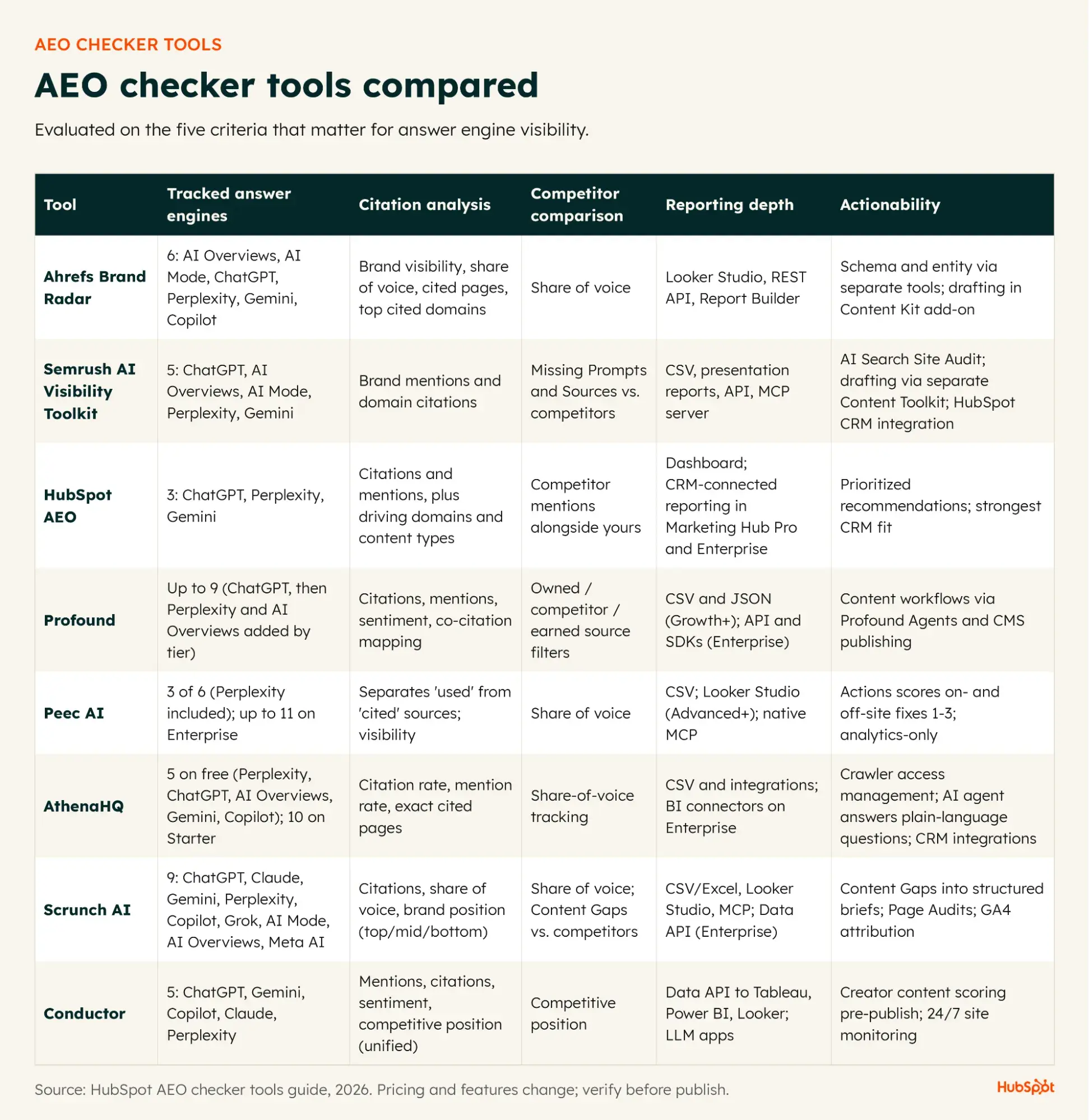
Leading AEO Checker Tools: A Comparative Overview
Several AEO checker tools are available, each offering distinct features and focusing on different aspects of AI visibility.
Tools with AI Overviews Tracking
- Ahrefs Brand Radar: Leverages real search queries rather than synthetic prompts for its AI Overviews index, offering a broad overview of AI visibility.
- Semrush AI Visibility Toolkit: Identifies which of your ranking keywords already trigger AI Overviews, allowing for strategic prioritization of content optimization efforts for near-inclusion pages.
Tools with ChatGPT Citation Detection
- HubSpot AEO: Tracks both citations and brand mentions across ChatGPT, Perplexity, and Gemini. It provides insights into the domains and content types driving visibility for both your brand and competitors. For users of Marketing Hub Professional and Enterprise, AEO integrates with the CRM, offering connected reporting.
- Profound: Extends beyond basic citation detection to analyze citation context, including sentiment scoring, flagging of uncited prompts, and a breakdown of citations by source type (owned, competitor, earned).
Tools with Perplexity Monitoring
- Peec AI: A specialized analytics tool that delivers clean and direct data specifically for Perplexity.
- AthenaHQ: Offers Perplexity monitoring across all its plans, including a free tier, and incorporates a conversational assistant for user interaction.
Tools for Schema and Entity Readiness
- Scrunch AI: Focuses on assessing whether AI crawlers can effectively access and render a website’s pages, ensuring technical readiness for AI consumption.
- Conductor: Combines continuous technical monitoring with a content scoring system designed to optimize for AI visibility.
Key AEO Metrics for Performance Tracking
Once an AEO checker is implemented, monitoring specific metrics is crucial for gauging progress and identifying trends:
- Citation Coverage: The percentage of relevant AI answers that cite your brand’s content.
- Mention Volume: The frequency with which your brand is named within AI-generated responses.
- Share of Voice (SOV) in AI: Your brand’s visibility in AI answers relative to competitors.
- AI-Referred Traffic: While challenging to track directly due to zero-click searches, some tools can attribute traffic that does originate from AI platforms.
- Brand Visibility Score: A composite score that reflects overall presence across AI engines.
- Competitive Discrepancy: The gap in visibility between your brand and key competitors.
These metrics should be viewed as trends over time. A consistent upward trajectory in citation coverage, mention volume, and SOV indicates successful AEO strategies. While direct attribution of zero-click searches is difficult, monitoring AI-referred traffic and observing potential lifts in branded search volume can serve as proxies for the impact of AI visibility.
From Measurement to Action: Integrating AEO with HubSpot
Many AEO checkers provide diagnostic insights, leaving the implementation of recommendations to the user. HubSpot aims to bridge this gap by integrating AEO monitoring with content creation and CRM functionalities, particularly within its Marketing Hub Professional and Enterprise tiers.
HubSpot AEO, available as a standalone product or as part of Marketing Hub, translates visibility data into prioritized recommendations. These recommendations guide users on what content to create or update, and where to focus their outreach efforts, along with the rationale behind each suggestion. The standalone HubSpot AEO product, priced at $50/month, includes tracking, prompt suggestions, citation analysis, and recommendations, but does not automate the implementation of fixes.
![AEO checker tools that measure answer engine visibility [2026]](https://53.fs1.hubspotusercontent-na1.net/hubfs/53/aeo-checker-4-20260903-6212698.webp)
With Marketing Hub Professional and Enterprise, users can act on recommendations directly within the HubSpot platform. The Content Agent feature, currently in public beta and utilizing HubSpot Credits, can generate a research-backed first draft of a blog post based on recommendations, tailored to the brand’s voice. This draft can then be refined within HubSpot’s content editor and published via Content Hub or Marketing Hub. The generation process is estimated to cost approximately $10 per blog post (1,000 credits).
Crucially, because this work is housed within the Smart CRM, traffic referred from AI tools is recorded as a distinct source, allowing for its connection to contacts and deals. This provides a holistic view of the marketing funnel. However, it’s important to acknowledge that AI engines often resolve queries without sending clicks. While HubSpot can attribute traffic from AI that does result in a click-through, visibility that doesn’t convert to a session will not directly register as pipeline. Therefore, visibility scores and referral revenue should be interpreted as related but distinct measures of impact. HubSpot AEO offers a practical pathway for businesses to move from manual measurement to continuous, automated AEO management.
Frequently Asked Questions About AEO Checkers
How often should you run an AEO check?
The frequency depends on the chosen method. For manual spot-checks, multiple sessions per query are recommended due to AI engine variability. Automated checkers can provide daily or weekly refreshes to capture this volatility, while monthly snapshots may miss short-term fluctuations.
Is AEO the same as AI search optimization?
While often used interchangeably, AEO is the more precise term. Answer Engine Optimization specifically refers to improving a brand’s presence in AI-generated answers from platforms like ChatGPT, Perplexity, and Gemini.
Can you reliably track citations in ChatGPT and Perplexity?
Yes, with caveats. Both platforms surface sources, making individual responses verifiable. However, the dynamic nature of AI means results can change between sessions. Reliability is achieved through repeated checks and pattern analysis rather than relying on single snapshots.
![AEO checker tools that measure answer engine visibility [2026]](https://53.fs1.hubspotusercontent-na1.net/hubfs/53/aeo-checker-5-20260903-8938354.webp)
Do AEO checkers replace traditional SEO tools?
No, they serve different purposes. AEO checkers focus on AI-generated answers and citations, while SEO tools monitor traditional rankings, keywords, and backlinks. Strong SEO remains fundamental for AI engines, so both types of tools should be used in conjunction.
About the Author