The way consumers find information online is undergoing a seismic shift, moving beyond traditional search engine results pages (SERPs) to embrace AI-powered answer engines. Tools like ChatGPT, Perplexity, and Google’s AI Overviews are now directly answering user queries, often bypassing the need for users to click through to external websites. This evolution necessitates a new strategic approach for businesses: Answer Engine Optimization (AEO). An AEO checker is a critical tool in this new era, designed to illuminate whether a brand’s content is being surfaced and accurately represented within these AI-generated answers. Without understanding this visibility, businesses risk seeing their hard-won search rankings vanish into an unseen AI response.
The core function of an AEO checker is to reveal which questions lead to a brand’s content being cited, which queries inadvertently boost competitors, and where AI engines might be misinterpreting or misrepresenting a brand. These tools operate through diverse methodologies, each offering a unique perspective on a brand’s AI-driven visibility. This comprehensive guide delves into the mechanics of AEO checkers, outlines manual methods for assessing visibility across leading AI platforms, and provides a comparative analysis of the top AEO tools available to help businesses adapt and thrive in this rapidly transforming digital landscape.
Understanding the Rise of Answer Engines and AEO
Answer Engine Optimization (AEO) is the strategic discipline focused on enhancing a brand’s presence and accuracy within the synthesized responses generated by AI-powered tools such as ChatGPT, Perplexity, and Gemini. This paradigm shift in search behavior was significantly amplified in May 2024 with Google’s introduction of AI Overviews, which aims to provide immediate, summary-style answers to user queries. Unlike traditional Search Engine Optimization (SEO), which focuses on ranking web pages in a list of links, AEO targets the brand’s appearance and citation within the AI-generated answer itself.
While distinct, AEO and SEO are not mutually exclusive; they are complementary forces. Robust SEO practices continue to provide the foundational crawlability and authority signals that answer engines rely upon when selecting and citing content. The content that answer engines favor for citation is typically well-structured, provides direct answers to user questions, and supports claims with verifiable primary sources. This means that a strong online presence, built through established SEO principles, remains a crucial prerequisite for success in the AEO landscape.
![AEO checker tools that measure answer engine visibility [2026]](https://53.fs1.hubspotusercontent-na1.net/hubfs/53/aeo-checker-1-20260903-3858273.webp)
The Functionality of an AEO Checker
An AEO checker serves as a diagnostic tool, quantifying a brand’s visibility across various answer engines and translating this data into actionable recommendations for improvement. Its primary functions include:
- Measuring Brand Visibility: Quantifying how often a brand’s content is cited or mentioned in AI-generated answers.
- Identifying Content Gaps: Pinpointing specific queries where competitors are being cited or mentioned, while the brand is not.
- Detecting Inaccuracies: Highlighting instances where AI engines misrepresent brand information or make erroneous claims.
- Assessing Competitor Performance: Benchmarking a brand’s AI visibility against key competitors.
- Providing Optimization Recommendations: Suggesting specific content updates, schema markups, or entity enhancements to improve AI citation and accuracy.
By analyzing these factors, an AEO checker helps prioritize optimization efforts, flagging the most impactful changes—whether content revisions, schema corrections, or entity improvements—that are likely to increase AI citations.
Manual AEO Checks: A Hands-On Approach
While automated tools offer scalability, understanding the manual process of checking AI visibility is fundamental. This hands-on approach provides valuable insights into how AI engines process information and cite sources.
Assessing Google AI Overviews
Google’s AI Overviews (AIOs) are designed to appear when the system determines a summary adds value beyond traditional links. Consequently, they do not trigger for every query and can vary between search sessions.
Step 1: Define Key Queries: Compile a list of critical search terms, including brand names, branded product terms, and questions commonly asked by potential buyers.
![AEO checker tools that measure answer engine visibility [2026]](https://no-cache.hubspot.com/cta/default/53/9dd5e54b-fbef-4dd0-bc44-1689feb1ea18.png)
Step 2: Conduct Manual Searches: Perform searches for these queries in an incognito or signed-out browser session. Note three key pieces of information for each query:
- Whether an AI Overview is generated.
- If your domain appears within the inline source links of the AI Overview.
- The precise claims made within the AI Overview.
Step 3: Analyze and Interpret Results: Compare queries where AIOs appear and cite your brand against those where AIOs are present but cite competitors. The latter group represents your "content gap" list. Due to the dynamic nature of AIOs, treat a single absence as a cue for re-checking rather than definitive proof of lost visibility.
Step 4: Document Findings: Screenshot each relevant result, ensuring the query, date, and location are clearly visible. This creates a verifiable record for before-and-after analysis. It’s important to note that Google Search Console’s standard performance reports do not isolate AI Overview activity, rolling it into the broader "Web" search type. While Google has introduced dedicated generative AI performance reports, these initially focused on impressions and reached only a subset of sites.
Pro Tip: Manual checks are feasible for a limited number of queries. However, the frequency with which AIOs change makes manual sampling unreliable for larger datasets. Automated AEO checkers offer a more scalable and consistent solution for monitoring AI Overviews.
Evaluating ChatGPT and Perplexity Citations
ChatGPT and Perplexity integrate citations directly within their responses, making manual checks more straightforward, though repetition is still key.
![AEO checker tools that measure answer engine visibility [2026]](https://53.fs1.hubspotusercontent-na1.net/hubfs/53/aeo-checker-2-20260903-852936.webp)
Step 1: Execute Practical Citation Checks: Using the defined branded and informational queries, assess two aspects for each answer:
- Does your domain appear among the cited sources?
- Is your brand name explicitly mentioned in the answer text?
A citation and a mention are distinct achievements in AEO.
Step 2: Refine Prompts for Retrieval: To ensure ChatGPT accesses current information, use direct, timely queries such as "best [category] tools for [use case]." This encourages the engine to leverage live web search results, which can then be inspected. Perplexity, by default, provides citations for nearly every answer, displaying them inline and in a dedicated "Sources" panel. ChatGPT also shows inline citations when web search is utilized, along with a "Sources" panel below the response.
Step 3: Log and Action Insights: Because sources can vary with each query, run prompts multiple times across fresh sessions. For each run, meticulously record the engine, prompt, date, whether your brand was cited or mentioned, and which competitors appeared. This log will reveal inconsistencies (e.g., being cited in one session but not another, or by Perplexity but not ChatGPT). Each absence or competitor mention should be translated into a specific optimization task, such as refining content or improving its structure, followed by a re-check after implementation.
Key Criteria for Selecting an AEO Checker
While manual checks offer foundational understanding, scaling these efforts requires specialized software. When evaluating AEO checking tools, consider the following criteria:
- AI Engine Coverage: Does the tool monitor the AI engines most relevant to your audience (e.g., ChatGPT, Perplexity, Gemini, Google AI Overviews)?
- Citation and Mention Tracking: Can it accurately detect both direct citations (links to your domain) and brand mentions (name recognition without a link)?
- Competitor Analysis: Does it provide insights into how competitors are performing in AI answer engines?
- Data Granularity: Does it offer detailed information on specific queries, content sources, and the types of answers generated?
- Actionable Recommendations: Does the tool provide clear, prioritized recommendations for improving AI visibility?
- Reporting and Analytics: Are the reports easy to understand and export, offering trend analysis over time?
- Integration Capabilities: Can it integrate with other marketing or CRM platforms for a holistic view?
- Scalability and Automation: Does it offer continuous, automated monitoring rather than requiring manual checks?
- Schema and Entity Analysis: Does it assess the readiness of your website’s structure and entities for AI crawling and comprehension?
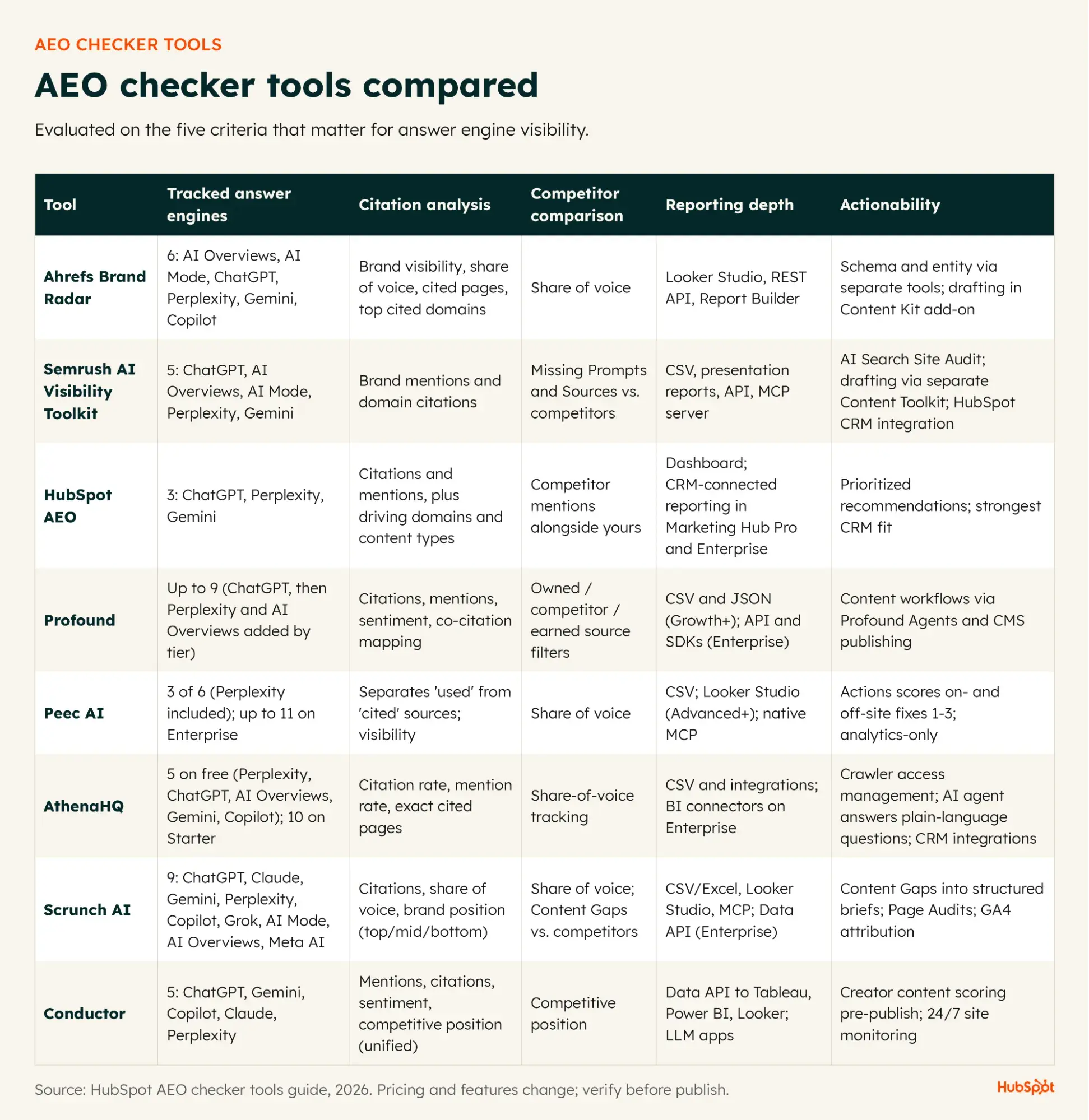
Leading AEO Checker Tools: A Comparative Overview
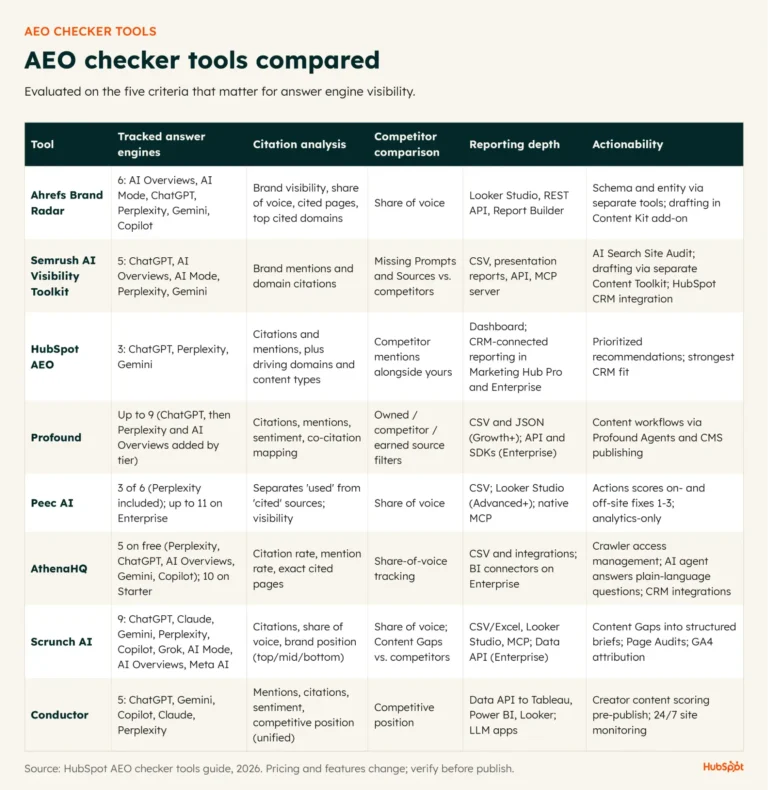
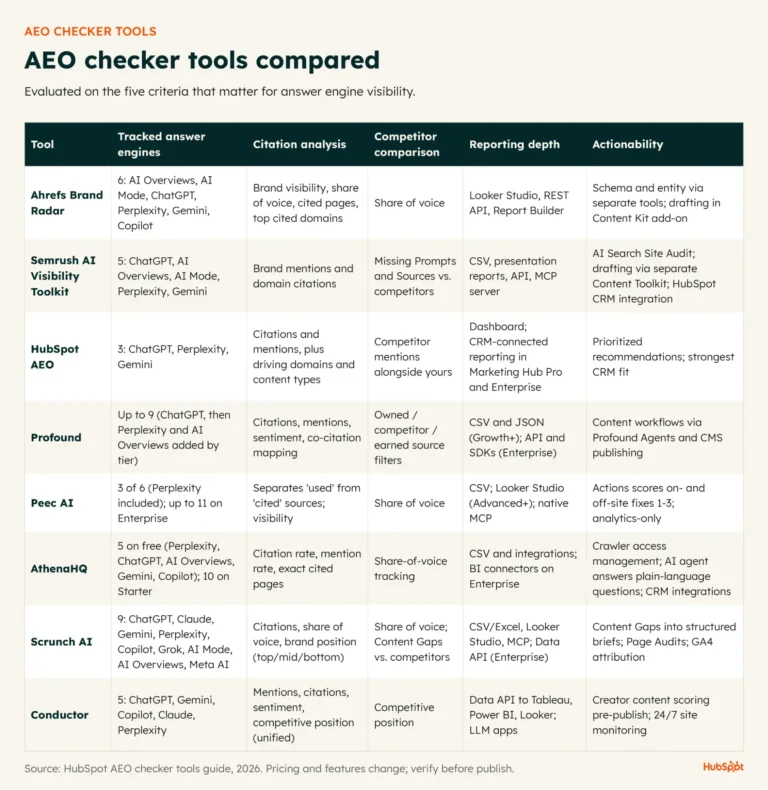
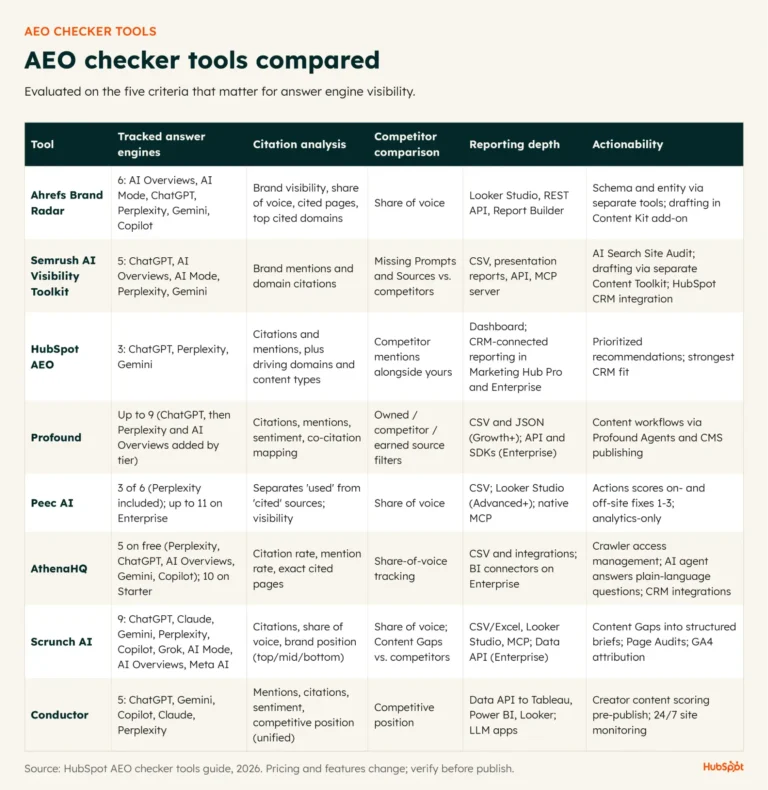
The market for AEO tools is evolving rapidly. Here’s a look at some prominent solutions, categorized by their primary strengths:
![AEO checker tools that measure answer engine visibility [2026]](https://53.fs1.hubspotusercontent-na1.net/hubfs/53/aeo-checker-3-20260903-8904553.webp)
Tools Featuring AI Overviews Tracking
- Ahrefs Brand Radar: This tool distinguishes itself by drawing on real search queries rather than synthetic prompts, offering a substantial index of AI Overviews. It provides insights into brand visibility and competitive landscape within Google’s AI-generated answers.
- Semrush AI Visibility Toolkit: Integrated within Semrush’s existing suite, this toolkit identifies ranking keywords that already trigger AI Overviews, enabling prioritization of content for optimization. It helps users understand which existing SEO efforts are poised to benefit from AEO strategies.
Tools Focusing on ChatGPT Citation Detection
- HubSpot AEO: HubSpot’s offering tracks both citations and brand mentions across ChatGPT, Perplexity, and Gemini. It provides a detailed breakdown of visibility drivers for both your brand and competitors. For users of Marketing Hub Professional and Enterprise, AEO integrates with the CRM, offering connected reporting on contacts and deals influenced by AI traffic.
- Profound: This tool extends beyond simple citation detection to analyze the context of citations. It offers sentiment scoring, flags uncited prompts, and provides a breakdown of citations by source type (owned, competitor, earned), offering deeper qualitative insights.
Tools for Perplexity Monitoring
- Peec AI: A specialized analytics tool, Peec AI focuses exclusively on delivering clean, precise data from Perplexity. It offers focused insights for brands prioritizing this particular AI search engine.
- AthenaHQ: Available across all plans, including a free tier, AthenaHQ monitors Perplexity and features a conversational assistant to help users navigate and interpret the data.
Tools for Schema and Entity Readiness
- Scrunch AI: This tool assesses the technical readiness of web pages for AI crawlers, ensuring that content is accessible and renderable by AI systems.
- Conductor: Conductor combines continuous technical monitoring with a content scoring mechanism, helping to ensure that content is not only discoverable but also optimized for AI comprehension.
Key AEO Metrics for Performance Tracking
Once an AEO checker is in place, monitoring specific metrics is crucial for gauging progress:
- Citation Coverage: The percentage of relevant queries where your brand is cited.
- Mention Volume: The frequency of your brand being named in AI answers, even without a direct link.
- Share of Voice: Your brand’s visibility compared to competitors within AI-generated responses.
- Accuracy Score: A measure of how accurately AI engines represent your brand and its offerings.
- Referral Traffic from AI: While challenging to track precisely due to zero-click scenarios, any attributed traffic provides a valuable proxy for AI influence.
These metrics should be viewed as trends over time. Consistent improvement in citation coverage and mention volume, alongside a reduction in inaccurate mentions, indicates successful AEO efforts. Tracking these alongside engagement and qualified traffic proxies helps to understand the indirect influence of AI visibility, which often resolves queries without a click-through.
Integrating AEO into Your Workflow: The HubSpot Example
The typical AEO checker identifies issues and leaves the implementation of fixes to the user. However, platforms like HubSpot are bridging this gap. HubSpot AEO, particularly within Marketing Hub Professional and Enterprise, integrates the diagnostic phase with the execution phase.
HubSpot AEO provides prioritized recommendations, guiding users on what content to create or update and why. On its own, HubSpot AEO offers tracking, prompt suggestions, and citation analysis. However, when integrated into Marketing Hub Professional or Enterprise, it unlocks advanced capabilities. The "Content Agent" feature, for example, can transform a blog recommendation into a research-backed draft in the brand’s voice with a single click. This draft then lands in HubSpot’s content editor for review and refinement before publishing through Content Hub or Marketing Hub. This generative capability, currently in public beta and utilizing HubSpot Credits, streamlines content creation significantly.
Crucially, this integrated workflow sits atop HubSpot’s Smart CRM. This allows for the attribution of AI-referred traffic to its proper source, connecting it to contacts and deals. This provides a holistic view of the marketing funnel. It’s important to acknowledge that answer engines often resolve queries without sending traffic. While HubSpot can attribute the traffic that does click through, the broader influence of AI visibility that doesn’t result in a session needs to be considered alongside pipeline metrics.
![AEO checker tools that measure answer engine visibility [2026]](https://53.fs1.hubspotusercontent-na1.net/hubfs/53/aeo-checker-4-20260903-6212698.webp)
Frequently Asked Questions About AEO Checkers
How often should you run an AEO check?
The frequency depends on the method. For manual checks, multiple sessions per query are necessary due to the variability of AI engine responses. Automated checkers can provide daily or weekly refreshes to capture this volatility, while monthly snapshots offer a broader trend view.
Is AEO the same as AI search optimization?
While often used interchangeably, AEO is more precise. It specifically refers to optimizing for AI-generated answers from tools like ChatGPT, Perplexity, and Gemini. AI search optimization is a broader term that encompasses various strategies within the AI-driven search ecosystem.
Can you reliably track citations in ChatGPT and Perplexity?
Yes, with a caveat of repetition. Both platforms surface sources, making individual responses auditable. However, results fluctuate between sessions. Reliability is achieved by running prompts multiple times and tracking patterns rather than relying on single snapshots.
Do AEO checkers replace traditional SEO tools?
No. They serve different but complementary purposes. SEO tools track rankings, keywords, and backlinks, while AEO checkers focus on AI citation and brand mentions. Strong SEO continues to be a prerequisite for AI visibility, making it essential to run both types of tools concurrently.
In conclusion, the advent of AI-powered answer engines marks a significant evolution in how consumers interact with information. Businesses that proactively embrace Answer Engine Optimization and leverage AEO checkers will be best positioned to maintain and grow their brand visibility in this dynamic and increasingly important digital frontier.
About the Author