The digital marketing world is undergoing a seismic shift, driven by the rapid ascent of artificial intelligence-powered answer engines. Platforms like ChatGPT, Perplexity, and Google’s Gemini are fundamentally altering how users seek information, moving away from traditional search engine results pages (SERPs) filled with links towards synthesized, direct answers. This evolution necessitates a new strategic approach to online visibility, giving rise to the practice of Answer Engine Optimization (AEO). An AEO checker is a crucial tool for businesses and marketers aiming to understand and adapt to this new paradigm, ensuring their brand is not only discoverable but also accurately represented within these AI-generated responses.
The core challenge for businesses is that visibility once achieved through robust Search Engine Optimization (SEO) can now evaporate into AI-generated answers. Users increasingly pose questions to these AI tools and act upon the provided response without ever clicking through to a website. This "zero-click" phenomenon means that a brand’s presence in search rankings may no longer translate into direct traffic or engagement. Consequently, marketers must now focus on whether their brand is mentioned, and their content is cited, within these AI-generated summaries.
An AEO checker serves as a vital diagnostic instrument in this evolving landscape. It helps identify which queries surface a brand’s content, which ones favor competitors, and where AI models might be misinterpreting or inaccurately representing a brand. The effectiveness of these checkers lies in their ability to measure this visibility across various AI platforms, each with its own methodology for sourcing and presenting information.
Understanding Answer Engine Optimization (AEO)
Answer Engine Optimization (AEO) is the strategic practice of enhancing a brand’s presence and accuracy within the AI-generated answers provided by conversational AI models and generative search experiences. This is distinct from, yet complementary to, traditional SEO, which focuses on ranking websites within a list of links. While SEO aims to get a page to appear in search results, AEO aims to ensure that when an AI synthesizes information to answer a query, it accurately references and potentially cites the brand’s content.
The shift towards AI-driven answers became particularly prominent with Google’s introduction of AI Overviews (formerly known as AI Generative Experience) in May 2024. This feature integrates AI-generated summaries directly at the top of search results for certain queries, offering a direct answer before users can explore traditional links. This move mirrors the behavior already established by standalone AI chat platforms.
![AEO checker tools that measure answer engine visibility [2026]](https://53.fs1.hubspotusercontent-na1.net/hubfs/53/aeo-checker-1-20260903-3858273.webp)
For content to be successfully cited by answer engines, it needs to be structured, authoritative, and verifiable. Clear organization, direct answers to user questions, and the backing of credible primary sources are key factors that AI models consider when selecting information to synthesize.
The Functionality of an AEO Checker
An AEO checker is designed to quantify a brand’s visibility within these answer engines and translate those insights into actionable optimization strategies. A comprehensive checker typically performs the following functions:
- Measures Brand Mentions: It tracks how often a brand’s name or related keywords appear within the AI-generated text of answers.
- Detects Content Citations: It identifies instances where the AI directly links to or attributes information to the brand’s website or content.
- Analyzes Competitor Presence: It reveals which competitors are being cited or mentioned for similar queries, highlighting competitive gaps.
- Identifies Inaccuracies: It flags instances where AI might be misrepresenting a brand, product, or service.
- Prioritizes Optimization Efforts: Based on the data, it helps users understand which issues are most critical to address, such as content updates, schema markup improvements, or entity disambiguation.
By providing this data, an AEO checker enables marketers to refine their content strategies, improve technical SEO elements that AI crawlers can parse, and ultimately adapt to the new landscape of digital information consumption.
Manual Checks: A Starting Point for AI Overviews
For businesses beginning their AEO journey, manual checks offer a foundational understanding of their visibility in platforms like Google AI Overviews. While automated tools are more scalable, manual methods provide direct, albeit time-consuming, insights.
Step 1: Defining Priority Queries
The process begins with identifying crucial search queries. This includes direct brand name searches, branded product terms, and informational questions that potential customers frequently ask.
![AEO checker tools that measure answer engine visibility [2026]](https://no-cache.hubspot.com/cta/default/53/9dd5e54b-fbef-4dd0-bc44-1689feb1ea18.png)
Step 2: Conducting Live Sessions
Each identified query should be entered into a search engine using an incognito or signed-out browser session. This ensures that personalized search history does not influence the results. The user then observes the search engine’s response, looking for the presence of an AI Overview.
Step 3: Analyzing AI Overview Results
When an AI Overview appears, the user meticulously examines its inline source links. The key questions are:
- Does an AI Overview appear for this query?
- Does the brand’s domain appear among the cited sources?
- What specific claims does the AI Overview make about the brand or topic?
It’s important to note that Google’s AI Overviews are not triggered for every query. Google states that they appear only when their systems determine the summary "adds something" beyond standard links. Furthermore, the content of AI Overviews can vary between search sessions, making it advisable to sample multiple runs of the same query to gauge consistency.
Step 4: Interpreting Findings and Identifying Gaps
The data collected from these manual checks is then analyzed. A critical comparison is made between queries that trigger an AI Overview and successfully cite the brand, versus those where an AI Overview appears but cites competitors instead. The latter group represents a significant "content gap," indicating areas where the brand’s content may be less visible or less preferred by the AI. It’s crucial to treat a single instance of absence as a prompt for re-evaluation rather than definitive proof of lost placement, given the dynamic nature of AI Overviews.
Step 5: Building a Reporting Framework
For accountability and future reference, each AI Overview result should be documented with screenshots. These records should include the query, date, and location of the search. This manual documentation is essential because tools like Google Search Console currently roll AI Overview activity into the broader "Web" search type, rather than providing a dedicated breakdown. While Google has introduced a generative AI performance report, it initially focused on impressions and was limited in its rollout.
Pro Tip for Manual Checks: While effective for a limited set of queries, manual checks are not scalable for comprehensive AEO monitoring. The volatility of AI Overviews makes manual sampling unreliable for large-scale analysis. This underscores the need for automated AEO checkers.
Manual Checks for ChatGPT and Perplexity
![AEO checker tools that measure answer engine visibility [2026]](https://53.fs1.hubspotusercontent-na1.net/hubfs/53/aeo-checker-2-20260903-852936.webp)
The process for evaluating visibility on platforms like ChatGPT and Perplexity involves examining their response structures for citations and mentions.
Step 1: Performing Practical Citation Checks
Using the same priority queries defined earlier, users query ChatGPT and Perplexity. The objective is to ascertain two key things:
- Does the brand’s domain appear in the list of cited sources?
- Is the brand name explicitly mentioned within the answer text itself?
A citation and a mention are distinct achievements, and both contribute to brand visibility.
Step 2: Crafting Effective Prompts
For ChatGPT, web search is not always initiated by default. The model relies on its training data unless a query necessitates current information or web browsing is manually enabled. To ensure access to live sources, prompts should be direct and query for current information, such as "best [category] tools for [specific use case]." This encourages the AI to retrieve data from the live web, which can then be inspected for citations.
Step 3: Logging and Actionable Insights
The sources used by AI models can vary significantly even for the same query. Therefore, it is essential to run each prompt multiple times across fresh sessions. For each run, meticulous records should be kept, including the AI engine used, the exact prompt, the date, whether the brand was cited or mentioned, and the presence of any competitors. This log helps identify inconsistencies (e.g., being cited in one session but not another, or by one platform but not a competitor). Each instance of absence or competitor presence presents an opportunity for optimization, prompting content or structural adjustments to the brand’s website, followed by re-testing.
Criteria for Selecting an AEO Checker Tool
As manual checks become impractical for scaling efforts, businesses need robust AEO checking software. The following criteria are essential when evaluating these tools:
- Automated and Continuous Monitoring: The tool should be capable of monitoring AI answer engine visibility automatically and consistently, rather than relying on manual spot-checks.
- Multi-Platform Support: It should track visibility across a range of relevant AI platforms, including Google AI Overviews, ChatGPT, Perplexity, and Gemini.
- Citation and Mention Tracking: The ability to differentiate between direct citations (links to your domain) and mentions (brand name appearing without a link) is crucial.
- Competitor Analysis: The tool should provide insights into competitor visibility, helping to benchmark performance and identify opportunities.
- Actionable Recommendations: Beyond reporting data, the best tools offer prioritized recommendations for improvement, such as content updates, schema enhancements, or entity optimization.
- Historical Data and Trend Analysis: The ability to track visibility over time and identify trends is essential for measuring the impact of optimization efforts.
- Integration Capabilities: For seamless workflow, integration with existing marketing stacks, such as CRMs, is highly valuable.
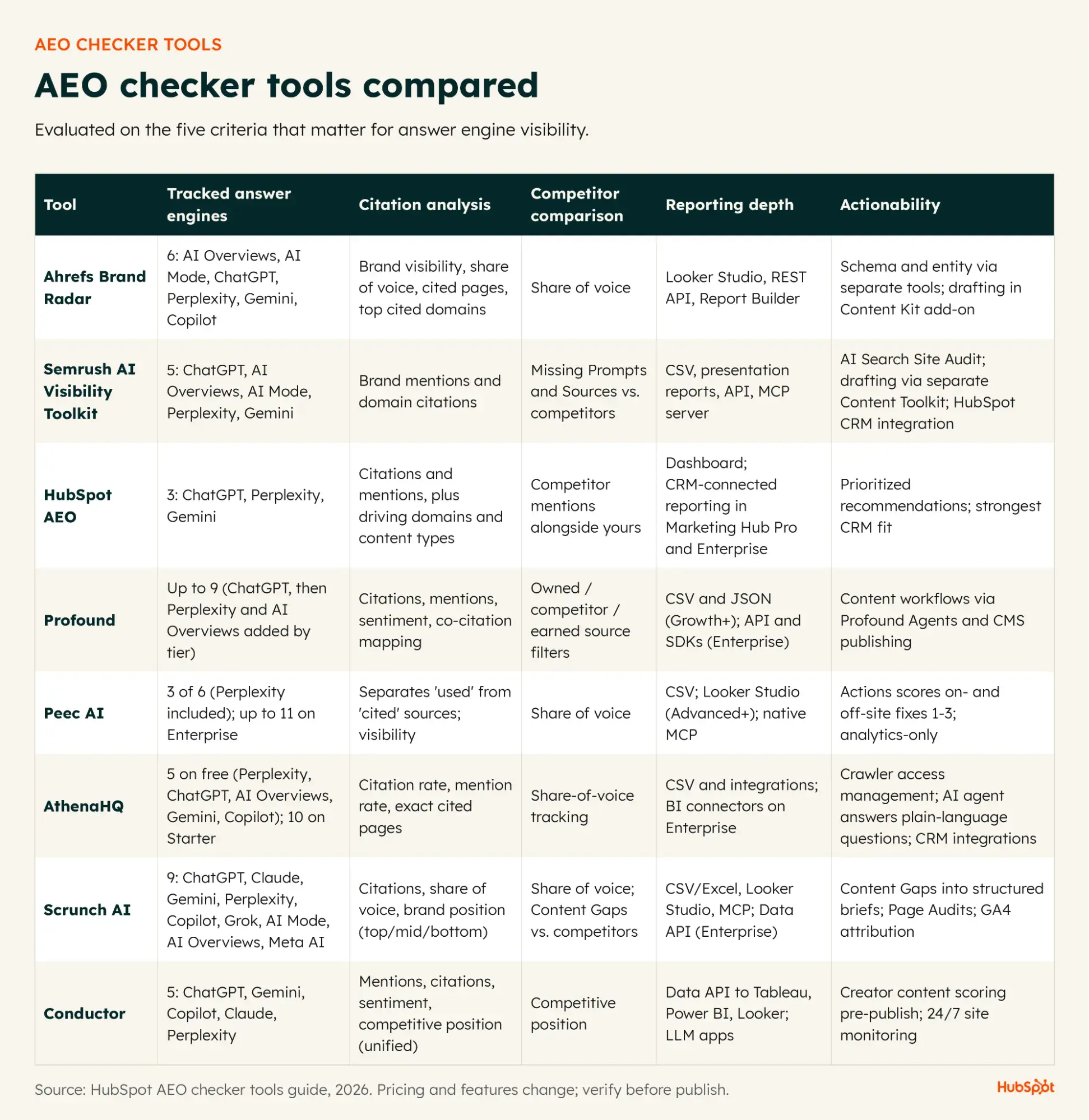
Key AEO Checker Tools in the Market
![AEO checker tools that measure answer engine visibility [2026]](https://53.fs1.hubspotusercontent-na1.net/hubfs/53/aeo-checker-3-20260903-8904553.webp)
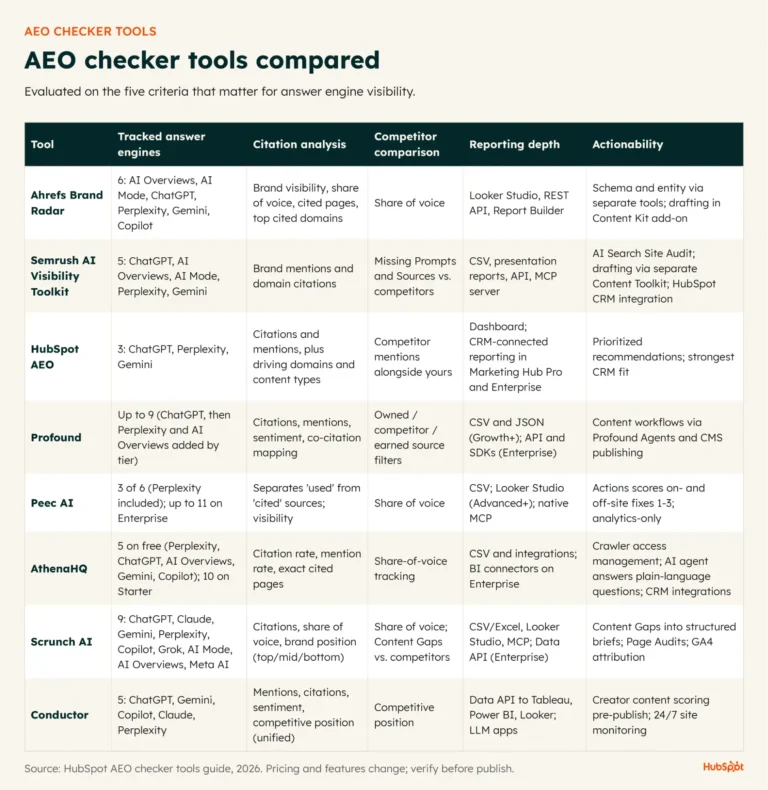
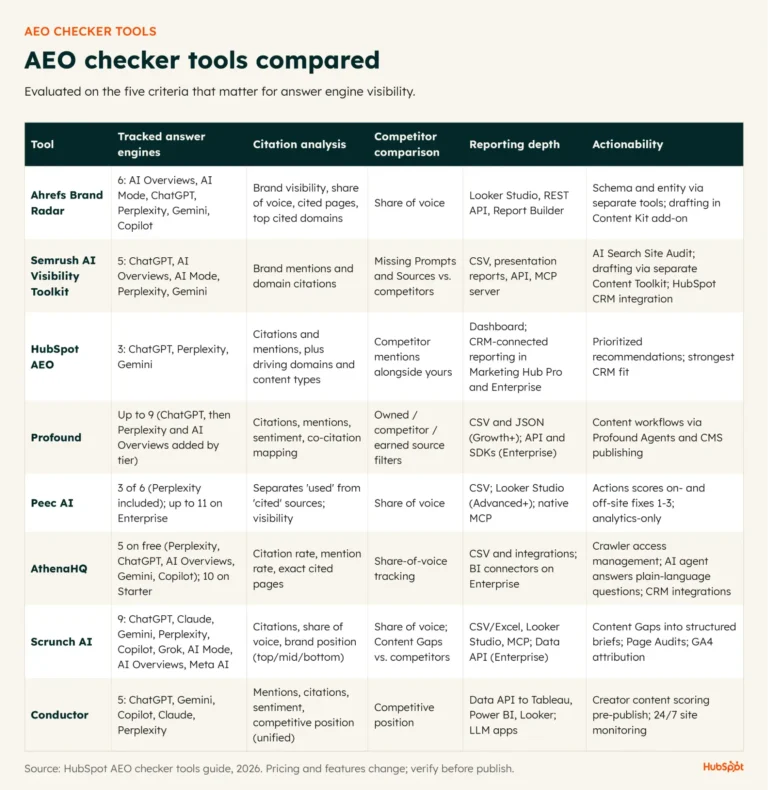
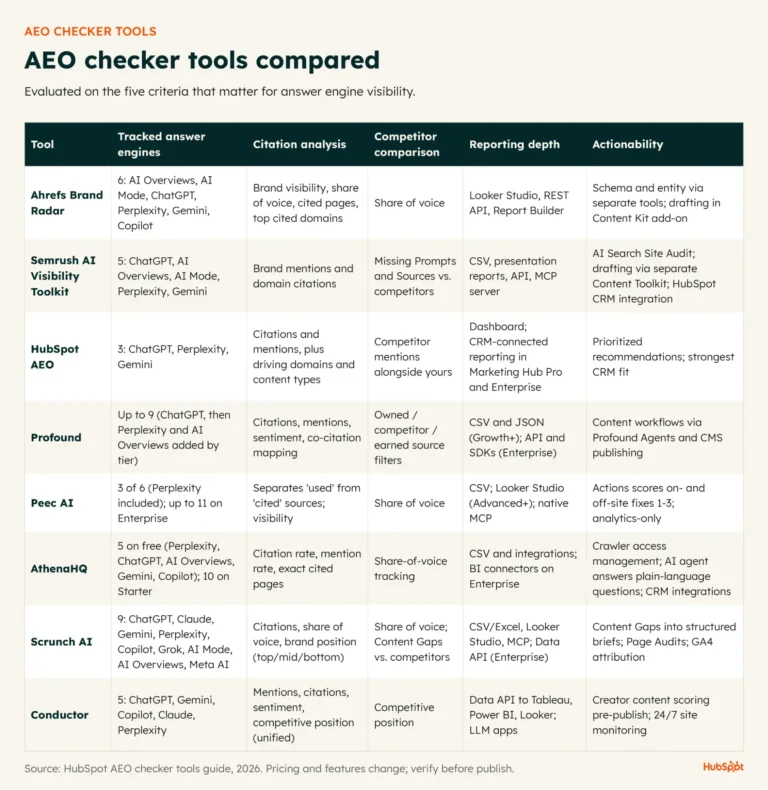
Several platforms are emerging to meet the demands of AEO. These tools often specialize in different aspects of AI visibility and cater to various user needs.
Tools with AI Overviews Tracking:
- Ahrefs Brand Radar: This tool leverages real search queries, not synthetic prompts, to index AI Overviews, making it a significant resource for understanding visibility in Google’s generative search. It focuses on the scale of AI Overviews.
- Semrush AI Visibility Toolkit: Semrush’s Organic Research features can identify ranking keywords that already trigger AI Overviews, allowing for strategic prioritization of content for optimization.
Tools with ChatGPT Citation Detection:
- HubSpot AEO: This tool offers comprehensive tracking of citations and mentions across major AI platforms. It also provides CRM-connected reporting, linking AI visibility data to sales and customer data.
- Profound: Profound extends beyond simple citation detection to analyze the context of citations, including sentiment analysis, identification of uncited prompts, and a breakdown of citation sources (owned, competitor, earned).
Tools with Perplexity Monitoring:
- Peec AI: A dedicated analytics tool focused on providing clear and actionable data from Perplexity.
- AthenaHQ: This platform offers Perplexity monitoring across all its plans, including a free tier, and features a conversational assistant for interaction.
Tools for Schema and Entity Readiness:
- Scrunch AI: This tool assesses the crawlability and renderability of web pages by AI crawlers, focusing on technical readiness for AI consumption.
- Conductor: Conductor combines continuous technical monitoring with a content scoring mechanism designed to enhance AI comprehension of web content.
Essential AEO Metrics for Success
Once an AEO checker is in place, monitoring specific metrics is key to understanding performance:
![AEO checker tools that measure answer engine visibility [2026]](https://53.fs1.hubspotusercontent-na1.net/hubfs/53/aeo-checker-4-20260903-6212698.webp)
- Brand Visibility Score: A composite score reflecting overall brand presence across answer engines.
- Citation Coverage: The percentage of queries where the brand’s content is cited.
- Mention Frequency: How often the brand is mentioned in AI answers.
- Share of Voice: The brand’s visibility compared to competitors within AI-generated answers.
- AI-Referred Traffic: Traffic originating from AI platforms, though this can be challenging to track directly due to zero-click searches.
- Branded Search Lift: An increase in direct searches for the brand name, potentially indicating increased awareness from AI exposure.
These metrics are most valuable when viewed as trends over time. A consistent upward trajectory in visibility, citation coverage, and mentions, alongside a growing share of voice, indicates successful AEO efforts. While direct attribution of zero-click searches remains difficult, tracking referral traffic and branded search lift can offer proxy measures of AI’s influence on awareness and consideration.
From Measurement to Action: Integrated AEO Solutions
Many AEO checkers provide diagnostic insights, but the true value lies in translating those insights into actionable content and optimization strategies. HubSpot’s AEO offering, particularly within Marketing Hub Professional and Enterprise, aims to bridge this gap by integrating measurement with execution.
HubSpot AEO, available as a standalone tool or as part of broader marketing suites, provides prioritized recommendations based on visibility data. These recommendations guide users on what content to create, what existing content to update, and where to focus their optimization efforts.
For a more integrated experience, HubSpot Marketing Hub Professional and Enterprise offer features that go beyond diagnosis. The "Content Agent," for example, can generate research-backed first drafts of blog posts based on AEO recommendations, directly within the HubSpot ecosystem. These drafts can then be refined and published through HubSpot’s Content Hub and Marketing Hub. This integration ensures that the insights gained from AEO monitoring are directly fed into the content creation and publishing workflow, streamlining the optimization process.
Crucially, HubSpot’s AEO capabilities are built on its Smart CRM. This integration allows for the tracking of AI-referred traffic as a distinct source, connecting it to specific contacts and deals within the CRM. This provides a more holistic view of the marketing funnel, from initial AI discovery to pipeline generation. However, it’s important to acknowledge the inherent limitation of zero-click searches: while AI-referred traffic that results in a click can be attributed, visibility that never converts into a session is harder to quantify in pipeline terms. Therefore, AEO reporting should consider both visibility scores and any measurable referral revenue as related but distinct indicators of success.
Frequently Asked Questions About AEO Checkers
![AEO checker tools that measure answer engine visibility [2026]](https://53.fs1.hubspotusercontent-na1.net/hubfs/53/aeo-checker-5-20260903-8938354.webp)
-
How often should you run an AEO check? The frequency depends on the method. Manual spot-checks require multiple sessions per query due to AI volatility. Automated checkers offer better scalability, with daily or weekly refreshes recommended for capturing rapid changes, while monthly snapshots can reveal broader trends.
-
Is AEO the same as AI search optimization? While often used interchangeably, AEO is more precise. It specifically refers to optimizing for brand presence within AI-generated answers, as opposed to optimizing for ranking within AI-powered search results more broadly.
-
Can you reliably track citations in ChatGPT and Perplexity? Yes, within limits. Both platforms provide source information for their answers. However, due to session-to-session variability, reliability is achieved through repeated querying and pattern analysis, rather than relying on single snapshots.
-
Do AEO checkers replace traditional SEO tools? No, they serve different but complementary purposes. SEO tools focus on website rankings, keywords, and backlinks, which provide the foundational authority and crawlability that AI engines rely on. AEO checkers focus on how that authority translates into direct answers. Running both in parallel is the most effective strategy.
The advent of AI-driven answer engines marks a pivotal moment for digital visibility. An AEO checker is no longer a niche tool but a critical component of any modern marketing strategy, enabling brands to navigate this evolving landscape and ensure their message is heard, and their information is accurately represented, in the answers that shape consumer understanding and decisions.
About the Author