Boston, MA | June 9, 2026
The burgeoning artificial intelligence landscape in India, characterized by an unprecedented surge in app downloads and user adoption, is poised for a significant inflection point. Tech titans, having aggressively pursued user acquisition through extensive free promotional campaigns, are now shifting their focus towards monetization. This strategic pivot aims to transform the world’s fourth-largest economy into a lucrative market for paid AI services, a move that will test the depth of user commitment beyond initial free access.
A Surge of Generative AI Adoption: India Leads the Global Charge
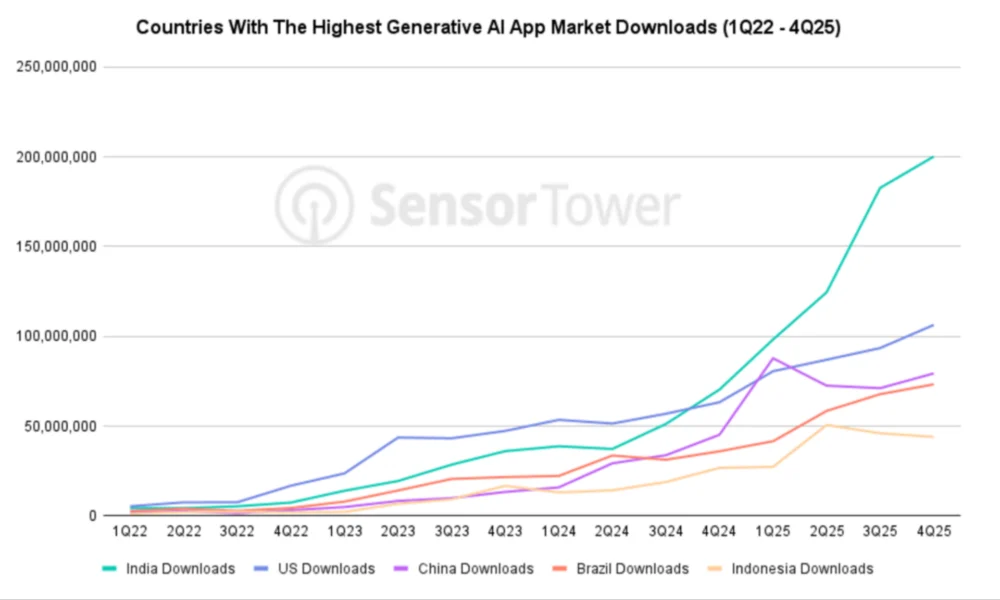
In 2025, India cemented its position as the undisputed global leader in generative AI application downloads, according to comprehensive data from market intelligence firm Sensor Tower. The nation witnessed a staggering 207% year-over-year increase in installs, significantly widening its lead over the United States. This dramatic growth underscores India’s burgeoning digital infrastructure and its population’s rapid embrace of advanced AI technologies.
The momentum was fueled by a concerted effort from major AI players, including OpenAI, Google, and Perplexity. Recognizing India’s unique price-sensitive market dynamics, these companies strategically rolled out extended free premium offers for their AI applications. This approach was designed not only to capture market share but also to cultivate a generation of users familiar with the capabilities of advanced AI tools.
The Indian government’s ambitious vision to establish the nation as a global artificial intelligence hub further amplified this trend. A pivotal moment in this national endeavor was the major AI summit held in New Delhi earlier this year. The event drew the attention of the global AI elite, with prominent figures such as OpenAI’s Sam Altman, Anthropic’s Dario Amodei, and Alphabet CEO Sundar Pichai in attendance. Their participation signaled India’s growing strategic importance in the global AI race and its potential to shape the future of the industry.
The End of an Era: Shifting from Free Access to Paid Subscriptions
The period of aggressive free promotions, instrumental in driving India’s AI adoption, is now drawing to a close. Companies are meticulously winding down these initial outreach efforts, signaling a crucial transition. Perplexity, for instance, concluded its bundled Pro offer with Indian telecommunications provider Airtel in January. Similarly, OpenAI’s complimentary ChatGPT Go access, a key driver of user acquisition, is no longer available to new users in India. These actions are expected to provide a clearer gauge of how many of the newly acquired, free-tier users will convert into paying subscribers.
While India has demonstrated phenomenal growth in AI app downloads, its revenue generation from these applications remains disproportionately low. Data shared by Sensor Tower with TechCrunch reveals that India accounts for approximately 1% of global in-app purchases for generative AI apps, despite contributing nearly 20% of worldwide downloads. This stark disparity highlights the significant monetization challenge facing the industry within one of its fastest-growing markets.
Analyzing the Download-to-Revenue Gap
The rapid acceleration of generative AI app adoption in India throughout 2025 was particularly pronounced. Downloads reached their peak in September and October, with year-over-year growth rates soaring to approximately 320% and 260%, respectively. However, this surge in user engagement did not directly translate into commensurate revenue gains. In November and December of 2025, in-app purchase revenue for AI applications in India experienced a month-over-month decline of 22% and 18%, respectively.
This revenue dip was even more pronounced for ChatGPT. Following the November launch of its sub-$5 ChatGPT Go access, the app’s revenue in India saw sharper decreases of 33% and 32% over the same two-month period. These figures underscore the immediate impact of aggressive promotional strategies on short-term revenue metrics, a phenomenon observed across the sector.

Given that ChatGPT continues to command over 60% of generative AI in-app revenue within India, any shifts in its pricing strategy are bound to have a significant influence on the overall market performance. This dominance makes the company’s monetization decisions particularly critical for the sector’s financial trajectory.

Factors Driving India’s AI Adoption Surge
Beyond the strategic promotional campaigns, Sensor Tower attributes the remarkable surge in generative AI app adoption in India during 2025 to a confluence of factors. The introduction of new platforms, such as DeepSeek, Grok, and Meta AI, played a crucial role in expanding the AI ecosystem. Furthermore, significant upgrades to established chatbots like ChatGPT, Gemini, Claude, and Perplexity enhanced their appeal and functionality.
A significant catalyst for this adoption was also the viral interest in AI-generated content. Content creation and editing tools emerged as a dominant force, with seven of the top 20 most downloaded generative AI apps in India in 2025 falling into this category. This indicates a strong user demand for tools that empower creative expression and digital content production.
The growth in user base has been equally impressive. In 2025, India represented approximately 19% of the global user base for leading AI assistant applications, surpassing the United States’ 10% share. ChatGPT maintained its leadership in the Indian market by monthly active users, though rivals such as Google’s Gemini and Perplexity have also experienced rapid expansion, largely attributed to their promotional offers. Earlier Sensor Tower data confirmed ChatGPT as the most downloaded generative AI app in both India and globally in 2025. In a significant development, OpenAI’s CEO recently revealed that the chatbot has surpassed 100 million weekly active users in India, a testament to its widespread adoption.
The Strategic Rationale Behind Promotional Pushes
Sneha Pandey, an insights analyst at Sensor Tower, explained that the widespread promotional pushes in India reflect a broader strategic imperative by AI firms to minimize pricing friction in a market that is highly attuned to value. The underlying bet is that early user adoption and sustained engagement will ultimately translate into stronger long-term customer retention once free access periods conclude.
India’s inherent appeal lies in its vast digital infrastructure. With over a billion internet users and approximately 700 million smartphone owners, the country represents one of the largest potential markets for AI services globally. This makes it a critical battleground for companies vying for user growth and market dominance.
Engagement Metrics and Future Monetization Strategies
Despite the impressive adoption rates, user engagement in India still lags behind more mature markets. In 2025, users of leading AI chatbot applications in the United States spent approximately 21% more time per week on these apps compared to their Indian counterparts. Additionally, U.S. users logged an average of 17% more sessions, according to Sensor Tower.
"AI in-app revenues will likely see meaningful but gradual improvement as users become more deeply integrated into these platforms, making sustained engagement paramount," Pandey told TechCrunch. This suggests that the path to robust revenue growth will be incremental, relying on the deepening utility and integration of AI tools into users’ daily lives.
Pandey further elaborated on the pricing pressures anticipated in the Indian market. Given the country’s predominantly young and value-conscious user base, strategies such as lower-cost subscription tiers, telecommunication bundles, and micro-transaction models are expected to be crucial for achieving long-term retention and revenue sustainability.
Entering 2026, ChatGPT continued to hold a commanding lead in the Indian market. In January, it reported 180 million monthly active users, followed by Google’s Gemini with 118 million, Perplexity with 19 million, and Meta AI with 12 million. These figures highlight both the immense scale of India’s AI opportunity and the escalating challenge for companies to convert rapid user adoption into consistent and significant revenue streams.
As the industry navigates this new phase, the strategies employed by Google, OpenAI, and Perplexity in the coming months will be closely watched. Their ability to successfully monetize the vast user base cultivated through free access will be a defining factor in the future trajectory of the AI market in India and potentially serve as a blueprint for other emerging economies.
While these tech giants did not immediately respond to requests for comment, the industry’s attention is now firmly fixed on India’s transition from an AI adoption hotspot to a proving ground for monetization strategies. The coming quarters will reveal whether the current wave of user enthusiasm can be successfully translated into sustainable financial success for the AI industry.
About the Author