
Understanding your cost per lead (CPL) is not merely an academic exercise; it is a fundamental necessity for any business seeking sustainable growth and efficient resource allocation. In today’s competitive landscape, where marketing budgets are often significant investments, knowing the precise financial outlay required to attract a single potential customer is paramount. This metric serves as a powerful diagnostic tool, illuminating the effectiveness of marketing and sales initiatives and providing a clear roadmap for optimization. Without a firm grasp of CPL, businesses risk operating in the dark, potentially wasting valuable capital on strategies that yield minimal returns. This comprehensive analysis will delve into the significance of CPL, outline its calculation, and offer actionable strategies for its reduction, ultimately empowering businesses to maximize their marketing expenditure and drive tangible results.
What Exactly is Cost Per Lead?
At its core, Cost Per Lead (CPL) is a key performance indicator (KPI) within marketing that quantifies the total expense incurred to generate a single lead. A "lead" in this context refers to an individual or entity that has expressed interest in a company’s products or services, typically by providing contact information or engaging with marketing materials. The definition of a "quality lead" can vary significantly depending on the business model and marketing campaign objectives. It might encompass individuals who have:
- Filled out a contact form on a website.
- Downloaded a whitepaper or e-book.
- Subscribed to a newsletter.
- Attended a webinar.
- Requested a demo or consultation.
- Engaged with a social media advertisement.
- Visited a specific landing page.
It is crucial to distinguish CPL from Cost Per Acquisition (CPA). While CPL focuses on the expense of attracting potential customers, CPA measures the cost of converting a lead into a paying customer or closing a sale. Understanding this distinction is vital for accurate performance evaluation. For instance, a campaign might have a low CPL but a high CPA, indicating that while leads are inexpensive to generate, they are not converting into sales effectively. Conversely, a campaign with a higher CPL might be highly effective if it consistently produces leads that convert at a high rate, leading to a profitable CPA.
The Paramount Importance of CPL for Business Expenses
Marketing and advertising expenditures often constitute a substantial portion of a company’s overall operational costs. Therefore, rigorously measuring the efficacy of these investments is not just advisable but essential for financial health and strategic decision-making. CPL plays a pivotal role in this assessment by providing a quantifiable measure of marketing campaign performance.
By understanding the CPL for different marketing channels and campaigns, businesses can make informed decisions about budget allocation. This allows for the strategic redirection of resources towards high-performing strategies that deliver the best return on investment (ROI). Conversely, underperforming or inefficient campaigns can be identified and either optimized or discontinued, preventing the wasteful expenditure of marketing funds.
Furthermore, CPL data, when analyzed in conjunction with other marketing metrics, can reveal whether a campaign is attracting the right kind of leads. If a campaign generates a large volume of leads but few convert into customers, it may indicate a misalignment between the marketing message and the target audience. In such scenarios, CPL analysis can prompt a necessary course correction, saving both time and money.
CPL also serves as a valuable tool for challenging assumptions and validating marketing strategies. A high-profile, widely recognized campaign might appear successful due to its visibility and the sheer number of leads it generates. However, a deeper dive into the CPL can reveal that a less ostentatious, but more targeted, campaign might offer a superior ROI due to lower operational costs and a higher conversion rate of its leads. This nuanced understanding prevents the perpetuation of ineffective marketing practices based on superficial metrics.
Defining a "Good" Cost Per Lead: A Context-Dependent Metric
The question of what constitutes a "good" CPL is inherently complex, as there is no universal benchmark that applies across all businesses, industries, or market conditions. The ideal CPL is highly contextual and depends on a multitude of factors, including:
- Industry: Highly competitive sectors with long sales cycles, such as enterprise software, financial services, or specialized B2B markets, typically exhibit higher CPLs. This is due to the increased value of each lead, the complexity of sales processes, and the specialized nature of the target audience.
- Product or Service Value: The price point of a company’s offerings is a critical determinant of an acceptable CPL. For example, a CPL of $80 might be considered exorbitant if the average product price is $20. However, if the average product price is $2,000, an $80 CPL becomes highly attractive. The revenue generated from a lead is the ultimate measure of its worth.
- Marketing Channels Used: Different marketing channels have varying cost structures. Paid advertising, while often effective for rapid lead generation, can result in higher CPLs compared to organic strategies like content marketing and SEO, which may have lower upfront costs but a longer lead time to generate results.
- Target Audience Specificity: Reaching highly niche or specialized target audiences can be more expensive, leading to a higher CPL. However, these leads may also be more qualified and have a higher propensity to convert.
- Lead Quality and Conversion Rates: The ultimate value of a lead is determined by its likelihood to convert into a paying customer. A higher conversion rate can justify a higher CPL, as more of the generated leads will ultimately contribute to revenue.
- Lifetime Value (LTV) of a Customer: For businesses with a strong recurring revenue model or a high customer lifetime value, a higher initial CPL may be acceptable if those customers are likely to generate significant revenue over an extended period.
Ultimately, a "good" CPL is one that is lower than the expected revenue generated from an average lead. Conversely, a "bad" CPL occurs when the cost of lead generation exceeds the anticipated revenue from that lead, resulting in a net loss. The expected revenue is a product of the average customer spend and the conversion rate, both of which are unique to each business. Benchmarking against industry averages can provide some perspective, but internal analysis and comparison against projected profitability remain the most accurate measures.
Calculating Your Cost Per Lead: A Step-by-Step Approach

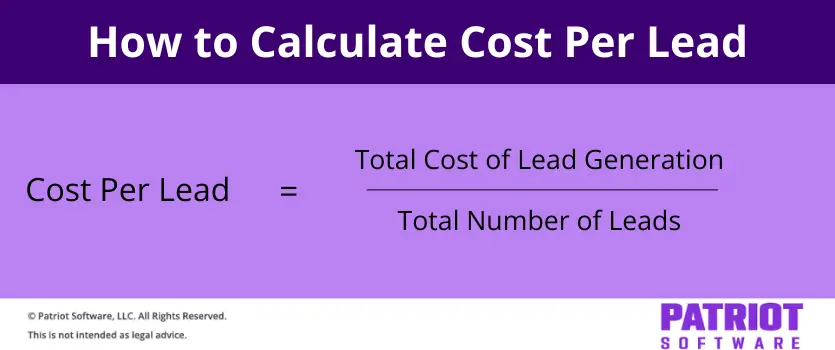
The calculation of Cost Per Lead is a straightforward process, requiring accurate tracking of marketing expenditures and the number of leads generated. The fundamental formula is:
Cost Per Lead = Total Cost of Lead Generation / Total Number of Leads
To implement this calculation effectively, a systematic approach is necessary:
1. Comprehensive Cost Tracking
The first critical step is to meticulously identify and aggregate all expenses directly attributable to lead generation efforts within a defined period (e.g., monthly, quarterly, annually). This includes a broad spectrum of costs:
- Advertising Spend: This encompasses all expenditures on paid advertising across various platforms, including search engine marketing (SEM), social media ads, display advertising, print advertisements, and any other paid media placements.
- Content Creation Costs: Expenses related to developing blog posts, whitepapers, e-books, videos, infographics, and other marketing collateral designed to attract and engage potential leads.
- Software and Tools: Costs associated with marketing automation platforms, CRM systems, email marketing software, SEO tools, analytics platforms, and any other technology used to support lead generation activities.
- Agency Fees and Freelancer Costs: Payments made to external marketing agencies, consultants, or freelance professionals hired for campaign execution, content creation, design, or strategic guidance.
- Internal Labor Costs: A portion of the salaries for marketing and sales team members whose time is dedicated to lead generation activities. This can be calculated by estimating the percentage of their work hours spent on these tasks.
- Website and Landing Page Development/Maintenance: Costs associated with designing, building, and maintaining websites and specific landing pages optimized for lead capture.
- Event Marketing Costs: Expenses related to hosting or participating in webinars, trade shows, conferences, and other events where lead generation is a primary objective.
It is often beneficial to categorize these costs into inbound and outbound marketing efforts, as their cost structures and lead generation dynamics can differ significantly.
- Inbound Marketing Costs: These typically include expenses related to content marketing, SEO, social media engagement, and organic search visibility. While often having a lower upfront cost, they require sustained effort and can lead to a lower CPL over time as organic traffic builds.
- Inbound Costs = Content Creation + SEO Tools/Services + Social Media Management + Website Optimization
- Outbound Marketing Costs: This category encompasses paid advertising, direct mail, telemarketing, and other proactive outreach methods. These can generate leads more quickly but often come with a higher price tag.
- Advertising Costs = Ad Spend + Ad Management (if outsourced or specific internal roles)
2. Accurately Quantifying Leads
Simultaneously, it is essential to have a robust system for tracking and counting the total number of leads generated within the same defined period. This requires clear definitions of what constitutes a lead for each campaign and channel.
- Inbound Leads: This includes leads generated through organic search, content downloads, website form submissions, social media engagement, and referral traffic.
- Outbound Leads: This encompasses leads acquired through paid advertising campaigns, direct outreach, and other proactive marketing efforts.
A unified CRM system or a dedicated lead tracking mechanism is crucial for accurately consolidating lead data from various sources. For instance, a landing page might capture leads through a form submission, while a paid ad campaign might directly generate leads through a click-to-call or lead form feature within the advertising platform.
3. Performing the CPL Calculation
Once both the total costs and the total number of leads are accurately determined for the chosen time period, the CPL can be calculated using the formula:
Cost Per Lead = Total Cost of Lead Generation / Total Number of Leads
For example, if a company spends $5,000 on an email marketing campaign and it generates 200 leads, the CPL would be $5,000 / 200 = $25 per lead.
To further refine this analysis, businesses can calculate CPLs for specific marketing channels or campaigns. This granular approach allows for a more precise understanding of where marketing investments are yielding the best results. Common breakdowns include:
- CPL by Channel: Calculating CPL for paid search, social media advertising, email marketing, content marketing, etc.
- CPL by Campaign: Determining the CPL for individual marketing campaigns, such as a specific product launch campaign or a seasonal promotion.
- CPL by Audience Segment: Analyzing the CPL for different demographic or psychographic groups targeted by marketing efforts.
- CPL by Geographic Location: Understanding the cost of acquiring leads in different regions or markets.
The availability of specialized tools, such as lead generation software and marketing analytics platforms (e.g., Google Analytics, Facebook Ads Manager), can significantly streamline this process, often providing automated CPL reporting for specific campaigns and channels.
Leveraging Cost Per Lead Data for Strategic Advantage
The power of CPL lies not just in its calculation but in its strategic application. Once computed, this metric becomes a potent tool for evaluating the cost-effectiveness of various marketing initiatives and making data-driven decisions.
1. Channel and Campaign Performance Analysis
CPL data allows businesses to directly compare the efficiency of different marketing channels and specific campaigns. For example, if the CPL for paid social media advertising is consistently higher than for content marketing efforts, it might prompt a reallocation of budget towards the more cost-effective channel. Similarly, if a particular campaign is generating leads at a significantly higher cost than others, it warrants a thorough investigation into its effectiveness and potential areas for optimization.
2. Identifying Profitable Target Groups
By segmenting CPL data by audience, businesses can identify which target groups are most cost-effective to acquire. This information can then be used to refine audience targeting strategies, focusing marketing efforts on demographics or segments that demonstrate a higher likelihood of conversion at a lower cost.
3. Monitoring Trends and Opportunities
Regularly tracking CPL over time is crucial for identifying trends and uncovering new opportunities. A steady increase in CPL across all channels might signal a need for a broader reevaluation of marketing strategies, perhaps indicating market saturation, increased competition, or a decline in the effectiveness of current tactics. Conversely, a declining CPL can indicate successful optimization efforts or emerging cost-effective channels.
4. Informing Budget Allocation
Ultimately, CPL data directly informs budget allocation decisions. By understanding the cost associated with acquiring leads through different avenues, marketing managers can allocate their budget more strategically, prioritizing investments in channels and campaigns that deliver the most leads at the lowest cost, while still ensuring lead quality.
Strategies for Reducing Cost Per Lead
Reducing your Cost Per Lead is a continuous process of optimization that can significantly enhance marketing ROI and make your budget stretch further. The overarching goal is to attract more qualified leads for less expenditure. Here are several effective strategies:
1. Aligning Marketing with Business Needs and Market Position
The optimal CPL is intrinsically linked to a business’s size, market position, and overall revenue. Larger enterprises with higher revenue streams may be able to sustain a higher CPL, especially if they operate in highly competitive markets or target high-value clients. They can afford to invest more in broad-reaching campaigns. For smaller businesses, however, a more conservative approach is often warranted. Starting with a modest budget and meticulously analyzing campaign analytics to identify the most efficient spending points is crucial. Expanding the budget should be a calculated decision based on demonstrated success and a clear understanding of ROI.
2. Enhancing Audience Targeting and Retargeting
Improving the precision of audience targeting is a direct path to increasing lead quality and reducing CPL. By leveraging sophisticated demographic, psychographic, and behavioral data, marketers can ensure their messages reach the individuals most likely to be interested in their offerings. This reduces wasted ad spend on irrelevant audiences. Furthermore, implementing retargeting campaigns for individuals who have previously interacted with the brand but did not convert can be highly effective. These individuals are already familiar with the brand, and a well-crafted retargeting message with a compelling offer can nudge them towards conversion, often at a lower CPL than acquiring a completely new lead. Adjusting sales planning templates to reflect these refined target segments is a vital step in this process.
3. Optimizing Website and Landing Page Performance
A well-optimized website is a powerful engine for organic lead generation and can significantly reduce CPL. Enhancing search engine optimization (SEO) by targeting long-tail keywords (which often indicate higher purchase intent), consistently publishing fresh, valuable content, and mirroring the style and depth of high-performing competitor content can improve organic search rankings. Beyond SEO, optimizing website navigation, improving page loading speeds, and refining landing pages for clarity and persuasive calls-to-action are critical. Lead magnets should offer genuine value, and sign-up forms can be enhanced with clarifying questions to pre-qualify leads and filter out those with less serious intent.
4. Embracing A/B Testing for Continuous Improvement
A/B testing is an indispensable tool for optimizing marketing materials and campaigns to attract more leads and consequently reduce CPL. This involves testing variations of elements such as landing page headlines, calls-to-action (CTAs), ad creatives, email subject lines, and even entire campaign concepts. By comparing the performance of different versions, businesses can identify which approaches resonate most effectively with their target audience. Experimentation across different marketing channels to determine optimal performance and diversification of strategies is also crucial. Testing can further refine the timing of ad deployments and content publications, ensuring maximum visibility when the target audience is most active online.
5. Strategic Adoption of Marketing Tools and Automation
While investing in marketing technology incurs costs, the efficiency gains can substantially reduce CPL by automating manual tasks and improving campaign execution. Marketing automation platforms can streamline email campaigns, social media scheduling, and lead nurturing processes. Customer Relationship Management (CRM) systems are essential for managing lead data and tracking interactions. Specialized lead generation software can identify potential leads from website visitors. The key is to select tools that align with business needs and to ensure that marketing teams are adequately trained to leverage their full capabilities, thereby maximizing the return on software investment.
6. Continuous Monitoring and Analysis
The marketing landscape is dynamic, influenced by economic shifts, competitive actions, and evolving consumer behavior. Therefore, it is imperative to calculate and monitor CPLs on a regular, ongoing basis. This continuous evaluation should encompass performance across various marketing methods, channels, and individual campaigns. Analyzing CPL in conjunction with other key sales and marketing metrics, such as conversion rates, cost per acquisition (CPA), and overall return on investment (ROI), provides a holistic view of marketing effectiveness. Customer satisfaction surveys (e.g., using CSAT score calculations) after a campaign can also offer valuable qualitative insights into its success. This vigilant approach allows businesses to adapt quickly to changing conditions and maintain optimal marketing efficiency.
Conclusion
In the intricate ecosystem of business operations, understanding and actively managing Cost Per Lead is not an optional add-on but a fundamental requirement for financial prudence and strategic growth. This metric serves as a vital compass, guiding businesses toward more efficient and effective marketing investments. By meticulously calculating and consistently monitoring CPL, companies can identify underperforming campaigns and channels, reallocate resources strategically, and ultimately ensure that their marketing budget is deployed in the most impactful manner possible. Factoring in all advertising and inbound costs, defining what constitutes a favorable or unfavorable CPL within the unique context of the business, and diligently applying the principles of optimization will lead to a streamlined marketing spend, attracting higher quality leads, and paving the way for sustained business success.
About the Author