
The recent announcement of Amazon Web Services’ (AWS) monumental $50 billion investment and strategic partnership with OpenAI has sent ripples through the technology industry. At the heart of this transformative deal lies AWS’s cutting-edge chip development, a sector where the tech giant has been quietly but relentlessly building capabilities. To gain an inside perspective on the technology powering this collaboration, a private tour of AWS’s chip development laboratory was arranged, offering an exclusive look at the innovation driving AI’s next frontier.
The tour, hosted by Kristopher King, Director of the AWS chip lab, and Mark Carroll, Director of Engineering, along with PR representative Doron Aronson, provided a comprehensive overview of the custom silicon designed to accelerate artificial intelligence workloads. This facility is not merely a research outpost; it is the birthplace of Amazon’s Trainium and Inferentia chips, hardware specifically engineered to challenge the dominance of established players like Nvidia in the lucrative AI chip market. The implications of these custom silicon solutions extend beyond cost-effectiveness, potentially reshaping the economics of AI development and deployment.

AWS’s relationship with leading AI companies has been a cornerstone of its cloud strategy. The company has served as a major cloud platform for Anthropic since its inception, a partnership that has persisted despite Anthropic later establishing a relationship with Microsoft. This existing infrastructure and deep integration made AWS a natural partner for OpenAI, further solidified by the recent multi-billion dollar investment.
The OpenAI deal, specifically, positions AWS as the exclusive provider for OpenAI’s new AI agent builder, Frontier. This exclusive arrangement could prove to be a significant revenue stream for OpenAI if the burgeoning field of AI agents meets industry expectations. However, the exclusivity of this arrangement is already subject to scrutiny. Reports have emerged suggesting that Microsoft, a long-standing partner of OpenAI, may contend that this deal with AWS violates their existing agreement, which grants Microsoft access to all of OpenAI’s models and technology.
A critical component of the AWS-OpenAI agreement involves AWS committing to supply OpenAI with a staggering 2 gigawatts of Trainium computing capacity. This is a colossal undertaking, especially considering that Trainium chips are already in high demand, with both Anthropic and AWS’s own Bedrock service consuming them at a rate that outpaces Amazon’s current production capabilities. The scale of this commitment underscores the strategic importance of Trainium chips to both AWS and its key AI partners.

The Evolution and Impact of AWS Trainium Chips
Amazon’s foray into custom chip design began with the acquisition of Israeli chip designer Annapurna Labs in January 2015 for approximately $350 million. This strategic move laid the foundation for the AWS chip division, which has been operating for over a decade, consistently innovating and refining its silicon offerings. The Annapurna legacy is still evident, with its logo prominently displayed throughout the Austin-based facility, often referred to as "Austin’s Silicon Valley."
The Trainium chip family, developed by this dedicated team, represents AWS’s ambition to provide cost-effective and high-performance alternatives for AI training and inference. While initially conceived with a focus on model training, a more pressing need a few years ago, Trainium chips have been recalibrated and optimized for inference – the critical process of running AI models to generate responses. Inference currently represents a significant bottleneck in the AI industry, and Trainium’s enhanced capabilities in this area are a key selling point.
Evidence of Trainium’s prowess can be seen in its significant role within AWS’s Bedrock service. Bedrock, a platform that empowers Amazon’s enterprise customers to build and deploy AI applications utilizing multiple models, relies heavily on Trainium2 chips for the majority of its inference traffic. Kristopher King highlighted the rapid growth of this service, stating, "Our customer base is just expanding as fast as we can get capacity out there. Bedrock could be as big as EC2 one day," drawing a parallel to AWS’s foundational compute service.

Trainium vs. Nvidia: A Strategic Offensive
AWS openly positions its Trainium chips as a direct competitor to Nvidia’s industry-leading GPUs. The company asserts that its latest generation, Trainium3, when deployed on new specialty Trn3 UltraServers, offers a cost reduction of up to 50% for comparable performance compared to traditional cloud servers. This aggressive pricing strategy, coupled with enhanced performance, aims to erode Nvidia’s near-monopoly in the AI hardware market.
The introduction of Trainium3, unveiled in December, was accompanied by new Neuron switches. Mark Carroll emphasized the transformative nature of this combined offering. "What that gives us is something huge," he explained, referring to the Neuron switches that enable a mesh configuration, allowing every Trainium3 chip to communicate seamlessly with every other chip, thereby reducing latency. This architectural innovation is credited with Trainium3 breaking performance records, particularly in "price per power" metrics, a crucial factor when dealing with the trillions of data tokens processed daily in AI operations.
The success of AWS’s custom silicon strategy is not limited to Trainium. The team also developed the Graviton processor, a low-power, ARM-based server CPU that garnered praise from Apple in 2024. In a rare public acknowledgment, Apple’s Director of AI lauded Graviton as a breakout chip and also recognized Inferentia, a chip specifically designed for inference, along with the then-nascent Trainium. This demonstrates a consistent strategy of identifying market needs and developing in-house solutions that compete aggressively on price and performance.

A significant hurdle for widespread adoption of alternative AI chips has historically been the substantial switching costs associated with re-architecting applications designed for Nvidia’s CUDA ecosystem. However, AWS has addressed this challenge by ensuring Trainium supports PyTorch, a widely adopted open-source framework for building AI models, including those hosted on Hugging Face, a popular repository for AI models. Carroll noted that transitioning to Trainium typically requires "basically a one-line change, and then recompile, and then run on Trainium," significantly lowering the barrier to entry for developers.
Further strengthening its AI hardware portfolio, AWS recently announced a partnership with Cerebras Systems. This collaboration involves integrating Cerebras’ inference chips with servers running Trainium, promising enhanced, low-latency AI performance. AWS’s strategy extends beyond individual chips, encompassing the entire server architecture, including its custom-designed Nitro hardware-software combination for virtualization, state-of-the-art liquid cooling technology, and proprietary server sleds. This holistic approach allows AWS to exert greater control over both cost and performance.
Inside the AWS Chip Development Lab
The AWS chip development unit, born from the Annapurna Labs acquisition, operates from a modern facility in Austin’s "The Domain" district. The lab itself, located on a high floor with panoramic city views, presents a contrast between a classic tech corporate environment and a bustling industrial space. While desks and conference rooms are standard, the actual lab area is a noisy, fan-driven environment that resembles a sophisticated high school shop class or a high-end movie set.

This is where the critical "bring-up" process takes place. Silicon bring-up is the crucial phase where a newly designed chip is powered on for the first time to verify its functionality. King described it as an intense, around-the-clock event, often involving extensive testing and troubleshooting. The team has documented the Trainium3 bring-up process, even posting a video on YouTube, which highlights the inherent challenges and dedication involved.
The development of Trainium3 itself showcases the engineering challenges and innovative solutions. Initially designed for air cooling, the current iteration utilizes liquid cooling, a significant engineering feat that offers improved energy efficiency. During the bring-up of a prototype, a dimensional mismatch between the chip and its air-cooling heat sink prevented activation. In a testament to the team’s agility and problem-solving skills, engineers resorted to grinding down the metal heat sink in a conference room to maintain the celebratory atmosphere of the bring-up event. This hands-on, "all-hands-on-deck" approach is characteristic of silicon bring-up.
The lab is equipped with a range of custom-made and commercial tools for testing and analysis. The intricate nature of the work is exemplified by the presence of a welding station, where hardware lab engineer Isaac Guevara demonstrated the precise welding of microscopic integrated circuit components under a microscope. This highly specialized skill set underscores the depth of expertise within the AWS chip team. Signal engineer Arvind Srinivasan also provided a demonstration of the sophisticated equipment used to test each individual component on a chip.

A central exhibit in the lab features a display of various generations of "sleds" – the custom-designed trays that house the Trainium AI chips, Graviton CPUs, and supporting components. When integrated with custom networking hardware, these sleds form the powerful systems that underpin the success of AI platforms like Anthropic’s Claude. The Trainium3 sled, showcased at the AWS re:Invent conference, represents the culmination of this integrated design philosophy.
Proven Performance and Future Ambitions
While the recent OpenAI deal has brought heightened attention to AWS’s chip capabilities, the team’s focus remains on delivering robust solutions for their existing and future partners. King and Carroll indicated that their immediate work has been primarily dedicated to meeting the demands of Anthropic and AWS’s own services, with direct engagement with OpenAI on their specific needs still in its early stages.
A significant deployment of Trainium2 chips is within Project Rainier, one of the world’s largest AI compute clusters, which went live in late 2025 with 500,000 chips dedicated to Anthropic’s workloads. Subtle pride in the team’s contributions was evident, however, with a wall monitor in the main office displaying a quote about OpenAI’s utilization of Trainium.

Beyond the development lab, the team operates a private data center for quality assurance and testing, situated in a co-location facility rather than an AWS data center. This isolated environment allows for rigorous testing without impacting customer workloads. The data center is a testament to the scale and intensity of their operations, characterized by mandatory earplugs due to the deafening noise of cooling systems and the distinct smell of heated metal.
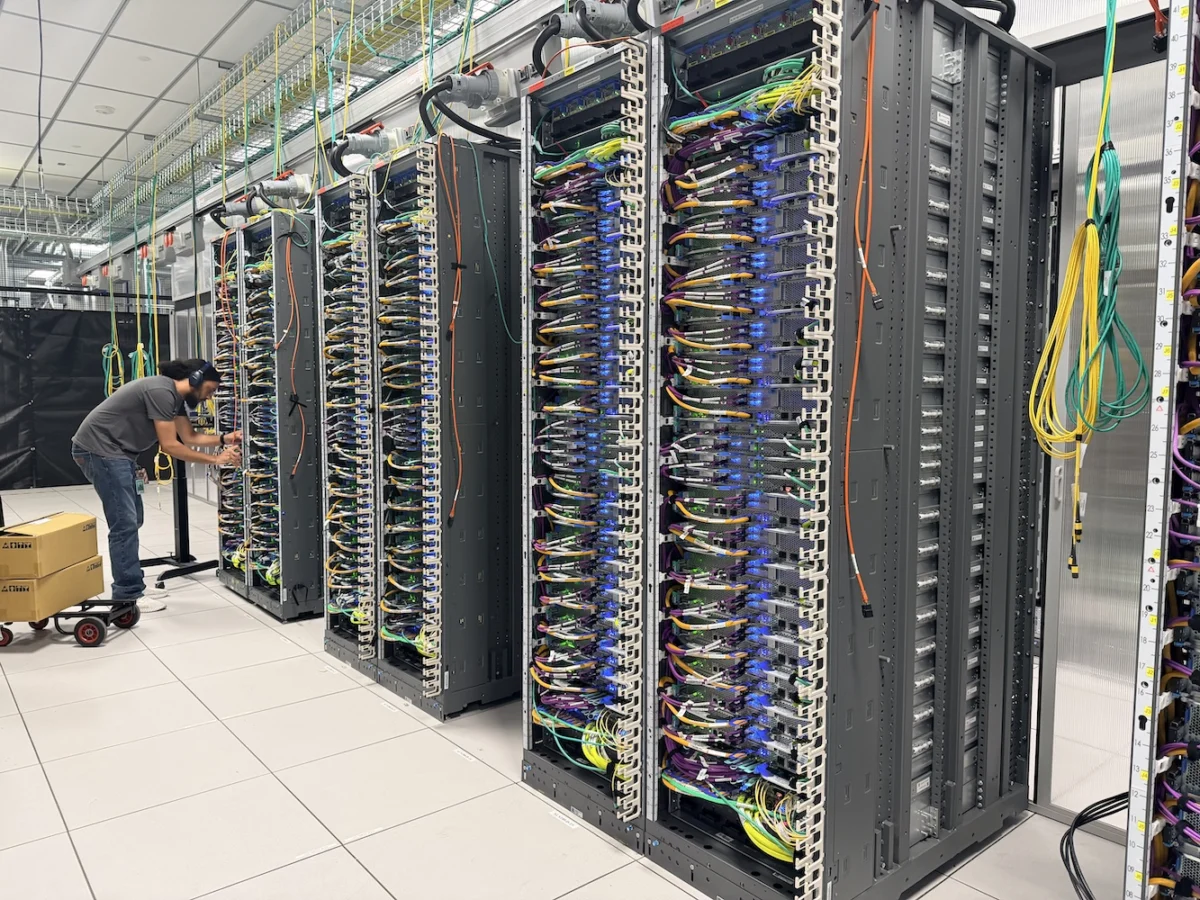
The data center houses rows of servers integrating AWS’s full suite of custom silicon: Graviton CPUs, liquid-cooled Trainium3 chips, and Amazon Nitro components. The liquid cooling system operates on a closed-loop, reusable cycle, aiming to minimize environmental impact. A Trn3 UltraServer configuration is displayed, showcasing multiple sleds and Neuron switches, with hardware development engineer David Martinez-Darrow performing maintenance, illustrating the practical application of their designs.
Amazon CEO Andy Jassy has publicly championed the work of the chip division, referring to Trainium as a "multi-billion dollar business" for AWS and expressing significant excitement about its potential. The announcement of the OpenAI agreement further underscored Jassy’s enthusiasm for the chip’s role in future AI advancements.

The engineering team feels the weight of these high expectations. During bring-up events, engineers often work around the clock for weeks to ensure chips are ready for mass production. "It’s very important that we get as fast as possible to prove that it’s actually going to work," Carroll stated, adding, "So far, we’ve been doing really well." This dedication and relentless pursuit of performance are the driving forces behind AWS’s increasingly influential position in the AI hardware landscape.
Disclosure: Amazon covered the cost of airfare and one night of accommodation for this reporting trip, adhering to its leadership principle of frugality by providing economy class travel and a modest hotel room. Additional travel expenses were borne by TechCrunch.
About the Author





