
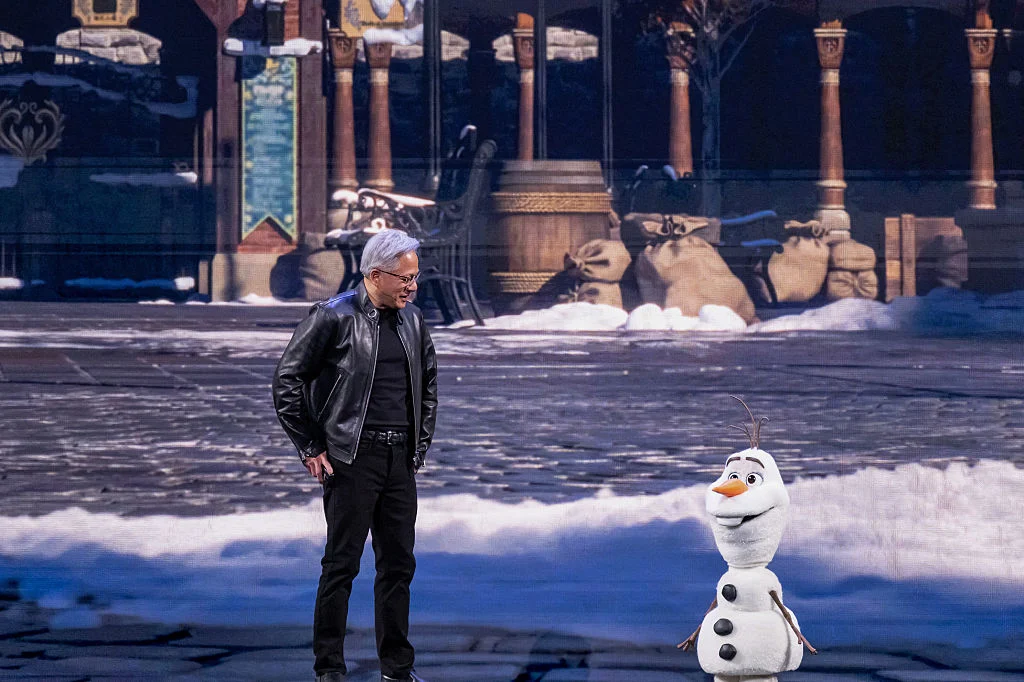
Nvidia’s annual GPU Technology Conference (GTC) concluded with a flurry of announcements, ambitious projections, and unexpected moments that underscore the company’s dominant position in the artificial intelligence and high-performance computing landscape. The event, held from October 13-15, 2026, in San Francisco, California, showcased not only Nvidia’s cutting-edge hardware and software innovations but also offered a glimpse into the company’s expansive vision for the future, a vision that now includes trillion-dollar sales forecasts and even a robotic rendition of a beloved Disney character.
A Grand Vision: Trillion-Dollar Ambitions and the Blackwell Era
At the heart of the GTC keynote, delivered by CEO Jensen Huang, was a staggering projection of Nvidia’s future revenue potential. The company anticipates its next-generation Blackwell platform, coupled with its Vera Rubin observatory-scale data processing capabilities, could propel its sales into the stratosphere, potentially reaching a valuation of $1 trillion. This projection is not merely aspirational; it is built upon the anticipated demand for AI infrastructure that will power the next wave of technological advancements across industries, from scientific research to enterprise computing.
The Blackwell architecture, detailed during the conference, represents a significant leap forward in GPU performance, designed to handle the immense computational requirements of large-scale AI models and complex simulations. Industry analysts have noted that Nvidia’s consistent ability to deliver architectural advancements that outpace market demand has been a key driver of its sustained growth. For instance, the previous Hopper architecture significantly boosted AI training and inference capabilities, leading to unprecedented demand and contributing to Nvidia’s market dominance. The Blackwell platform is expected to continue this trend, offering enhanced memory bandwidth, AI-specific processing units, and improved power efficiency, crucial for the sustained operation of massive data centers.
Advancing Graphics and Gaming: The "Yassification" of Pixels
Beyond the core AI infrastructure, Nvidia also unveiled advancements in its graphics technologies, notably with DLSS 5 (Deep Learning Super Sampling). This new iteration promises to leverage generative AI to enhance photo-realism in video games, pushing the boundaries of visual fidelity. The term "yassify," used humorously to describe the transformative power of this technology, highlights its ability to dramatically alter and enhance visual elements, bringing a new level of polish and detail to digital worlds.
DLSS 5’s integration of generative AI signals a shift in how graphics are rendered. Instead of solely relying on traditional rendering techniques, the technology can intelligently generate or enhance textures, lighting, and even character models, creating a more immersive and lifelike experience for gamers. This development is particularly significant as the gaming industry continues to explore the potential of AI to create more dynamic and responsive game environments. While the immediate application is in gaming, the underlying principles of generative AI for visual enhancement have broader implications for content creation, virtual reality, and augmented reality applications.
OpenClaw: A Strategic Imperative for Every Enterprise
A recurring theme throughout the conference was the imperative for every company to develop an "OpenClaw strategy." Jensen Huang’s assertion that this open-source project is now essential for businesses marks a significant declaration of its perceived importance. OpenClaw, a project whose founder has recently joined OpenAI, represents a critical juncture. Its future trajectory—whether it flourishes as an independent, evolving open-source initiative or languishes—hinges on the support it receives.
Nvidia’s strong endorsement and investment in OpenClaw, through initiatives like NemoClaw, are seen by industry observers as a strategic move to ensure its continued development and relevance. Kirsten Korosec, a TechCrunch reporter, noted that "for Nvidia, it costs them nothing in the grand scheme of things to launch what they call NemoClaw, which is an open source project, which they built with the OpenClaw creator. But if they don’t do something, they have a lot to lose." This perspective suggests that Nvidia’s push for an OpenClaw strategy is as much about solidifying its own position within the evolving tech landscape as it is about promoting the project itself. By championing OpenClaw, Nvidia aims to embed its solutions and influence within a broad ecosystem of companies, creating new pathways for its technology to be integrated into diverse enterprise operations. The success of this strategy will be a key indicator of Nvidia’s foresight in identifying and cultivating foundational technologies for the AI era.
The Curious Case of Olaf: Robotics, Demos, and the Human Factor
Perhaps one of the most memorable and talked-about moments of GTC 2026 was the appearance of a robotic version of Olaf, the beloved snowman from Disney’s "Frozen." This demonstration, intended to showcase Nvidia’s advancements in robotics, provided both entertainment and a point of contention for industry commentators. The robot, designed to interact with attendees, ultimately had its microphone turned off when it began to "ramble" and speak beyond its programmed parameters.
Sean O’Kane, another TechCrunch reporter, humorously suggested that an Olaf robot could be the key to Nvidia becoming a "$100 trillion company." However, this lighthearted observation quickly led to a deeper discussion about the practicalities and challenges of deploying such technologies in real-world environments, particularly in spaces like Disney parks.
The Olaf robot demonstration highlighted Nvidia’s capabilities in creating sophisticated robotic systems, integrating AI for natural language processing and physical interaction. However, as Sean O’Kane pointed out, such demonstrations often focus on the "engineering challenges" while overlooking the "really messy gray areas" of social integration and public acceptance. The question posed—"But what happens when a kid kicks Olaf over?"—resonates with the broader debate surrounding the deployment of humanoid robots and interactive automatons in public spaces.
The history of robotics in theme parks, as explored by various commentators and content creators like the YouTuber Defunctland, is replete with examples of ambitious technological endeavors facing unforeseen social and operational hurdles. The potential for damage, misuse, or simply the unpredictable nature of human interaction can quickly derail even the most technologically advanced creations.
Kirsten Korosec offered a counterpoint, suggesting that such robotic deployments could, in fact, be job creators. The need for human "babysitters" or supervisors in these interactive installations, potentially dressed as characters like Elsa, could lead to new employment opportunities within the entertainment industry. This perspective shifts the focus from purely technological advancement to the symbiotic relationship between AI-driven systems and human labor.
Broader Implications and Future Outlook
Nvidia’s GTC 2026 has solidified its position as a central player in the ongoing AI revolution. The ambitious sales projections for the Blackwell platform underscore the immense market opportunity and the company’s confidence in its technological roadmap. The advancements in graphics technology, exemplified by DLSS 5, point towards a future where digital realities are increasingly indistinguishable from the physical world.
The strategic push for an OpenClaw strategy highlights Nvidia’s intent to shape the foundational elements of future computing infrastructures, ensuring its continued relevance and influence. Finally, the memorable, albeit flawed, demonstration of the Olaf robot serves as a poignant reminder that while technological innovation is crucial, the successful integration of these advancements into society requires careful consideration of human factors, social dynamics, and unforeseen challenges.
As Nvidia continues to push the boundaries of what’s possible, its GTC conferences remain a critical barometer for the future of technology, offering insights into not only what can be built but also the complex considerations involved in bringing these innovations to the world. The company’s ability to navigate both the engineering marvels and the social complexities will ultimately define its long-term impact.
About the Author





