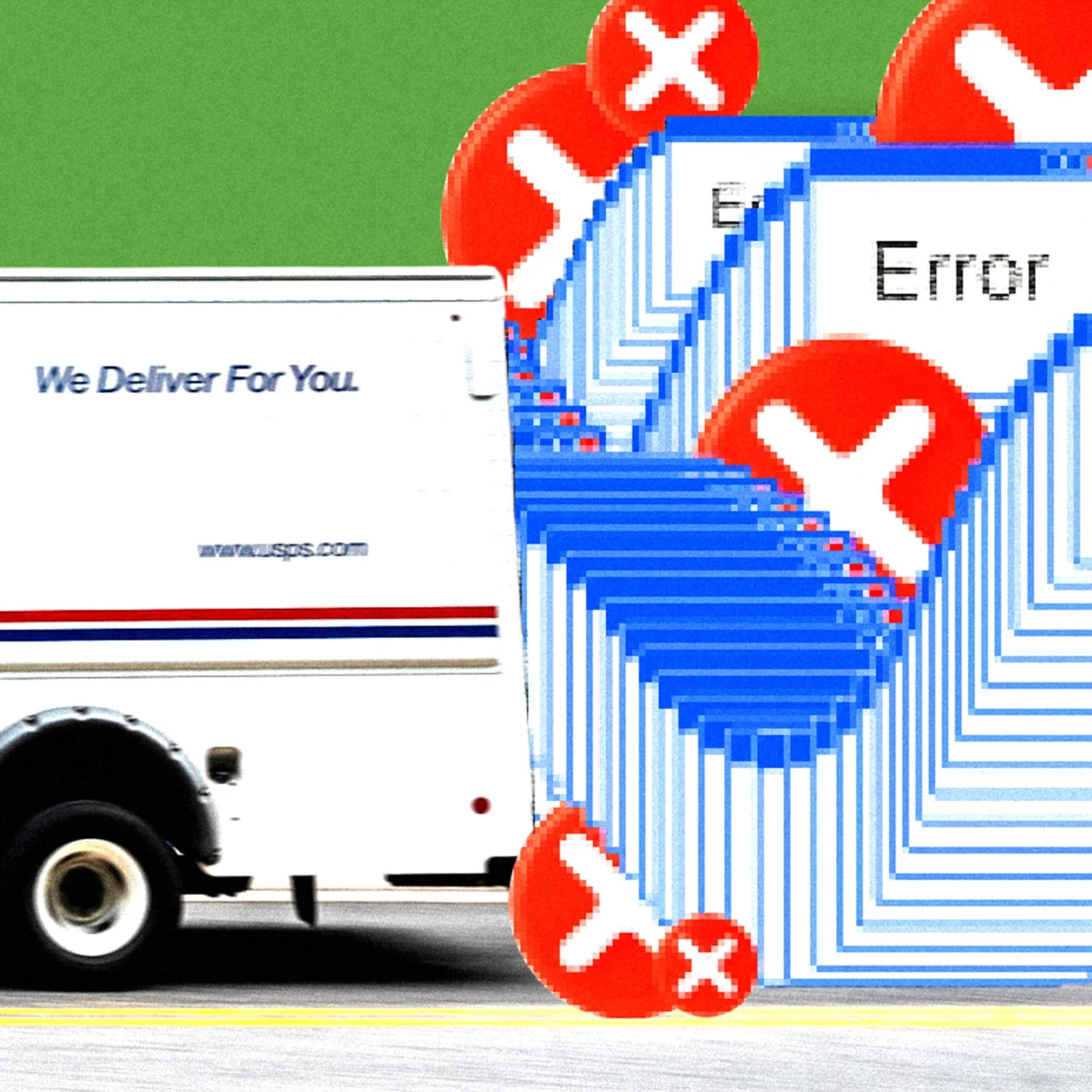
When Emilia Rybak attempted to update her residency from New York to Florida last autumn, she expected the transition to be a standard administrative procedure. Navigating to the United States Postal Service (USPS) Movers Guide website, she followed the prompts to change her address, a task millions of Americans perform annually. After paying a $1.25 identity verification fee, Rybak encountered a prompt asking if she would like to update her voter registration simultaneously. For Rybak, a professional in user behavior research, the convenience seemed ideal. However, the ensuing digital experience revealed a sophisticated system of "dark patterns"—manipulative user interface designs intended to prioritize corporate advertising revenue over civic duty and consumer privacy.
Instead of being directed to a streamlined voter registration portal, Rybak was funneled into a gauntlet of unskippable advertisements. The website, operated by a private contractor named MyMove, presented her with offers for internet service providers, home security systems, and retail discounts. To progress toward her goal of registering to vote, Rybak was forced to interact with these commercial solicitations. The experience, which Rybak described as "highly unethical," highlights a growing tension between government-sanctioned public-private partnerships and the protection of citizen data and democratic access.
The Mechanics of Deception: Understanding Dark Patterns
The term "dark patterns," coined by user experience (UX) designer Harry Brignull, refers to interfaces crafted to trick users into doing things they might not otherwise do, such as buying insurance or signing up for recurring bills. In the context of the USPS-MyMove partnership, experts identify several specific manipulative techniques.
Lior Strahilevitz, a professor at the University of Chicago Law School, notes that MyMove employs an "egregious cocktail" of these patterns. His research indicates that aggressive dark patterns can quadruple the rate at which consumers inadvertently sign up for unwanted services. On the MyMove site, these include "forced action," where a user must navigate through advertisements to reach a promised service, and "interface interference," where the option to decline an offer is obscured by small, low-contrast text while the "accept" button is large and vibrant.
For example, when Rybak attempted to bypass internet offers, she was met with buttons labeled "Keep my current service" or "Get Deals," with no clear "Skip" or "No thanks" option. Even when attempting to close the browser window, a "confirmshaming" pop-up appeared, stating, "Don’t go yet! Moving is expensive, so why not save where you can?" Such tactics are designed to exhaust the user’s cognitive load, eventually leading them to surrender personal information simply to complete their original task.
A Chronology of the USPS and MyMove Partnership
The relationship between the USPS and the entity now known as MyMove spans over three decades, tracing back to an era when the federal government sought to "reinvent" itself through private sector efficiencies.
1992: The Pilot Program
The partnership began when entrepreneurs Brett Matthews and Virginia Salazar proposed a way for the USPS to modernize its change-of-address process at no cost to the taxpayer. They formed Targeted Marketing Solutions and pitched a model where advertisers would fund the distribution of "welcome kits" to movers in exchange for access to their new addresses.
1995–1997: National Expansion and Federal Recognition
By 1995, the company secured an exclusive national contract. In 1997, the program received high-level political endorsement when then-Vice President Al Gore presented Matthews with an award for government innovation. Gore praised the initiative as a model for "good enough for government work" meaning the highest level of quality and efficiency.
2001–2015: Digital Transition and Corporate Acquisitions
In 2001, the first Mover’s Guide website was launched, shifting the focus from physical coupon books to digital lead generation. The company, rebranded as Imagitas, was sold to Pitney Bowes in 2005 for $230 million. A decade later, in 2015, it was acquired for $310 million by Red Ventures, a massive marketing and technology conglomerate that renamed the service MyMove.
2020–2023: Whistleblower Allegations and Settlement
The partnership’s integrity was formally questioned in 2020 when Marcos Arellano, a former director of operations at MyMove, filed a whistleblower lawsuit. Arellano alleged that MyMove and Red Ventures had defrauded the USPS by misclassifying revenues and expenses to avoid sharing the full scope of profits with the postal agency. In 2023, the companies paid $2.75 million to settle these allegations, though they admitted no liability.
Financial Incentives and the "Secret Contract"
The persistence of the MyMove partnership, despite mounting user complaints and legal scrutiny, is rooted in its unique financial structure. The USPS operates as a self-funding entity and does not receive taxpayer dollars for its day-to-day operations. Consequently, it relies heavily on ancillary revenue streams.
Under the terms of the agreement, MyMove manages the change-of-address infrastructure for free. In return, MyMove is permitted to monetize the data of "visitors and abandoners" of the site. Revenue generated from advertisers—who pay for the privilege of appearing in the "flow"—is split between MyMove and the USPS. While the specific percentages of this split remain confidential, the whistleblower complaint suggested that the USPS is guaranteed a minimum annual payment.
The USPS has consistently shielded the details of this contract from public view. Unlike most federal agencies, the USPS claims an exemption from the Freedom of Information Act (FOIA) regarding its commercial contracts, arguing that disclosing such information would put it at a competitive disadvantage against private shippers like FedEx and UPS. This lack of transparency prevents independent auditors from assessing whether the "dark patterns" used on the site are a requirement of the contract or a choice made by MyMove to maximize its own margins.
Regulatory Risks and the Impact on Voter Participation
The use of deceptive design in a civic context—specifically voter registration—raises significant legal and ethical concerns. Johanna Gunawan, a professor at Maastricht University, emphasizes that while users might expect aggressive marketing on an e-commerce site, they anticipate a higher standard of neutrality from a government-branded portal.
The Federal Trade Commission (FTC) has recently signaled a crackdown on dark patterns. In 2023, the agency secured a $2.5 billion settlement with Amazon over manipulative designs that made it difficult for customers to cancel Prime subscriptions. Similarly, Epic Games was ordered to pay $245 million for using dark patterns to trick players into making unwanted in-game purchases.
Legal experts suggest that MyMove’s current interface could be vulnerable to similar regulatory action. A former FTC official, speaking on the condition of anonymity, described the presentation of choices on the MyMove site as "deeply problematic" and "easily fixable," suggesting that the company continues the practice only because of the significant revenue at stake.
Furthermore, the "digital friction" created by these ads may serve as a deterrent to voter registration. When a user like Rybak is forced through multiple pages of ads to reach a registration form, the likelihood of "drop-off" increases. In Rybak’s case, she eventually abandoned the process entirely, frustrated by the lack of a clear path to the actual registration documents.
Official Responses and Industry Feedback
In response to inquiries regarding the user experience, the USPS issued a statement acknowledging "some customer discontent." The agency noted that it processes 24 million change-of-address requests annually and emphasized that movers have alternative methods for updating their records, such as visiting a physical post office. The USPS stated it is "actively working with MyMove to increase transparency and enhance the customer experience."
MyMove, for its part, defended its practices by stating that all users who begin the voter registration process receive a follow-up email with the necessary instructions and forms, regardless of whether they engage with the promotional offers. "We understand that online experiences, particularly those connected to civic processes, demand particular care," the company stated, adding that they regularly review and refine their products based on customer feedback.
However, many users remain unconvinced. Online review platforms like Trustpilot are replete with testimonials calling the service a "middle-man scam" and "predatory." The core of the criticism lies in the perceived "enshittification" of a public service—a process where a platform’s utility to the user is sacrificed to extract maximum value for advertisers and shareholders.
Broader Implications for Public Trust
The USPS-MyMove saga serves as a cautionary tale about the long-term costs of public-private partnerships that lack sufficient oversight. While the program successfully shifted the costs of the change-of-address system away from the government, it did so by treating citizens as products to be sold to the highest bidder.
The erosion of trust is perhaps the most significant consequence. When a citizen interacts with a government-sanctioned website and feels manipulated or deceived, that frustration often transfers to the institution itself. As Gunawan notes, "It messes with my perception of trust because I trust the public institution, and I trust that their contracts are made in the best interest of citizenry."
As the 2024 election cycle approaches, the efficiency and integrity of voter registration systems are under intense scrutiny. The presence of commercial barriers in the path of a prospective voter represents not just a failure of web design, but a potential failure of democratic accessibility. For the USPS to reclaim its reputation for "the highest level of quality," it may need to reconsider whether the revenue generated by MyMove is worth the cost of its users’ trust and privacy.
About the Author