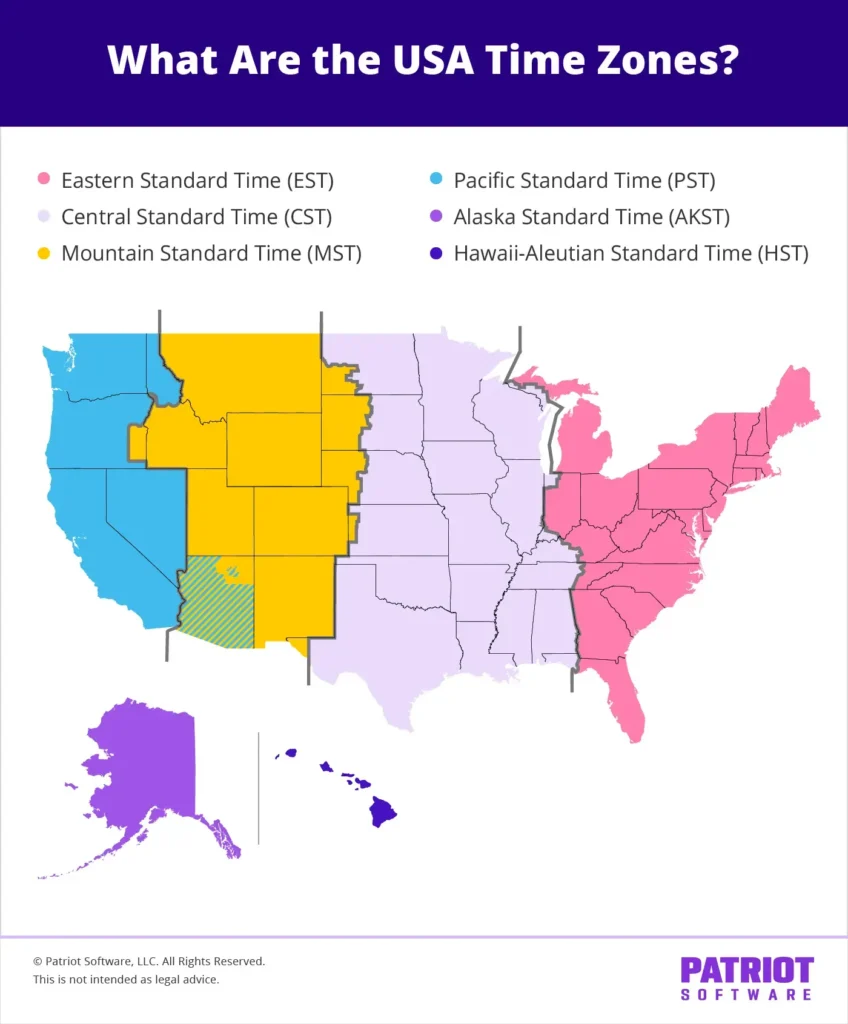
The intricate tapestry of time zones across the United States presents a unique challenge for businesses operating in an increasingly decentralized and remote work environment. From the bustling financial centers of the East Coast to the tech hubs on the West, understanding and effectively managing these temporal discrepancies is no longer a mere logistical consideration but a critical component of operational efficiency and employee well-being. This comprehensive guide delves into the complexities of U.S. time zones, their impact on business, the nuances of Daylight Saving Time, and actionable strategies for navigating this ever-present challenge.
The Ubiquitous Impact of Time Zones on Modern Business
In today’s hyper-connected global economy, businesses frequently interact with partners, clients, and employees spread across vast geographical distances. This necessitates a keen awareness of time zone differences, which can significantly influence communication, scheduling, and productivity. The rise of remote work, accelerated by recent global events, has amplified this need. According to a 2023 report by Gallup, approximately 45% of full-time U.S. employees continue to work from home, a significant portion of whom may be distributed across various time zones. This distributed workforce model, while offering flexibility, demands robust strategies to mitigate potential disruptions caused by differing local times.
The implications are far-reaching. Imagine a scenario where a sales team in New York attempts to contact a vendor in Los Angeles only to find the latter has already closed for the day. Or consider the frustration of an employee in Chicago agreeing to a meeting at 3 p.m. their local time, only to realize their colleague in Portland is already heading home at 3 p.m. PST, which is 6 p.m. EST. These seemingly minor misalignments can lead to missed opportunities, decreased customer satisfaction, and internal friction. Furthermore, the coordination of project deadlines, the execution of critical operational tasks, and the scheduling of team-wide communications all hinge on a precise understanding of when each team member is actively available.
Understanding the Six U.S. Time Zones
The United States, encompassing its contiguous states, Alaska, and Hawaii, is divided into six primary time zones. Each zone represents a distinct segment of the day, calculated relative to Coordinated Universal Time (UTC). Navigating these zones requires a clear understanding of their geographical spread and the corresponding time differences.
- Eastern Standard Time (EST): This is the easternmost time zone, covering states from Maine down to Florida, and extending westward to include Ohio and parts of Michigan. During standard time, EST is UTC-5. When Daylight Saving Time is in effect, it becomes Eastern Daylight Time (EDT), which is UTC-4.
- Central Standard Time (CST): Situated west of EST, CST spans a significant portion of the Midwest and the South, including states like Illinois, Wisconsin, and Texas. CST is UTC-6, transitioning to Central Daylight Time (CDT), UTC-5, during DST.
- Mountain Standard Time (MST): This zone covers states primarily in the Rocky Mountain region, such as Colorado, Utah, and Montana. MST is UTC-7. Notably, Arizona (with the exception of the Navajo Nation) and Hawaii do not observe Daylight Saving Time, meaning their clocks remain on MST year-round.
- Pacific Standard Time (PST): Located on the West Coast, PST encompasses California, Washington, and Oregon. PST is UTC-8, becoming Pacific Daylight Time (PDT), UTC-7, during DST.
- Alaska Standard Time (AKST): This zone covers the majority of Alaska. AKST is UTC-9, and during DST, it becomes Alaska Daylight Time (AKDT), UTC-8.
- Hawaii-Aleutian Standard Time (HST): This is the westernmost time zone, encompassing Hawaii and the Aleutian Islands of Alaska. HST is UTC-10. Like Arizona, Hawaii does not observe Daylight Saving Time and remains on HST year-round.
The visual representation of these time zones, often depicted on maps, underscores their geographical distribution and highlights the significant temporal gaps that can exist between different regions of the country. For instance, when it is noon in New York (EST), it is 9 a.m. in Los Angeles (PST), a three-hour difference that can necessitate careful planning for synchronous activities.
The Complicating Factor: Daylight Saving Time (DST)
Adding another layer of complexity to this temporal landscape is Daylight Saving Time (DST). This practice, observed in most of the United States, involves advancing clocks by one hour during the spring and setting them back by one hour in the fall. DST officially begins on the second Sunday in March and concludes on the first Sunday in November, encompassing a total of 34 weeks. The primary rationale behind DST is to extend daylight hours into the evening during the warmer months, theoretically promoting energy conservation and providing more time for outdoor activities.
However, the observance of DST is not universal. As previously mentioned, Hawaii and most of Arizona opt out of this biannual clock change, remaining on their standard time year-round. This creates fluctuating time differences between these states and those that observe DST. For example, during the period when DST is active, the time difference between Ohio (EST/EDT) and Arizona (MST) is three hours. But once Ohio reverts to EST in November, and Arizona remains on MST, the time difference shrinks to two hours. This inconsistency can be a recurring source of confusion for businesses and individuals alike.
The Debate Around Permanent Daylight Saving Time
The biannual clock change has been a subject of ongoing debate for years, with many advocating for a permanent switch to either standard or daylight saving time. In the U.S., several legislative proposals have been introduced in Congress to make DST permanent. As of early 2026, these proposals remain stalled. If enacted, such legislation would not only standardize DST across states but would also address the unique situation of Arizona and Hawaii, potentially allowing them to remain on standard time if they choose. The implications of making DST permanent are significant, impacting everything from sleep patterns and public health to economic activity and energy consumption.
Charting the States: A Practical Reference
To facilitate a clear understanding of which states fall under which time zones, the following charts provide a comprehensive overview. It is crucial to note that some states are split across multiple time zones, with the division often occurring along county or town lines. These areas are marked with an asterisk (*) for clarity.
Chart 1: States by Time Zone
This chart categorizes states based on their primary time zone.
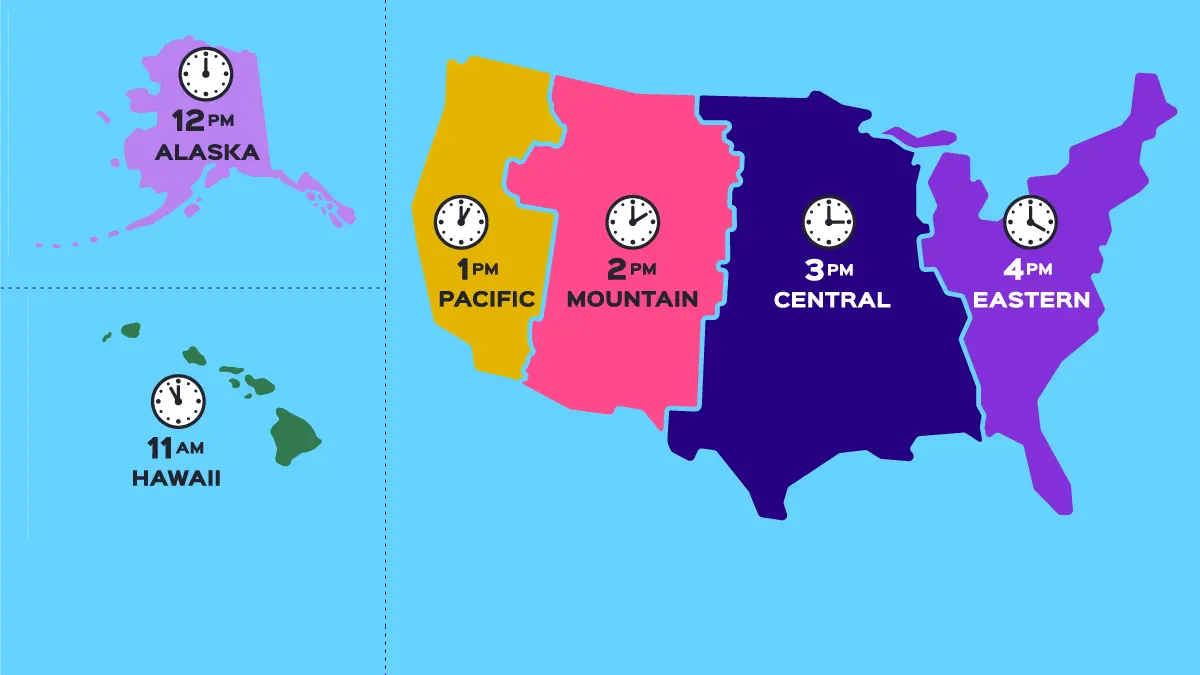
| Eastern Standard Time | Central Standard Time | Mountain Standard Time | Pacific Standard Time | Alaska Standard Time | Hawaii-Aleutian Standard Time |
|---|---|---|---|---|---|
| Connecticut | Alabama | Arizona | California | Alaska | Hawaii |
| Delaware | Arkansas | Colorado | Idaho* | ||
| D.C. | Florida* | Idaho* | Nevada* | ||
| Florida* | Illinois | Kansas* | Oregon* | ||
| Georgia | Indiana* | Montana | Washington | ||
| Indiana* | Iowa | Nebraska* | |||
| Kentucky* | Kansas* | Nevada* | |||
| Maine | Kentucky* | New Mexico | |||
| Maryland | Louisiana | North Dakota* | |||
| Massachusetts | Michigan* | Oregon* | |||
| Michigan* | Minnesota | South Dakota* | |||
| New Hampshire | Mississippi | Texas* | |||
| New Jersey | Missouri | Utah | |||
| New York | Nebraska* | Wyoming | |||
| North Carolina | North Dakota* | ||||
| Ohio | Oklahoma | ||||
| Pennsylvania | South Dakota* | ||||
| South Carolina | Tennessee* | ||||
| Tennessee* | Texas* | ||||
| Vermont | Wisconsin | ||||
| Virginia | |||||
| West Virginia |
Chart 2: States Alphabetically by Time Zone
This chart provides an alphabetical listing of states and their corresponding time zone(s).
| State | Time Zone(s) |
|---|---|
| Alabama | Central Standard Time |
| Alaska | Alaska Standard Time |
| Arizona | Mountain Standard Time |
| Arkansas | Central Standard Time |
| California | Pacific Standard Time |
| Colorado | Mountain Standard Time |
| Connecticut | Eastern Standard Time |
| Delaware | Eastern Standard Time |
| D.C. | Eastern Standard Time |
| Florida | Eastern Standard Time, Central Standard Time |
| Georgia | Eastern Standard Time |
| Hawaii | Hawaii-Aleutian Standard Time |
| Idaho | Mountain Standard Time, Pacific Standard Time |
| Illinois | Central Standard Time |
| Indiana | Eastern Standard Time, Central Standard Time |
| Iowa | Central Standard Time |
| Kansas | Central Standard Time, Mountain Standard Time |
| Kentucky | Central Standard Time, Eastern Standard Time |
| Louisiana | Central Standard Time |
| Maine | Eastern Standard Time |
| Maryland | Eastern Standard Time |
| Massachusetts | Eastern Standard Time |
| Michigan | Eastern Standard Time, Central Standard Time |
| Minnesota | Central Standard Time |
| Mississippi | Central Standard Time |
| Missouri | Central Standard Time |
| Montana | Mountain Standard Time |
| Nebraska | Central Standard Time, Mountain Standard Time |
| Nevada | Pacific Standard Time, Mountain Standard Time |
| New Hampshire | Eastern Standard Time |
| New Jersey | Eastern Standard Time |
| New Mexico | Mountain Standard Time |
| New York | Eastern Standard Time |
| North Carolina | Eastern Standard Time |
| North Dakota | Central Standard Time, Mountain Standard Time |
| Ohio | Eastern Standard Time |
| Oklahoma | Central Standard Time |
| Oregon | Pacific Standard Time, Mountain Standard Time |
| Pennsylvania | Eastern Standard Time |
| Rhode Island | Eastern Standard Time |
| South Carolina | Eastern Standard Time |
| South Dakota | Central Standard Time, Mountain Standard Time |
| Tennessee | Central Standard Time, Eastern Standard Time |
| Texas | Central Standard Time, Mountain Standard Time |
| Utah | Mountain Standard Time |
| Vermont | Eastern Standard Time |
| Virginia | Eastern Standard Time |
| Washington | Pacific Standard Time |
| West Virginia | Eastern Standard Time |
| Wisconsin | Central Standard Time |
| Wyoming | Mountain Standard Time |
For businesses operating internationally, understanding global time zones is equally imperative. Resources like timeanddate.com offer detailed maps and conversion tools for worldwide time zone management.
Strategies for Seamless Time Zone Management
Effectively managing time zone differences is crucial for avoiding miscommunications and ensuring smooth operations. Whether coordinating with remote teams, interacting with vendors, or serving customers, proactive strategies can significantly alleviate confusion and enhance productivity.
Practical Tips for Handling Time Zone Differences:
- Clearly State Time Zones: When scheduling meetings, setting deadlines, or communicating important times, always specify the time zone. For example, instead of "meeting at 2 p.m.," use "meeting at 2 p.m. EST" or "meeting at 11 a.m. PST."
- Utilize World Clocks and Calendars: Employ digital calendars and tools that automatically display multiple time zones or allow for easy conversion. Many operating systems and productivity suites offer built-in world clock features.
- Establish Core Working Hours: For teams spread across different zones, define a set of "core hours" during which all members are expected to be available for synchronous communication and collaboration. This typically involves finding an overlap that accommodates the majority of team members.
- Document and Share Time Zone Information: Create and maintain an easily accessible document or internal wiki that lists the time zones of all key employees, partners, and vendors. This serves as a quick reference for everyone.
- Be Mindful of Business Hours: Always consider the local business hours of the parties you are contacting. A quick check of their time zone can prevent frustration and ensure timely responses.
- Leverage Asynchronous Communication: For tasks that do not require immediate real-time interaction, embrace asynchronous communication methods like email, project management platforms, and shared documents. This allows individuals to contribute on their own schedule.
- Embrace Technology: Invest in collaboration tools that can automatically adjust meeting times based on participants’ time zones or display their current local time. Time and attendance software can also be invaluable for managing hourly employees across different locations.
- Consider Time Zone Overlap for Meetings: When scheduling meetings, aim for times that fall within the standard working hours of the majority of attendees. If a perfect overlap is impossible, rotate meeting times to ensure fairness for all participants over time.
- Provide Clear Instructions for International Communications: If your business interacts with international clients or partners, ensure that all employees understand how to accurately convert times and consider cultural norms around communication timing.
Frequently Asked Questions About U.S. Time Zones
What are the main time zones in the United States?
The primary time zones in the United States are Eastern, Central, Mountain, and Pacific. Additionally, Alaska and Hawaii have their own distinct time zones, bringing the total to six.
Why are there different time zones?
Time zones were established to align the clock with solar noon, ensuring that daylight hours are most effectively utilized throughout the day across different geographical regions. This system helps to avoid situations where the sun is still high in the sky at midnight or has already set by noon.
How many time zones are in the United States?
There are six official time zones in the United States: Eastern, Central, Mountain, Pacific, Alaska, and Hawaii-Aleutian. Four of these are located within the contiguous U.S.
How can businesses manage employees working in different time zones?
Businesses can effectively manage employees across different time zones by utilizing time and attendance software, clearly specifying the time zone for all scheduled events and deadlines, providing equivalent times for various zones, and employing collaboration tools that automatically display team members’ local times.
What is Daylight Saving Time (DST)?
Daylight Saving Time is the practice of advancing clocks by one hour in the spring and setting them back by one hour in the fall. This is done to maximize daylight during the evening hours in warmer months.
Do all U.S. states observe Daylight Saving Time?
No, not all U.S. states observe Daylight Saving Time. Hawaii and most of Arizona (excluding the Navajo Nation) do not participate in DST and remain on their standard time year-round.
What tools help teams work across time zones?
Several tools can facilitate effective teamwork across time zones, including time and attendance software, project management platforms (e.g., Asana, Trello), and communication and collaboration suites (e.g., Slack, Microsoft Teams) that often feature built-in time zone awareness.
By understanding the intricacies of U.S. time zones and implementing strategic management practices, businesses can transform a potential logistical hurdle into an opportunity for enhanced operational efficiency and a more inclusive work environment for their distributed teams.
About the Author