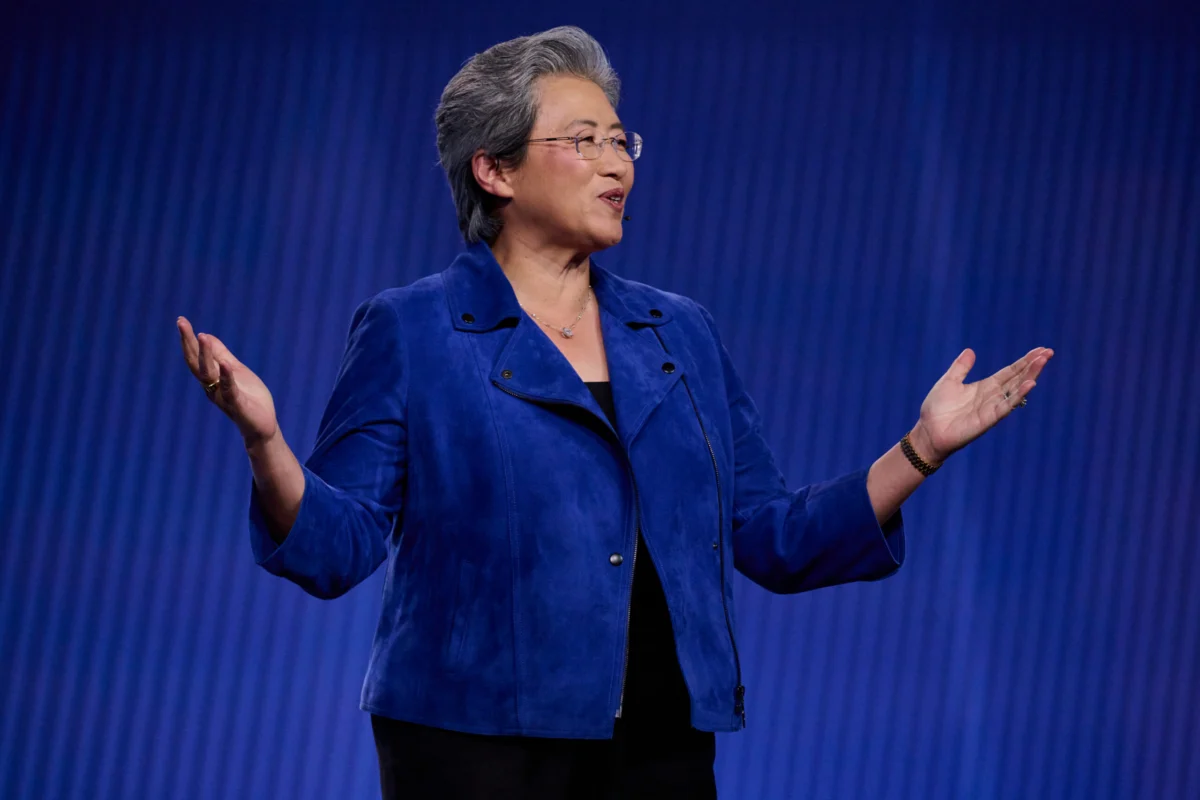
San Francisco, CA – [Date of Publication] – Chipmaker Advanced Micro Devices (AMD) has officially unveiled its highly anticipated rack-scale system, codenamed Helios, directly challenging competitor Nvidia’s long-standing dominance in the critical market of powering the world’s largest artificial intelligence laboratories. The announcement, made at AMD’s sold-out Advancing AI conference in San Francisco, marks a significant strategic move by the company to capture a larger share of the burgeoning AI hardware sector.
AMD’s Bold Entry into the AI Rack Market
At the heart of AMD’s offensive is the Helios system, a comprehensive, high-density computing solution designed to meet the insatiable demands of cutting-edge AI research and development. Dr. Lisa Su, AMD’s Chair and CEO, presented Helios as the industry’s "highest-performance AI rack," engineered to "train and run the most demanding frontier models in the world at massive scale." The company stated that Helios will be deployed by leading AI entities at gigawatt-scale, underscoring the immense power and capacity of the new system.
Rack systems are the backbone of modern data centers, consolidating numerous high-performance processors into a single, powerful unit. These systems are indispensable for the intensive computational tasks involved in training and running complex AI models, as well as other compute-intensive workloads that are increasingly defining technological advancement.
Helios: A Direct Competitor to Nvidia’s Reign
Nvidia has historically held a near-monopoly in this lucrative market, primarily with its Vera Rubin and Grace Blackwell rack-scale systems. AMD’s Helios is positioned as a direct and formidable competitor, with early reports suggesting significant performance advantages. According to an analysis by The Register, Helios appears to outperform Nvidia’s Vera Rubin on a number of key metrics, signaling a genuine opportunity for AMD to disrupt the established order.
The introduction of Helios represents a culmination of AMD’s strategic investments in AI hardware. The system, first revealed in 2025 and showcased onstage at CES 2026, has already secured a formidable list of early adopters. These include industry giants such as OpenAI, Meta, Oracle, Anthropic, and Microsoft, all of which have publicly announced plans to integrate Helios into their AI infrastructure.
Key Partnerships and Deployments
The partnerships announced underscore the significance of AMD’s entry. Microsoft CEO Satya Nadella confirmed on Monday that the tech behemoth would be expanding its Azure cloud infrastructure with Helios. This collaboration highlights Microsoft’s commitment to diversifying its AI hardware suppliers and leveraging AMD’s advanced capabilities.
In a particularly impactful development, AMD and Anthropic announced a strategic partnership on Wednesday. This collaboration aims to deploy up to two gigawatts of AMD Instinct MI450 series GPUs through the new Helios rack system. Such a substantial deployment signifies a long-term commitment and a strong vote of confidence from one of the leading AI research organizations.
Expanding the AI Compute Portfolio: Venice-X CPU
Beyond the Helios rack system, AMD also used the Advancing AI conference to introduce its Venice-X CPU. This new processor is specifically engineered for data centers and is designed to handle the most demanding high-computing workloads. The Venice-X CPU is slated for a 2027 launch, further bolstering AMD’s comprehensive offerings for the AI industry. This dual-pronged approach, focusing on both high-density rack solutions and powerful individual processors, demonstrates AMD’s holistic strategy to cater to the diverse needs of AI development.
The Escalating Demand for AI Compute Power
Dr. Su’s remarks at the conference provided a stark overview of the trajectory of the chip industry and the pivotal role of AI. She asserted that by 2030, chips designed to power artificial intelligence will constitute a massive segment of the overall computing market. This projection is driven by what she described as a "step change in compute demand," largely fueled by the rapid evolution and widespread adoption of agentic AI.
Agentic AI, characterized by its ability to perform complex tasks autonomously, requires significantly more computational resources. "When you ask the agent to do something, it actually has dozens of steps, and it has to reason, and it has to call tools, and it has to access data, and it has to keep doing it over and over until it solves the problem, and so you need lots of GPUs to do all that," explained Dr. Su. This intricate process necessitates a parallel increase in the availability of powerful, scalable computing solutions like the Helios system.
Market Projections and the Future of AI Accelerators
The scale of the projected growth in the AI accelerator market is staggering. Dr. Su anticipates that by 2030, the AI accelerator market will reach approximately $1.4 trillion. To put this into perspective, she stated, "What that means is, by the end of the decade, the AI accelerator market is going to approach the size of the entire semiconductor market today." This projection underscores the transformative impact of AI on the global technology landscape and the immense opportunities it presents for companies like AMD.
The dominant role of GPUs within this rapidly expanding market is also a key observation. Dr. Su elaborated, "We do expect that GPUs are going to make up the vast majority of that market because the algorithms are still very much in their infancy, and we’re still continuing to see the workloads change, and that favors programmability in the overall silicon ecosystem." This focus on programmability and flexibility, inherent in GPU architectures, is crucial as AI research continues to evolve and new algorithmic approaches emerge. AMD’s investment in its Instinct line of GPUs, integral to the Helios system, aligns perfectly with this market trend.
Background and Context: The Advancing AI Conference
The Advancing AI conference, held in San Francisco, served as the premier platform for AMD to unveil its latest innovations and articulate its vision for the future of AI. The event, which was reportedly sold out, attracted a significant number of industry leaders, researchers, developers, and media representatives, signaling the high level of interest and anticipation surrounding AMD’s advancements. Such conferences are critical for technology companies to not only announce new products but also to foster ecosystem development, showcase customer success stories, and engage directly with the community that drives technological progress. The choice of San Francisco, a global hub for technology and AI innovation, further amplified the event’s significance.
Implications for the Semiconductor Industry and Beyond
AMD’s aggressive push into the AI rack market has profound implications for the broader semiconductor industry. By directly challenging Nvidia, AMD is likely to intensify competition, potentially leading to accelerated innovation and more competitive pricing for AI hardware. This increased competition could benefit AI labs and cloud providers by offering more choices and potentially driving down costs, thereby democratizing access to advanced AI computing resources.
The success of Helios could also signal a shift in the established power dynamics within the semiconductor landscape. For years, Nvidia has been the undisputed leader in AI hardware, particularly in the high-performance computing segment. AMD’s robust challenge, backed by significant customer commitments and impressive technical specifications, suggests that this dominance may be tested more rigorously in the coming years.
Furthermore, the sheer scale of the projected AI market underscores the importance of companies like AMD in enabling future technological breakthroughs. The development of more sophisticated AI models, capable of tackling complex global challenges in areas such as climate science, healthcare, and advanced materials, will depend on the availability of increasingly powerful and efficient computing infrastructure. AMD’s investment in systems like Helios is a direct response to this escalating need.
The company’s strategic focus on AI accelerators, coupled with its ongoing advancements in CPU technology, positions it as a key player in the ongoing technological revolution. The coming years will undoubtedly be a crucial period for AMD as it seeks to translate its ambitious product roadmap and strategic partnerships into sustained market share and technological leadership in the rapidly evolving world of artificial intelligence. The competitive landscape for AI compute is clearly entering a new and dynamic phase, with AMD emerging as a significant contender.
About the Author