Understanding Cost Per Lead (CPL) is vital for businesses seeking to maximize their marketing expenditures and ensure the efficacy of their outreach strategies. This fundamental metric provides a clear picture of the financial investment required to acquire a single potential customer, enabling organizations to refine their campaigns, allocate budgets more strategically, and ultimately drive greater return on investment (ROI). Without a firm grasp of CPL, businesses risk inefficient spending and missed opportunities in an increasingly competitive marketplace.
The Significance of Cost Per Lead in Modern Business
In today’s dynamic business environment, marketing is not merely an expense but a critical investment in future growth. The adage "you have to speculate to accumulate" holds particularly true in the realm of lead generation. However, the true effectiveness of marketing efforts hinges on understanding the precise cost associated with attracting each prospective client. This is where the calculation of Cost Per Lead (CPL) becomes indispensable. CPL serves as a powerful diagnostic tool, allowing businesses to assess the performance of their marketing and sales initiatives with clarity and precision.
The core purpose of CPL is to quantify the financial outlay required to generate a single lead. A lead, in this context, is defined as an individual or entity that has demonstrated interest in a company’s products or services. This interest can manifest in various ways, such as filling out a contact form on a website, downloading a whitepaper, subscribing to a newsletter, or engaging with a social media advertisement. By tracking CPL, businesses can gain insights into the efficiency of their digital marketing endeavors, enabling them to evaluate the performance of specific campaigns, assess the effectiveness of individual marketing channels, and gauge the overall efficiency of their marketing budget allocation.
It is crucial to distinguish CPL from Cost Per Acquisition (CPA). While CPA measures the total expenditure to acquire a paying customer or close a deal, CPL focuses solely on the cost of generating potential customers. This distinction is vital for understanding the initial stages of the sales funnel. Leads represent an early-stage engagement, whereas acquisitions signify a completed transaction. The journey from lead to customer often involves multiple touchpoints and requires further investment, making CPL a critical metric for evaluating the top of the marketing funnel.
Why Cost Per Lead Matters for Business Growth
Marketing typically constitutes a significant portion of a company’s overall operational expenses. Therefore, rigorously measuring the effectiveness of these investments and identifying avenues for optimization is paramount. Cost Per Lead emerges as a pivotal metric in this endeavor, offering invaluable insights into the performance of sales and marketing campaigns.
By understanding the financial commitment involved in generating each potential customer, businesses can optimize their marketing budget allocation and refine their client management strategies. This knowledge empowers them to compare the ROI of different marketing channels and strategies, allowing for increased investment in high-performing avenues while divesting from those that prove to be cost-ineffective.
Furthermore, when CPL data is analyzed in conjunction with other marketing metrics, it can reveal whether a particular campaign or channel is attracting the wrong type of leads – individuals or entities with a low probability of conversion. In such scenarios, CPL calculations can guide necessary adjustments, saving valuable time and financial resources.
Beyond performance analysis, CPL helps in challenging ingrained assumptions. A large-scale campaign generating significant attention and seemingly high-quality leads might be erroneously perceived as highly effective. However, a less conspicuous campaign with a lower operational cost might actually yield a better ROI if it attracts leads that are more inclined to convert. CPL provides the data to make such informed comparisons.
Defining a "Good" Cost Per Lead: Context is Key
The concept of a "good" Cost Per Lead is not universally defined; it is inherently contextual and varies significantly across businesses and industries. There is no single benchmark that applies to all. The determination of an optimal CPL is influenced by a multitude of factors, including:
- Industry: Highly competitive or high-value sectors, such as enterprise software, financial services, or specialized B2B markets, typically experience higher CPLs. This is attributed to the higher perceived value of each lead, longer and more complex sales cycles, and the need for highly specialized targeting. For instance, a B2B software company might have a significantly higher CPL than a direct-to-consumer e-commerce business due to the intricate nature of their sales process and the higher lifetime value of each client.
- Product/Service Value: The price point of a product or service plays a crucial role. A CPL of $80 might be considered prohibitive for a business selling items at $20 each. However, for a company offering services priced at $2,000, the same $80 CPL would represent an exceptionally good return. The revenue generated from a converted lead must comfortably exceed the cost of acquiring that lead.
- Target Audience: The specificity and accessibility of the target market influence CPL. Reaching niche audiences with specialized needs may require more targeted and thus more expensive marketing efforts. Conversely, broader consumer markets might allow for more cost-effective reach, potentially lowering CPL.
- Marketing Channels Used: Different marketing channels have inherent cost structures. Paid advertising platforms like Google Ads or social media advertising often have higher direct costs compared to organic strategies like content marketing and SEO, which require investment in time and resources but can yield lower CPLs over time as they build organic reach.
- Competition: The intensity of competition within an industry directly impacts marketing costs. In crowded markets, businesses often need to increase their ad spend and offer more compelling incentives to capture attention, leading to a higher CPL.
- Economic Conditions: Broader economic trends can influence consumer spending habits and the overall cost of advertising, indirectly affecting CPL. During economic downturns, businesses might reduce ad spend, potentially increasing CPL for remaining advertisers.
Ultimately, a "good" CPL is one that is lower than the expected revenue generated from an average lead. Conversely, a "bad" CPL occurs when the cost of lead generation exceeds the anticipated revenue, resulting in a net loss. Determining this expected revenue requires an understanding of average customer spend and conversion rates. Industry benchmarks can serve as a useful reference point, but the most relevant measure is internal profitability. A higher conversion rate from leads to customers can justify a higher CPL, especially when factoring in the potential lifetime value of a customer.
Calculating Your Cost Per Lead: A Step-by-Step Approach
To effectively calculate Cost Per Lead, a systematic approach is required. This involves meticulously tracking all relevant expenses and accurately counting the number of leads generated within a defined period.
1. Defining the Time Period: Consistency is key. Choose a specific timeframe for your calculations, such as a month, quarter, or year. This ensures that your CPL figures are comparable and allow for trend analysis. For instance, if you are analyzing a quarterly marketing campaign, you would sum all costs and leads generated within that three-month period.

2. Calculating Total Lead Generation Costs: This is the most comprehensive part of the calculation and requires meticulous accounting. All expenditures directly related to marketing and lead generation efforts within the chosen timeframe must be included. These costs can be broadly categorized:
- Advertising Costs: This includes direct ad spend on platforms like Google Ads, social media (Facebook, Instagram, LinkedIn), print advertising, and any other paid promotional activities.
- Ad Management Costs: This encompasses the cost of personnel or agencies responsible for creating, managing, and optimizing ad campaigns. This could be internal marketing team salaries allocated to ad management or fees paid to external advertising agencies.
- Inbound Marketing Costs: These are expenses related to attracting organic traffic and generating leads through content and engagement. This includes:
- Content Creation: Costs associated with writing blog posts, creating videos, designing infographics, producing webinars, etc.
- Website Development and Maintenance: Expenses related to website design, hosting, and ongoing optimization for lead capture.
- SEO Efforts: Costs for keyword research, on-page and off-page optimization, and link building.
- Social Media Management: Expenses related to content scheduling, community engagement, and social media advertising (if not already included in direct ad spend).
- Landing Page Development: Costs for creating and optimizing landing pages designed to capture lead information.
- Email Marketing Software and Campaigns: Costs for email marketing platforms and the resources dedicated to creating and sending email campaigns.
- Software and Tools: Expenses for any marketing automation tools, CRM systems, analytics platforms, graphic design software, or other technologies used in the lead generation process.
- Personnel Costs: A portion of the salaries for marketing team members whose roles directly contribute to lead generation efforts. This can be challenging to allocate precisely, but a reasonable estimation based on time spent is advisable.
- Agency Fees and Freelancer Costs: Any payments made to external agencies or freelancers for services such as content writing, graphic design, SEO consulting, or campaign management.
A simplified breakdown of costs for a given period might look like this:
Total Cost of Lead Generation = Advertising Costs + Ad Management Costs + Inbound Marketing Costs + Software & Tools Costs + Personnel Costs + Agency Fees
Where:
Advertising Costs = Ad Spend + Ad Management (if ad management is a separate budget line item)
Inbound Marketing Costs = Content Creation + Website Expenses + SEO Efforts + Social Media Management + Landing Page Development + Email Marketing Costs
3. Calculating the Total Number of Leads: This involves aggregating all leads generated through the various marketing channels during the same defined period. It’s important to have a clear definition of what constitutes a lead for your business and to track them consistently. This includes:
- Inbound Leads: Leads generated through organic search, social media engagement, content downloads, webinar registrations, website form submissions, and referrals from blog content.
- Outbound Leads: Leads generated through paid advertising (digital and traditional), direct mail campaigns, or other proactive outreach efforts.
Total Leads = Total Inbound Leads + Total Outbound Leads
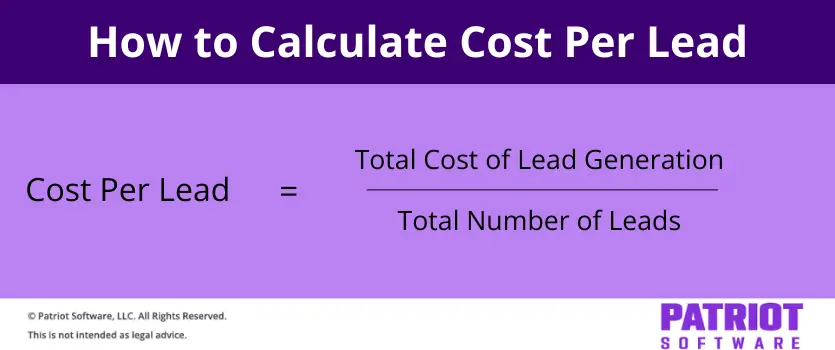
4. Performing the CPL Calculation: Once you have your total cost of lead generation and the total number of leads for the chosen period, the calculation is straightforward:
Cost Per Lead (CPL) = Total Cost of Lead Generation / Total Number of Leads
For example, if a business spent $5,000 on an email marketing campaign and generated 200 leads from it, the CPL for that campaign would be $5,000 / 200 = $25.
To further refine analysis, businesses can calculate CPL for individual campaigns, channels, or even specific target audiences. This granular approach provides deeper insights into what is working and where improvements are needed. For instance, one might calculate:
- CPL for Google Ads Campaigns: Total spend on Google Ads / Number of leads from Google Ads.
- CPL for Blog Content: Total cost of creating and promoting blog content / Number of leads attributed to blog content.
- CPL for a Specific Webinar: Total cost of the webinar (platform, promotion, speaker fees) / Number of leads generated from webinar registrations.
Many platforms, including Google Ads and Facebook Ads, provide built-in tools to track CPL for their respective campaigns. Additionally, specialized tools like Leadfeeder offer CPL calculators and comprehensive lead tracking capabilities to streamline this process.
Leveraging Cost Per Lead for Strategic Advantage
Once CPL is calculated, its true value lies in its application. This metric empowers businesses to make informed decisions and optimize their marketing strategies.
1. Channel and Campaign Performance Evaluation: By calculating CPL for different marketing channels (e.g., social media, search engine marketing, email marketing) and individual campaigns, businesses can identify which avenues are most cost-effective in generating leads. This allows for a strategic reallocation of budget towards high-performing channels and a potential reduction or overhaul of underperforming ones. For instance, if social media advertising yields a CPL of $10 while paid search yields a CPL of $50, a business might consider shifting more resources to social media.
2. Identifying Profitable Target Groups: Calculating CPL for different customer segments or demographic groups can reveal which audiences are most cost-effective to reach. This allows for more precise targeting and tailored messaging, maximizing the chances of conversion.
3. Monitoring Trends and Opportunities: Regularly tracking CPL over time is essential. A consistently flat or increasing CPL might signal a need to re-evaluate marketing strategies, adapt to market changes, or explore new tactics. Conversely, a declining CPL can indicate successful optimization efforts. Identifying seasonal trends in CPL can also inform campaign timing and budget allocation.
4. Enhancing Lead Quality Assessment: While CPL focuses on the cost of generating a lead, it should be considered alongside lead quality. A low CPL is only truly effective if the leads generated are likely to convert. By pairing CPL data with conversion rates, businesses can discern whether a low CPL is a result of efficient targeting or the generation of low-quality leads. For example, a campaign with a very low CPL but a conversion rate of less than 1% might be less valuable than a campaign with a higher CPL but a 10% conversion rate.
5. Challenging Assumptions and Driving Innovation: CPL data can provide objective evidence to challenge deeply held beliefs about marketing effectiveness. It encourages a data-driven approach, pushing teams to experiment with new strategies and channels based on empirical results rather than intuition alone.
Strategies to Reduce Cost Per Lead
Lowering your Cost Per Lead directly translates to more efficient use of your marketing budget and a greater return on your investment. The most effective way to achieve this is by focusing on attracting more qualified leads, thereby reducing the cost associated with each one.
1. Aligning with Business Needs and Market Position:
For large enterprises with substantial revenue streams, a higher overall ad spend might be justifiable, especially in highly competitive markets. However, for smaller businesses, it is often prudent to start with a more modest budget. Careful monitoring of campaign analytics is crucial to identify the optimal point at which to scale spending. Understanding your business’s capacity for growth and its competitive landscape is foundational to setting realistic CPL targets.
2. Enhancing Audience Targeting:
Precision in audience targeting is paramount for increasing the number of quality leads and subsequently lowering CPL. Implementing retargeting campaigns for individuals who initially showed interest but did not convert can be highly effective. By presenting them with relevant content and tailored offers, you can re-engage them. If your current messaging isn’t resonating with the right prospects, it’s essential to refine your segmentation strategy. Focusing on demographics or groups that have historically demonstrated higher interest and conversion rates will yield better results. Adjusting your sales planning templates to reflect these refined segments is a crucial step in this process.
3. Optimizing Website Presence and User Experience:
Improving your website’s visibility and user experience can significantly boost organic reach and reduce CPL. Enhancing search engine rankings by targeting long-tail keywords—phrases used by searchers with high intent—is a strategic move. Maintaining fresh, relevant content and matching the style and length of successful competitor articles can also improve search performance. Beyond search visibility, optimizing website navigation, improving page loading speed, and refining landing pages are critical. Ensuring your lead magnets provide genuine value and adding clarifying questions to sign-up forms can help filter out less serious inquiries, thereby improving lead quality and reducing CPL.
4. Embracing A/B Testing for Continuous Improvement:
A/B testing is an invaluable tool for determining which marketing materials and approaches attract the most leads, thereby reducing CPL. Experiment with variations of landing page elements, such as headlines, calls-to-action (CTAs), and imagery. Test different ad creatives and messaging to see what resonates best with your target audience. It’s also wise to experiment with various marketing channels to identify the most effective ones and avoid over-reliance on a single strategy. Testing can also help optimize the timing of your advertisements and content publications, ensuring they reach your target audience when they are most active online.
5. Leveraging the Right Marketing Technology Stack:
Automating manual processes with the right software tools can significantly enhance lead generation efficiency and reduce CPL. While there is an initial investment in software, the long-term gains in efficiency, particularly in terms of human resources, can be substantial. Ensuring your team is adequately trained to utilize these tools effectively is crucial. Consider investing in specialized lead generation software, robust accounting software for expense tracking, automation tools for email and social media campaigns, and a comprehensive CRM system for managing lead and customer data.
6. Implementing Continuous Tracking and Analysis:
Regularly calculating and monitoring your CPL across different marketing methods, channels, and campaigns is non-negotiable. External factors such as economic shifts, industry trends, and the competitive landscape can change rapidly and impact your CPL. Therefore, it is imperative to evaluate CPL in the context of other key sales and marketing metrics, including conversion rates, Cost Per Acquisition (CPA), and overall Return on Investment (ROI). Surveying leads who have converted after a campaign, using metrics like Customer Satisfaction (CSAT) scores, can also provide valuable qualitative data to gauge campaign success and inform future strategies.
Conclusion: The Strategic Imperative of CPL Mastery
Calculating and understanding Cost Per Lead is not merely an accounting exercise; it is a strategic imperative for any business aiming to optimize its marketing expenditure and drive sustainable growth. Armed with this knowledge, organizations can effectively identify underperforming campaigns and channels, ensuring that their marketing budget is allocated to strategies with the highest probability of success.
A thorough CPL calculation necessitates the inclusion of all advertising costs, both inbound and outbound, as well as associated operational expenses. Defining what constitutes a "good" and "bad" CPL, tailored to the specific business context and industry benchmarks, is fundamental. By diligently applying the tips and strategies outlined, businesses can proactively work towards reducing their CPL, streamlining their marketing spend, and ultimately achieving a more efficient and profitable lead generation process. In an era where every dollar counts, mastering Cost Per Lead is a critical differentiator for success.
About the Author