The landscape of commerce, forever intertwined with the art of answering questions, has entered a new era. From the initial salesperson’s pitch to the ubiquitous search engine, the methods of finding answers have evolved. Now, Artificial Intelligence (AI) has been integrated into this quest, posing a fundamental challenge for businesses: how can one ascertain the effectiveness of AI-driven search initiatives? This question is no longer a niche concern for marketing technologists; it is a critical business imperative. AI search visibility ROI, a metric designed to quantify the business impact of a brand appearing in AI-generated answers across platforms like ChatGPT, Gemini, and Google’s AI Overviews, connects the frequency of brand mentions or citations by AI systems to tangible outcomes such as website traffic, sales pipeline growth, and ultimately, closed revenue. However, the nebulous nature of AI’s influence presents significant attribution challenges, leading to potentially costly blind spots for businesses. This comprehensive guide aims to clarify these complexities by outlining a robust three-layer measurement framework to understand AI search impact, calculate its ROI, and effectively communicate findings to leadership.
The Elusive Nature of AI Search Attribution
The core problem in measuring AI search visibility ROI lies in the indirect pathways through which users interact with brands after encountering them in AI-generated content. While some AI answers provide direct citations that generate referral traffic, a significant portion of user journeys unfold differently. A common scenario illustrates this challenge: a prospective buyer queries an AI for product recommendations, discovers a particular brand, and subsequently conducts a direct search for that brand on a traditional search engine days later. If this user then converts via a paid search advertisement for the brand, traditional last-click attribution models will credit the paid search campaign entirely, leaving AI with zero credit for initiating the discovery phase.
This attribution gap is amplified by evolving search behaviors. Data from early 2026 revealed a notable shift, with U.S. organic search traffic experiencing a year-over-year decline of approximately 2.5%. Concurrently, AI referral traffic to retail websites surged dramatically, by an astonishing 693% over the same period. This indicates a profound transformation in how consumers begin their research and purchasing journeys. While the notion that AI is "killing" web traffic is a subject of ongoing debate, the data unequivocally points to a substantial reallocation of user attention towards AI-driven discovery tools. The challenge is compounded by the fact that most AI search engines do not readily share referral data, making it difficult to trace their influence throughout the complex buyer’s journey. Therefore, the solution is not to abandon attribution efforts but to enhance them by incorporating a measurement layer capable of capturing these nascent AI touchpoints.
Key Metrics for Proving AI Search Visibility ROI
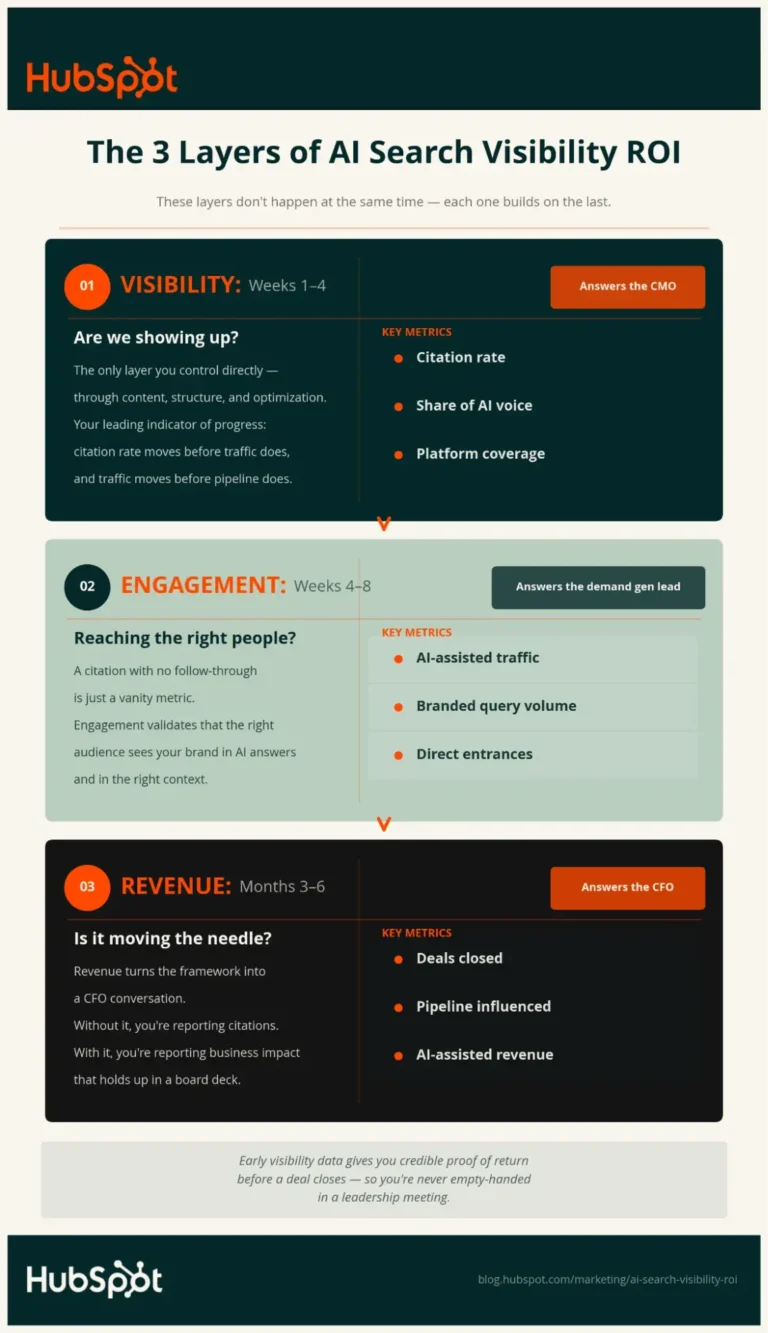
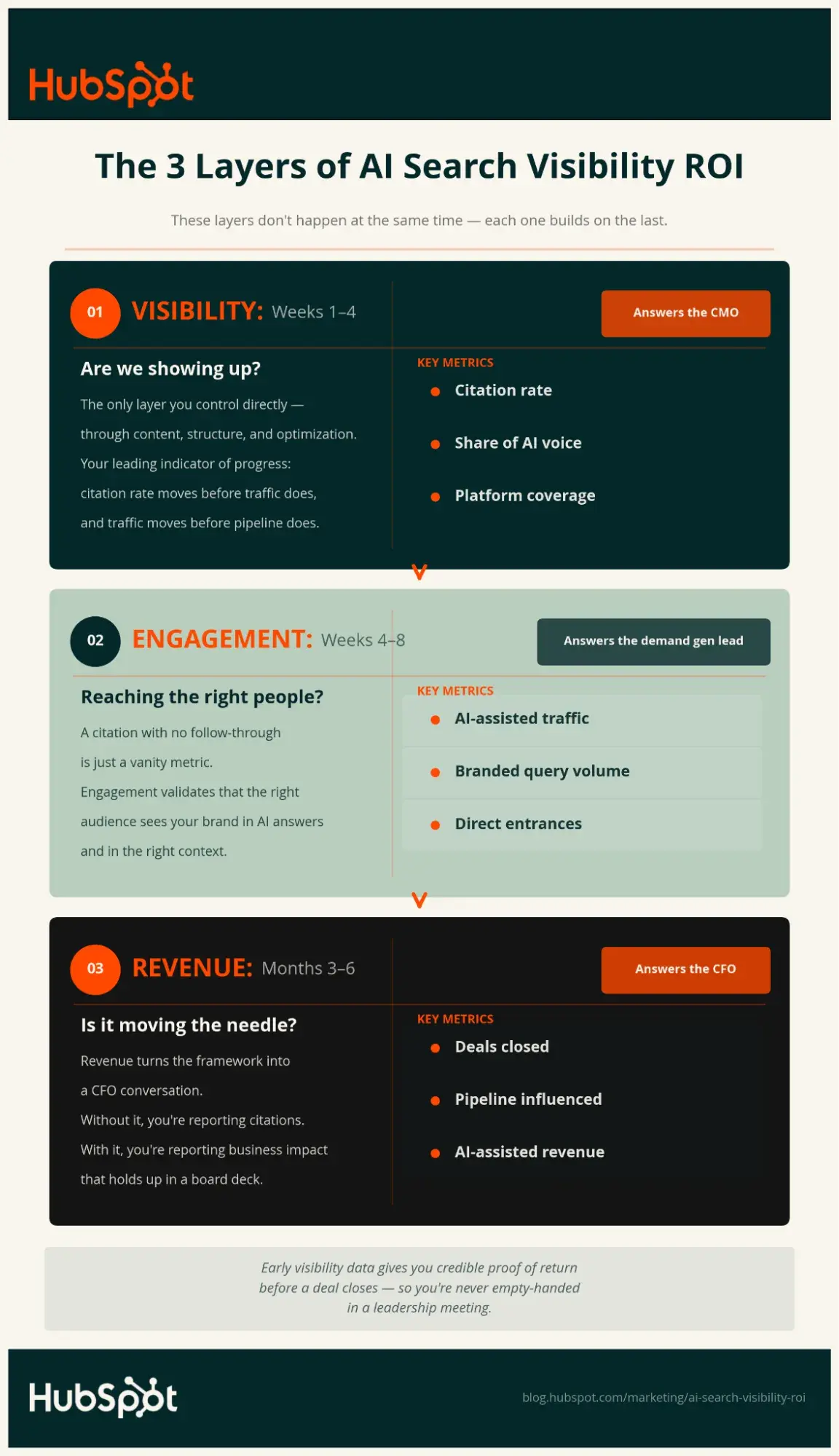
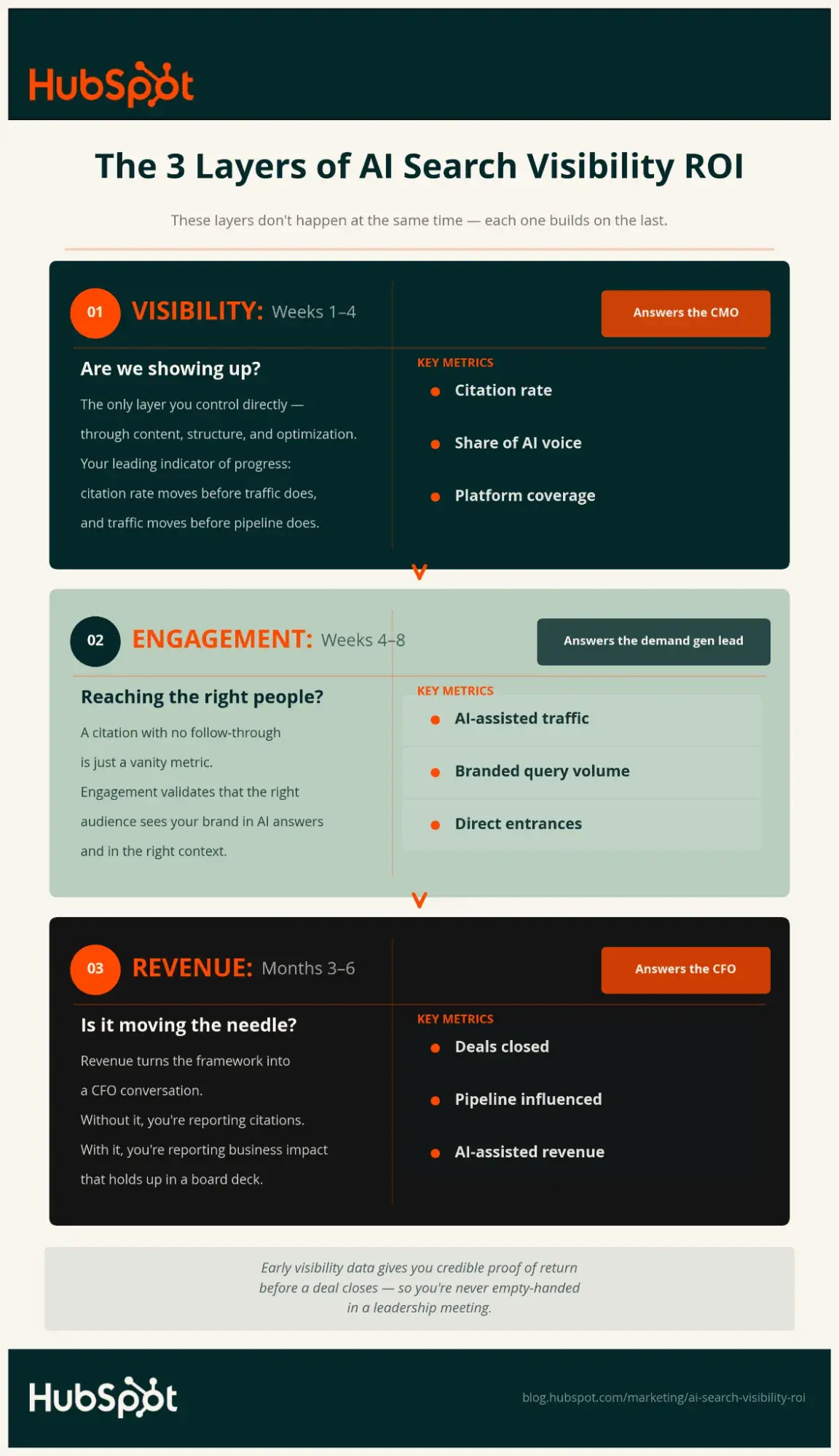
AI search visibility ROI quantifies the return on investment derived from a brand’s presence within AI-generated answers. While specific metrics may vary depending on organizational goals and data availability, a robust measurement framework typically encompasses three distinct layers, each serving a unique purpose in painting a comprehensive picture of AI’s impact. These layers operate in a sequential manner, often referred to as a "delayed funnel," meaning their effects do not manifest simultaneously.
Each layer also addresses a different stakeholder or concern. The first layer focuses on Visibility, providing foundational data that demonstrates the brand’s presence and recognition within AI outputs. This layer is crucial for convincing skeptics who may dismiss AI’s influence as mere "vanity metrics." The second layer, Engagement, builds upon visibility by measuring how users interact with the brand after encountering it through AI, offering context and demonstrating active interest. Finally, the third layer, Revenue, connects these earlier touchpoints to tangible business outcomes, providing the ultimate proof of ROI. Understanding the progression and interplay of these layers is paramount. Without visibility, it’s impossible to explain shifts in user behavior. Without engagement context, leadership may dismiss the data as superficial. Conversely, early visibility metrics can provide credible indicators of return even before a deal is finalized, ensuring that teams are not left without quantifiable data to present to leadership while the longer-term revenue impacts mature. A comprehensive approach that addresses all three layers over time establishes a measurement framework that is both defensible and impactful in board-level discussions.
Layer 1: Visibility – Tracking Share of AI Voice and Citations
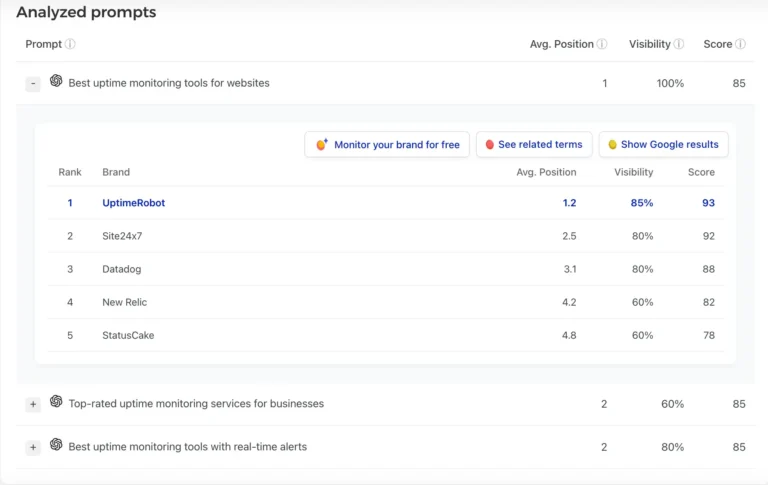
The foundational layer of AI search measurement focuses on Visibility. This involves two key metrics: Share of AI Voice (SAIV) and Citation Tracking. SAIV represents the percentage of tracked AI prompts for which a brand’s presence is detected within the generated answer. Citation tracking delves deeper, assessing whether the brand is explicitly linked as a source, indicating that AI systems recognize the brand’s content as authoritative and relevant.
How to Calculate Visibility Metrics:

-
Share of AI Voice (SAIV):
- Define a comprehensive set of prompts that reflect how potential customers research your products or services across different stages of the buyer’s journey.
- Run these prompts through various AI search platforms (e.g., ChatGPT, Gemini, Perplexity).
- For each prompt, record whether your brand is mentioned in the AI-generated answer.
- Calculate SAIV for a specific prompt or a set of prompts as: (Number of prompts where brand is mentioned / Total number of prompts run) * 100.
- Aggregate SAIV across topic clusters and competitor sets to understand your relative presence.
-
Citation Tracking:
- When running prompts, specifically note if your brand’s website is linked as a source within the AI answer.
- Track the frequency of these citations.
- Monitor competitor citations to understand who else is being recognized as authoritative.
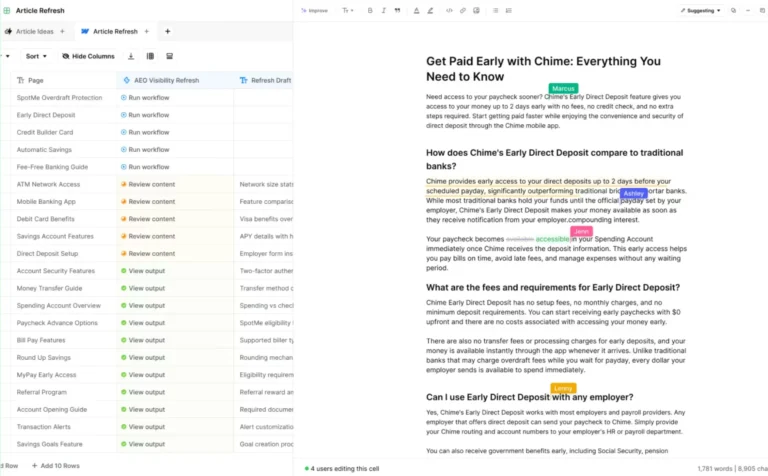
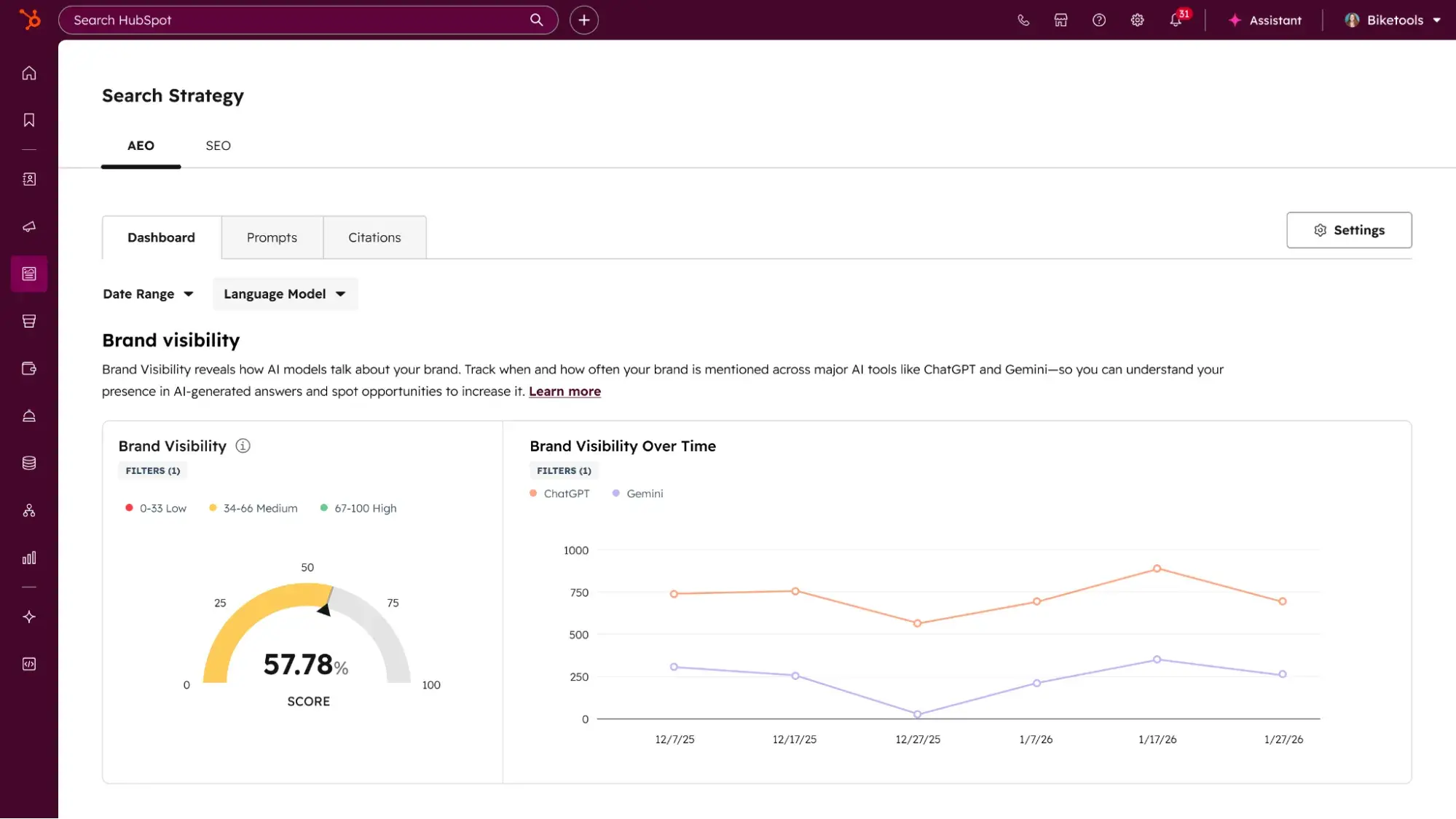
- Tools like HubSpot’s AI SEO (AEO) can automate the tracking of Brand Visibility Scores across platforms like ChatGPT, Perplexity, and Gemini, monitor competitor mentions within a defined prompt set, identify content gaps, and directly link this visibility data to your CRM for a more integrated view.
The advantage of focusing on visibility is its relative immediacy. Early data on brand mentions and citations can provide an initial indication of AI’s reach and the effectiveness of content optimization efforts, even before direct attribution to revenue can be firmly established.
Layer 2: Engagement – Understanding Branded Search Lift and Direct Traffic
The second layer, Engagement, moves beyond mere presence to measure user interaction prompted by AI visibility. When a brand appears in an AI answer, users often take subsequent actions, such as directly searching for the brand name. This surge in branded search queries and subsequent direct traffic, even without a direct click from the AI response, serves as a powerful indicator that AI awareness is translating into active user interest.
How to Measure Engagement Metrics:
-
Branded Search Lift:
- Monitor your branded keyword performance in tools like Google Search Console.
- Analyze trends in search queries that include your brand name.
- Look for a sustained increase in branded search volume that correlates with your AI visibility efforts, particularly when no concurrent paid campaigns are driving this lift.
- Compare branded search trends against periods with lower AI visibility to isolate the impact.
-
Direct Traffic:
- Utilize web analytics platforms like Google Analytics 4 (GA4).
- Track the volume of direct traffic to your website.
- Analyze the correlation between increases in direct traffic and your AI visibility initiatives.
- Segment direct traffic to identify if a noticeable portion originates from users who might have been exposed to your brand via AI search.
A sustained increase in branded search volume, independent of paid advertising efforts, is a strong signal that AI-driven awareness is effectively driving users to seek out your brand directly. This layer provides a crucial bridge between initial visibility and eventual revenue, demonstrating that AI is not just generating mentions but is actively influencing user intent.

Layer 3: Revenue – Attributing Pipeline Influence in Your CRM
The ultimate layer of measurement is Revenue, which aims to connect AI touchpoints to tangible business outcomes. Perfect AI attribution remains an aspiration, as sessions often arrive via indirect channels like direct or branded search. The goal, therefore, is to establish assisted attribution, acknowledging AI’s role as a contributing factor in the customer journey.
How to Attribute Pipeline Influence:
- Build an Assisted Attribution Model:
- Identify AI-Influenced Contacts: Leverage CRM data to flag contacts who have demonstrated AI-influenced behavior. This can include visiting pages that rank highly in AI answers, downloading content that is frequently cited by AI, or exhibiting search patterns associated with AI discovery.
- Track AI Touchpoints: Implement mechanisms to record instances where a contact interacted with AI-generated content related to your brand. This might involve specific campaign tracking for content promoted via AI or advanced CRM segmentation.
- Assign Assisted Credit: Develop a model that assigns a portion of credit to AI for influencing the conversion. This credit should be distributed alongside other marketing and sales touchpoints. A common approach is to assign a percentage of the deal value or pipeline influence based on the strength of the AI interaction. For instance, if AI was a significant early touchpoint, it might receive a 10-25% credit.
Data from HubSpot’s January 2026 survey of over 3,000 CRM purchase decision-makers underscores the significance of AI search in driving purchase intent. The survey found that AI search was the single strongest predictor of purchase intent, outperforming even product demos, review sites, and direct sales calls. Buyers who utilized AI search were a remarkable 36% more likely to make a purchase, highlighting the high-intent nature of AI-discovered leads. By building a robust assisted attribution model within your CRM, you can begin to quantify the revenue impact of your AI search visibility efforts, providing a defensible metric for ROI.
Benchmarking Brand Visibility in AI Search
To render AI visibility data actionable, it must be contextualized through benchmarking. Benchmarking provides two essential elements: a competitive reference point and a trend line. The competitive reference point reveals how your brand’s share of AI voice stacks up against key competitors, while the trend line indicates whether your optimization efforts are yielding positive results over time. Without both, it is challenging to demonstrate progress or identify areas for improvement effectively.
1. Identify Your Answer Competitors:
In the realm of AI search, your competitors are not necessarily your direct product rivals. AI systems cite content that is deemed most authoritative and clearly structured on a given topic. This often includes industry media outlets, analyst reports, review platforms (e.g., G2, Yelp), and niche newsletters, alongside blogs and aggregators. Understanding these "answer competitors" is crucial for shaping your content strategy and identifying where to focus your optimization efforts. For example, if a prominent media site consistently ranks higher than your brand for buying-stage prompts, it signals a content gap that can be addressed. Document every source that appears in AI answers for your key topic clusters, not just direct brand competitors, to map the complete citation landscape.
2. Build a Share of Citations Chart:
Regularly run your defined prompt set (e.g., monthly) and, for each prompt, record every cited source. Aggregate these citations by topic cluster. This data can be presented in a simple chart that visually represents where your brand leads, trails, and where the widest gaps exist relative to top competitors. For instance, if "Sales pipeline management" prompts show your brand cited in 6 out of 20 instances while a competitor is cited in 14, this identifies a priority area for content improvement. Conversely, strong performance in "Email marketing tools" (15 out of 20 citations for your brand versus 5 for a competitor) indicates a position of strength worth defending.
3. Interpret Trends:
Changes in citation share can be attributed to several factors: improvements in your content, degradation of competitor content, or shifts in AI model preferences following updates. It is advisable to establish a fresh baseline after significant AI model releases (e.g., GPT, Gemini, Perplexity updates) as these can alter citation patterns independently of content quality. The trend line, observed over several months, is more informative than any single data snapshot. A sustained upward trend in citation share signifies the effectiveness of your strategy, while a decline warrants investigation into potential causes. Integrating this benchmark data with your CRM and marketing automation platforms can provide a unified view of AI citation share alongside other marketing channel performance metrics, making it more accessible and impactful for leadership.
Planning for Long-Term AI Search Visibility Measurement
A structured approach to measuring AI search visibility over time is essential for sustained success. This involves defining key parameters and establishing a consistent monitoring process.
1. Define Your Prompt Set:
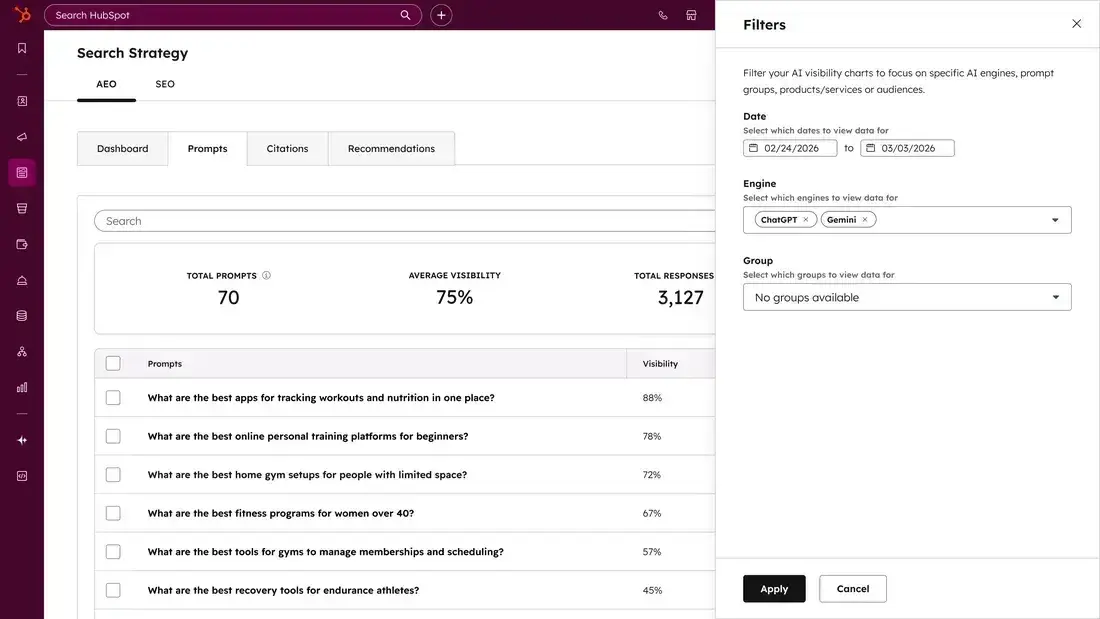
Curate a set of 20-30 prompts that accurately reflect how buyers research your category at various stages of the funnel, from initial awareness to final decision-making. These prompts should be specific and reflect real-world user queries.
2. Input Prompts into Your AI Visibility Tool:
Utilize AI visibility tracking tools, such as HubSpot’s AI SEO (AEO), which can automate the daily updating of citation data across platforms like ChatGPT, Gemini, and Perplexity. Manual testing across different AI surfaces is also an option, particularly for platforms not yet integrated into automated tools. Tracking across multiple platforms is critical, as AI search visibility is no longer confined to a single dominant engine. Reports indicate a declining share for platforms like ChatGPT in B2B AI referrals, with others like Claude and Gemini gaining traction. Understanding the retrieval logic, citation behavior, and user intent variations across these platforms is vital for a comprehensive strategy.
3. Record Your Brand Visibility Score:
For each prompt and platform, assign a score based on brand mention: not mentioned, mentioned, cited as a source, or recommended. Aggregate these scores to calculate a Brand Visibility Score, establishing your baseline. Re-run prompts and update scores regularly (e.g., monthly) to track changes.
4. Audit Your Existing Content:
Conducting an AI search visibility audit, potentially using tools like HubSpot’s free AI Search Grader, can reveal areas where your brand is visible and where competitors are gaining ground. Documenting AI performance in a structured table, including details like date, prompt, platform, model version, mention/citation status, competitor citations, sentiment, and response summary, provides a granular view of your AI presence. This detailed tracking, conducted consistently (e.g., weekly or bi-weekly), allows for timely analysis and strategic adjustments.
5. Repeat:
After implementing content or strategy changes based on your data insights, repeat the prompt testing process. Consistent tracking and analysis on a regular schedule are key to understanding long-term trends and the impact of your optimization efforts.
Calculating AI Search Visibility ROI
While AI attribution presents challenges, a calculated ROI can still be achieved by focusing on visibility, engagement, and revenue metrics. The formula for AI Search Visibility ROI is as follows:
ROI (%) = (AI-Assisted Revenue – AI Costs) / AI Costs * 100
AI-Assisted Revenue:
Since direct click attribution from AI is rare, marketers must build an assisted revenue model that accounts for AI touchpoints preceding conversion. This relies on:
- Unified Visibility and Pipeline Data: Integrating AI visibility data with CRM contact records.
- Assisted Attribution Modeling: Assigning partial credit to AI for influencing deals where AI touchpoints were identified.
- Revenue Impact Analysis: Quantifying the value of deals where AI played a role, even indirectly.
A practical example illustrates this: If a team invests $2,000 per month in AI visibility tools and content efforts, totaling $6,000 over a quarter, and identifies $30,000 in pipeline influenced by AI touchpoints. Assigning a 25% assisted credit to AI results in $7,500 in AI-assisted revenue. Applying the ROI formula: ($7,500 – $6,000) / $6,000 * 100 = 25% ROI. This provides a tangible and defensible figure for leadership.
AI Costs:
These are typically more straightforward and include:
- AI Visibility Tools: Subscription costs for platforms that track AI mentions and citations.
- Content Optimization: Resources allocated to content creation, refinement, and optimization specifically for AI search.
- Data Analysis & Reporting: Time and tools dedicated to analyzing AI performance data and generating reports.
By unifying visibility and pipeline data within a CRM and leveraging marketing automation for multi-touch attribution, businesses can gain a comprehensive understanding of their AI search performance and its contribution to the bottom line.
Making the Leadership Case for AI Search Investment
Presenting a compelling case for AI search investment to leadership requires a strategic approach focused on opportunity cost, competitive risk, and a clear measurement plan.
Opportunity Cost:
Highlight that AI-referred leads often exhibit higher conversion rates than those from traditional search. Delaying measurement and optimization for AI visibility means forfeiting high-intent buyers who are actively engaging with AI-generated answers and may be deciding without your brand’s input. This represents tangible, albeit uncaptured, revenue.
Competitive Risk:
Emphasize the growing performance gap between companies actively investing in AI search visibility and those that are not. Early adopters are already demonstrating significant uplifts in Marketing Qualified Leads (MQLs) and closed deals. The longer a business waits, the wider this competitive chasm becomes.
Measurement Plan:
Leadership teams fund concrete strategies, not vague promises. Present a clear 30/60/90-day roadmap that includes establishing a baseline, defining a prompt set, outlining a metric framework, and detailing a CRM attribution model that links AI visibility signals to pipeline growth. Demonstrating precisely how success will be measured and when it can be expected is crucial.
Expected Timelines for AI Search Visibility Milestones
It is critical to set realistic expectations regarding the timeline for AI search visibility results, as they differ from the rapid turnaround often seen with paid media or even traditional SEO. AI search optimization, often referred to as Generative Engine Optimization (GEO) or AI SEO (AEO), requires a phased approach.
Typical AI Search Visibility Milestone Windows:
- Days 1-30: Establish baseline visibility scores and set up prompt tracking. Report on initial visibility scores and competitor benchmarks.
- Days 30-60: Collect initial citation data and observe early trends in branded search. Report on Share of AI Voice and direct traffic deltas.
- Days 60-90: Begin identifying AI-influenced contacts within the CRM and observe initial pipeline touch data. Report on AI-influenced MQL rates and pipeline touch points.
- Days 90-180: Accumulate pipeline influence data and activate the revenue attribution model. Report on AI-assisted close rates and deal velocity.
Leading Indicators to Watch:
While waiting for full pipeline data to mature, several leading indicators can signal the strategy’s effectiveness within the first 60 days:
- Increased Brand Visibility Score: A consistent upward trend in your brand’s appearance and citation in AI answers.
- Growing Share of AI Voice: An increase in the percentage of prompts where your brand is mentioned or cited, relative to competitors.
- Positive Branded Search Lift: A noticeable and sustained increase in organic searches for your brand name.
- Uplift in Direct Traffic: A corresponding rise in direct website visits.
- Increased Engagement with AI-Generated Content: Higher click-through rates or time spent on pages linked from AI answers.
When two or more of these indicators move favorably by day 60, it provides a credible narrative for leadership, demonstrating that the AI search strategy is on the right track even before long-term revenue impacts are fully realized.
Frequently Asked Questions About AI Search Visibility ROI
How can I improve visibility with an AI search optimization strategy?
Begin by focusing on content structure. AI systems prioritize clear, direct answers. Ensure your most important content leads with a direct answer within the first 150 words, uses question-based headings, and incorporates FAQ and Article schema for easier parsing. Beyond your own site, aim to get your brand cited in authoritative third-party sources, as this carries significant weight with AI. Crucially, optimize for multiple AI engines, as each has unique retrieval logic and citation patterns.
What timeline should I expect for improvements in AI search visibility?
Content improvements typically reflect in citation rates within 30-60 days, with measurable pipeline influence taking 90-180 days. AI systems do not update in real-time, so content changes require time to be processed and reflected in AI answers. However, signals like branded search lift and direct traffic can shift within four to six weeks. High-intent buying prompts, especially in competitive landscapes, may take longer. Consistent tracking and reporting on leading indicators are vital during this maturation period.
How should I pick prompts to track AI share of voice?
Source prompts from sales call recordings, customer support tickets, and existing keyword research to capture authentic buyer queries. Prioritize specificity over brevity; detailed questions yield more consistent and trackable AI answers. Structure your prompt set across all funnel stages: awareness, consideration, and decision. Aim for 5-10 prompts per topic cluster initially, revisiting and refreshing the set quarterly to align with evolving buyer language.
What if my brand is rarely mentioned today?
A low visibility score presents a clear opportunity. Audit which topic clusters have the lowest citation rates and identify who is currently appearing in those answers. This reveals both winning content strategies and content gaps your brand needs to address. Focus on content clarity, direct answers, and E-E-A-T (Experience, Expertise, Authoritativeness, Trustworthiness) signals on your highest-priority pages. Begin with two to three topic clusters where the competitive gap is smallest and buyer intent is highest, and expand from there as visibility compounds.
The evolution of commerce is intrinsically linked to the evolution of answering questions. AI search has fundamentally altered the landscape of where those answers reside. While the methods have changed, the core principle remains: whoever provides the clearest, most credible, and timely answers wins business. The good news is that a robust AI search visibility strategy does not require an exorbitant budget or a dedicated AI team to initiate. By starting with the available resources, leveraging tools like HubSpot AEO for automated tracking, and systematically flagging AI-influenced contacts in your CRM, the picture of AI’s impact becomes clearer with each data point collected. Every metric gathered today builds a stronger case for tomorrow, ensuring your brand is not just a participant, but a featured answer in the new era of AI-driven discovery.
About the Author