The landscape of internet search is undergoing its most significant structural transformation since the inception of the commercial web. For over two decades, the "ten blue links" model championed by Google defined how information was discovered, processed, and monetized. However, the rapid proliferation of generative artificial intelligence (AI) models, including OpenAI’s ChatGPT, Anthropic’s Claude, and Perplexity, has introduced a new paradigm: AI Optimization (AIO). This shift represents a move away from traditional Search Engine Optimization (SEO) toward a system where information is synthesized and delivered directly to the user, bypassing the traditional click-through journey.
As of early 2025, the data indicates that this is no longer a niche phenomenon. ChatGPT reached the 100-million-user milestone faster than any consumer application in history, and by the first quarter of 2025, it was processing over 10 million queries daily through its integrated web-browsing features. This behavioral change has forced market leaders to pivot; Google recently reported that its integration of AI features contributed to a 10% year-over-year increase in search revenue, reaching $50.7 billion in Q1 2025. The global rollout of Google’s "AI Mode" to over 180 countries further signals that the industry is moving toward a conversational, synthesis-based discovery model.
A Chronology of the Generative Shift
The transition from traditional indexing to AI synthesis did not happen overnight but followed a clear chronological trajectory marked by rapid technological breakthroughs.
- The Pre-Generative Era (2010–2021): Search was dominated by PageRank-style algorithms. Success was measured by "backlinks," "keyword density," and "domain authority." Google introduced featured snippets and knowledge panels to answer queries on-page, hinting at a "zero-click" future.
- The ChatGPT Catalyst (November 2022): The launch of ChatGPT by OpenAI shifted public expectations. Users realized they could receive complex, synthesized answers to natural language questions without scanning multiple websites.
- The Rise of AI Search Engines (2023): Platforms like Perplexity emerged, specifically designed to function as "answer engines" rather than "search engines," citing real-time web sources in a conversational format.
- The Integration Phase (2024–Early 2025): Major incumbents responded. Microsoft integrated GPT-4 into Bing, and Google launched Search Generative Experience (SGE), eventually evolving it into "AI Mode." By 2025, AI-generated summaries became the primary real estate on search result pages.
The Economic Impact and Market Data
The financial stakes of this shift are immense. Traditional SEO was built on an advertising model that prioritized impressions and clicks. AIO, however, prioritizes "citation and endorsement." When an AI model recommends a product or a course, it does so with a level of perceived authority that traditional ads lack.
Market analysts observe that users who discover brands through AI citations often demonstrate higher intent and better engagement metrics. Because the AI has already "vetted" the source and summarized its value, the traffic reaching the destination site is pre-qualified. This has led to a surge in demand for AIO expertise. Professional tracking tools have emerged to meet this need, with companies like Ahrefs and SE Ranking launching AIO-specific features. Pricing for these services ranges from $39 to over $300 per month, reflecting the growing commercial value of appearing in a ChatGPT or Perplexity response.
Technical Mechanics of AI Optimization (AIO)
While SEO and AIO share the goal of visibility, their underlying mechanisms differ fundamentally. SEO focuses on signals that help a crawler index a page; AIO focuses on signals that help a Large Language Model (LLM) understand, trust, and cite a page. Industry experts have identified seven core tactics that are currently moving the needle in AI visibility.
1. Data-Backed Authority and Statistical Precision
AI models exhibit a measurable preference for factual, quantitative data. In a comparative analysis, models are more likely to cite sources that provide specific numbers (e.g., "150,000 active users") over those that use vague descriptors (e.g., "many users"). This preference stems from the models’ training on high-quality academic and technical datasets where precision is a marker of reliability.
2. Community Signal Integration
LLMs are heavily trained on conversational data from platforms like Reddit, Quora, and niche community forums. When a brand or expert is discussed naturally within these communities, it creates a "reputation signal" that the AI picks up. Authentic engagement in these forums has become a primary driver for being cited as a "top-recommended" source in AI responses.
3. Natural Language Query Alignment
Unlike traditional search queries, which are often fragmented (e.g., "best SaaS hosting"), AI queries are conversational and complex (e.g., "What is the most reliable hosting for a WordPress-based SaaS on a budget?"). Content that is structured to answer these specific, long-form questions is significantly more likely to be extracted by the AI’s synthesis engine.
4. Semantic Structure and Parsing Efficiency
AI models excel at processing structured information. The use of comparison tables, bulleted lists, and step-by-step guides allows the model to "scrape" and "re-synthesize" the information more accurately. If the data is easy for the model to parse, the probability of citation increases.
5. Multi-Platform Consistency
AI models with web access often cross-reference multiple sources to verify a claim. Consistency across a company’s website, LinkedIn profile, YouTube channel, and third-party interviews reinforces the model’s "confidence" in that information. Discrepancies in data across platforms can lead to a source being de-prioritized.
6. Freshness and Temporal Signals
For real-time search models, recency is a critical ranking factor. Explicit "Last Updated" dates and references to current events serve as signals that the information is still relevant. This has led to a "refresh economy," where maintaining existing content is as vital as creating new assets.
7. Technical Markup (JSON-LD)
Machine-readable data remains a cornerstone of visibility. Implementing Schema.org vocabulary through JSON-LD script tags helps AI models categorize content (e.g., as a HowTo, an FAQ, or a Product) with high precision, facilitating its inclusion in specialized AI response modules.
Measuring Performance in a "Black Box" Environment
One of the primary challenges for the industry is the lack of transparent analytics. Unlike Google Search Console, which provides detailed click and impression data, platforms like OpenAI and Anthropic do not currently offer a dashboard for website owners.
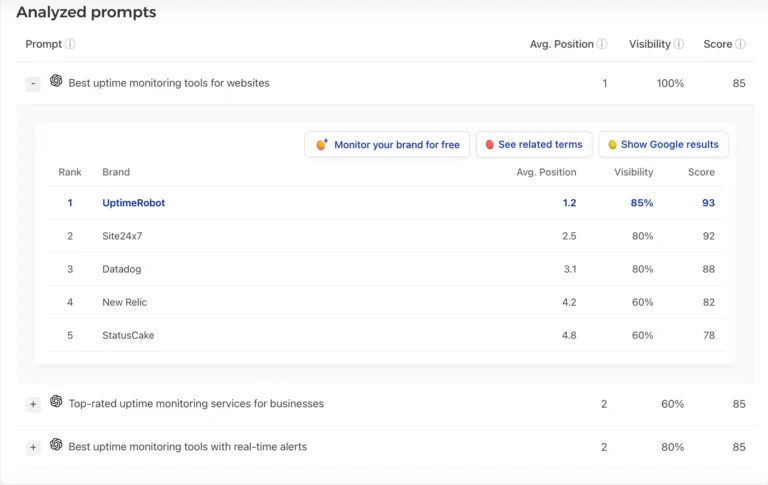
To solve this, developers are increasingly turning to no-code automation platforms like Make.com to build custom tracking systems. These systems programmatically query AI models with target prompts and record which websites are cited. This "synthetic tracking" allows businesses to monitor their "share of voice" in AI responses, providing a data-driven basis for their optimization strategies.
Strategic Implications and the Future of Search
The shift to AIO has profound implications for the future of the open web. There are growing concerns regarding the "cannibalization" of traffic, where users receive all the information they need from the AI summary and never click through to the original source. This has sparked legal and regulatory debates regarding copyright and the fair use of content for AI training.
However, for content creators who successfully adapt, the rewards are substantial. Being the "first result" in a ChatGPT response carries a weight of authority that traditional search results struggle to match. As AI models become more personalized, the future of search will likely involve "agentic" discovery, where AI assistants proactively find and recommend content based on a deep understanding of the user’s history and preferences.
Conclusion: The New Competitive Frontier
The emergence of AI Optimization represents a "blue ocean" opportunity for early adopters. While traditional SEO remains a crowded and mature field, the rules of AIO are still being written. The current landscape favors those who prioritize high-density factual content, community engagement, and technical clarity.
As Google, Microsoft, and OpenAI continue to refine their models, the boundary between "searching the web" and "chatting with an AI" will continue to blur. For businesses and creators, the mandate is clear: visibility in the age of AI requires more than just ranking; it requires being the most trusted, cited, and synthesized source of truth in an increasingly automated information economy. The traffic of the future will not go to those who simply have the most backlinks, but to those whose content is most indispensable to the models that now mediate the world’s knowledge.
About the Author