The global digital landscape is undergoing a fundamental transformation as Artificial Intelligence (AI) migrates from specialized technical applications to the center of the content marketing industry. In 2022, the unprecedented demand for high-velocity, SEO-optimized content has necessitated a shift in how businesses, agencies, and independent creators approach the writing process. As digital saturation makes it increasingly difficult for brands to capture consumer attention, AI-powered writing assistants have emerged as a critical solution to bridge the gap between human creativity and the massive scale required by modern search engines and social media platforms.
The rise of these tools is largely attributed to advancements in Natural Language Processing (NLP) and the release of sophisticated large language models, most notably OpenAI’s GPT-3. These technologies have enabled software to move beyond simple "article spinning"—which often resulted in garbled, unreadable text—to generating coherent, contextually relevant, and persuasive prose that mimics human tone and logic.

The Evolution of Generative AI in Professional Writing
The chronology of AI in content creation saw a significant acceleration between 2020 and 2022. Following the 2020 release of GPT-3, a wave of startups began developing user interfaces designed to make these powerful models accessible to non-technical users. By early 2022, the market reached a point of maturity where AI writers were no longer viewed as experimental curiosities but as essential productivity tools.
Market data from industry analysts suggests that the AI writing assistant market is expanding at a Compound Annual Growth Rate (CAGR) of over 15%. This growth is fueled by the realization that AI can reduce the initial drafting time for long-form content by up to 80%, allowing human editors to focus on strategy, fact-checking, and brand voice alignment.
Comprehensive Analysis of the Top 10 AI Content Generators
To assist organizations in navigating this rapidly evolving marketplace, this report identifies and analyzes the ten most influential AI content generation tools of 2022, evaluating their features, economic viability, and specific use cases.
1. Jasper AI (Formerly Jarvis)
Jasper AI has established itself as a market leader, particularly following its strategic acquisitions and rebranding efforts. Utilizing the most advanced iterations of the GPT-3 model, Jasper is designed for versatility, offering over 50 templates ranging from blog post outlines to creative stories.
Technical Capabilities: The platform’s "Boss Mode" represents a significant leap in AI-human collaboration, allowing users to issue direct commands to the AI. This feature facilitates the creation of long-form content that maintains thematic consistency across thousands of words.
Pricing Structure: Jasper operates on a tiered model, with a Starter plan often beginning around $29 per month and Boss Mode starting at $99 per month, reflecting its position as a premium enterprise-grade solution.
2. Copy.ai
Copy.ai has gained significant traction among social media managers and advertising specialists. The platform focuses on "short-form" high-conversion copy, providing users with more than 90 tools and templates.

Operational Focus: Its strength lies in its ability to generate multiple variations of ad headlines, product descriptions, and social media hooks in seconds. This allows for rapid A/B testing in digital marketing campaigns.
Economic Model: The platform offers a limited free trial, with a professional plan priced at $49 per month, or a discounted annual rate of approximately $420.
3. Frase.io
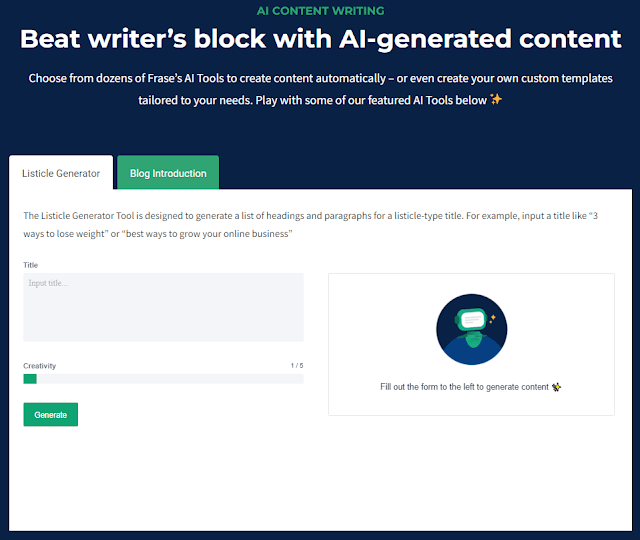
Frase distinguishes itself by integrating AI generation with comprehensive SEO research. Unlike tools that focus solely on writing, Frase analyzes top-performing search engine results to help users create content briefs and optimize existing articles.
Strategic Utility: Frase’s AI uses the data gathered from the first page of Google to suggest keywords and topics that should be included to improve search rankings.
Pricing: The "Solo" plan is positioned at $14.99 per month for individual creators, while the "Team" plan at $114.99 per month serves larger collaborative environments.
4. Article Forge
Article Forge represents a more automated approach to content generation. While tools like Jasper require constant user input, Article Forge is designed to produce a complete article based on a single keyword.
Mechanism: It utilizes deep learning models to research, plan, and write long-form content. It is frequently used by SEO professionals who need to populate "niche sites" or generate background research material.
Pricing: The service offers a 30-day money-back guarantee, with a Basic plan starting at $27 per month for 25,000 words.
5. Rytr
Rytr is often cited as the most accessible tool for freelancers and small businesses due to its balance of performance and affordability. It supports over 30 languages and 20 different tones of voice.

Functional Highlights: The platform includes a built-in plagiarism checker and a Chrome extension, allowing users to utilize AI generation directly within email clients and WordPress.
Cost Efficiency: Rytr offers a generous free tier (5,000 characters per month), with a "Saver" plan at $9 per month and an "Unlimited" plan at $29 per month.
6. Writesonic
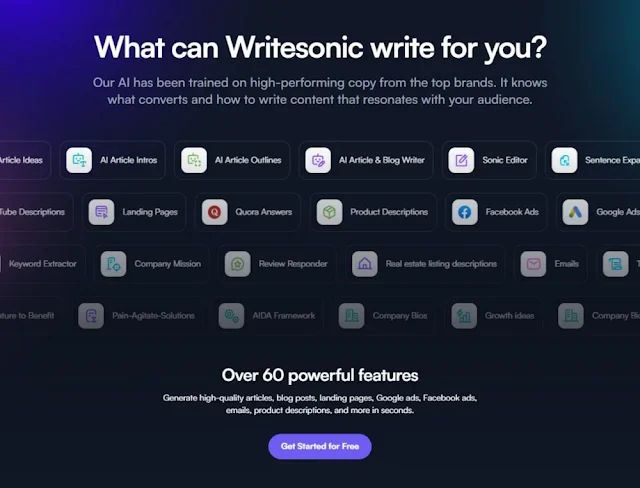
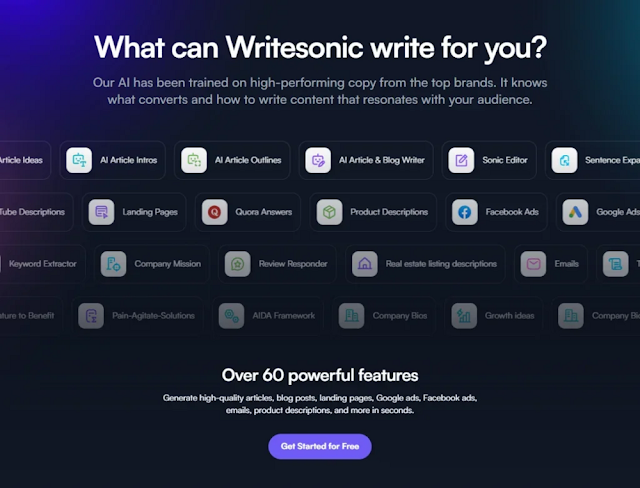
Writesonic is engineered for marketing teams that require landing pages and high-performing Google Ads. The tool is particularly noted for its "AI Article Writer 3.0," which guides the user through a four-step process to generate 1,500-word articles.
Key Features: It includes specialized tools for paraphrasing, sentence expansion, and readability improvement.
Pricing: The platform utilizes a credit-based system, with short-form plans starting at $15 per month.

7. Copysmith
Copysmith is tailored for enterprise-level teams and e-commerce platforms. It integrates seamlessly with platforms like Shopify, WooCommerce, and Google Ads, making it a powerful tool for generating thousands of product descriptions simultaneously.
Enterprise Features: The software allows for bulk content generation and offers collaboration features that permit teams to review and edit AI-generated drafts in a centralized dashboard.
Pricing: Starter plans begin at $19 per month, with professional tiers reaching $59 per month.
8. Hypotenuse.ai
Hypotenuse.ai specializes in high-quality content for e-commerce and creative agencies. It excels at taking minimal product attributes and transforming them into compelling, benefit-driven product descriptions.
Performance Data: Users have reported significant reductions in "time-to-market" for new product launches when using Hypotenuse to automate catalog descriptions.
Pricing: It offers a Starter plan at $29 per month and a Growth plan at $59 per month.
9. Kafkai
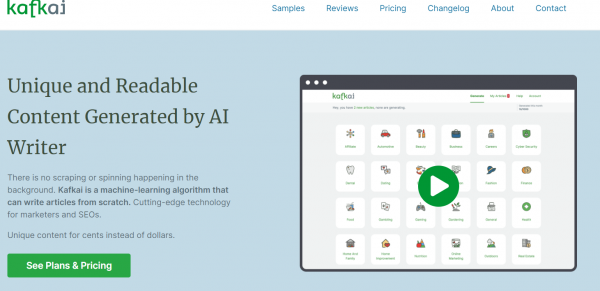
Kafkai is a niche-specific AI writer that utilizes proprietary machine learning models trained on specific industries rather than general web data. This makes it a preferred choice for SEOs working in highly technical or regulated sectors.
Bulk Generation: The tool is designed for scale, with an "Industrial Printer" plan capable of generating 2,500 articles per month for $199.
Niche Focus: It covers over 30 niches, including health, finance, and technology.

10. Peppertype.ai
Built on top of the "Pepper Content" ecosystem, Peppertype.ai focuses on the quality of the output, aiming to produce content that requires minimal human intervention. It is widely used for blog ideas, YouTube video descriptions, and professional bios.
User Interface: The platform is praised for its clean, intuitive interface that categorizes tools based on the user’s specific intent.
Pricing: The Personal plan is priced at $35 per month, while the Team plan is $199 per month.
Supporting Data and Industry Response
The adoption of these tools has not been without controversy. In early 2022, Google’s Search Quality team clarified their stance on AI-generated content. While Google’s algorithms are designed to prioritize "helpful content" written for humans, the company’s primary concern is with low-quality, automated content intended solely to manipulate search rankings.

Industry surveys conducted in mid-2022 indicate that 60% of digital marketers now use some form of AI in their content workflow. Furthermore, content teams utilizing AI report a 33% increase in lead generation efficiency, as they are able to publish more frequently and across more channels without increasing their headcount.
Ethical Implications and Human-AI Collaboration
A critical analysis of the current state of AI writing suggests that the most successful implementation is the "Cyborg" model—a collaborative effort where the AI handles the heavy lifting of drafting and research, while the human editor provides the "soul," creative direction, and factual verification.
Plagiarism remains a central concern. While most top-tier tools like Jasper and Rytr include or integrate with plagiarism checkers (such as Copyscape), the nature of generative AI means that the text is technically original, though it may echo existing ideas. Organizations are increasingly implementing strict "AI Disclosure" policies to maintain transparency with their audiences.
Broader Impact and Future Outlook
As 2022 draws to a close, the impact of these ten tools on the global economy is becoming clear. AI content generators are democratizing content marketing, allowing small businesses with limited budgets to compete with larger corporations in the digital space.
The future of the industry points toward even greater integration. We can expect AI writing tools to move beyond text, incorporating image generation (via DALL-E or Midjourney) and video script-to-voiceover automation. The conclusion for businesses is clear: the question is no longer whether to use AI, but which specific toolset will provide the greatest competitive advantage in an increasingly automated world. The tools listed above represent the vanguard of this revolution, each offering unique strengths to meet the diverse needs of the modern digital economy.
About the Author