The Technological Shift: Emergence of Generative AI in Professional Workflows
The rise of AI content generators is primarily attributed to advancements in transformer-based machine learning models, which have moved beyond simple predictive text to nuanced, context-aware generation. In 2022, the market reached a critical mass of accessibility, allowing small business owners and individual freelancers to utilize technology that was previously reserved for large-scale tech enterprises. This democratization of AI has led to a competitive marketplace where tools are distinguished by their specific use cases, ranging from SEO optimization to e-commerce product descriptions.
Industry data suggests that the adoption of AI in marketing increased by over 25% between 2020 and 2022, with a significant portion of that growth concentrated in automated copywriting. Professionals report that using AI tools can reduce the time spent on initial drafts by up to 80%, allowing creators to focus on high-level strategy and editorial refinement rather than the mechanical aspects of writing.

Comprehensive Analysis of the Top 10 AI Content Generation Platforms
1. Jasper AI: The Industry Benchmark for Enterprise Content
Formerly known as Jarvis, Jasper AI has established itself as a leader in the generative writing space through its robust integration of OpenAI’s GPT-3 technology. Jasper is designed for professional environments where speed and brand consistency are paramount. The platform’s "Boss Mode" provides users with an expanded character lookback, allowing the AI to maintain narrative continuity over longer documents.
Jasper distinguishes itself with over 50 templates tailored to specific marketing needs, including AIDA (Attention, Interest, Desire, Action) frameworks and PAS (Problem-Agitate-Solution) formulas. For organizations requiring high-volume output, Jasper offers a subscription model starting at approximately $99 per month for premium features, reflecting its position as a high-end solution for serious content creators.
2. Copy.ai: Specialized Social Media and Advertising Solutions
Copy.ai focuses on the "short-form" segment of the market, offering over 90 specialized tools for social media managers and digital advertisers. The platform is engineered to generate high-conversion marketing copy, including Facebook Ads, email subject lines, and Instagram captions. Its user interface is designed for rapid iteration, allowing users to input basic brand information and receive multiple creative variations within seconds.
The platform operates on a "freemium" model, providing a seven-day trial with 100 runs per day, while its Pro Plan is priced at approximately $49 monthly or $420 annually. This tiered pricing structure has made it a favorite among early-stage startups and solo entrepreneurs.
3. Frase: Integrating SEO Research with Generative Writing
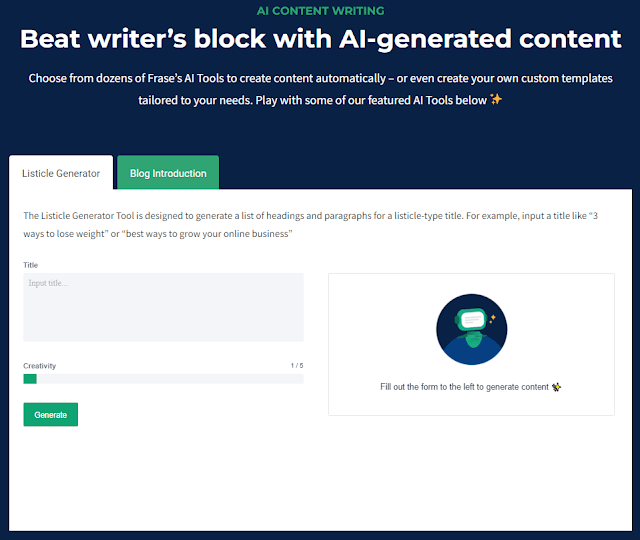
Frase represents a hybrid category of software that combines content research, SEO optimization, and AI generation. Unlike tools that focus solely on the prose, Frase analyzes top-performing search engine results to provide users with a roadmap for their content. It identifies keyword gaps, suggests headings, and generates text that is structurally aligned with Google’s ranking algorithms.
The platform offers several tiers, including a Solo Plan at $14.99 per month and a Team Plan at $114.99 per month. Frase’s value proposition lies in its ability to reduce the "research-to-writing" cycle, making it an essential tool for SEO specialists and digital publishers.

4. Article Forge: High-Efficiency Automated Blog Production
Article Forge employs a unique approach to content generation by focusing on end-to-end automation. While other tools require constant human prompting, Article Forge can generate a complete 1,500-word article based on a single keyword. The platform uses deep learning models to research the topic and structure the content without direct oversight.
Pricing is structured by word count, with a Basic Plan at $27 per month for 25,000 words and an Unlimited Plan at $117 per month. Notably, Article Forge guarantees that its output will pass plagiarism detection software such as Copyscape, addressing a primary concern for web publishers.
5. Rytr: Accessible AI for Entry-Level Users
Rytr has gained popularity as a cost-effective alternative to more expensive enterprise platforms. It supports over 30 languages and 20 different tones of voice, making it highly versatile for international markets. The platform includes a built-in plagiarism checker and an SEO analyzer, features often reserved for higher-priced competitors.
Rytr’s pricing model includes a free tier for up to 5,000 characters per month, a Saver Plan at $9 per month, and an Unlimited Plan at $29 per month. This affordability has positioned Rytr as the primary choice for students and small-scale bloggers.
6. Writesonic: The All-in-One Marketing Suite
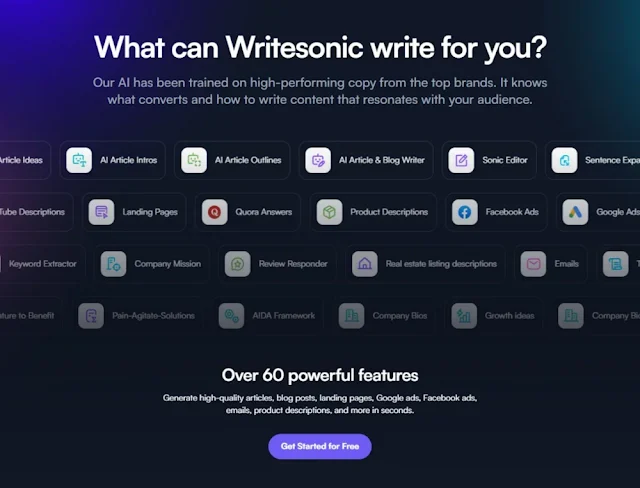
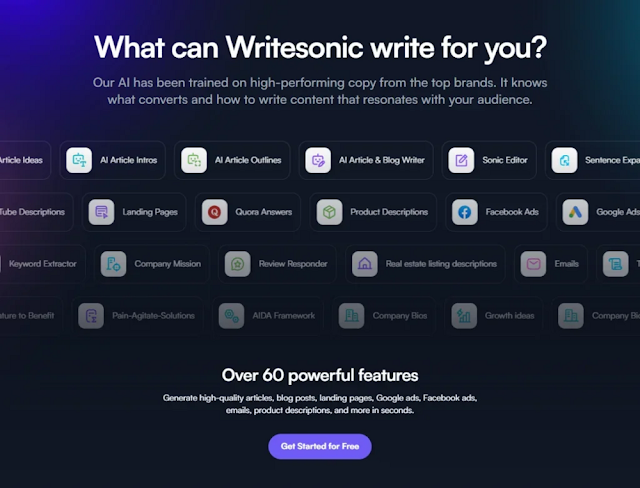
Writesonic is designed to serve as a comprehensive writing assistant for diverse business needs. It offers features ranging from landing page generation to product descriptions and professional emails. One of its standout features is the "AI Article Writer 3.0," which guides users through a multi-step process to ensure the final output meets specific quality standards.
The platform offers a credit-based system, with a free trial of 10 credits and paid plans starting at $15 per month for short-form content and $19 per month for long-form capabilities.

7. Copysmith: Collaboration and Enterprise Scale
Copysmith targets marketing teams and agencies that require collaborative workflows. The platform allows multiple users to work on the same project and offers integrations with e-commerce platforms like Shopify. Its "Content Rewriter" and "Bullet Point Expander" tools are particularly effective for refreshing existing copy.
With a Starter Plan at $19 per month and custom Enterprise options, Copysmith caters to businesses that need to scale their content operations while maintaining a centralized repository of brand voice and assets.
8. Hypotenuse.ai: Optimization for E-Commerce Workflows
Hypotenuse.ai specializes in high-volume product descriptions and marketing materials for online retailers. The tool can take raw product data—such as technical specifications or images—and transform it into persuasive copy. This specialization makes it a vital tool for e-commerce managers who must manage thousands of SKUs.

The platform offers a Starter Plan at $29 per month and a Growth Plan at $59 per month, focusing on the specific needs of digital storefronts and brand managers.
9. Kafkai: Niche-Specific Content for SEO Networks
Kafkai is built on a specialized model that has been trained on specific niches rather than general web data. This results in content that is often more relevant to specialized industries such as health, finance, or technology. It is widely used by "Private Blog Network" (PBN) operators and SEO professionals who need bulk content that remains on-topic.
Kafkai’s pricing is article-based, ranging from $29 per month for 100 articles to $199 per month for 2,500 articles, offering one of the lowest per-article costs in the industry.
10. Peppertype.ai: Rapid Content Ideation and Drafting
Peppertype.ai emphasizes speed and ease of use, positioning itself as a "virtual content assistant." It is designed to overcome writer’s block by providing instant ideas for blog topics, social media posts, and ad copy. The platform’s clean interface and intuitive prompting system make it accessible for non-technical users.
Peppertype.ai offers a Personal Plan at $35 per month and a Team Plan at $199 per month, focusing on small to medium-sized businesses looking to streamline their content calendar.
A Chronology of the AI Content Revolution
The development of these tools did not occur in a vacuum but is the result of a decade of research into Natural Language Processing (NLP).

- 2015-2018: The founding of OpenAI and the release of early GPT (Generative Pre-trained Transformer) models set the stage for text generation.
- 2019: GPT-2 demonstrated that AI could generate coherent paragraphs, sparking initial interest from the tech community.
- 2020: The release of GPT-3 marked a paradigm shift. With 175 billion parameters, it could mimic human writing styles with startling accuracy. This led to the first wave of startups like Copy.ai and Jasper.
- 2021: The industry shifted toward "specialization," where developers began building niche interfaces on top of LLMs to serve specific industries like SEO and E-commerce.
- 2022: The current era is defined by mass adoption. AI content generation is no longer a niche experimental tool but a standard component of the digital marketing stack.
Market Data and Strategic Impact
The economic implications of AI content generators are profound. According to market analysis, the global AI in marketing market size was valued at $15.84 billion in 2021 and is projected to reach over $100 billion by 2028. This growth is driven by the significant cost savings associated with automated writing. While a professional freelance writer may charge between $0.10 and $1.00 per word, AI tools can produce similar volumes of "first-draft quality" text for a fraction of a cent per word.
Furthermore, the impact on search engine dynamics is significant. Google has clarified its stance, stating that its focus remains on the "quality" of content rather than its source. As long as AI-generated content provides value to the user and is not used primarily to manipulate search rankings, it is considered acceptable within the search ecosystem. This has emboldened marketers to integrate these tools into their primary SEO strategies.
Industry Responses and Future Implications
The reception of these tools within the creative community has been mixed. While many professionals embrace the efficiency gains, others raise concerns regarding the "homogenization" of web content and the potential for misinformation. Editorial experts suggest that the most successful implementation of AI involves a "Human-in-the-Loop" (HITL) model, where the AI generates the initial draft and a human editor provides the final polish, fact-checking, and emotional resonance.

As we move beyond 2022, the trajectory of AI content generation points toward even greater integration. We are likely to see these tools move into the "multimodal" space, where a single prompt can generate text, images, and video simultaneously. For now, the top 10 tools listed above represent the current state of the art, providing a necessary bridge between human creativity and machine efficiency. Organizations that fail to adopt these technologies risk being outpaced by competitors who can produce high-quality content at ten times the speed and half the cost.
About the Author