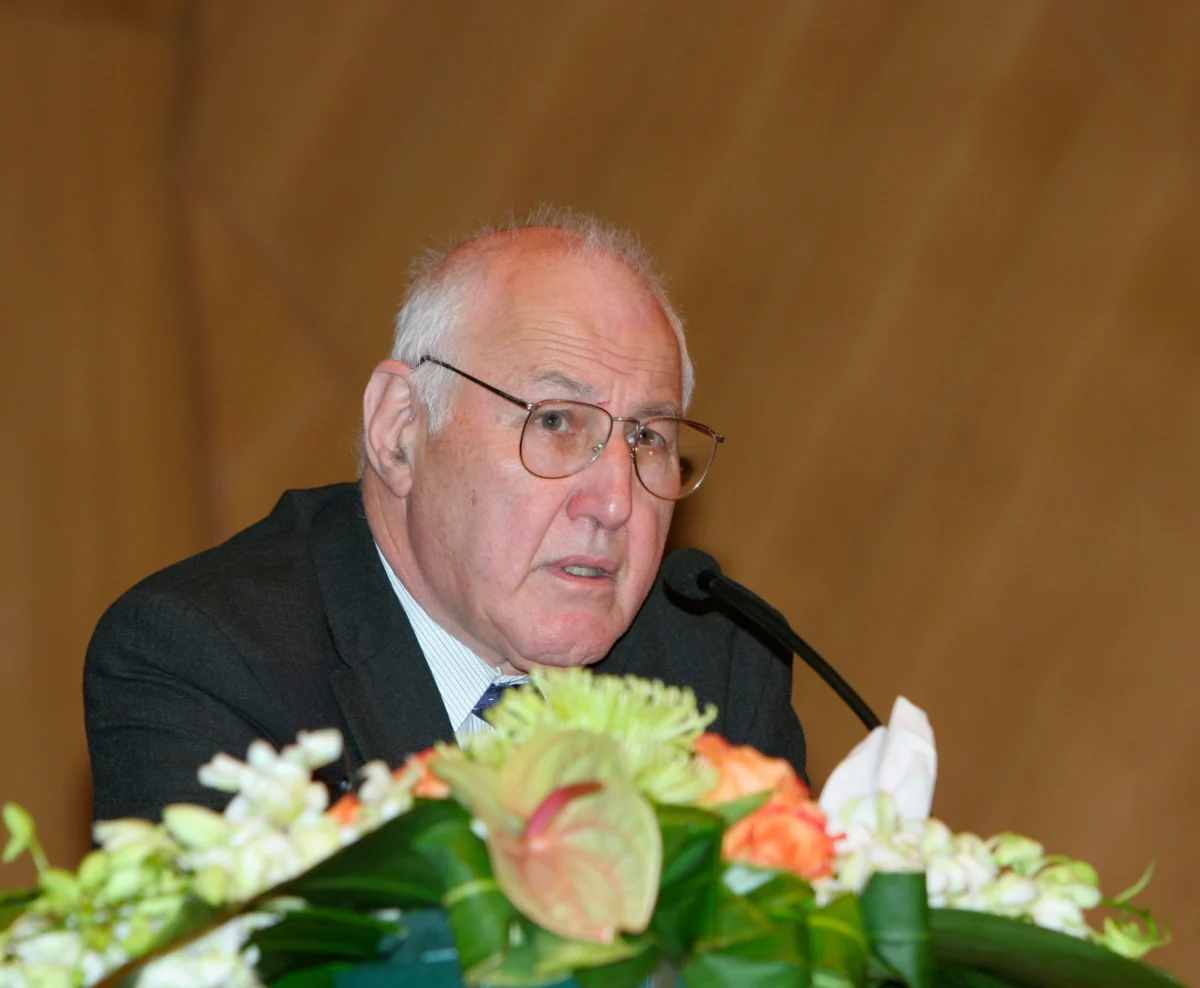
The international legal community is mourning the loss of Sir Roy Goode, an Emeritus Professor of Law at the University of Oxford and a Fellow of the British Academy, whose work redefined the landscape of global commerce. Widely regarded as one of the most influential legal scholars of the 20th and 21st centuries, Sir Roy’s contributions spanned the practicalities of banking, the complexities of international trade finance, and the foundational principles of commercial law. His passing marks the end of an era for the International Chamber of Commerce (ICC), where his intellectual leadership helped synchronize disparate legal traditions into a unified language of "commercial common sense."
Throughout a career that spanned more than six decades, Sir Roy was not merely an observer of the law but an architect of it. His involvement with the ICC was particularly profound, serving as the Chair of the ICC Global Commercial Law and Practice Commission and as a founding member of the ICC Task Force on Guarantees. His work provided the scaffolding for modern trade finance, ensuring that the movement of goods and capital across borders remained stable, predictable, and legally sound.
A Career Defined by Intellectual Rigor and Academic Excellence
Sir Roy Goode’s journey to the pinnacle of international law began with a deep commitment to the intersection of academic theory and practical application. Born in 1933, he initially practiced as a solicitor for nearly 20 years before transitioning into academia, a background that gave him a unique perspective on how laws function in the real world. In 1971, he moved to the academic sector, eventually founding the Centre for Commercial Law Studies (CCLS) at Queen Mary University of London in 1980. This institution remains one of the world’s leading centers for the study of commercial law, a testament to his vision of creating a space where practitioners and scholars could collaborate.
In 1990, he was appointed the Norton Rose Professor of English Law at the University of Oxford, a position he held until his retirement, after which he became an Emeritus Professor. His textbook, Goode on Commercial Law, remains the definitive treatise on the subject, used by students, judges, and practitioners globally. His ability to synthesize complex statutes into clear, principled frameworks earned him a reputation for unparalleled intellectual rigor.
The ICC and the Standardization of Trade Finance
The International Chamber of Commerce has highlighted Sir Roy’s pivotal role in developing globally recognized banking rules. Perhaps his most enduring contribution to the ICC was his leadership in the development of the Uniform Rules for Demand Guarantees (URDG). Specifically, his work on URDG 758 is considered the gold standard for demand guarantees worldwide.
Sir Roy famously described demand guarantees as "abstract payment undertakings." This terminology reflected his deep understanding of the independence principle—the idea that a guarantee is separate from the underlying contract. By codifying these rules, Sir Roy helped eliminate the frequent disputes that arose from ambiguous language in international contracts. Today, URDG 758 is incorporated into hundreds of billions of dollars worth of trade contracts annually, providing a balanced framework that protects the interests of the beneficiary, the applicant, and the guarantor alike.
His leadership as Chair of the ICC Global Commercial Law and Practice Commission saw the ICC expand its influence in emerging markets. He was instrumental in ensuring that the ICC’s rules were not just Eurocentric but truly global, accommodating various legal systems, including common law, civil law, and Islamic finance principles.
Chronology of a Legal Titan: Key Milestones
To understand the scale of Sir Roy’s impact, one must look at the timeline of his major contributions to international legal instruments:
- 1980: Founded the Centre for Commercial Law Studies (CCLS) at Queen Mary University of London.
- 1982: Published the first edition of Commercial Law, which would become the industry’s "Bible."
- 1988-2010: Played a lead role in the drafting and subsequent revision of the ICC Uniform Rules for Demand Guarantees.
- 1990-1998: Served as a member of the Governing Council of UNIDROIT (the International Institute for the Unification of Private Law).
- 2001: Served as the Chairman of the Diplomatic Conference that adopted the Cape Town Convention on International Interests in Mobile Equipment.
- 2010: The implementation of URDG 758, which significantly updated the rules for demand guarantees to reflect modern electronic commerce and banking practices.
Beyond the ICC: The Cape Town Convention and UNIDROIT
While his work with the ICC was monumental, Sir Roy’s influence extended to other major international bodies, including UNIDROIT and UNCITRAL (the United Nations Commission on International Trade Law). One of his most significant achievements outside of banking rules was his role in the Cape Town Convention on International Interests in Mobile Equipment (2001).
This treaty addressed the difficulties of obtaining financing for high-value mobile assets—such as aircraft, railway rolling stock, and space assets—that frequently move across national borders. Before this convention, creditors faced immense risks because different countries had different laws regarding collateral and repossession. Sir Roy’s work helped create an international registry for these interests, drastically lowering the cost of credit for airlines and transport companies globally. Analysis suggests that the Cape Town Convention has saved the aviation industry billions of dollars in financing costs by providing legal certainty to lenders.
Official Reactions and Global Tributes
The news of his passing has prompted a wave of tributes from the highest echelons of the legal and financial sectors. Tomasch Kubiak, ICC Policy Manager, emphasized the personal qualities that complemented Sir Roy’s intellect. "Sir Roy will be remembered not only for his unparalleled expertise but also for his generosity, intellectual rigor, and steadfast commitment to excellence," Kubiak stated. "His legacy will continue to shape ICC’s work and the global trade finance community for years to come."
Georges Affaki, Chair of the ICC Banking Commission Legal Committee, who worked alongside Sir Roy for over 35 years on projects for the ICC, UNIDROIT, and UNCITRAL, described him as a "towering legal mind." Affaki noted, "I never ceased to admire his gift for making all legal traditions speak the same language of commercial common sense."
These sentiments are echoed by academic institutions and law firms worldwide. Mentoring was a cornerstone of Sir Roy’s career; he was known for his willingness to engage with junior lawyers and students, many of whom now hold senior positions in international courts, global law firms, and regulatory bodies.
Supporting Data: The Economic Impact of Legal Standardization
The frameworks Sir Roy helped build have tangible economic implications. According to ICC trade finance reports, demand guarantees and standby letters of credit are essential for global infrastructure projects and large-scale trade.
- Market Volume: It is estimated that the value of outstanding demand guarantees governed by ICC rules exceeds $2 trillion globally.
- Dispute Reduction: Since the adoption of URDG 758, which Sir Roy co-authored, the rate of litigation regarding demand guarantees has seen a measurable decline due to the clarity of the "independent" nature of the obligations he helped define.
- Aviation Financing: The Cape Town Convention, which he championed, has been ratified by over 80 countries. For emerging economies, ratification often results in a direct reduction in sovereign risk premiums for aircraft leasing.
Analysis of Implications and Future Legacy
The passing of Sir Roy Goode comes at a time when international trade is facing new challenges, from the digitalization of trade documents to the complexities of green finance. However, the foundational principles he established—autonomy, certainty, and the unification of law—provide the necessary tools for the next generation of jurists to navigate these changes.
His work on the "digitalization" of commercial law was ahead of its time. He was an early advocate for recognizing electronic records as the functional equivalent of paper documents, a principle that is now being codified in the Electronic Trade Documents Act in the UK and similar legislation globally.
Sir Roy’s legacy is twofold. First, it is found in the written word—the treaties, rules, and textbooks that serve as the operating system for global commerce. Second, it is found in the "Goode School" of thought: a pragmatic, clear-eyed approach to law that prioritizes the needs of the marketplace without sacrificing legal integrity.
As the ICC and the international legal community look to the future, the frameworks established by Sir Roy Goode will remain the benchmark for excellence. His ability to bridge the gap between complex legal theory and the practical needs of a globalized economy ensures that his influence will be felt as long as goods and services are traded across borders. The ICC has extended its deepest condolences to his family, noting that while the man has passed, his "towering mind" remains etched into the very fabric of international law.
About the Author