The landscape of online discoverability is rapidly evolving, with AI-powered answer engines like ChatGPT, Gemini, and Perplexity becoming central to how users find information. For brands, ensuring their content is not only present but also utilized by these sophisticated systems is paramount. This requires a strategic approach to Answer Engine Optimization (AEO), moving beyond traditional SEO to address specific challenges posed by AI’s unique content consumption patterns. The first critical step in this process is a thorough audit to identify and rectify "AEO gaps" – any reason an AI answer engine cannot or will not use a brand’s web page as a source for its generated answers.
The complexities of AEO are often oversimplified, with many teams attributing a lack of AI visibility to a single, vague problem like "not showing up in ChatGPT." However, the underlying causes are multifaceted and require distinct solutions. These gaps can range from pages simply not existing, to answers being buried deep within lengthy content, or even perfectly good pages being overlooked in favor of other sources. This article delves into a structured audit process, providing diagnostic questions for each layer of AEO and offering a framework for prioritizing fixes based on tangible business impact rather than intuition.
Understanding the AEO Content Audit
An Answer Engine Optimization (AEO) content audit is a systematic review designed to assess a website’s potential authority and its suitability for use by AI answer engines. This audit evaluates content based on four core criteria that AI systems employ to determine reliability and relevance: coverage, answerability, schema health, and citation-source gaps. The distinction between these categories is crucial because each often falls under the purview of different departments and operates on varying timelines. For instance, schema implementation typically rests with development teams, while citation-source gaps might involve PR, partnerships, or customer marketing efforts.
The overarching goal of an AEO audit is to diagnose these issues collaboratively and then segment the remediation list according to ownership. A page might successfully pass initial checks for coverage but fail on answerability, a common scenario for many organizations. The potential rewards for identifying and fixing these gaps are substantial. As reported by HubSpot’s CMO, doubling down on AEO led to a remarkable 433% improvement in brand citation, underscoring the transformative impact of a focused strategy.
David Kirkdorffer, a B2B fractional marketer specializing in LLM discoverability, likens traditional SEO to the Dewey Decimal System for libraries. "SEO can help get you found on the shelf," he explains, "but it doesn’t help get you mentioned or cited." AEO audits are precisely designed to uncover these citation and mention gaps, recognizing that being findable and being usable by AI are distinct conditions, with only the latter leading to direct integration into AI-generated answers.
Diagnosing and Fixing AEO Gaps in Coverage
The initial phase of any AEO diagnosis typically focuses on content coverage. This is often the most straightforward and cost-effective layer to assess, as the absence of relevant content renders all subsequent optimization efforts moot. Coverage gaps directly impact AI search visibility by limiting the topical breadth a brand demonstrates. Unlike traditional search engines that evaluate individual pages against specific queries, AI answer engines often synthesize information from multiple sources, favoring domains that exhibit comprehensive coverage of a subject. A site with a strong pillar page but lacking supporting in-depth content may appear "thin" to retrieval systems, even if that pillar page ranks well in traditional search results.
Identifying Content Coverage Gaps: The Prompt Inventory Method
The most efficient method for identifying content coverage gaps involves constructing a "prompt inventory." This is essentially a curated list of questions that a brand’s target audience genuinely asks during their buyer journey. To begin, brainstorm 25 to 50 realistic questions a potential customer might type into an AI answer engine while evaluating solutions within your industry. Potential sources for these prompts include:
- Customer Support Logs: Analyzing common questions and pain points raised by existing customers.
- Sales Call Transcripts: Identifying recurring queries and objections from prospects.
- Competitor Content Analysis: Examining what topics competitors are addressing and how users are engaging with them.
- Industry Forums and Social Media: Monitoring discussions and questions within relevant online communities.
- Keyword Research Tools (with an AI lens): Adapting traditional keyword research to focus on question-based queries.
Once this prompt inventory is established, execute each query multiple times within an AI answer engine. Crucially, log two key pieces of information for each prompt:
- Mentions: Whether your brand or its offerings are mentioned in the AI’s generated answer.
- Citations: Whether your website is directly cited as a source within the AI’s answer.
If your brand is mentioned but not cited, it indicates an answerability or citation-source gap, not a coverage issue. However, if neither your brand is mentioned nor cited, and no page on your website adequately addresses the prompt, this signifies a genuine content coverage gap.
Pro Tip: When conducting these AI answer engine audits, always log out of your personal accounts and use a fresh chat session. Personalized search results can skew your perception and mask underlying problems.
Leveraging Content Gap Analysis for Prioritizing New Content
AEO-focused content gap analysis differs from traditional methods that primarily compare keyword coverage against competitors. The AEO approach involves comparing your brand’s prompt coverage against the entities that AI engines are actually citing. These cited sources may extend beyond direct competitors to include review sites, trade publications, or even online forums like Reddit. Catalog these cited sources for future reference.
Subsequently, prioritize identified gaps based on the following criteria:
- Buyer Stage: Focus on prompts related to the evaluation and decision-making stages, as these often have a more direct impact on pipeline.
- Prompt Volume/Frequency: Address questions that are asked more frequently by the target audience.
- Content Existing (Partial Coverage): Prioritize prompts for which you have some existing content but it’s not comprehensive enough for AI citation.
According to HubSpot’s "State of AEO 2026" report, comparison content achieved a 95% citation rate on ChatGPT, the highest among tested content types. Product listings and landing pages also performed strongly at 86% and 84% respectively. Informative blog posts and articles demonstrated a 42% citation rate in Google AI Overviews, highlighting the varied performance of content formats across different AI engines.
Diagnosing and Fixing AEO Gaps in Answerability
Answerability refers to the presence of a self-contained, extractable answer within a single "chunk" of content. AI answer engines deconstruct web pages into passages, embed them, and then retrieve the most contextually relevant passage to formulate an answer. If an answer is dispersed across multiple paragraphs and subheadings, the AI may struggle to find a single, coherent passage to cite. As Kirkdorffer elaborates, these retrieved chunks compete based on contextual completeness and semantic alignment, with only a select few surviving the selection process. This explains why a page can be topically relevant yet still fail to be cited.

Page Elements Crucial for LLM Content Citation
Content structured for "answer-first" presentation enhances its extractability for AI citation. Incorporating the following elements can significantly improve answerability:
- Direct Answer in the Opening: Provide a clear, concise answer within the first 40 to 60 words immediately following each H2 heading. The subsequent content should then elaborate on this initial answer.
- Concise Paragraphs: Keep paragraphs focused and relatively short, ideally within a single idea or concept.
- Clear Subheadings (H2s, H3s): Use descriptive subheadings to break down content logically and signal key topics.
- FAQs: Integrate a well-structured Frequently Asked Questions section to directly address common user queries.
- Bullet Points and Numbered Lists: Employ these formatting elements to present information clearly and concisely.
HubSpot’s "State of AEO 2026" data reveals a correlation between keyword-rich H1 headings and increased citation rates. Furthermore, heading depth is significant, with citation rates peaking on pages featuring seven to fifteen H2 headings.
A rapid diagnostic for answerability involves reading only the first three sentences under each H2 heading. If these sentences do not adequately answer the heading they are under, it signals an answerability issue. Applying this approach across an entire piece of content can quickly pinpoint areas needing improvement.
Pro Tip: Before implementing any structural changes, always verify if content was cited at all. AI answer engines may sometimes rely on their internal knowledge base rather than retrieving external content, especially if they deem their existing information sufficient. In such cases, no amount of restructuring will lead to citations. Log whether an answer featured sources for each prompt to differentiate between pages that weren’t in contention and those that were overlooked.
Integrating Conversational Q&A Without Jeopardizing SEO
A common concern among SEO professionals is whether restructuring content for AI might negatively impact existing search rankings. Generally, improvements in answerability, such as clearer definitions, explicit comparisons, better-structured FAQs, and stronger internal linking, tend to enhance clarity and can even bolster rankings. The primary risk of cannibalization arises from URL strategy. Creating separate, thin pages for every question, rather than integrating Q&A sections into existing high-performing pages, can dilute authority. A cleaner approach involves:
- Adding a Q&A Layer: Integrate a comprehensive FAQ section or question-based content directly onto existing, relevant pages.
- Internal Linking: Link from other relevant pages on your site to these integrated Q&A sections.
- Canonicalization: Ensure that if separate pages are unavoidable, they are properly canonicalized to avoid duplicate content issues.
For a deeper understanding of how content gap analysis fits into broader generative engine optimization strategies, consult HubSpot’s guide to generative engine optimization.
Diagnosing and Fixing AEO Gaps in Schema Health
Valid structured data, or schema markup, enhances a website’s machine readability and helps AI systems understand the context of your content. For example, schema can define a product, an event, or a recipe, providing AI engines with precise information about your content. However, implementing schema does not automatically guarantee AI citations. It serves to remove friction in the AI’s understanding, rather than acting as a direct growth tactic.
Key Schema Types for Current AEO Strategies
As of mid-2026, several schema types are particularly beneficial for AEO:
- Organization Schema: Provides essential details about your company, including name, logo, and contact information.
- Article Schema: Helps AI understand the nature of your content as an article, including author and publication date.
- FAQ Schema: Explicitly marks up questions and answers, making them readily available for AI to extract.
- How-To Schema: Outlines step-by-step instructions, ideal for tutorial or guide content.
- Product Schema: Details product attributes, pricing, and availability, crucial for e-commerce.
Pro Tip: When faced with a choice between implementing schema and improving content answerability, prioritize answerability. Structured data on unextractable content will not resolve the core issue.
Validating and Monitoring Structured Data
Schema validation is a one-time task, but ongoing monitoring is critical because structured data can break silently due to website changes like template updates, CMS migrations, or plugin alterations. These changes can strip markup without any visible impact on the website’s front end. Therefore, a recurring cycle for validation and monitoring is essential:
- Regular Audits: Conduct periodic audits using tools like Google’s Rich Results Test or Schema Markup Validator.
- Integrate into QA: Include schema validation in the quality assurance checklist for all website updates and new page launches.
- Automated Monitoring: Set up automated alerts for schema errors or breaks.
Broader technical SEO considerations, such as crawlability, indexation, and rendering, are also vital. If a page cannot be cleanly rendered and indexed, any markup applied to it becomes irrelevant. Refer to HubSpot’s technical SEO guide for in-depth information on these areas.
Measuring AI Search Visibility and Tracking Fixes
The inherent variability of AI answer engines presents a significant challenge in measuring AI search visibility. Asking the same question twice can yield different sets of cited sources, making attribution difficult. According to HubSpot’s "State of AEO in 2026" report, measuring success is a primary AEO challenge for marketers. Attribution technology has not yet fully caught up with the pace of AEO evolution.
Effective tracking requires more than just dashboard metrics. Document the following for each prompt in your inventory:
- AI Engine Used: Specify whether the test was conducted on ChatGPT, Gemini, Perplexity, etc.
- Prompt: Record the exact query used.
- Brand Mentions: Note if your brand was mentioned.
- Brand Citations: Record if your website was cited.
- Cited URLs: List the specific URLs cited by the AI.
- Other Sources Cited: Document other domains or sources that appeared alongside yours.
- Sentiment: If applicable, note the sentiment of the AI’s answer regarding your brand.
Pro Tip: Consolidate all this information in a single spreadsheet. This documentation is crucial for distinguishing between genuine fix efficacy and the inherent variability of AI models. AEO reporting fundamentally differs from traditional rank tracking.
Tracking AI Overviews, Perplexity, and Bing Copilot Mentions
Each AI engine has its own reporting mechanisms, necessitating a blended approach of native tools and manual capture:

-
Google AI Overviews: Google Search Console offers a dedicated generative AI performance report that provides impression data for AI Overviews, AI Mode, and Discover generative AI features. While it indicates surfacing, it lacks click, CTR, or query data. Correlating impression trends with standard performance reports can help discern whether pages are being summarized rather than driving clicks. Manual checks of key prompts are essential for deeper insights.
-
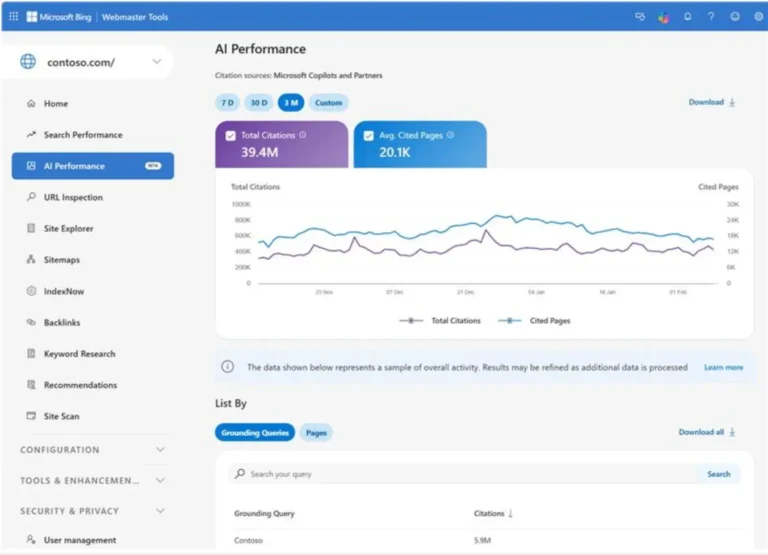
Bing Copilot: Bing Webmaster Tools features an AI Performance report detailing total citations, cited URLs, daily average cited pages, and "grounding queries" – the specific queries the system used to retrieve your content. These grounding queries offer valuable insights into how the AI categorizes your content, providing a different perspective than traditional keyword reports.
-
Perplexity and ChatGPT: These platforms lack native publisher reporting. Tracking relies on referral traffic segmented by source within your analytics and a meticulous manual prompt log. It is imperative to segment AI referral traffic separately from organic traffic from the outset to gain clear trend visibility.
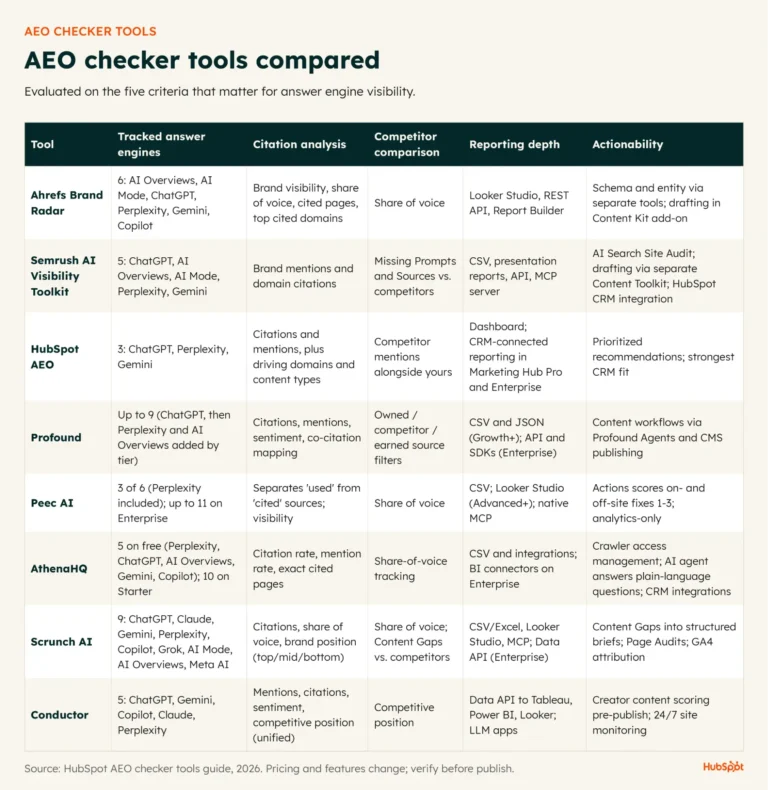
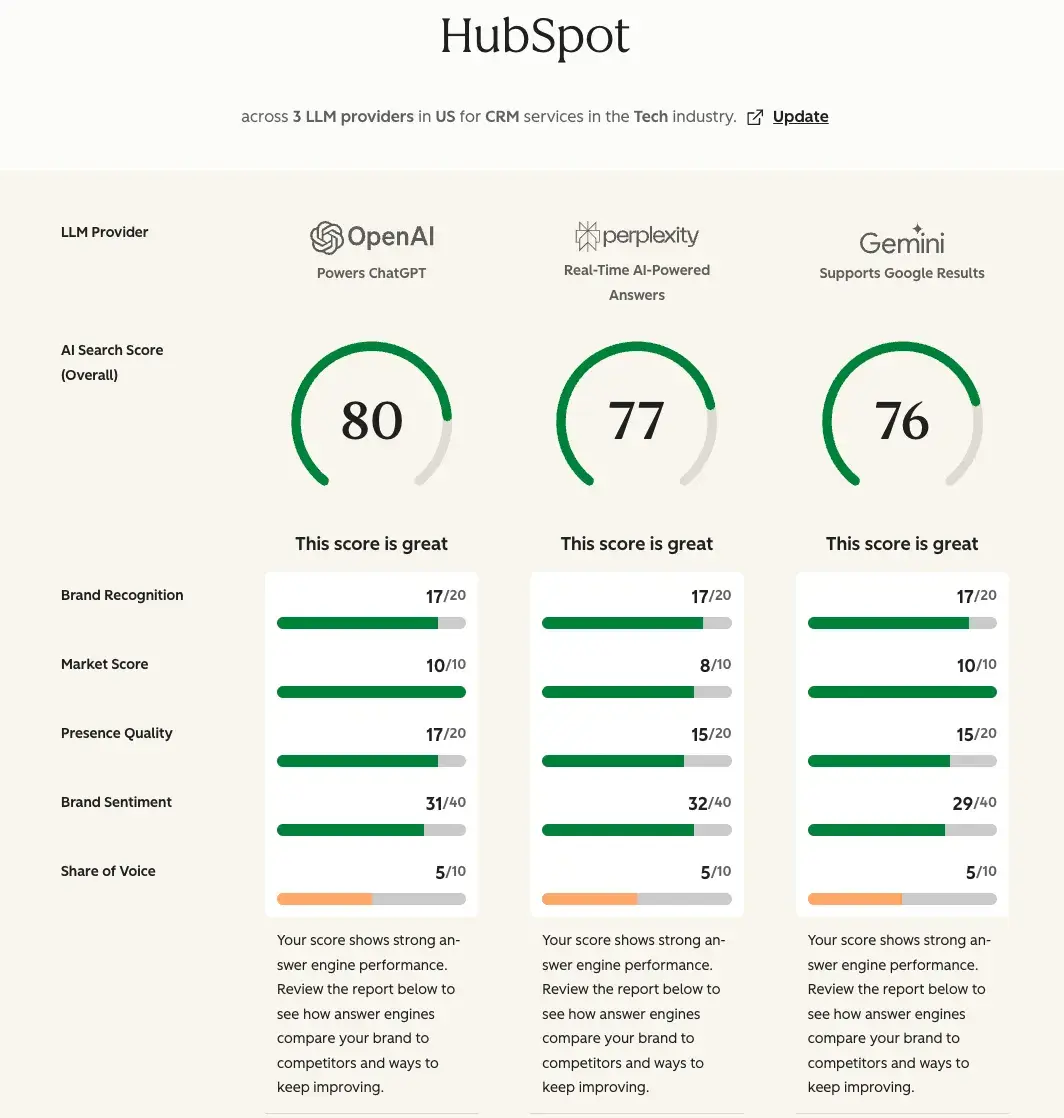
Tools: Free tools like HubSpot’s AI Search Grader provide a baseline assessment of brand visibility across answer engines, evaluating dimensions such as sentiment, presence quality, and share of voice. For ongoing tracking across ChatGPT, Perplexity, and Gemini, HubSpot AEO offers brand visibility scoring against competitors, prompt tracking, and citation analysis.
Pro Tip: Maintain a consistent set of 25 to 50 core prompts and run them at regular intervals. Avoid altering this core set during measurement periods, though new prompts can be added.
Key KPIs for Validating AEO Fixes
AEO Key Performance Indicators (KPIs) focus on whether answer engines are utilizing specific content, rather than solely on traffic volume. These metrics are tailored for answer engine optimization:
-
Citation Frequency: This metric measures how often a brand’s content appears as a cited source in AI-generated answers and serves as a primary north-star metric for AEO.
-
Prompt Coverage: This represents the percentage of a tracked prompt set in which a brand appears. Low prompt coverage typically indicates a content issue rather than a formatting problem.
-
Answer Share of Voice: This KPI quantifies a brand’s share of cited sources relative to competitors. It helps assess whether a brand is gaining ground in AI-generated answers. As Kristina Frunze of WebViewSEO noted on "Found in AI," share of voice is more insightful than raw traffic or citation counts, as it reveals the competitive landscape of AI answer real estate.
-
Citation Distribution: This metric tracks the number of unique pages on a site that receive citations, not just the total citation count. A broad distribution across multiple pages signals strengthening brand authority.
-
Entity Accuracy Rate: This measures the percentage of AI answers that correctly describe a brand, its category, and its differentiators. Inaccurate citations require a different approach, often focusing on source-of-truth consistency. LLMs represent meaning through word relationships, and changes in wording can shift meaning, potentially repositioning a brand within the AI’s understanding without explicit content edits. Predecessor content also plays a role, as older, un-updated information can influence current AI perceptions.
-
AI-Referred Sessions and Conversion Rate: Segmenting AI referral traffic and tracking its conversion rate separately from organic search is crucial. HubSpot’s "State of AEO in 2026" report indicates that AI referral traffic exhibits a higher conversion rate (11.4%) compared to organic search (5.3%) in global e-commerce. Furthermore, a significant percentage of marketers report making business purchases based on brands discovered through AI answers.
Pro Tip: Benchmark internal segmented data against industry-specific market data, as conversion multiples can vary significantly.
Prioritizing and Operationalizing AEO Fixes with CRM Data
The most impactful prompts in AI search are those that reflect the late-stage questions buyers ask when comparing vendors. A company’s Customer Relationship Management (CRM) system is a rich repository of this critical information, holding:
- Lost Deal Analysis: Understanding why deals were lost can reveal critical questions buyers had that went unanswered.
- Won Deal Analysis: Examining the questions asked by successful clients can highlight key decision-making factors.
- Customer Support Interactions: Identifying recurring issues and information gaps that customers face.
- Sales Team Notes: Capturing insights from sales representatives on prospect queries and concerns.
Leveraging CRM data to build the prompt set creates a defensible priority order, essential when collaborating with multiple departments. Identifying prompts that have directly influenced won or lost deals allows for a data-driven approach to AEO prioritization.

HubSpot AEO offers a solution for tracking brand visibility across AI-driven search experiences, identifying AEO gaps, and prioritizing content recommendations. Marketing Hub further integrates native CRM and marketing data to surface prompts used by actual customers, building custom priorities directly from a company’s knowledge base.
The Two Layers of AEO and Their Impact on Priorities
AEO can be conceptually divided into two layers:
- Layer One: Coverage & Answerability: This layer focuses on the content itself – its comprehensiveness and how effectively it answers questions.
- Layer Two: Schema & Citation-Source Gaps: This layer deals with how the content is presented to AI (schema) and its presence and credibility across various platforms (citation sources).
These layers shape priorities due to their distinct ownership and operational cadences:
- Layer One (Content): Typically owned by marketing and content teams, with faster iteration cycles and direct impact on discoverability within the website’s owned assets.
- Layer Two (Schema & Citations): Involves development teams for schema and PR, partnerships, and customer marketing for citation-source gaps. These efforts often have longer lead times and broader external dependencies.
The "State of AEO in 2026" report highlights that AI answer engines increasingly surface content from social platforms and long-form video channels like LinkedIn and YouTube. Krista Doyle, head of AEO at Fan Out, emphasizes the growing importance of niche industry communities for B2B, where a mention from a specialized forum can carry more weight than a generic high-DA backlink. This reframes Layer Two as requiring presence in the specific places where a company’s buyers actively engage, underscoring its ownership by PR, partnerships, and customer marketing.
To optimize AEO efforts, run both layers in parallel. Layer One typically yields faster results and should commence immediately, while Layer Two, requiring more time, should be initiated concurrently to minimize potential losses.
Pro Tip: Identify the top five to six third-party sources consistently cited for your highest-value prompts and share this list with the teams responsible for those relationships. HubSpot’s guide to AEO competitor analysis can assist in systematically building this source list.
Preventing Regression and Sustaining AEO Improvements
AEO gains are often fleeting, as content ages, AI models update, competitors publish new material, and schema can break during website migrations. A remediation sprint without a sustained maintenance cadence can see most gains erode within two quarters. To counteract this:
- Regular Re-audits: Re-run the core prompt set monthly. This serves as an early warning system for regression, detecting declines before they impact traffic.
- Content Freshness Cadence: Establish a schedule for updating cited pages based on industry dynamics. Fast-moving sectors like SaaS, finance, and news may require updates every three to six months, while real estate, e-commerce, and manufacturing can sustain longer cycles.
- Annotate Changes: Document every change made, including the date, page, modification, and responsible party. While AEO engines are not static, annotations provide a timeline for evaluating progress and justifying future initiatives.
- Schema Validation in QA: Integrate schema validation into the quality assurance process for all website template changes, not just new page launches.
- Assign Ownership: Designate clear owners for each AEO tactic to ensure accountability and consistent tracking.
Frequently Asked Questions About Diagnosing and Fixing AEO Gaps
How long until AEO fixes show up in AI Overviews?
Answerability and schema changes on indexed pages can appear within days to weeks. Coverage fixes on new URLs require crawling, indexing, and retrieval, taking longer. Entity-level changes, impacting how a model perceives your brand overall, can take months and depend heavily on off-site signals. Expectations should be set based on these AEO layers.
Does adding schema guarantee AI citations?
No. Valid structured data enhances machine readability but does not guarantee citations. Schema removes parsing barriers but does not create trust or authority. Answerability must be addressed first; schema then serves to mark up that extractable content.
Do I need an llms.txt file for AEO?
As of July 2026, no major answer engine has publicly confirmed the use of llms.txt as a retrieval or ranking input. While it incurs minimal cost, there’s no evidence to prioritize it over coverage, answerability, or schema work. Treat it as optional housekeeping.
Should I rewrite all my content for AEO?
No. Rewriting all content can damage existing rankings. Most pages require restructuring for clarity and extractability, not wholesale rewriting. Focus rewrites on outdated content or pages built around keywords rather than questions. Prioritize existing high-ranking pages that map to evaluation-stage prompts.
How do I avoid duplicating Q&A across articles?
Maintain a single canonical answer for each question on one URL and link to it from all other relevant pages. Before adding a question, search your site for existing answers. Duplicated Q&A blocks create competing passages and dilute signals.
The Audit as a Foundation for Organizational Alignment
An AEO audit encompasses coverage, answerability, schema health, and citation-source gaps, all presenting the symptom of content not being utilized by AI. However, these are distinct problems requiring distinct solutions. Diagnosing them in order prevents unnecessary content rewriting. Prioritizing fixes based on pipeline impact and assigning remediation tasks to the appropriate teams is crucial.
The audit process itself is rarely the most challenging aspect; diagnosing a site can often be completed within a week. The true organizational hurdle lies in securing agreement among multiple, non-reporting departments regarding ownership of citation-gap remediation. Bringing these stakeholders into the diagnostic phase, rather than solely the remediation, fosters a collaborative understanding. The audit is a content exercise, but the fix is an organizational endeavor.
For benchmarking AEO gaps against industry standards, the "State of AEO" report provides valuable insights. Subsequently, utilizing tools like HubSpot AEO can establish a baseline visibility across AI-driven search experiences.
About the Author