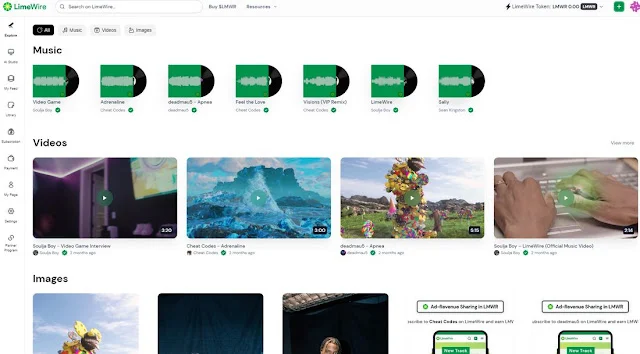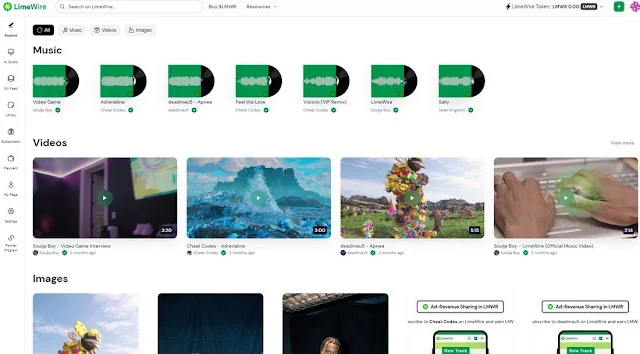
The digital landscape is witnessing a significant pivot as LimeWire, a brand once synonymous with the peer-to-peer file-sharing era of the early 2000s, has fully transitioned into a high-tech ecosystem for generative artificial intelligence and decentralized content distribution. This evolution marks a departure from its controversial past, repositioning the entity as a sophisticated AI Studio that integrates content creation, blockchain-based ownership, and automated monetization models. In an era where generative AI is democratizing the ability to produce high-fidelity visual and auditory media, the new LimeWire seeks to provide a comprehensive infrastructure where creators can not only generate assets but also secure their intellectual property and generate recurring revenue through a proprietary tokenized economy.
The Historical Transformation: From Peer-to-Peer to AI-Powered Studio
To understand the current trajectory of LimeWire, one must look at its historical context. Originally launched in 2000 by Mark Gorton, LimeWire became one of the most prominent Gnutella-based file-sharing clients globally. However, following a protracted legal battle with the Recording Industry Association of America (RIAA), the platform was shuttered in 2010. The brand remained dormant until 2022, when it was acquired by Austrian entrepreneurs Paul and Julian Zehetmayr. Their vision was to leverage the brand’s global recognition to build a legitimate, creator-centric platform utilizing Web3 and AI technologies.
The re-emergence of LimeWire began with a $10.5 million private token sale in early 2022, led by prominent venture capital firms including Kraken Ventures, Arrington Capital, and GSR. This capital infusion provided the foundation for the LimeWire AI Studio, which officially moved the brand away from its legacy as a utility for secondary distribution and toward a primary destination for original content generation. The current iteration of the platform focuses on solving two primary challenges in the modern digital economy: the high barrier to entry for professional-grade content creation and the difficulty of monetizing digital assets in a saturated market.
Technical Infrastructure of the LimeWire AI Studio
At the core of the platform is the LimeWire AI Studio, a multi-model interface that allows users to generate complex digital assets through natural language processing. Unlike many AI tools that rely on a single proprietary model, LimeWire has adopted an aggregator approach, integrating several of the industry’s most advanced generative models.
Currently, the platform supports:
- Stable Diffusion 2.1 and Stable Diffusion XL: These models are utilized for high-resolution image synthesis, allowing for specific stylistic controls ranging from photorealism to abstract digital art.
- DALL-E 2: Integrated to provide users with OpenAI’s sophisticated image generation capabilities, particularly effective for conceptual art and complex prompt adherence.
- Proprietary Models: LimeWire is currently developing its own in-house AI models to offer unique aesthetic outputs and improved processing speeds tailored specifically to the platform’s ecosystem.
The user interface is designed to accommodate both novice creators and professional designers. Features such as advanced samplers, quality fine-tuning, and style presets (including cinematic, pixel art, anime, and analog film) allow for a high degree of creative control. This technical versatility is a strategic move to position LimeWire as a competitor to established tools like Midjourney and Adobe Firefly, with the added advantage of integrated publishing and monetization.
Blockchain Integration and Automated NFT Minting
A distinguishing factor of the LimeWire ecosystem is its seamless integration with blockchain technology. While traditional AI tools often leave creators with questions regarding ownership and copyright, LimeWire utilizes the Polygon and Algorand blockchains to provide a definitive record of provenance.
When a user generates and publishes a piece of content on the platform, LimeWire automates the "minting" process. This converts the digital image or media file into a Non-Fungible Token (NFT). By choosing Polygon (an Ethereum Layer-2 scaling solution) or Algorand (a Layer-1 proof-of-stake blockchain), the platform ensures that transaction costs remain low while maintaining high security and environmental efficiency.
This blockchain layer serves several functions:
- Verifiable Ownership: Every piece of content is tied to the creator’s digital wallet, providing proof of origin.
- Secondary Market Royalties: LimeWire has implemented a smart contract-based royalty system. Creators earn a 2.5% royalty on all secondary sales of their content within the LimeWire marketplace, ensuring long-term financial participation in the success of their work.
- Scarcity and Exclusivity: Creators can choose to release content publicly or restrict it to "premium subscribers." This allows for the creation of gated communities where fans pay for exclusive access to digital collectibles.
The LMWR Token and the Monetization Model
The economic engine of the new LimeWire is the LMWR token, a utility token that facilitates transactions and rewards within the ecosystem. This tokenized approach represents a shift toward a "circular economy" where the platform, the creators, and the consumers are financially aligned.
The monetization strategy is multi-faceted, focusing on both active and passive income streams for creators:
Ad Revenue Sharing
In a move that mirrors the revenue-sharing models of platforms like YouTube, LimeWire offers a generous ad revenue split. Creators receive up to 70% of the revenue generated from advertisements displayed alongside their content. This is a significant departure from traditional social media platforms where creators often receive a much smaller fraction of ad revenue, if any.
Subscription Revenue
The platform allows creators to establish a subscription-based model. Fans can subscribe to a creator’s profile to gain access to exclusive AI-generated content. This provides a predictable, recurring income stream for artists, musicians, and designers who build a dedicated following on the platform.
Token Utility
The LMWR token is used for:
- Prompt Payments: Users can pay for AI generations using LMWR.
- Trading: The token is listed on major global exchanges, including Kraken, ByBit, and UniSwap, allowing creators to convert their earnings into other cryptocurrencies or fiat currency.
- Governance: Token holders may eventually participate in the governance of the platform, voting on feature updates and ecosystem developments.
Pricing Tiers and Accessibility
To ensure broad adoption, LimeWire utilizes a tiered subscription model designed to scale with the needs of the user. While a free tier exists to lower the barrier to entry, premium tiers offer enhanced computational resources and higher revenue-sharing percentages.
- Free Tier: Provides 10 credits daily, allowing for up to 20 image generations. Users in this tier receive a 50% share of ad revenue.
- Basic ($9.99/mo): Increases capacity to 1,000 credits and 2,000 image generations, along with early access to new models.
- Advanced ($29/mo): Aimed at frequent creators, offering 3,750 credits and a 60% ad revenue share.
- Pro ($49/mo): Targets professional designers with 5,000 credits and the maximum 70% ad revenue share.
- Pro Plus ($99/mo): The highest tier, providing 11,250 credits and up to 22,500 image generations per month.
All premium plans remove advertisements for the user and provide a "Pro" profile badge, faster processing times, and a full history of all generated assets.
Broader Impact and Future Outlook
The transformation of LimeWire is indicative of a broader trend in the technology sector: the convergence of AI and Web3. By combining generative tools with blockchain-based ownership, LimeWire is addressing the "attribution crisis" currently facing the AI industry. As AI models are often trained on vast datasets without direct compensation to the original artists, LimeWire’s model of rewarding creators for new, platform-generated content offers a potential path forward for ethical AI utilization.
The platform has already attracted high-profile endorsements and participation from the entertainment industry. Artists such as Deadmau5, Sean Kingston, and Soulja Boy have utilized the platform to release NFT-based music and visual content, signaling that the brand has successfully shed its "piracy" stigma in the eyes of many industry professionals.
Looking ahead, LimeWire has announced plans to expand its AI Studio beyond static imagery. The upcoming launch of AI-powered music and video generation tools will position the platform as a full-service multimedia studio. This expansion is expected to attract a new wave of musicians and filmmakers who can use AI to storyboard, compose, and distribute their work within a single ecosystem.
Conclusion
LimeWire’s evolution from a 2000s-era file-sharing service to a 2024-era AI powerhouse represents one of the most significant brand pivots in digital history. By integrating advanced generative models with the Polygon and Algorand blockchains, the platform provides a unique value proposition: the ability to create, own, and monetize digital content in a streamlined, automated fashion. As the platform expands into music and video, its success will likely depend on its ability to maintain a balance between user-friendly AI tools and a robust, fair economic system for the creators who drive the ecosystem. For now, LimeWire stands as a compelling example of how legacy brands can find new life at the intersection of emerging technologies.
About the Author