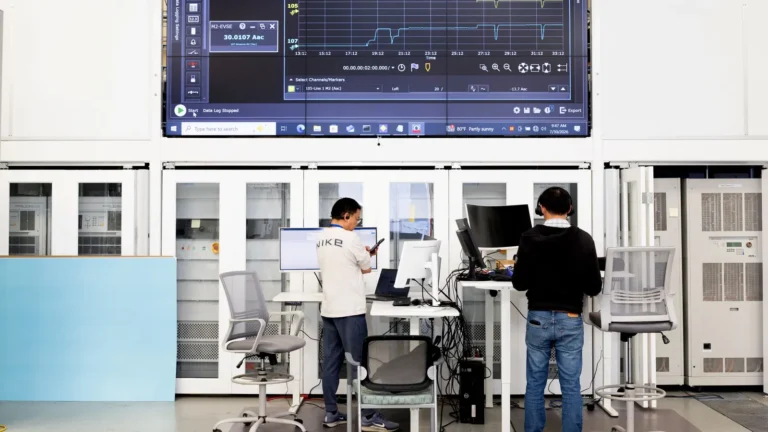
The quest for clean, virtually limitless energy has entered a critical phase, with numerous startups racing to harness the power of nuclear fusion. While groundbreaking advancements are being made in reactor design and plasma physics, a significant bottleneck has emerged: the specialized hardware and software required to precisely control these complex machines. Addressing this burgeoning need, Lausanne-based startup Fusionality has announced the successful closure of a $3.7 million (CHF 3 million) pre-seed funding round, co-led by Founderful and Playfair. This capital infusion is earmarked to accelerate the development of modular, industry-standard control systems and simulation environments, a crucial step in commercializing fusion power.
The genesis of Fusionality lies in a recurring pain point identified by numerous companies operating in the fusion energy sector. Federico Felici, CEO and co-founder, highlighted this challenge in a recent interview. "Over and over again, we heard the same thing from fusion companies: ‘We would ideally buy many of the components to make our control system, but there isn’t really anybody providing them – and especially there isn’t anybody who speaks the language of fusion,’" Felici stated. This sentiment underscores a significant gap in the emerging fusion supply chain. While some companies are focused on manufacturing key reactor components or developing grid-integration technologies, the intricate domain of real-time control systems has largely been a DIY endeavor for most fusion startups.
Fusionality’s founders, Federico Felici and Jonas Buchli, bring a wealth of experience directly relevant to this specialized field. Their backgrounds include years dedicated to developing sophisticated control mechanisms for experimental fusion devices. "We spent quite a lot of our time solving exactly the problems that our customers need to solve," Felici explained. "It felt like the right time" to formalize their expertise into a dedicated company. Buchli, serving as Chief Technology Officer, complements Felici’s leadership, bringing a deep technical understanding of the challenges involved in controlling plasma behavior.
The Fusion Control Challenge: Complexity and Commonality
Nuclear fusion, the process that powers stars, involves forcing atomic nuclei to combine, releasing immense amounts of energy. In terrestrial fusion reactors, this is achieved by heating a fuel mixture, typically isotopes of hydrogen like deuterium and tritium, to extraordinarily high temperatures—millions of degrees Celsius—creating a superheated state of matter known as plasma. Maintaining this plasma in a stable and contained state, optimizing its temperature, density, and shape, is paramount to achieving a net energy gain.
Plasma is inherently unstable and reactive, behaving like a "fickle" fluid that requires constant, split-second adjustments to prevent it from interacting with reactor walls or dissipating. This delicate dance is orchestrated by sophisticated control systems that monitor a multitude of parameters and issue precise commands to electromagnets, heating systems, and fuel injectors. The development and deployment of these systems are exceptionally complex, requiring expertise in physics, electrical engineering, computer science, and artificial intelligence.
However, Felici and Buchli identified a critical insight: despite variations in reactor designs—such as tokamaks and stellarators—a substantial portion of the underlying control requirements are universally applicable. "Across the industry, many companies make their own control systems from scratch," Felici noted. "But actually, 80% of each company’s control system is really exactly the same." This commonality presents a significant opportunity for standardization and specialization. Fusionality aims to capitalize on this by developing a foundational suite of control system modules and simulation environments. These platforms will provide fusion startups with a robust starting point, allowing them to focus their resources on fine-tuning the unique aspects of their specific reactor designs rather than reinventing fundamental control logic.
A Foundation Built on Shared Experience and Expertise
The partnership between Felici and Buchli was forged in the crucible of fusion research. They first crossed paths while collaborating on teaching artificial intelligence techniques to control an experimental tokamak at EPFL (École Polytechnique Fédérale de Lausanne) in Switzerland. Felici was affiliated with EPFL, while Buchli was with Google DeepMind. Felici later transitioned to Google DeepMind, where he deepened his work on fusion, developing advanced simulations and machine learning interfaces specifically for fusion devices. This direct experience in both academic research and cutting-edge industrial AI development provided them with an intimate understanding of the practical challenges faced by fusion developers.
Their tenure at Google DeepMind, a leader in artificial intelligence research, also informed their perspective on the role of AI in fusion control. Felici acknowledges the significant potential of AI but emphasizes a pragmatic approach. "AI will play an important role in future control systems," he said, "but it’s not quite ready to tackle the entire challenge." He cautioned against viewing AI as a complete replacement for human-designed control architectures in the immediate future. Instead, he sees AI’s current strength lying in its ability to "complement or enhance or optimize" specific aspects of the control system, such as predictive modeling of plasma behavior or optimizing operational parameters in real-time. This nuanced view suggests Fusionality’s systems will likely integrate AI as a powerful tool within a broader, robust control framework.
Navigating the Emerging Fusion Supply Chain
Fusionality’s emergence aligns with a broader trend of the fusion industry maturing into a distinct economic sector with its own specialized supply chain. Historically, fusion research was largely confined to national laboratories and academic institutions. However, the last decade has witnessed an explosion of private investment, fueling a new wave of startups aiming to bring fusion power to the grid within the next decade.
Companies like Kyoto Fusioneering, which is developing key components for fusion power plants, represent one facet of this evolving ecosystem. Others, like Commonwealth Fusion Systems, Realta Fusion, Proxima Fusion, and Type One Energy, are prominent players in the magnetic confinement fusion approach, developing their own reactor designs. These companies, often backed by substantial venture capital and government funding, are pushing the boundaries of engineering and physics. However, their success hinges not only on their core reactor technology but also on the ability to reliably and efficiently control them.
While many established manufacturing companies possess the precision engineering capabilities to produce high-quality components, the specialized knowledge of fusion physics and control system architecture remains scarce. This is where Fusionality intends to carve out its niche. By focusing exclusively on the control layer, the company aims to become the go-to provider for the hardware and software that govern the heart of a fusion reactor.
Strategic Focus and Future Ambitions
Currently, Fusionality is concentrating its efforts on magnetic confinement fusion, the dominant approach among private fusion companies. This method utilizes powerful superconducting electromagnets to create a magnetic field that traps and confines the hot plasma, preventing it from touching the reactor walls. This approach is favored by many leading fusion ventures due to its perceived scalability and faster development timeline compared to inertial confinement fusion.
The initial $3.7 million in pre-seed funding will empower Fusionality’s team of seven to develop a "tightly selected number of technologies." Felici described these as akin to "Lego blocks," suggesting a modular and scalable approach to their product development. The company’s ambition extends beyond magnetic confinement, with plans to eventually develop control systems for other fusion approaches as the industry diversifies. This foresight positions Fusionality as a potentially foundational partner for a wide spectrum of fusion energy developers.
The implications of Fusionality’s success could be far-reaching. By providing standardized, high-quality control systems, the company can significantly reduce the development time and cost for fusion startups. This, in turn, could accelerate the timeline for commercial fusion power deployment, bringing the world closer to a clean energy future. The reduction in the need for each startup to build its control system from scratch frees up valuable resources and expertise, allowing them to focus on their unique technological innovations and operational scaling. This specialized focus from Fusionality addresses a critical need, demonstrating the growing maturity of the fusion industry as it moves from pure research toward commercial viability, requiring a robust and specialized industrial ecosystem to support its ambitious goals. The success of this pre-seed round signals strong investor confidence in the company’s vision and its potential to become a key enabler of the fusion revolution.
About the Author