The genesis of Flock Safety is often told as a classic Silicon Valley-style origin story, though it began in the American South. CEO Garrett Langley has frequently recounted how the company’s first automated license plate recognition (ALPR) cameras were assembled on his dining room table in Atlanta, Georgia. Those early prototypes, built with a DIY ethos, left permanent drill marks and scratches on his furniture—physical reminders of a startup’s humble beginnings. A decade later, Flock Safety has transformed into a dominant force in the American surveillance landscape, with its cameras installed in thousands of neighborhoods and used by over 5,000 law enforcement agencies. However, as the company’s footprint has expanded, the transparency regarding its manufacturing processes has notably diminished.
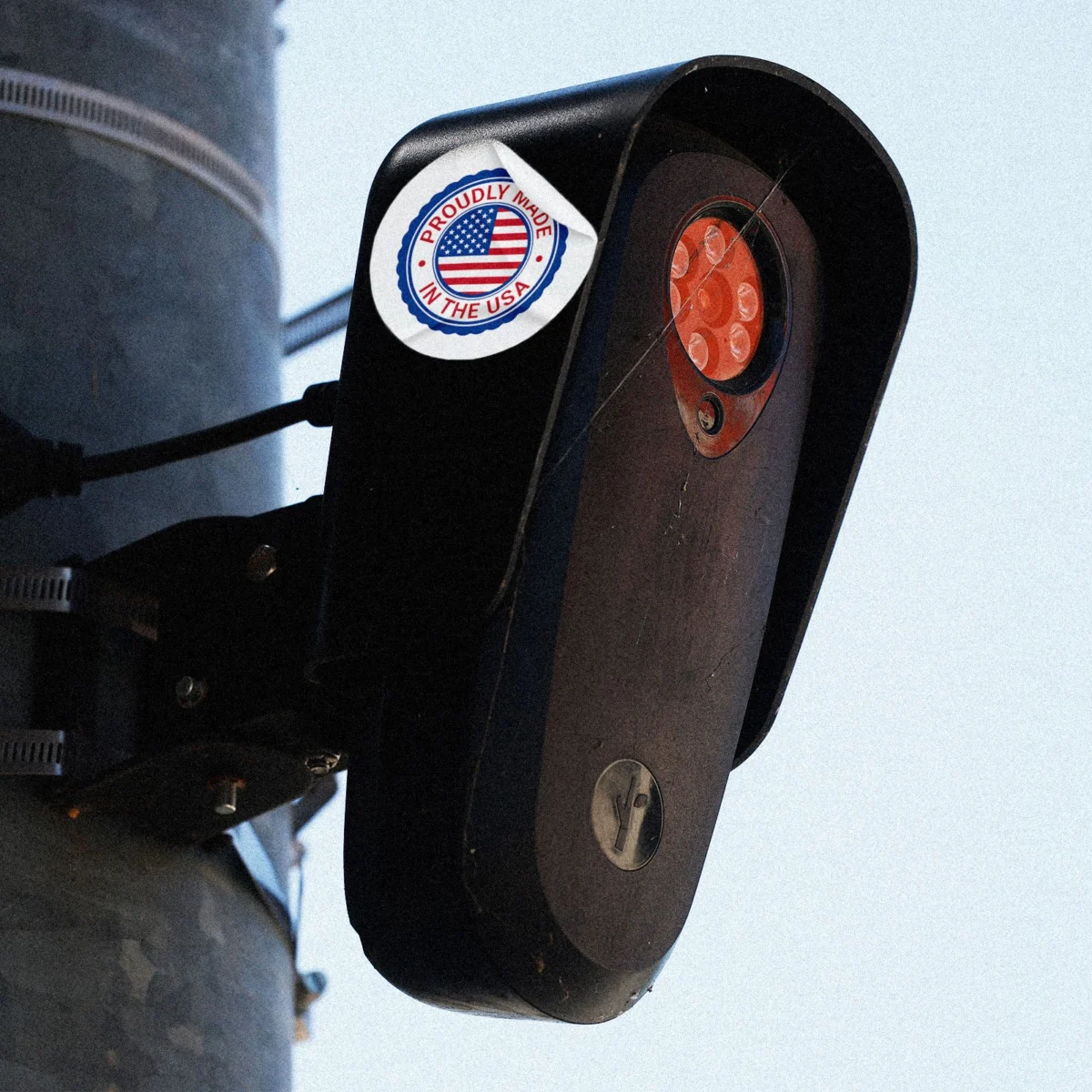
For several years, Flock’s public identity was tethered to its status as an American manufacturer. Marketing materials and public statements proudly touted that its devices were produced within the United States. This "Made in the USA" branding was not merely a point of patriotic pride; it served as a strategic shield against the growing bipartisan anxiety over foreign-made surveillance technology, particularly hardware originating from China. Yet, a recent investigation of company materials and supply chain records indicates a significant shift. More recent marketing collateral reviewed by journalists and industry analysts no longer specifies the country of origin for its signature cameras. Furthermore, the corporate ecosystem surrounding Flock has begun to distance itself; at least one major U.S. manufacturer that previously listed Flock as a high-profile client quietly scrubbed the company from its website earlier this year.
This pivot in transparency coincides with a period of unprecedented turbulence for the startup. Flock Safety has become the primary target of a burgeoning nationwide protest movement. Activists, civil libertarians, and privacy advocates have successfully lobbied dozens of local governments to terminate their contracts with the company, citing concerns over mass surveillance and the potential for abuse. Simultaneously, the company faces mounting pressure from Washington D.C. Members of Congress are currently weighing legislation that would implement a "carrot and stick" approach to federal funding, potentially stripping states of highway grants if they fail to establish strict limits on how ALPR data from companies like Flock is utilized and shared.
The Evolution of the Hardware Pipeline
The technical foundation of Flock’s hardware has always been rooted in a strategy of "aggregation." In a 2021 marketing video, Langley explained that the company’s value proposition did not lie in inventing new sensor technology from scratch, but rather in the packaging of globally sourced components into a "waterproof, consumer-friendly device." The earliest iterations of the Flock camera were essentially "Frankenstein" devices; prototypes were reportedly constructed using camera modules extracted from Android smartphones purchased on Alibaba. These were then integrated with batteries and soldered to solar panels to create a low-cost, high-utility surveillance node.
As the company scaled from serving small homeowners associations (HOAs) to major metropolitan police departments, its assembly requirements outgrew the dining table and, eventually, its initial corporate offices. By 2020, Flock had transitioned its assembly line to a shared warehouse facility in Atlanta. During this phase, engineers and technical staff worked alongside one another to assemble the main camera units, while less technical employees handled the mounting brackets and solar attachments.
However, as demand skyrocketed, Flock began to outsource final assembly to larger contract manufacturing facilities. Records indicate that between 2021 and 2023, the company utilized facilities operated by East West Manufacturing in North Carolina and Plexus in Wisconsin. This move allowed Flock to increase its production capacity ten-fold, reaching a capability of 500 cameras per day by early 2024. Despite this domestic assembly, the underlying components remained heavily reliant on Asian supply chains.
Supply Chain Volatility and National Security Concerns
The most significant questions regarding Flock’s current manufacturing status involve its relationship with Primax Electronics. Import records collected by ImportGenius reveal a steady stream of shipments from Primax Electronics in Thailand to Flock Safety. While Primax is headquartered in Taiwan, it maintains extensive manufacturing operations in China and Thailand. Analysts note that these shipments frequently include radar systems and "commodity" camera components.
The reliance on international suppliers like Primax raises complex questions about National Defense Authorization Act (NDAA) compliance. The NDAA includes provisions, specifically Section 889, that prohibit federal agencies and government contractors from using telecommunications and video surveillance equipment produced by certain Chinese entities, such as Huawei, ZTE, and Hikvision, due to national security risks. In response to inquiries, Flock spokesperson Paris Lewbel stated that all products built by the company are "NDAA compliant." However, the lack of specific detail regarding which components are sourced from where continues to trouble transparency advocates.
Cris van Pelt, the founder of the advocacy project "Have I Been Flocked," argues that the ambiguity is symptomatic of a larger lack of oversight. "It all speaks to the fact that there is no real oversight, and that tens of thousands of literal and figurative black boxes are being installed on American roads," van Pelt noted. He emphasized that if any segment of the supply chain were compromised, the public and local governments would have no mechanism to detect it.
Privacy Scandals and Public Backlash
The scrutiny of Flock’s manufacturing is inextricably linked to the controversies surrounding the use of its data. While police departments argue that the cameras are indispensable for solving "stranger-on-stranger" crimes and recovering stolen vehicles, the reality of the technology’s application has frequently strayed from its marketed purpose.
In Georgia, a police officer was discovered using the Flock system to track the movements of his ex-girlfriend and her friend. In other jurisdictions, data sharing agreements have allowed license plate footage to be accessed by immigration authorities, a move that critics say turns local police into de facto federal agents. Furthermore, the introduction of "Flock AI" has expanded the system’s capabilities beyond license plate reading; the software now allows users to search for vehicles based on specific features like roof racks, bumper stickers, or even the movement patterns of pedestrians in the vicinity of a camera.
This "feature creep" has fueled the legislative push in Congress. The proposed "Fourth Amendment Is Not For Sale Act" and similar state-level bills aim to close loopholes that allow law enforcement to bypass warrant requirements by purchasing data from private brokers or utilizing third-party surveillance networks like Flock’s "Talos" system.
Technical Vulnerabilities and Workplace Safety
The hardware itself has also come under fire for technical shortcomings. Recent reports have highlighted that Flock cameras continue to utilize smartphone-style processors and, in many cases, leave significant amounts of data unencrypted. This "smartphone in a box" architecture, while cost-effective, potentially leaves the devices vulnerable to sophisticated hacking or tampering.
Beyond the technology, the company’s internal operations have faced regulatory hurdles. In July, the U.S. Occupational Safety and Health Administration (OSHA) cited Flock Safety for failing to promptly report a workplace incident in Houston, Texas, where an employee suffered a leg amputation. While Flock is contesting the $9,500 penalty, claiming they reported the injury as soon as they were fully informed, the incident has drawn attention to the company’s "audio and video equipment manufacturing" site in Houston—a location previously unknown to many industry observers.
The Drone Frontier and the Smyrna Strategy
As the debate over its cameras continues, Flock is aggressively pivoting toward the next frontier of surveillance: drones. Last October, the company announced the opening of a dedicated facility in Smyrna, Georgia, specifically designed to assemble its new "Alpha" drone. This move is largely a response to shifting federal regulations. Current U.S. law and various state-level executive orders have restricted or banned the use of foreign-made drones—most notably those from the Chinese giant DJI—by government agencies.
By establishing a domestic drone manufacturing hub, Flock aims to capture the "Drone as a First Responder" (DFR) market. The Smyrna facility is intended to ensure that Flock’s drones are seen as a "secure, American-made" alternative to DJI. However, the rollout has been marred by delays. The Alpha drone only recently "hit the field" in May 2024, and the company has told officials in cities like Berkeley, California, that it will take up to two years to fully replace their existing DJI fleets with the new U.S.-made models.
Broader Implications for the Surveillance Industry
The trajectory of Flock Safety reflects a broader tension in the American tech sector between the convenience of globalized supply chains and the necessity of national security and privacy protections. Flock’s competitors, such as Motorola Solutions and Axon, have taken different approaches to transparency. Motorola has been vocal about its assembly facility in Richardson, Texas, while Axon has emphasized its domestic assembly of body cameras in Arizona.
For civil liberties organizations like the Electronic Frontier Foundation (EFF), the location of a factory is secondary to the impact of the technology itself. Matthew Guariglia, a senior policy analyst at the EFF, argues that "domestic manufacturing is no substitute for accountability." He contends that a multi-billion dollar industry dedicated to mass surveillance does not become inherently safer or more ethical simply because it is "Made in America."
As Flock Safety continues to navigate legislative challenges and public skepticism, its transition from a transparent "homegrown" startup to a more opaque corporate entity remains a point of contention. The "black boxes" on American utility poles represent more than just a tool for law enforcement; they are the physical manifestation of a debate over where the line between public safety and private life should be drawn, and who—if anyone—is truly watching the watchers.
About the Author