The digital marketing and search engine optimization landscape is undergoing a seismic shift, driven by the rapid integration of Artificial Intelligence into how users seek information. A new frontier, known as Answer Engine Optimization (AEO), has emerged, demanding a fundamental reevaluation of visibility strategies. At the heart of this evolution are AEO checkers, sophisticated tools designed to measure and enhance a brand’s presence within the synthesized answers generated by AI platforms like ChatGPT, Perplexity, and Google’s AI Overviews. This article delves into the critical function of AEO checkers, explores how to manually assess AI-driven visibility, and provides a comprehensive overview of the leading AEO checker tools available to businesses today.
Understanding the Paradigm Shift: From Search Engine Optimization to Answer Engine Optimization
For years, Search Engine Optimization (SEO) has been the cornerstone of online visibility, focusing on ranking web pages in a list of hyperlinks. However, the advent of generative AI has fundamentally altered user behavior. Instead of sifting through multiple links, a growing number of users now pose questions directly to AI chatbots and rely on the synthesized answers provided. This shift means that visibility once achieved through high search engine rankings can now be lost within an AI-generated response, often without the user ever clicking through to a website.
Answer Engine Optimization (AEO) is the strategic response to this evolving search paradigm. It is the practice of ensuring that a brand not only appears in search results but is also accurately and frequently mentioned within the AI-generated answers that users consume. This is not a replacement for traditional SEO but rather a complementary discipline. Strong SEO continues to provide the foundational crawlability and authority signals that AI engines leverage when selecting sources for their answers. AEO, therefore, focuses on the content itself – ensuring it is clearly structured, directly answers user queries, and cites verifiable sources to build trust with AI models.
The implications of this shift are profound. Brands that fail to adapt to AEO risk becoming invisible to a significant and growing segment of their potential customer base. This invisibility can manifest as a decline in website traffic, a loss of brand awareness, and ultimately, missed business opportunities.
![AEO checker tools that measure answer engine visibility [2026]](https://53.fs1.hubspotusercontent-na1.net/hubfs/53/aeo-checker-1-20260903-3858273.webp)
The Function of an AEO Checker: Illuminating AI Visibility
An AEO checker serves as a crucial diagnostic tool, meticulously measuring a brand’s visibility across various answer engines. Its primary objective is to identify where a brand appears, where it is overlooked, and critically, where AI models might be misrepresenting or omitting it. By quantifying this visibility, AEO checkers transform raw data into actionable insights, guiding businesses on how to improve their standing.
These tools typically perform several key functions:
- Brand Mentions: They track whether a brand’s name or key products are explicitly mentioned within AI-generated answers.
- Citation Tracking: They determine if the AI’s answers are citing the brand’s content as a source, indicating a direct link to the brand’s digital assets.
- Competitor Analysis: They monitor how often competitors are cited or mentioned in response to relevant queries, highlighting areas where the brand is losing ground.
- Query Analysis: They identify the specific questions or prompts that lead to AI Overviews, ChatGPT responses, or Perplexity answers, and importantly, whether the brand features in these.
- Content Gap Identification: They pinpoint queries where AI Overviews appear but do not cite the brand’s content, or where competitors are favored.
- Accuracy Assessment: They help assess whether the AI accurately represents the brand’s information or makes erroneous claims.
Based on this comprehensive analysis, AEO checkers then prioritize areas for improvement. This often translates into recommendations for content updates, schema markup corrections, and entity optimizations – all designed to enhance the likelihood of a brand being cited and mentioned in AI-generated responses.
Navigating the AI Frontier: Manual AEO Checks
While sophisticated AEO tools offer automated solutions, understanding the manual process of checking AI visibility is fundamental for grasping the underlying mechanics and for businesses with limited resources. This approach involves direct interaction with the AI platforms themselves.
Manual Checks in Google AI Overviews
Google’s AI Overviews (AIOs) represent a significant integration of AI into the traditional search experience. These summaries appear when Google’s systems deem them to be additive to standard search results. Due to their dynamic nature, AIOs do not trigger for every query and can vary between search sessions.
![AEO checker tools that measure answer engine visibility [2026]](https://no-cache.hubspot.com/cta/default/53/9dd5e54b-fbef-4dd0-bc44-1689feb1ea18.png)
Step 1: Define Priority Queries: The first step involves identifying the most critical search terms. These should include brand names, branded product terms, and the informational questions that prospective buyers frequently ask.
Step 2: Conduct Live Search Sessions: Run these priority queries in a signed-out or incognito browser session to ensure unbiased results. For each query, record three key pieces of information:
- Whether an AI Overview appears.
- If an AI Overview is present, whether the brand’s domain is listed among the inline source links.
- The specific claim or information presented in the AI Overview.
Step 3: Interpret and Analyze Results: Compare the queries where an AI Overview appears and cites the brand against those where an AI Overview is present but competitor domains are cited instead. The latter category represents a "content gap" that requires immediate attention. It is important to remember that AIOs can fluctuate; a single instance of absence should prompt a re-check rather than be taken as definitive proof of lost visibility.
Step 4: Document and Report: For each result, meticulously document the query, date, and location. Screenshots are invaluable for creating a verifiable record of performance. Traditional tools like Google Search Console do not yet isolate AI Overview activity from general "Web" search types, though Google has begun rolling out dedicated generative AI performance reports. However, these initial reports focus on impressions and have limited reach.
Pro Tip: Manual checks are feasible for a small set of queries. However, as the number of queries grows and the frequency of AI Overview shifts increases, manual sampling becomes unreliable and time-consuming. This is where automated AEO checkers become indispensable.
![AEO checker tools that measure answer engine visibility [2026]](https://53.fs1.hubspotusercontent-na1.net/hubfs/53/aeo-checker-2-20260903-852936.webp)
Manual Checks for ChatGPT and Perplexity Citations
Both ChatGPT and Perplexity offer mechanisms for users to review the sources that inform their answers, making manual citation checks more straightforward.
Step 1: Perform Practical Citation Checks: Using the same defined priority queries (branded and informational), examine each AI response for two key indicators:
- Does the brand’s domain appear within the list of cited sources?
- Is the brand name explicitly mentioned within the body of the AI’s answer?
Both a citation and a mention represent distinct successes in AI visibility.
Step 2: Optimize Prompts for Retrieval: To ensure that AI models access up-to-date information, it is crucial to phrase prompts effectively. ChatGPT, for instance, will only engage its web search capabilities if a question genuinely benefits from current data or if web search is manually selected. Therefore, posing direct, timely questions, such as "What are the best [product category] tools for [specific use case]?", increases the likelihood of the AI accessing live sources that can be inspected.
Step 3: Log and Convert Gaps into Actionable Tasks: Given that AI engines can draw from varying sources for similar queries, it is essential to run each prompt multiple times across fresh sessions. For every iteration, meticulously record the engine used, the prompt, the date, whether the brand was cited or mentioned, and importantly, which competitors appeared. This detailed log helps identify inconsistencies (e.g., being cited in one session but not another, or being cited by Perplexity but not ChatGPT). Each instance where the brand is absent or a competitor is favored should be treated as a specific task. For content gaps where competitors are cited, the recommended action is to refine the content or structure of the relevant page and then re-run the prompt after publication.
Criteria for Selecting an AEO Checker Tool
As manual AEO checks become impractical for scaling businesses, the selection of an appropriate AEO checker tool becomes paramount. These tools automate the monitoring process, providing continuous and consistent insights into AI visibility. When evaluating AEO checker software, several key criteria should be considered:
![AEO checker tools that measure answer engine visibility [2026]](https://53.fs1.hubspotusercontent-na1.net/hubfs/53/aeo-checker-3-20260903-8904553.webp)
- Engine Coverage: Does the tool monitor the AI platforms most relevant to your target audience? This typically includes Google AI Overviews, ChatGPT, and Perplexity. Some tools may also extend to other emerging AI search engines.
- Citation and Mention Tracking: Beyond just identifying if a brand is cited, does the tool differentiate between direct citations (linking to the brand’s domain) and mere mentions (where the brand name appears without a link)? This distinction is vital for understanding the depth of visibility.
- Competitor Benchmarking: The ability to track competitor visibility is crucial for understanding market dynamics and identifying competitive advantages or disadvantages.
- Query-Based Analysis: Does the tool allow for the tracking of specific queries and keywords that are important to the brand? This ensures that the monitoring is aligned with business objectives.
- Automated Reporting and Alerts: Does the tool provide regular reports and customizable alerts for significant changes in visibility? This helps in staying informed without constant manual oversight.
- Actionable Recommendations: Beyond simply reporting data, does the tool offer concrete, data-driven recommendations for improving AEO performance? This could include suggestions for content optimization, schema enhancements, or keyword targeting.
- Integration Capabilities: Does the tool integrate with existing marketing technology stacks, such as CRMs or content management systems? This can streamline workflows and enhance the value of the data.
- Data Accuracy and Reliability: Given the fluctuating nature of AI responses, the tool’s methodology for ensuring data accuracy and consistency is critical.
- User Interface and Ease of Use: A well-designed and intuitive interface can significantly improve the user experience and adoption rate within an organization.
- Cost and Scalability: The pricing structure should align with the business’s budget, and the tool should be capable of scaling as the brand’s needs evolve.
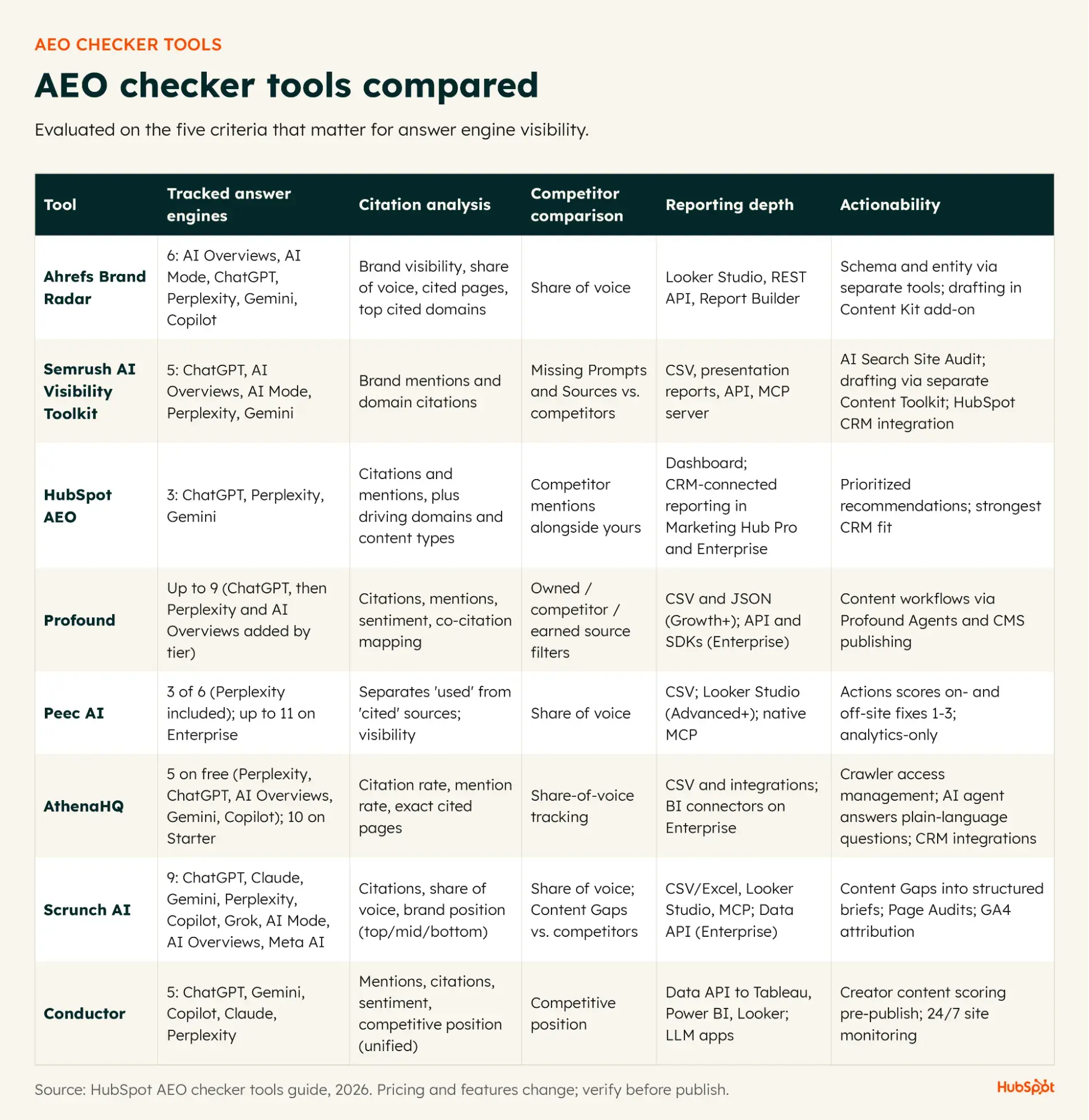
Leading AEO Checker Tools: A Comparative Overview
The market for AEO checkers is rapidly evolving, with several robust solutions emerging. These tools vary in their focus, feature sets, and pricing, catering to different business needs.
Tools with AI Overviews Tracking
- Ahrefs Brand Radar: This tool differentiates itself by drawing on real search queries rather than synthetic prompts, making its AI Overview index particularly valuable. It offers comprehensive tracking of AI Overviews, competitor analysis, and insights into the queries driving this visibility.
- Semrush AI Visibility Toolkit: Semrush’s offering integrates AI Overviews tracking into its existing suite. The Organic Research feature highlights keywords that already trigger AI Overviews, allowing users to prioritize content optimization efforts for pages that are close to achieving AI inclusion.
Tools with ChatGPT Citation Detection
- HubSpot AEO: HubSpot’s solution provides a holistic approach by tracking both direct citations and brand mentions within ChatGPT responses. It also analyzes the domains and content types that contribute to a brand’s visibility and offers competitive insights. For users of Marketing Hub Professional and Enterprise, AEO integrates with the CRM, providing advanced reporting that connects AI visibility to customer and deal data.
- Profound: This tool goes beyond basic citation detection by offering context-rich analysis. It includes sentiment scoring for mentions, flags prompts where a brand is uncited despite relevance, and breaks down citations by source type (owned, competitor, earned).
Tools with Perplexity Monitoring
- Peec AI: As a specialized analytics tool, Peec AI focuses on delivering clean and reliable data specifically for Perplexity. Its strength lies in its dedicated monitoring of this increasingly popular answer engine.
- AthenaHQ: AthenaHQ offers Perplexity monitoring across all its plans, including a free tier, making it an accessible option for many businesses. It also incorporates a conversational assistant to help users navigate and interpret the data.
Tools for Schema and Entity Readiness
- Scrunch AI: This tool focuses on the foundational aspects of AI visibility by assessing whether AI crawlers can effectively access and render a brand’s web pages. It checks for technical readiness, ensuring that content is discoverable by AI models.
- Conductor: Conductor combines 24/7 technical monitoring with a content scoring mechanism. This dual approach ensures both the technical infrastructure and the content itself are optimized for AI consumption, addressing both crawlability and comprehensibility.
Key AEO Metrics for Measuring Success
Once an AEO checker is in place, tracking specific metrics is essential to gauge the effectiveness of optimization efforts. These metrics provide a clear picture of whether visibility is improving over time.
- Visibility Score: This is an aggregate score that reflects a brand’s overall presence across monitored AI engines. Tracking this score week-over-week or month-over-month indicates the direction of progress.
- Citation Coverage: This metric quantifies the percentage of relevant queries where the brand’s content is cited as a source. An increasing citation coverage suggests that AI engines are finding and trusting the brand’s information.
- Mention Volume: This tracks the number of times a brand is mentioned in AI-generated answers. While not as direct as a citation, a higher mention volume contributes to brand awareness.
- Share of Voice: This metric compares a brand’s visibility (citations and mentions) against that of its competitors for specific queries. A growing share of voice indicates that the brand is gaining an advantage.
- AI-Referred Traffic: This measures the volume of website traffic originating from AI answer engines. While a zero-click phenomenon is common, any traffic that does convert from AI is a tangible indicator of success.
- Branded Search Lift: An increase in branded search queries following AEO efforts can be an indirect indicator of enhanced brand awareness driven by AI visibility.
It is crucial to interpret these metrics as trends rather than isolated data points. Consistent improvement over time is the key indicator of successful AEO strategy.
From Measurement to Action: Streamlining AEO with Integrated Solutions
The ultimate value of an AEO checker lies not just in diagnosing visibility issues but in facilitating the implementation of solutions. While many checkers provide recommendations, integrated platforms like HubSpot’s Marketing Hub offer a more seamless workflow.
HubSpot AEO, available as a standalone product or as part of Marketing Hub Professional and Enterprise, aims to bridge the gap between diagnosis and action. The standalone HubSpot AEO ($50/month) provides tracking, prompt suggestions, citation analysis, and prioritized recommendations. However, implementing these fixes often requires manual export of data and integration with other content creation tools.
![AEO checker tools that measure answer engine visibility [2026]](https://53.fs1.hubspotusercontent-na1.net/hubfs/53/aeo-checker-4-20260903-6212698.webp)
In contrast, AEO within Marketing Hub Professional and Enterprise takes this a step further. It leverages CRM data to inform prompt and recommendation suggestions, making them more contextually relevant. The integrated "Content Agent" can transform a blog recommendation into a research-backed first draft with a single click, which then lands in HubSpot’s content editor for review and refinement. This workflow streamlines content creation and publishing directly through HubSpot’s Content Hub and Marketing Hub. This AI-powered content generation is currently in public beta and utilizes HubSpot Credits, with an estimated cost of $10 per blog post.
A significant advantage of this integrated approach is its connection to HubSpot’s Smart CRM. Traffic referred from AI tools is accurately attributed as its own source, and this data is linked to the contacts and deals it influences. This provides a comprehensive view of the customer journey, from initial AI discovery to eventual conversion. While answer engines often resolve queries without generating a click, and therefore without direct pipeline attribution, tracking both visibility scores and referral revenue provides a more complete understanding of AEO’s impact.
Frequently Asked Questions About AEO Checkers
How often should you run an AEO check?
The frequency of checks depends on the method. For manual spot-checks, multiple sessions per query are recommended due to the variability of AI responses. Automated checkers can handle this better, with daily or weekly refreshes capturing volatility, while monthly snapshots might obscure these fluctuations.
Is AEO the same as AI search optimization?
While often used interchangeably, AEO is the more precise term. Answer Engine Optimization specifically refers to improving visibility within AI-generated answers from platforms like ChatGPT, Perplexity, and Gemini. "AI search optimization" is a broader term that may encompass other AI-driven search functionalities.
Can you reliably track citations in ChatGPT and Perplexity?
Yes, with caveats. Both platforms allow users to review the sources behind their answers, making individual responses auditable. However, the variability of results across sessions necessitates repetition. Running prompts multiple times and tracking patterns over time, rather than relying on a single snapshot, ensures reliability.
![AEO checker tools that measure answer engine visibility [2026]](https://53.fs1.hubspotusercontent-na1.net/hubfs/53/aeo-checker-5-20260903-8938354.webp)
Do AEO checkers replace traditional SEO tools?
No. AEO checkers and traditional SEO tools measure different aspects of online presence. SEO tools focus on keyword rankings, backlinks, and technical site health, which remain critical for AI engine crawlability and authority. AEO checkers focus on how content is synthesized and cited within AI answers. The two disciplines are complementary and should be run in tandem for a comprehensive digital strategy.
In conclusion, as AI continues to reshape the information retrieval landscape, AEO checkers are no longer a niche tool but a fundamental requirement for businesses seeking to maintain and grow their visibility. By understanding the principles of AEO, leveraging manual checks, and strategically selecting and implementing AEO checker tools, brands can navigate this new era of search and ensure they remain discoverable and relevant to their target audiences.
About the Author