The digital landscape is undergoing a seismic shift, driven by the rapid integration of artificial intelligence into search and information retrieval. As consumers increasingly turn to AI-powered chatbots like ChatGPT, Perplexity, and Google’s Gemini for answers, a critical challenge has emerged for brands: ensuring their presence within these synthesized responses. Traditional Search Engine Optimization (SEO), focused on ranking high in a list of links, is no longer sufficient. A new discipline, Answer Engine Optimization (AEO), is gaining prominence, aiming to secure a brand’s mention and citation within the AI-generated answers that are bypassing traditional click-throughs. This evolving search paradigm necessitates specialized tools and strategies, prompting the development of AEO checkers to monitor and adapt to this new era of information discovery.
The core of AEO lies in understanding how AI models interpret and present information. Unlike traditional search engines that provide a list of web pages, generative AI tools synthesize information from multiple sources to provide a direct, often conversational, answer. This means that visibility that once translated into website traffic through search rankings can now effectively "vanish" into an AI-generated summary, leaving brands unseen and unacknowledged. An AEO checker serves as a crucial diagnostic tool, identifying which queries surface a brand’s content, which inadvertently highlight competitors, and instances where the AI misinterprets or omits brand-specific information. The effectiveness of these checkers is paramount, as they provide the actionable insights needed to adapt content and digital strategies to this new search behavior.
The practice of Answer Engine Optimization (AEO) is fundamentally about enhancing a brand’s presence and accuracy within the AI-generated responses delivered by platforms such as ChatGPT, Perplexity, and Gemini. This shift in user behavior, where individuals pose questions directly to AI and act upon the provided answers without necessarily clicking through to external links, represents a significant departure from established search patterns. Google’s integration of AI Overviews in May 2024 further solidified this trend, bringing a summary-first approach to its own search results. AEO and SEO, while distinct, are highly complementary. While SEO continues to be vital for ensuring content is crawlable and authoritative—the foundational elements that AI models rely on for information—AEO focuses on the subsequent step: ensuring that the brand is not only cited but also accurately represented within the synthesized answers. This requires content that is not only well-structured and authoritative but also directly answers user queries and supports its claims with verifiable sources.
![AEO checker tools that measure answer engine visibility [2026]](https://53.fs1.hubspotusercontent-na1.net/hubfs/53/aeo-checker-1-20260903-3858273.webp)
What an AEO Checker Does: Diagnosing AI Visibility
At its heart, an AEO checker functions as a sophisticated monitoring system, meticulously measuring a brand’s visibility across various AI-powered answer engines. It then translates this data into concrete recommendations for improvement. These tools typically assess:
- Brand Mentions: Whether the brand’s name or associated keywords appear within the AI-generated answer text.
- Source Citations: If the AI explicitly links back to the brand’s content as a source for its answer.
- Competitor Visibility: Identifying when and how competitors are being cited or mentioned in response to similar queries.
- Accuracy of Information: Detecting any factual inaccuracies or misrepresentations of the brand within the AI’s output.
- Content Gaps: Pinpointing queries where the brand should be visible but is not.
Based on these assessments, an AEO checker prioritizes areas for optimization. This might involve suggesting content updates, refining schema markup for better machine readability, or improving entity recognition to ensure AI models accurately understand and attribute information to the correct brand. The process is often iterative, forming a continuous loop of measurement, diagnosis, prioritization, optimization, and reporting, crucial for adapting to the dynamic nature of AI search.
Manual Checks: Navigating Google AI Overviews, ChatGPT, and Perplexity
![AEO checker tools that measure answer engine visibility [2026]](https://no-cache.hubspot.com/cta/default/53/9dd5e54b-fbef-4dd0-bc44-1689feb1ea18.png)
While automated AEO checkers offer scalability, understanding the manual process is essential for grasping the fundamentals. For Google AI Overviews (AIOs), the initial step involves defining a list of critical queries. This includes brand names, branded product terms, and common informational questions that potential buyers might ask. These queries should then be run in a signed-out or incognito browser session to avoid personalized search results. The key data points to record are: the appearance of an AI Overview, whether the brand’s domain is listed among the inline source links, and the specific claims made within the overview.
Interpreting these manual AIO results requires comparing queries where the brand is cited against those where an AI Overview appears but competitors are featured instead. The latter group represents content gaps that need immediate attention. It’s important to note that AIOs can fluctuate between search sessions, so a single absence should prompt further investigation rather than immediate conclusions of lost placement. Building a robust reporting system, including screenshots with query, date, and location, is vital for creating a defensible record of visibility. It’s worth noting that Google Search Console’s standard performance reports currently aggregate AI Overview activity within the broader "Web" search type, although a dedicated generative AI performance report is being rolled out.
When examining ChatGPT and Perplexity, the process involves a direct review of their generated answers and citations. Perplexity, by default, provides inline citations linked to their sources and a dedicated panel listing all referenced materials. ChatGPT also offers inline citations when web search is utilized, along with a "Sources" panel. For both platforms, users should run their defined queries and meticulously check for domain citations and brand mentions within the answer text. To maximize the chances of AI models accessing current information, prompts should be direct and relevant to current events or trends. For example, using formats like "best [category] tools for [use case]" can encourage the AI to access live web sources. Similar to AIOs, consistency is key; running prompts multiple times across different sessions is crucial for identifying any variability in citations and mentions. Each instance where a competitor is cited and the brand is not represents an actionable task to refine content or structure.
AEO Checker Buyer Criteria: Selecting the Right Tool
![AEO checker tools that measure answer engine visibility [2026]](https://53.fs1.hubspotusercontent-na1.net/hubfs/53/aeo-checker-2-20260903-852936.webp)
The limitations of manual checks—namely their scalability and reliability at volume—underscore the need for automated AEO checking software. When evaluating these tools, several criteria are paramount:
- Supported Answer Engines: The tool should cover major platforms like Google AI Overviews, ChatGPT, and Gemini.
- Citation and Mention Tracking: The ability to distinguish between direct citations and mere mentions of the brand is crucial.
- Competitor Analysis: Insight into how competitors are performing in AI answers provides valuable benchmarks and competitive intelligence.
- Prioritized Recommendations: The software should not just present data but also offer actionable advice on how to improve visibility.
- Historical Data and Trend Analysis: The capacity to track changes in visibility over time is essential for measuring the impact of optimization efforts.
- Integration Capabilities: For businesses using CRM or marketing automation platforms, seamless integration can streamline workflows.
- User-Friendliness and Reporting: An intuitive interface and clear, comprehensive reporting are vital for effective implementation.
HubSpot’s AEO tool, for instance, tracks visibility across ChatGPT, Perplexity, and Gemini, offering prioritized recommendations. For a preliminary assessment, their AI Search Grader provides a snapshot of how answer engines currently represent a brand. Beyond these foundational elements, specialized tools emerge, each with unique strengths.
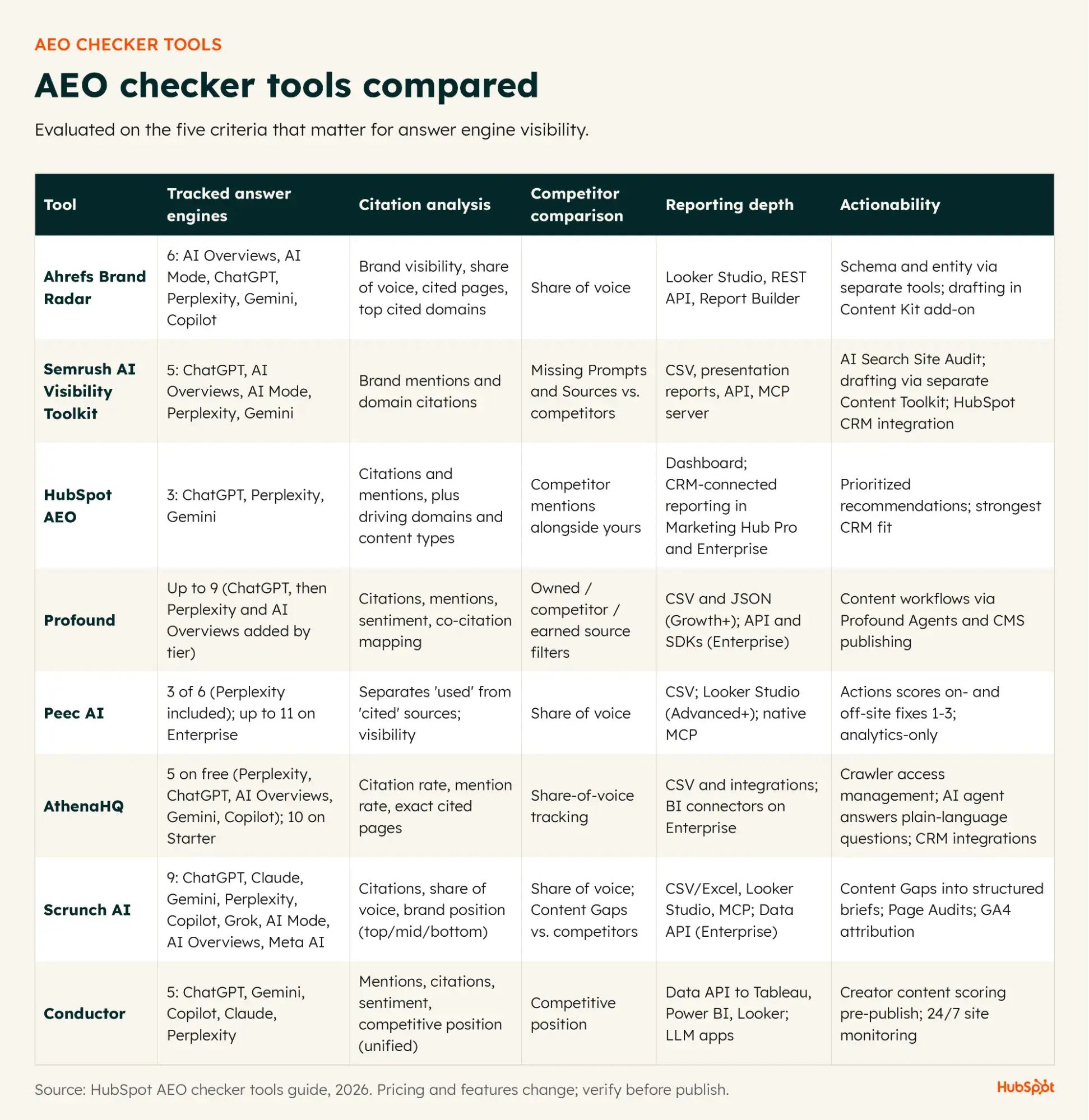
Best AEO Checker Tools: A Comparative Overview
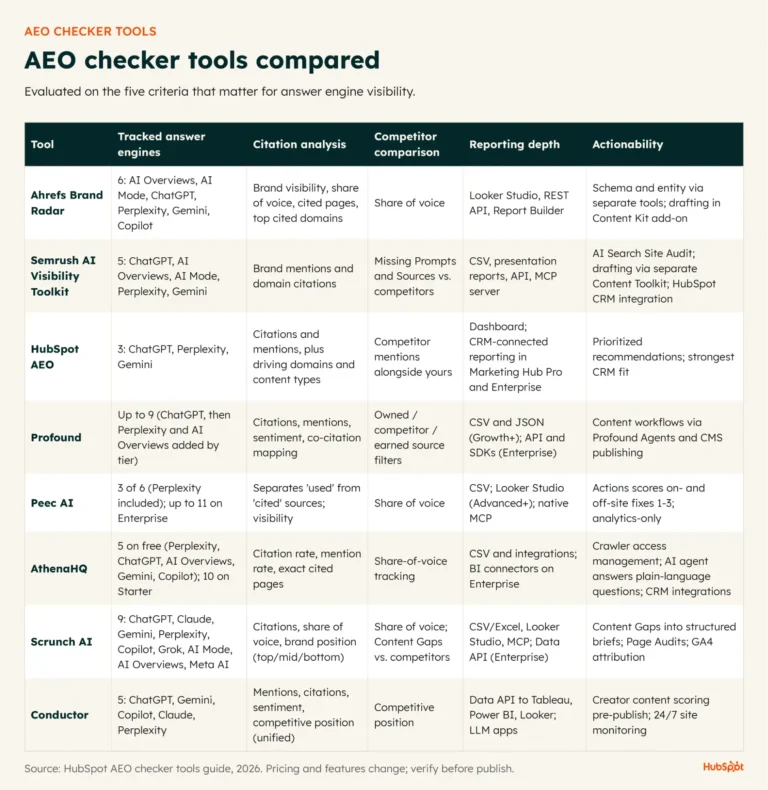
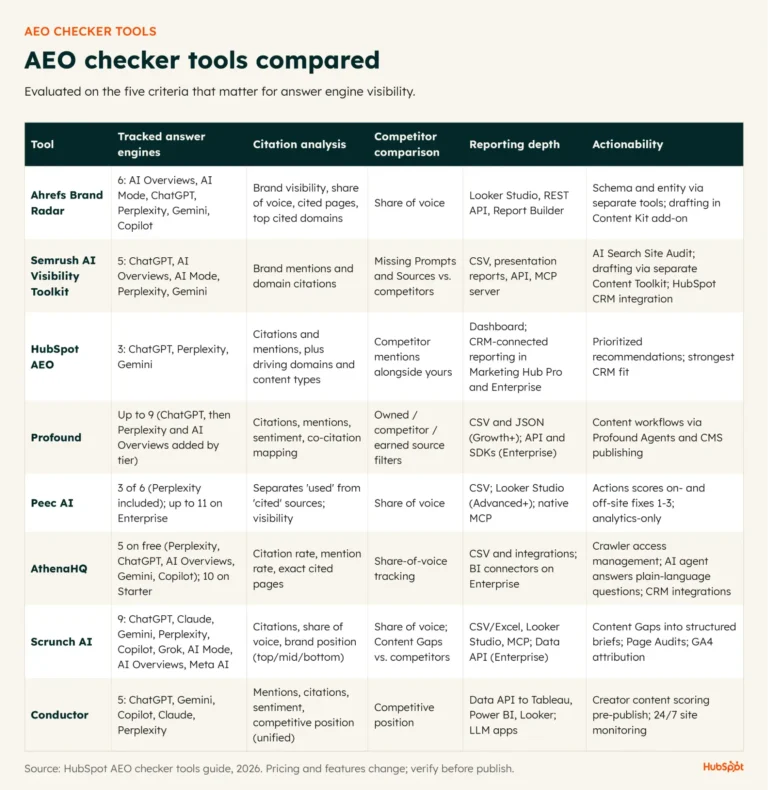
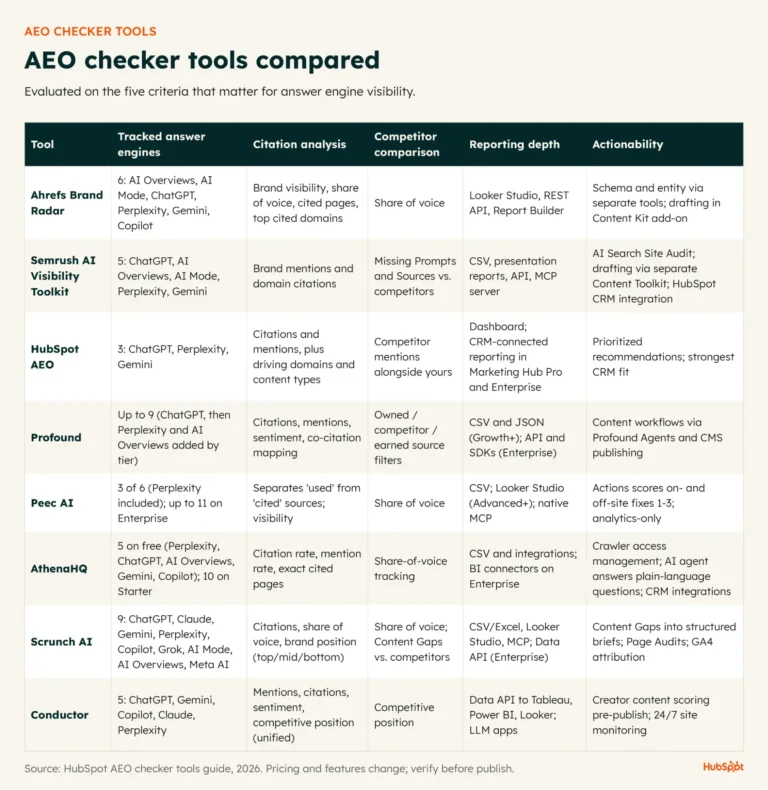
The market for AEO checkers is rapidly evolving, with various tools offering distinct capabilities. These can be broadly categorized by their primary focus:
![AEO checker tools that measure answer engine visibility [2026]](https://53.fs1.hubspotusercontent-na1.net/hubfs/53/aeo-checker-3-20260903-8904553.webp)
Tools with AI Overviews Tracking
- Ahrefs Brand Radar: This tool leverages real search queries rather than synthetic prompts, making its AI Overviews index particularly relevant. It provides insights into brand mentions and citations within Google’s AI Overviews.
- Semrush AI Visibility Toolkit: Semrush’s Organic Research feature identifies keywords that already trigger AI Overviews, allowing marketers to prioritize optimization efforts on pages with existing visibility potential.
Tools with ChatGPT Citation Detection
- HubSpot AEO: Beyond just tracking citations, HubSpot AEO monitors mentions (brand names without links) and analyzes the domains and content types that drive visibility for both the brand and its competitors. This holistic approach offers a comprehensive view of brand presence.
- Profound: This platform delves deeper into citation context, offering sentiment scoring, flagging uncited prompts, and providing a detailed breakdown of citations by source type (owned, competitor, earned). This granular analysis is invaluable for understanding the nuances of AI-generated content.
Tools with Perplexity Monitoring
- Peec AI: As a dedicated analytics tool, Peec AI focuses on delivering clean and precise data specifically from Perplexity.
- AthenaHQ: Offering Perplexity monitoring across all its plans, including a free tier, AthenaHQ also integrates a conversational assistant for a more interactive user experience.
Tools for Schema and Entity Readiness
- Scrunch AI: This tool assesses the accessibility and renderability of web pages for AI crawlers, focusing on technical readiness for AI consumption.
- Conductor: Conductor combines continuous technical monitoring with a content scoring system, ensuring that content is not only technically sound but also optimized for AI understanding.
AEO Metrics that Matter: Measuring Success
Once an AEO checker is in place, focusing on key metrics is essential for gauging progress. These include:
- Citation Coverage: The percentage of AI answers that correctly cite your brand’s content.
- Brand Mentions: The frequency with which your brand is named in AI responses.
- Share of Voice: Your brand’s visibility in AI answers relative to competitors.
- Accuracy Score: A measure of how accurately AI models represent your brand and its offerings.
- AI-Referred Traffic: Website traffic originating from AI answer engines, though this is often a zero-click phenomenon.
- Branded Search Lift: An increase in direct searches for your brand, potentially indicating enhanced awareness from AI visibility.
These metrics should be viewed as trends over time rather than isolated data points. A consistent upward trajectory in citation coverage and brand mentions, coupled with a decreasing competitor share of voice, indicates successful AEO efforts. While direct attribution of AI-generated traffic can be challenging due to the prevalence of zero-click answers, tracking any referred sessions and monitoring branded search volume can provide proxies for influence.
From Measurement to Action: Integrating AEO into Workflows
![AEO checker tools that measure answer engine visibility [2026]](https://53.fs1.hubspotusercontent-na1.net/hubfs/53/aeo-checker-4-20260903-6212698.webp)
The ultimate value of an AEO checker lies in its ability to translate diagnostic data into actionable strategies. While many tools flag issues, platforms like HubSpot’s Marketing Hub Professional and Enterprise aim to bridge the gap between diagnosis and execution. HubSpot AEO, available as a standalone product or integrated within Marketing Hub, provides prioritized recommendations, guiding users on what content to create or update, and where to focus outreach efforts.
For businesses seeking a more integrated approach, HubSpot’s advanced tiers offer AI-powered content generation tools. The Content Agent, for example, can transform a blog recommendation into a first draft, tailored to the brand’s voice, with a single click. This draft then enters a collaborative workflow within HubSpot’s content editor, allowing teams to refine and publish content through Content Hub and Marketing Hub. This integrated workflow, powered by HubSpot Credits, streamlines the entire content lifecycle, from AI-driven insights to polished publication.
A significant advantage of this integrated approach is its connection to the Smart CRM. AI-referred traffic is accurately categorized and attributed, allowing businesses to track its impact on contacts, deals, and overall pipeline. While acknowledging that many AI interactions result in zero clicks, thereby limiting direct pipeline attribution, the ability to measure both direct referral revenue and broader visibility scores provides a comprehensive understanding of AEO’s impact. HubSpot AEO represents a practical evolution for businesses looking to move beyond manual checks and establish a continuous loop of AI visibility monitoring and optimization.
Frequently Asked Questions About AEO Checkers
![AEO checker tools that measure answer engine visibility [2026]](https://53.fs1.hubspotusercontent-na1.net/hubfs/53/aeo-checker-5-20260903-8938354.webp)
The burgeoning field of AEO raises several common questions among marketers and business owners:
- How often should you run an AEO check? The frequency depends on the method. For manual checks, sampling multiple sessions per query is advised due to AI answer variability. Automated checkers can provide daily or weekly refreshes to capture this volatility, while monthly snapshots offer a broader trend view.
- Is AEO the same as AI search optimization? While often used interchangeably, AEO is the more precise term, specifically referring to optimizing for AI-generated answers from tools like ChatGPT, Perplexity, and Gemini. AI search optimization is a broader concept that may encompass other AI-driven search functionalities.
- Can you reliably track citations in ChatGPT and Perplexity? Yes, to a degree. Both platforms allow for the inspection of sources behind answers. However, reliability is achieved through repetition and pattern analysis across multiple query runs, rather than relying on single instances.
- Do AEO checkers replace traditional SEO tools? No, they serve complementary roles. AEO checkers focus on AI-generated answers, while SEO tools track traditional rankings, keywords, and backlinks. Strong SEO remains a foundational element that fuels AI model crawlability and authority. Therefore, running both types of tools in parallel is the most effective strategy.
In conclusion, the advent of AI-powered answer engines has irrevocably altered the digital marketing landscape. AEO checkers are not merely tools but essential navigators for brands seeking to maintain and enhance their visibility in this new informational ecosystem. By understanding how AI models work, employing specialized tools for monitoring and analysis, and integrating AEO strategies into broader digital marketing efforts, businesses can ensure they remain not only discoverable but also accurately represented in the answers consumers increasingly rely on. The journey from ranking to being cited within an AI response is a critical evolution, and AEO is the roadmap for this transformative shift.
About the Author