The advent of sophisticated AI-powered chatbots and AI Overviews in search engines has fundamentally altered how consumers discover information, moving the focus from traditional search engine rankings to direct answers provided by artificial intelligence. This seismic shift necessitates a new approach to digital visibility, one that emphasizes not just appearing in search results, but being accurately and prominently featured within AI-generated responses. This evolving domain has given rise to "Answer Engine Optimization" (AEO) and the critical tools designed to measure and improve it: AEO checkers.
At its core, an AEO checker serves as a vital diagnostic tool for businesses and content creators. It quantifies how often a brand’s content is referenced or directly mentioned by AI answer engines like ChatGPT, Google’s Gemini, and Perplexity. For consumers, the convenience of receiving synthesized answers without clicking through to multiple links means that visibility once gauged by search engine rankings can now disappear into an AI’s response, often unseen by the brand itself. Understanding which questions surface a brand’s content, which inadvertently highlight competitors, and where AI models might misrepresent a brand is paramount for maintaining relevance in this new search paradigm.
What is Answer Engine Optimization (AEO)?
Answer Engine Optimization (AEO) is the strategic discipline focused on enhancing a brand’s presence and accuracy within the AI-generated answers provided by platforms such as ChatGPT, Perplexity, and Gemini. This concept has gained significant traction following the widespread adoption of generative AI in information retrieval. These platforms function as "answer engines," moving beyond the traditional list of links to synthesize information from various sources into a single, comprehensive response. This often resolves user queries directly, bypassing the need for a click-through to a website. Google’s integration of AI Overviews in May 2024 further solidified this trend, bringing a summary-first approach to its own search results.
![AEO checker tools that measure answer engine visibility [2026]](https://53.fs1.hubspotusercontent-na1.net/hubfs/53/aeo-checker-1-20260903-3858273.webp)
AEO and its predecessor, Search Engine Optimization (SEO), are not competing strategies but rather complementary ones. While SEO aims to improve a website’s ranking in a list of search results, AEO focuses on ensuring that a brand’s content is cited and accurately represented within the AI-generated answer itself. The underlying principles of strong SEO—crawlability, authority, and structured data—continue to be foundational for AEO, as answer engines rely on these signals to determine which sources are credible and relevant. Content that is clearly structured, provides direct answers to user queries, and supports its claims with verifiable sources is more likely to be parsed and trusted by AI systems.
What Does an AEO Checker Do?
An AEO checker acts as a performance monitor for a brand’s presence in AI-generated answers. It measures visibility across various answer engines and translates this data into actionable recommendations for improvement. The core functions of an AEO checker typically include:
- Brand Visibility Measurement: Quantifying how often a brand is mentioned or cited in AI responses.
- Competitive Analysis: Identifying which competitors are appearing in AI answers for relevant queries.
- Content Gap Identification: Pinpointing queries where a brand is not being cited or mentioned, but competitors are.
- Accuracy Assessment: Verifying that the information presented about the brand within AI answers is correct.
- Source Tracking: Identifying the specific web pages or content pieces that AI engines are drawing from.
- Prioritization of Efforts: Ranking identified issues based on their potential impact on visibility and citation.
- Reporting and Analysis: Providing insights into trends, performance over time, and the effectiveness of optimization efforts.
Based on these diagnostics, an AEO checker can guide businesses in making necessary content updates, refining schema markup, and improving entity recognition to enhance their standing within AI-generated answers.
Manual Checks: Navigating AI Overviews, ChatGPT, and Perplexity
![AEO checker tools that measure answer engine visibility [2026]](https://no-cache.hubspot.com/cta/default/53/9dd5e54b-fbef-4dd0-bc44-1689feb1ea18.png)
While sophisticated AEO tools are becoming increasingly available, understanding the manual processes for checking AI visibility provides valuable foundational knowledge.
How to Run an AEO Check in Google AI Overviews
Google’s AI Overviews (AIOs) are designed to appear only when the system determines a summary adds significant value beyond traditional search results. Consequently, they do not trigger for every query and can vary between search sessions. A manual check involves conducting live search sessions using priority queries and carefully examining the results.
Step 1: Define Your Priority Queries.
Begin by compiling a list of critical search terms. This should include your brand name, branded product terms, and the informational questions your target audience frequently asks. Conduct these searches in a signed-out or incognito browser window to minimize personalization bias. For each query, record three key pieces of information:
- Whether an AI Overview appears.
- If your domain is listed among the inline source links within the AI Overview.
- The specific claims made about your brand or topic in the AI Overview.
Step 2: Interpret the Results.
Compare the queries that successfully trigger an AI Overview and cite your domain against those where an AI Overview appears but cites competitors instead. The latter group represents your "content gap" list—areas where your brand is missing an opportunity. Due to the dynamic nature of AI Overviews, a single absence should prompt a re-check rather than be considered definitive proof of lost visibility.
Step 3: Build Comprehensive Reporting.
For each relevant result, capture a screenshot that includes the query, the date of the search, and the geographical location. This creates a verifiable record for tracking progress. It’s important to note that Google Search Console’s standard Performance report currently rolls AI Overview activity into the general "Web" search type, rather than isolating it. While Google has announced a dedicated generative AI performance report, its initial rollout provided impression data only and was limited in scope.
![AEO checker tools that measure answer engine visibility [2026]](https://53.fs1.hubspotusercontent-na1.net/hubfs/53/aeo-checker-2-20260903-852936.webp)
Pro Tip: Manual checks are feasible for a limited set of queries. However, as the volume of queries increases and AI Overviews evolve rapidly, manual sampling becomes unreliable and time-consuming. Dedicated AEO checkers automate this process, systematically detecting and logging AI Overviews.
How to Check ChatGPT and Perplexity Citations
Both ChatGPT and Perplexity provide citations within or alongside their responses, allowing for direct manual inspection.
Perplexity: By default, Perplexity attaches citations to virtually every answer, linking directly to the source material. A dedicated "Sources" panel to the right of the response also lists all referenced articles.
ChatGPT: When ChatGPT utilizes web search for a response, it often displays inline citations. Additionally, a "Sources" panel typically appears beneath the main reply, enumerating the references used.
Step 1: Conduct Practical Citation Checks.
Using the same branded and informational queries defined earlier, evaluate two aspects:
![AEO checker tools that measure answer engine visibility [2026]](https://53.fs1.hubspotusercontent-na1.net/hubfs/53/aeo-checker-3-20260903-8904553.webp)
- Whether your domain is present in the list of cited sources.
- Whether your brand name is explicitly mentioned within the AI-generated text. A citation and a mention are distinct achievements, both contributing to visibility.
Step 2: Phrase Prompts to Encourage Retrieval.
ChatGPT initiates web searches when a question requires current information or when web search is manually selected. To ensure your content is considered, formulate prompts that are direct and seek up-to-date information. Examples include queries like "best [category] tools for [use case]" to encourage the engine to access live web sources.
Step 3: Log Results and Convert Gaps into Actionable Tasks.
The sources referenced by AI engines can vary significantly from one query to the next, and even from one session to another for the same query. Therefore, it is crucial to run each prompt multiple times across fresh sessions. For each run, meticulously record:
- The AI engine used (e.g., ChatGPT, Perplexity).
- The exact prompt.
- The date and time.
- Whether your brand was cited or mentioned.
- Which competitors appeared in the results.
This detailed log will highlight inconsistencies, such as being cited in one session but not another, or appearing in Perplexity but not ChatGPT. Each instance where your brand is absent while a competitor is present represents an actionable task. Addressing these gaps might involve updating existing content or creating new content tailored to the specific query, followed by re-running the check after publishing.
AEO Checker Buyer Criteria
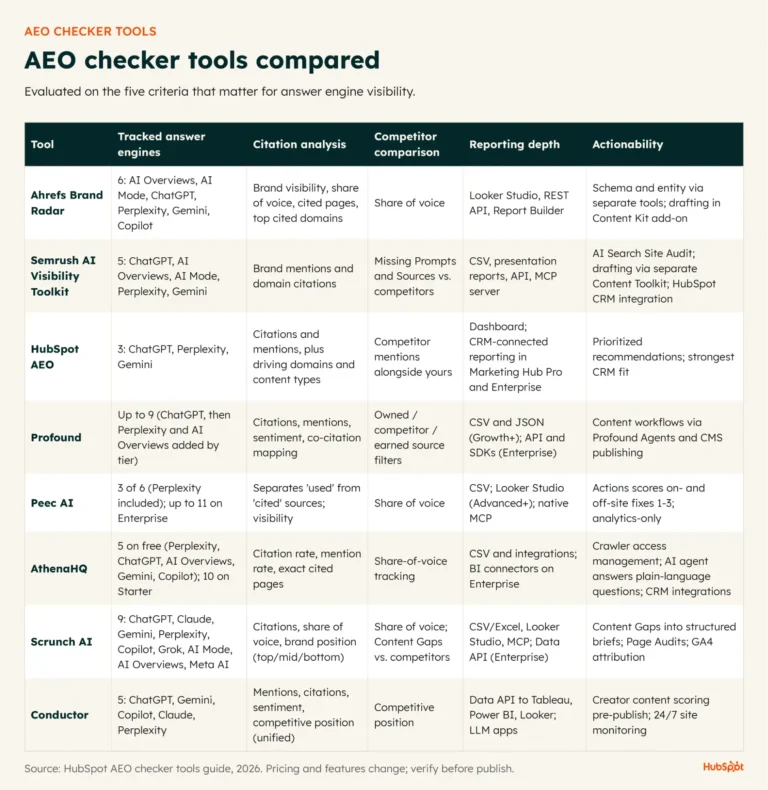
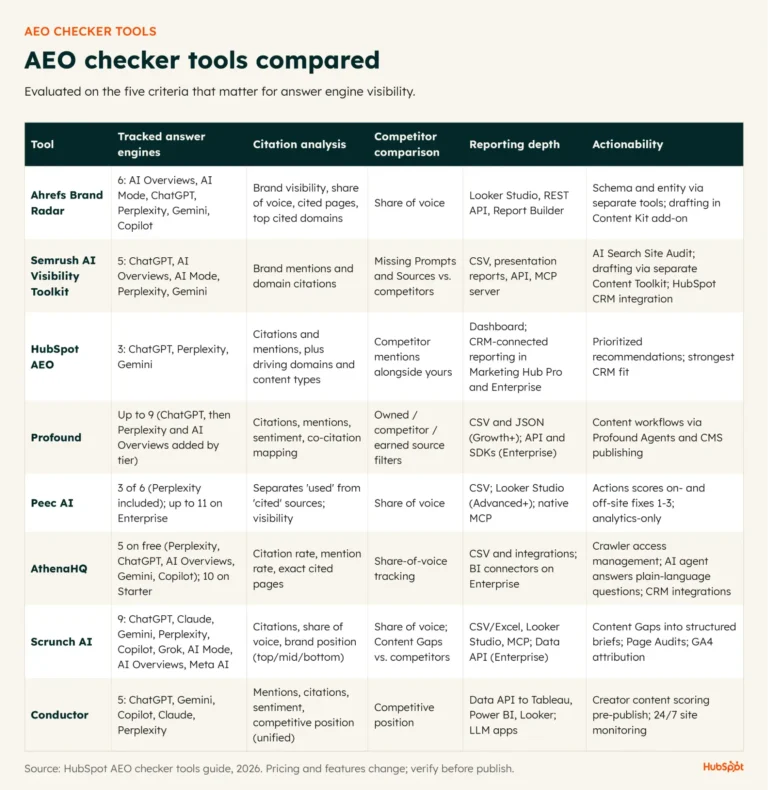
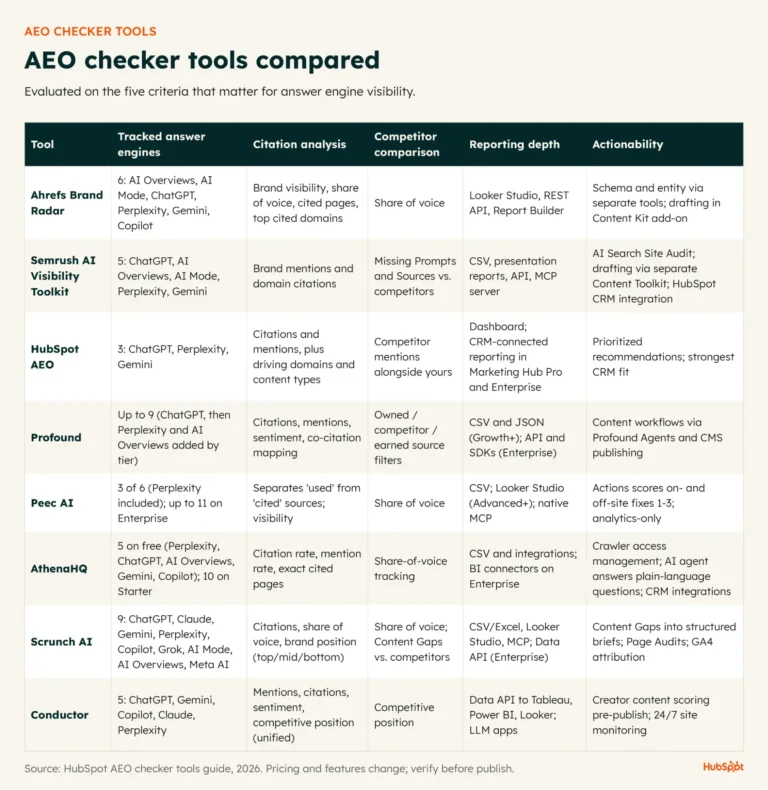
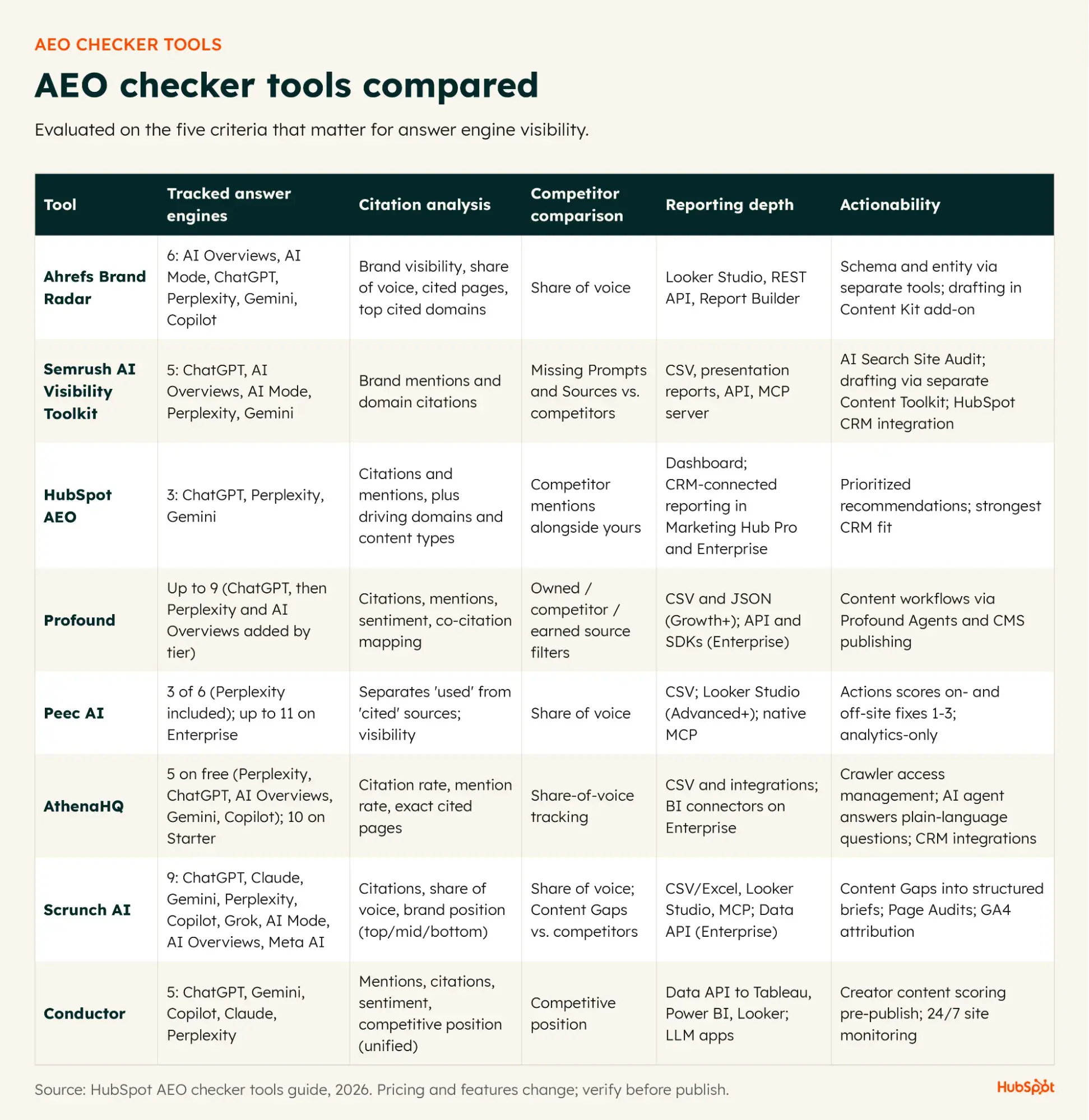
While manual checks are invaluable for initial understanding, they do not scale effectively for ongoing monitoring. Businesses looking to systematically manage their AEO should invest in automated AEO checking software. Key criteria for selecting such tools include:
![AEO checker tools that measure answer engine visibility [2026]](https://53.fs1.hubspotusercontent-na1.net/hubfs/53/aeo-checker-4-20260903-6212698.webp)
- Engine Coverage: Does the tool support the AI engines most relevant to your audience (e.g., Google AI Overviews, ChatGPT, Gemini, Perplexity)?
- Citation vs. Mention Tracking: Does it differentiate between being cited (linked) and being mentioned (named)?
- Competitor Benchmarking: Can it track competitor visibility alongside your own?
- Data Granularity: Does it provide insights into specific queries, content sources, and the types of AI features (e.g., featured snippets, AI Overviews)?
- Actionable Recommendations: Does the tool offer clear, prioritized suggestions for improvement?
- Integration Capabilities: Can it integrate with existing marketing and analytics platforms (e.g., CRM, analytics suites)?
- Reporting and Visualization: Does it offer clear, customizable reports and dashboards for easy performance tracking?
- Scalability and Automation: Can it handle a large volume of queries and provide continuous, automated monitoring?
- Cost and ROI: Does the pricing model align with the expected return on investment from improved AI visibility?
AEO Metrics That Matter
Once an AEO checker is in place, several key metrics are essential for tracking performance and demonstrating the impact of optimization efforts. These metrics should be viewed as trends over time rather than isolated data points.
- Citation Coverage: The percentage of relevant queries where your brand is cited as a source. This is a direct measure of how well your content is being leveraged by AI engines.
- Mention Volume: The frequency with which your brand name appears in AI-generated answers, even without a direct citation. This indicates brand recall and recognition within AI responses.
- Brand Visibility Score: A composite score that often combines citation coverage, mention volume, and potentially sentiment or accuracy, providing a holistic view of your brand’s AI presence.
- Competitor Citation Share: The proportion of citations your brand holds compared to key competitors for specific queries or across your entire set of monitored terms.
- AI-Referred Traffic: While direct clicks from AI answers can be a "zero-click" phenomenon, some AI platforms and search engines do provide referral data. Tracking this traffic, even if limited, can offer insights into direct engagement.
- Branded Search Lift: An indirect metric that can indicate increased brand awareness stemming from AI visibility. If AI answers drive more people to search for your brand directly, this can be observed in branded search volume.
- Qualified Traffic Proxies: Analyzing the quality of traffic that does arrive from AI referrals, looking at metrics like conversion rates, time on site, and bounce rates to understand user engagement.
Tracking these metrics as trends over weeks and months provides a much more reliable picture of your AEO performance than any single reading. While direct measurement of visibility that doesn’t result in a click remains challenging, correlating these visibility scores with engagement metrics and potential pipeline impact offers a more complete understanding of the value of AEO.
The Broader Impact and Implications
The shift towards AI-driven search has profound implications for businesses across all sectors. The traditional digital marketing funnel, heavily reliant on search engine rankings, is being reconfigured. Brands that fail to adapt to the demands of AEO risk becoming invisible to a growing segment of consumers who prefer direct answers.
![AEO checker tools that measure answer engine visibility [2026]](https://53.fs1.hubspotusercontent-na1.net/hubfs/53/aeo-checker-5-20260903-8938354.webp)
- Content Strategy Evolution: AEO mandates a focus on creating content that is not only informative and authoritative but also easily digestible and parsable by AI. This means prioritizing clear structure, direct answers, and verifiable sources.
- Technical SEO’s Enduring Importance: Despite the rise of AEO, foundational SEO principles remain critical. AI engines still rely on technical SEO factors like crawlability, site speed, and schema markup to understand and trust content.
- Brand Reputation Management: Inaccurate or misleading information presented by AI can quickly damage a brand’s reputation. AEO checkers are crucial for monitoring and correcting such inaccuracies.
- New Measurement Challenges: The "zero-click" nature of many AI answers presents new challenges for attribution and ROI calculation. Businesses need to adopt new metrics and analytical frameworks to understand the impact of their AEO efforts.
- Competitive Landscape Shifts: Brands that master AEO can gain a significant competitive advantage by capturing attention within AI-generated answers, potentially diverting traffic and leads from less optimized competitors.
In conclusion, the emergence of Answer Engine Optimization and the tools designed to measure it, such as AEO checkers, represent a critical evolution in digital marketing. As AI continues to shape how consumers find information, businesses must prioritize understanding and optimizing their presence within these intelligent answer engines to remain visible, relevant, and competitive in the ever-changing digital landscape.
About the Author