The digital marketing and search landscape is undergoing a seismic shift, driven by the rapid integration of artificial intelligence into everyday search behaviors. Consumers are increasingly turning to AI-powered tools like ChatGPT, Perplexity, and Google’s Gemini for direct answers, often bypassing traditional search result pages and the associated website clicks. This fundamental change necessitates a new approach to online visibility, a concept known as Answer Engine Optimization (AEO). AEO focuses on ensuring a brand’s presence and accuracy within the synthesized responses generated by these AI answer engines, a critical evolution from traditional Search Engine Optimization (SEO) which primarily targets visibility within lists of links.
This comprehensive guide delves into the intricacies of AEO, exploring what it entails, how to conduct manual checks across prominent AI platforms, and evaluating the tools designed to streamline this process. As AI continues to reshape how users seek information, understanding and implementing AEO strategies is no longer an option but a necessity for businesses aiming to maintain and enhance their digital footprint.
What is Answer Engine Optimization?
Answer Engine Optimization (AEO) is the strategic practice of enhancing a brand’s visibility and accuracy within the AI-generated answers provided by conversational AI models and AI-powered search features. Unlike traditional SEO, which aims to rank content on search engine results pages (SERPs) as a list of clickable links, AEO focuses on ensuring that a brand’s information is correctly and prominently featured within the single, synthesized answer that AI models often deliver.
The emergence of AI answer engines represents a significant departure from the conventional search paradigm. Platforms like ChatGPT, Perplexity, and Google’s AI Overviews (launched in May 2024) aggregate information from various sources to provide a direct, often comprehensive, response to user queries. This "answer-first" approach means that users may receive the information they need without ever needing to click through to a website. Consequently, visibility that was once directly attributable to search engine rankings can now be subsumed within an AI-generated summary, making traditional SEO metrics less indicative of a brand’s true reach.
AEO and SEO are not mutually exclusive but rather complementary disciplines. Robust SEO practices, including strong technical foundations, authoritative content, and effective backlink profiles, remain crucial. These elements provide the crawlability, trustworthiness, and authority signals that AI answer engines rely on when selecting and citing sources. However, AEO adds a layer of optimization specifically tailored to the nuances of AI comprehension and synthesis. It addresses how a brand’s information is parsed, understood, and presented by AI, ensuring accuracy and relevance within the generated answers.
![AEO checker tools that measure answer engine visibility [2026]](https://53.fs1.hubspotusercontent-na1.net/hubfs/53/aeo-checker-1-20260903-3858273.webp)
The Function of an AEO Checker
An AEO checker is a specialized tool designed to measure a brand’s visibility across various AI answer engines. Its primary function is to identify how often and how accurately a brand’s content is being cited or mentioned in AI-generated responses. Beyond mere measurement, these checkers translate this data into actionable recommendations for improvement.
A comprehensive AEO checker typically performs the following critical functions:
- Brand Mention Tracking: It verifies whether a brand’s name is explicitly mentioned in the AI’s answer, even if no direct link is provided.
- Citation Analysis: It identifies instances where the AI cites a specific piece of content from the brand’s website as a source for its answer.
- Competitor Benchmarking: It analyzes which competitors are being cited or mentioned for similar queries, highlighting areas of competitive advantage or disadvantage.
- Content Gap Identification: It pinpoints specific queries where AI Overviews appear but do not cite the brand’s content, or where competitors are favored.
- Accuracy Assessment: It evaluates the factual accuracy of the information presented about the brand within AI responses, flagging any misrepresentations or inaccuracies.
- Recommendation Generation: Based on the analysis, it provides prioritized recommendations for content updates, schema markup improvements, and entity optimization to enhance AI visibility.
The insights provided by an AEO checker enable businesses to proactively manage their presence in the evolving AI search ecosystem, ensuring that their brand is accurately represented and their content is leveraged by these powerful new information sources.
Manual AEO Checks: Navigating Google AI Overviews
Initially, understanding a brand’s visibility in Google’s AI Overviews (AIOs) requires a manual approach. Google’s AIOs are designed to surface only when the system determines that a synthesized summary offers significant value beyond traditional search results. This means they do not appear for every query and can vary between search sessions, necessitating repeated checks and careful interpretation.
Step 1: Defining Critical Queries
The foundational step in manual AEO checking is to identify and compile a list of "priority queries." These should encompass:
- Brand Name Queries: Direct searches for the brand’s name.
- Branded Product/Service Terms: Queries related to specific offerings.
- Informational Buyer Questions: Questions that potential customers frequently ask during their buyer journey, which the brand’s content aims to answer.
Each of these queries should be executed in a signed-out or incognito browser session to avoid personalized search results. For each query, meticulously record three key pieces of information:
![AEO checker tools that measure answer engine visibility [2026]](https://no-cache.hubspot.com/cta/default/53/9dd5e54b-fbef-4dd0-bc44-1689feb1ea18.png)
- AI Overview Appearance: Does an AI Overview manifest in the search results?
- Brand Citation: If an AI Overview appears, does it include inline source links pointing to your domain?
- Claim Accuracy: What specific claim or information does the AI Overview present about your brand or topic?
Step 2: Interpreting the Findings
The next crucial phase involves analyzing the data collected. Compare queries where an AI Overview triggers and correctly cites your domain against those where an AI Overview appears but favors competitor citations. The latter category represents your "content gap list"—areas where your content is not being recognized or prioritized by the AI.
It’s important to acknowledge that AI Overviews can be dynamic. A single absence of your brand’s citation in one session should be treated as an opportunity for re-evaluation rather than definitive proof of lost placement. Consistent absence across multiple sessions, however, signals a need for strategic intervention.
Step 3: Constructing a Reliable Reporting System
For defensible record-keeping and to track progress, systematically document each manual check. This involves taking screenshots of the search results, clearly showing the query, date, and geographic location. This detailed logging is essential because Google Search Console’s standard performance reports do not isolate AI Overview activity, rolling it into the general "Web" search type. While Google has begun rolling out dedicated generative AI performance reports, these initially focused on impressions for a limited subset of sites and may not provide the granular citation data needed for AEO.
Pro Tip: While manual checks are valuable for initial exploration and for small query sets, they become impractical and unreliable at scale. The dynamic nature of AI Overviews and the sheer volume of potential queries mean that automated solutions are eventually necessary for continuous monitoring and comprehensive analysis.
Manual AEO Checks: ChatGPT and Perplexity Citations
Beyond Google’s AI Overviews, assessing visibility within conversational AI models like ChatGPT and Perplexity involves a similar, albeit slightly different, manual review process. These platforms typically embed citations directly within their responses or provide a dedicated panel for source attribution.
Step 1: Executing Practical Citation Checks
Using the same priority queries defined for Google AIOs, users should examine the AI’s responses on ChatGPT and Perplexity. The primary objectives are to ascertain:
![AEO checker tools that measure answer engine visibility [2026]](https://53.fs1.hubspotusercontent-na1.net/hubfs/53/aeo-checker-2-20260903-852936.webp)
- Domain Citation: Does your website appear among the sources cited by the AI?
- Brand Mention: Is your brand’s name explicitly mentioned within the AI’s synthesized answer?
It is important to distinguish between a citation (a direct link to your content) and a mention (your brand name appearing in the text). Both contribute to visibility, but a citation often carries more weight in terms of direct attribution and potential traffic.
Step 2: Crafting Effective Prompts for Retrieval
For ChatGPT, web search functionality is triggered when a query genuinely benefits from current information or when web browsing is explicitly enabled. To ensure the AI accesses and cites external sources, prompts should be direct and solicit up-to-date information. Examples include queries formatted as "best [category] tools for [use case]" or questions requiring current data. This encourages the AI to engage with live web sources that can then be inspected for citations.
Perplexity, by default, is designed to provide cited answers, often displaying a panel listing all sources used. This makes it more straightforward to identify the origin of its information.
Step 3: Logging Results and Transforming Gaps into Actionable Tasks
The nature of AI responses means that sources can vary even for identical prompts across different sessions. Therefore, it is crucial to run each prompt multiple times and across fresh sessions. For each execution, record:
- The AI engine used (ChatGPT, Perplexity).
- The exact prompt.
- The date and time of the check.
- Whether your domain was cited or your brand was mentioned.
- Which competitor domains or brands appeared in the results.
This detailed log helps identify inconsistencies (e.g., being cited in one session but not another, or cited by Perplexity but not ChatGPT). Each instance where your brand is absent and a competitor is present should be treated as an actionable task. This might involve updating or restructuring content related to that specific query or question, followed by re-running the check after publishing the changes.
Key Criteria for Selecting an AEO Checker Tool
While manual checks are a vital starting point, their scalability is limited. For ongoing and comprehensive AEO management, specialized software solutions are indispensable. When evaluating AEO checking tools, several key criteria should guide the selection process:
![AEO checker tools that measure answer engine visibility [2026]](https://53.fs1.hubspotusercontent-na1.net/hubfs/53/aeo-checker-3-20260903-8904553.webp)
- Engine Coverage: The tool should support monitoring across a broad spectrum of relevant AI answer engines, including Google AI Overviews, ChatGPT, Perplexity, and Gemini.
- Automated Monitoring: The ability to continuously and automatically track brand visibility without manual intervention is paramount. This includes scheduled scans and alerts for significant changes.
- Citation and Mention Tracking: The tool must accurately identify both direct citations (links to your site) and mentions (brand name references) within AI responses.
- Competitor Analysis: Robust features for benchmarking against competitors, revealing who is being cited and for which queries, are essential for strategic insights.
- Prioritized Recommendations: The software should not only report data but also translate findings into actionable, prioritized recommendations for content, technical SEO, and schema improvements.
- Historical Data and Trend Analysis: The ability to store historical data and analyze trends over time is crucial for measuring the impact of optimization efforts.
- Integration Capabilities: Compatibility with existing marketing stacks, such as CRMs and content management systems, can streamline workflows and data utilization.
- User-Friendliness and Reporting: An intuitive interface and clear, customizable reporting features are necessary for effective team collaboration and stakeholder communication.
- Cost and Value: The pricing model should align with the business’s budget and the tool’s demonstrated return on investment.
By carefully considering these factors, businesses can select an AEO checker that effectively supports their strategic objectives in the dynamic AI-driven search environment.
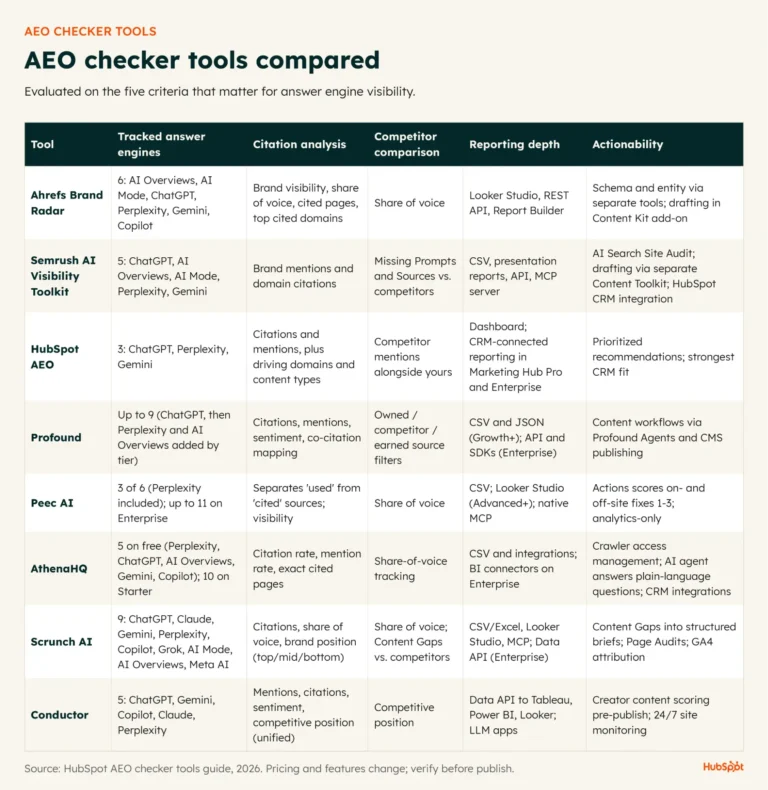
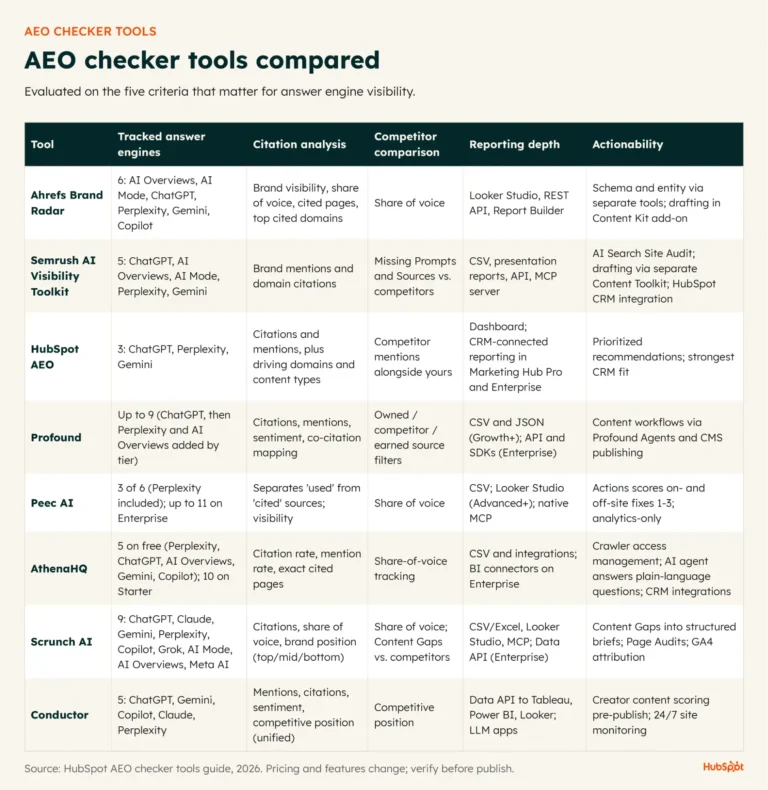
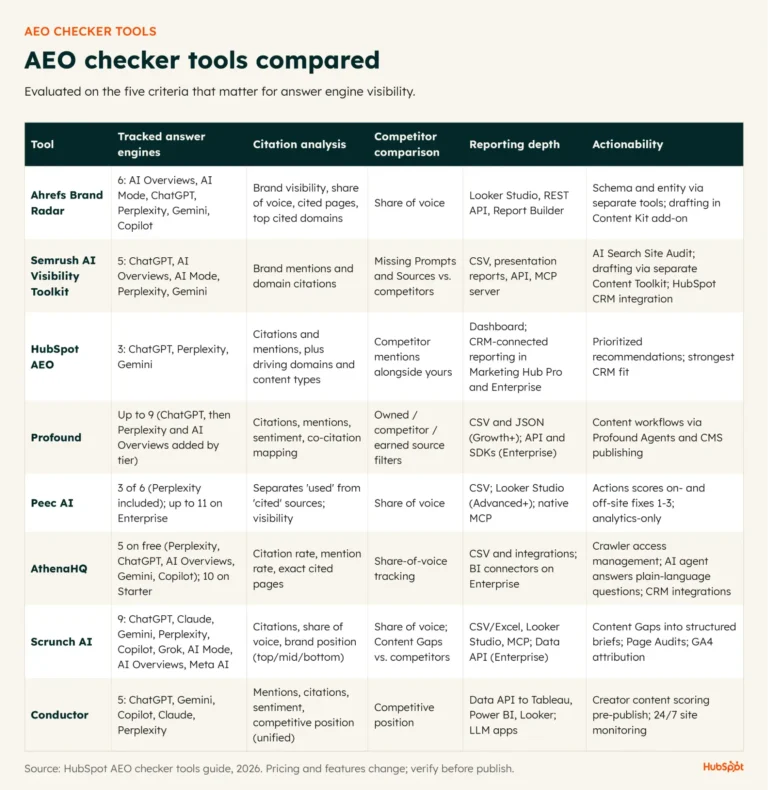
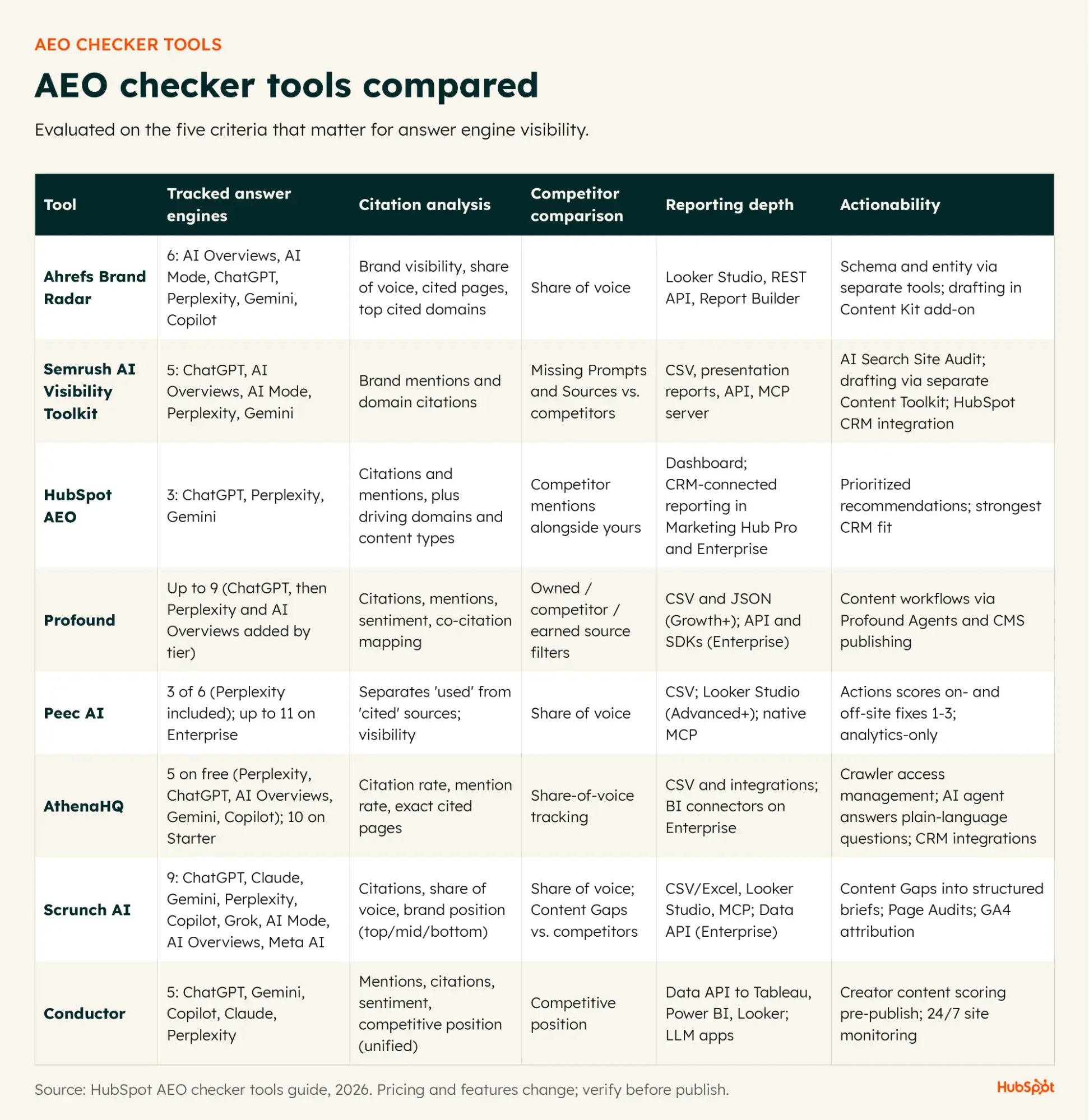
Leading AEO Checker Tools: A Comparative Overview
The market for AEO tools is rapidly evolving. Several platforms offer varying degrees of functionality, catering to different needs and budgets. Here’s a look at some prominent tools, categorized by their primary strengths:
Tools Featuring AI Overviews Tracking
- Ahrefs Brand Radar: This tool leverages real search queries rather than synthetic prompts, providing a more accurate reflection of actual user behavior. Its AI Overviews index is particularly comprehensive, offering insights into how brands are represented in Google’s synthesized search results. Brand Radar tracks brand mentions, competitor visibility, and provides data on the number of unique queries where a brand appears.
- Semrush AI Visibility Toolkit: Integrated within Semrush’s suite, this toolkit highlights which of a brand’s ranking keywords trigger AI Overviews. This allows marketers to prioritize optimization efforts for keywords that are already generating AI-driven visibility, focusing on pages that are close to being included in AI summaries. It also provides insights into competitor AI visibility.
Tools Featuring ChatGPT Citation Detection
- HubSpot AEO: This tool provides a holistic view of AI visibility, tracking both direct citations and brand mentions across ChatGPT, Perplexity, and Gemini. It offers detailed competitor analysis, identifying the content types and domains driving visibility for both the brand and its competitors. For users of Marketing Hub Professional and Enterprise, AEO integrates with the CRM for enhanced reporting on contacts and deals influenced by AI traffic.
- Profound: Profound extends beyond simple citation detection by offering deeper context. It provides sentiment scoring for mentions, flags prompts that generate answers without citations, and breaks down citations by source type (owned, competitor, earned media). This granular analysis allows for a more nuanced understanding of AI’s perception of a brand.
Tools Featuring Perplexity Monitoring
- Peec AI: This platform is a dedicated analytics tool focused on delivering clean and precise data from Perplexity. It offers insights into Perplexity’s citation patterns and brand representation, allowing for focused optimization on this specific AI search engine.
- AthenaHQ: AthenaHQ includes Perplexity monitoring across all its plans, even offering a free tier. It leverages a conversational assistant to help users understand and act on the data, making Perplexity insights more accessible.
Tools for Schema and Entity Readiness
- Scrunch AI: This tool assesses the technical readiness of a website for AI crawlers, checking if AI bots can successfully access and render pages. This is crucial for ensuring that the underlying structure of content is optimized for AI comprehension.
- Conductor: Conductor combines 24/7 technical monitoring with a content scoring mechanism. It helps ensure that content is not only technically accessible to AI but also structured and written in a way that AI can easily understand and cite, focusing on both technical and content-based optimization.
Key AEO Metrics That Matter for Performance Tracking
Once an AEO checker is in place, consistent monitoring of specific metrics is essential to gauge the effectiveness of optimization efforts and identify trends. These metrics provide a data-driven approach to understanding a brand’s performance in the AI search landscape:
- Visibility Score: This metric represents an aggregate score of a brand’s presence across various AI answer engines, factoring in citations, mentions, and prominence within responses. Tracking this score week-over-week reveals the overall trend of a brand’s AI visibility.
- Citation Coverage: This measures the percentage of relevant queries for which the brand’s content is cited as a source by AI engines. An increasing citation coverage indicates that AI systems are increasingly relying on the brand’s content.
- Mention Volume: This tracks the frequency of a brand’s name appearing in AI-generated answers, irrespective of whether a direct citation is included. A rising mention volume suggests increased brand recognition and awareness within AI responses.
- Competitor Share of Voice: This metric analyzes the proportion of AI-generated answers that mention or cite your brand compared to your competitors for a given set of queries. It provides a clear picture of competitive positioning.
- AI-Referred Traffic: While many AI interactions are zero-click, some AI engines do direct users to websites. Tracking the volume and quality of traffic referred from AI platforms is a direct measure of AEO’s impact on website visits.
- Branded Search Lift: An increase in branded search queries following improvements in AEO can indicate that AI visibility is driving greater brand recall and direct search intent.
It is vital to interpret these metrics as trends over time rather than isolated data points. Consistent improvement in visibility scores, citation coverage, and mention volume, alongside increases in AI-referred traffic and branded search lift, collectively signal successful AEO strategies.
From Measurement to Action: Integrating AEO with HubSpot
The ultimate goal of AEO is not just measurement but actionable improvement. While many AEO checkers diagnose issues and flag gaps, the process of implementing fixes often requires exporting data and working across disparate systems. HubSpot aims to bridge this gap by integrating AEO diagnostics with content creation and optimization workflows.
HubSpot’s AEO tool, available as a standalone product or integrated within Marketing Hub Professional and Enterprise, provides prioritized recommendations. These recommendations guide users on what content to create, update, or enhance to improve AI visibility.
![AEO checker tools that measure answer engine visibility [2026]](https://53.fs1.hubspotusercontent-na1.net/hubfs/53/aeo-checker-4-20260903-6212698.webp)
For businesses leveraging HubSpot Marketing Hub Professional or Enterprise, the AEO capabilities extend further. The platform’s "Content Agent" can transform blog post recommendations into research-backed first drafts, written in the brand’s voice, with a single click. These drafts are then accessible within HubSpot’s content editor for review and refinement before publishing through Content Hub or Marketing Hub. This generative AI feature, currently in public beta and utilizing HubSpot Credits, streamlines the content creation process significantly.
Crucially, because this work is embedded within HubSpot’s Smart CRM, traffic referred from AI tools is accurately recorded as a distinct source and can be linked to specific contacts and deals. This provides a comprehensive view of the customer journey, connecting AI visibility to tangible business outcomes. While answer engines may often resolve queries without sending clicks, HubSpot’s ability to attribute the AI traffic that does click through, combined with visibility scores, offers a dual-pronged approach to understanding the full impact of AEO.
HubSpot AEO represents a practical evolution for businesses looking to move beyond manual checks and establish a continuous loop of AI visibility measurement and optimization.
Frequently Asked Questions About AEO Checkers
How Often Should You Run an AEO Check?
The frequency of AEO checks depends on the method employed. For manual spot-checks, multiple sessions per query are recommended due to the variability of AI responses. Automated checkers, however, can provide more consistent insights. Daily or weekly refreshes are ideal for capturing the rapid volatility of AI engine outputs, while a monthly snapshot can offer a broader trend analysis but may obscure short-term fluctuations.
Is AEO the Same as AI Search Optimization?
While often used interchangeably, "Answer Engine Optimization" (AEO) is the more precise term. It specifically refers to the practice of optimizing for how brands appear within the direct, synthesized answers generated by AI platforms like ChatGPT, Perplexity, and Gemini. "AI search optimization" is a broader term that could encompass various AI-driven search strategies. Standardizing on AEO ensures clarity and focus on this particular aspect of AI-powered information retrieval.
Can You Reliably Track Citations in ChatGPT and Perplexity?
Yes, with caveats. Both ChatGPT and Perplexity offer mechanisms to reveal the sources behind their answers, making individual responses inspectable. However, the reliability comes not from a single check but from repetition. Running prompts multiple times across fresh sessions and tracking the patterns of citations and mentions is crucial for dependable analysis.
![AEO checker tools that measure answer engine visibility [2026]](https://53.fs1.hubspotusercontent-na1.net/hubfs/53/aeo-checker-5-20260903-8938354.webp)
Do AEO Checkers Replace Traditional SEO Tools?
No, AEO checkers and traditional SEO tools serve distinct but complementary purposes. SEO tools focus on rankings, keyword research, backlink analysis, and technical site health within traditional search engine results pages. AEO checkers, conversely, monitor how brands are cited and mentioned within AI-generated answers. Since strong SEO fundamentals still underpin the crawlability and authority that AI engines rely on, running both types of tools concurrently is the most effective strategy for comprehensive online visibility.
About the Author