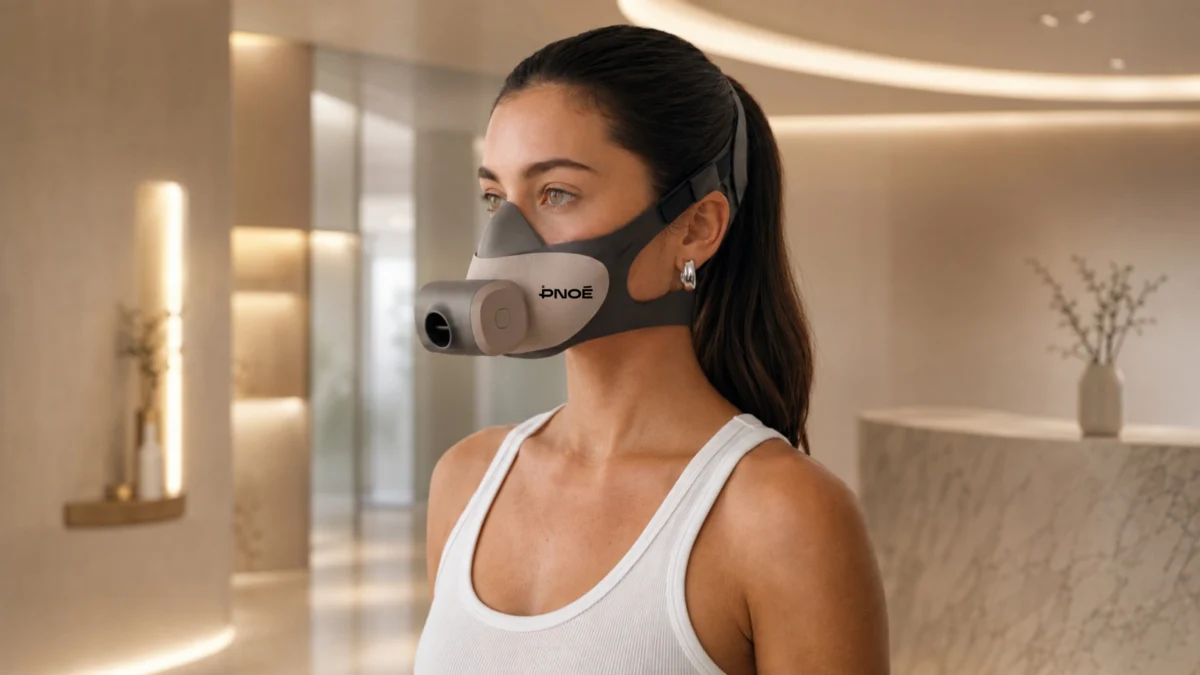
Malden, Massachusetts – PNOÂ’, a company at the intersection of wearable technology and metabolic science, is poised to launch its latest innovation, the PNOÂ’ 2.0, on October 1. This new iteration of their metabolic testing mask promises to bring sophisticated physiological data, previously confined to specialized laboratories, into the hands of everyday consumers. While visually reminiscent of fictional villainous attire, the device’s core function is to empower individuals with actionable insights into their body’s energy production, training efficacy, and potentially, longevity.
The PNOÂ’ 2.0 marks a significant shift towards user autonomy. Unlike its predecessor, which necessitated trained personnel for operation, the new mask is designed for self-administration. Co-founder and CEO Apostolos Atsalakis elaborated on the streamlined process during a recent virtual interview, stating, "Someone can walk into a gym, just wear the mask, push the button, sit down, and breathe for eight minutes. That’s it. It’s that easy." This simplification is a strategic move to broaden accessibility, potentially extending the reach of metabolic testing beyond elite athletic facilities and hospitals to fitness centers, pharmacies, and other wellness hubs.
The Science of Breath: A Century-Old Foundation
The underlying scientific principle behind PNOÂ’’s technology is metabolic testing, a field with over a century of research. This process analyzes the composition of exhaled breath – specifically oxygen consumption and carbon dioxide production – to understand how an individual’s body generates energy. For decades, this methodology has been considered the gold standard for measuring VOâ‚‚ max, a critical indicator of cardiorespiratory fitness that quantifies the maximum amount of oxygen the body can utilize during strenuous activity. Historically, the equipment required for such tests has been substantial, expensive, and complex, typically housed in specialized sports science labs and clinical settings. This exclusivity has largely relegated its benefits to professional athletes and individuals participating in high-end corporate wellness programs.
PNOÂ’, a decade-old startup with dual headquarters in Malden, Massachusetts, and Athens, Greece, aims to dismantle these barriers. Their proposition is to deliver the same scientific rigor of traditional metabolic analysis within a portable, user-friendly device. "We made it accessible to everyone," Atsalakis emphasized, highlighting the company’s mission to democratize access to vital physiological data.
Beyond VOâ‚‚ Max: A Comprehensive Metabolic Snapshot
The PNOÂ’ 2.0 claims to capture a comprehensive suite of 23 biomarkers, offering a more nuanced understanding of an individual’s metabolic health than conventional measurements. Beyond the highly sought-after VOâ‚‚ max, the device assesses resting metabolic rate (RMR), which quantifies the number of calories the body burns at rest. Crucially, it also measures metabolic flexibility – the body’s efficiency in transitioning between burning carbohydrates and fats for fuel.
Atsalakis posits that these metrics provide answers that traditional blood tests often cannot, such as precise caloric needs and optimal training strategies tailored to an individual’s unique metabolic profile. This data-driven approach to personal wellness aligns with the burgeoning longevity industry, where cardiorespiratory fitness, particularly VOâ‚‚ max, is increasingly recognized for its correlation with reduced mortality rates. Atsalakis boldly labels VOâ‚‚ max as "the strongest predictor of human longevity," positioning PNOÂ’’s data as a vital scorecard for the rapidly expanding wellness sector.
Design Evolution: Iteration and User Experience
The development of the PNOÂ’ 2.0 involved a rigorous design process, collaborating with Milan-based Design Group Italia. Atsalakis described the journey as one of "a lot, a lot, a lot of iterations," underscoring the challenge of creating a self-administered metabolic testing device from the ground up. The result is a smaller, more compact unit with fewer components, which Atsalakis believes enhances its reliability.
Addressing post-pandemic hygiene concerns, the PNOÂ’ 2.0 incorporates a detachable electronics module from the silicone mask and straps. This design allows for shared hardware while ensuring individual users maintain their own sanitary mask components, a practical consideration for business clients offering the service to multiple patrons.
Navigating the Regulatory Landscape: Wellness vs. Medical Device
Despite its sophisticated physiological measurements, PNOÂ’ maintains a cautious stance regarding regulatory claims. The device is not cleared by the U.S. Food and Drug Administration (FDA). Atsalakis explicitly stated, "we do not provide medical recommendations." Instead, PNOÂ’ categorizes its offering as a wellness device, drawing parallels to body composition analyzers or scales. "A doctor cannot prescribe medication based on our results," he clarified, emphasizing the distinction between wellness insights and clinical diagnoses.
However, the company acknowledges the potential for future medical applications. Researchers have long investigated the use of breath biomarkers for disease detection, including certain cancers. Atsalakis expressed optimism that PNOÂ’’s expanding data repository could, in the future, contribute to identifying health issues. Yet, he tempered expectations, stating that "full diagnoses are definitely a couple of years away," with regulatory hurdles likely extending this timeline.
Genesis and Growth: From Cambridge to Global Reach
PNOÂ’’s origins trace back to Apostolos Atsalakis’s doctoral research at the University of Cambridge, where his fascination with sensing technologies and the diagnostic potential of human breath coalesced during the rise of wearable devices. He co-founded the company with Panos Papadiamantis, a childhood friend and now the company’s chief product officer.
The startup gained early traction by participating in Y Combinator’s Winter 2019 cohort, a period when the concept of "longevity" was less prominent in the industry than it is today. Since then, PNOÂ’ has secured approximately $22 million in funding, including a recent $11 million round. Notable investors include 50 Years and Lars Rasmussen, co-founder of Google Maps, who is now based in Athens.
Business Model and Market Penetration
PNOÂ’ primarily operates on a business-to-business model, supplying its technology to enterprises that then offer the testing service to their clientele. Key clients include prominent fitness chain Equinox, Four Seasons hotels, Red Bull, the NBA, the Mount Sinai Health System, and the med spa chain Restore Hyper Wellness.
The United States represents PNOÂ’’s largest market, accounting for approximately 85% of its business. Atsalakis described the U.S. as "by far the most advanced market globally" for longevity-focused solutions. The company is actively expanding its presence in Europe and, through strategic partnerships, is making inroads into Latin America and Asia.
Businesses typically engage with PNOÂ’ through a subscription service, with monthly fees ranging from $400 to over $1,000. This package, which Atsalakis terms a "business in a box," encompasses the hardware, software, training, and marketing collateral. A significant aspect of PNOÂ’’s offering is its ability to link test results directly to the services a business provides. This allows gyms or spas to offer personalized recommendations based on a customer’s metabolic data, effectively positioning the PNOÂ’ test as an intermediary between comprehensive medical evaluations and the estimations derived from consumer smartwatches.
Competitive Landscape and Future Outlook
The wellness technology market is increasingly competitive. Companies like Apple, Garmin, and Whoop leverage heart-rate data to estimate VOâ‚‚ max, while devices such as Lumen analyze breath to assess fat and carbohydrate utilization. At the higher end, traditional metabolic carts remain the benchmark in clinical and laboratory settings.
PNOÂ’, with a workforce of 110 employees, reports recent profitability and sustained annual growth exceeding 100%. The company plans to initiate a Series B funding round within the next six to twelve months. The objective is to further scale its operations and expand the reach of its innovative metabolic testing mask, aiming to place its technology – Bane comparisons notwithstanding – in front of an even wider audience. The journey from a specialized scientific tool to an accessible wellness instrument is well underway, promising a future where personalized metabolic insights are within reach for a broader segment of the population.
About the Author