The digital marketing realm is undergoing a seismic shift, driven by the rapid integration of artificial intelligence into search engines and conversational AI platforms. Users are increasingly turning to tools like ChatGPT, Perplexity, and Google’s AI Overviews for direct answers, often bypassing traditional search result pages filled with links. This evolving behavior necessitates a new approach to online visibility, one that focuses not just on ranking in search results, but on being recognized and cited within AI-generated responses. This is where Answer Engine Optimization (AEO) checkers emerge as indispensable tools for businesses seeking to maintain and grow their brand presence in this new era of search.
Understanding the Dawn of Answer Engines and the Rise of AEO
For years, Search Engine Optimization (SEO) has been the cornerstone of digital visibility, focused on improving a website’s ranking in organic search results. However, the advent of sophisticated AI models capable of synthesizing information from multiple sources and presenting a single, coherent answer has fundamentally altered user search behavior. Platforms like ChatGPT, Perplexity, and Google’s AI Overviews function as "answer engines," designed to provide immediate solutions to user queries. This means that visibility once achieved through high search rankings can now vanish into an AI-generated response that users engage with without ever clicking a link.
Answer Engine Optimization (AEO) is the strategic practice of ensuring a brand’s prominence and accuracy within these AI-generated answers. It complements traditional SEO by focusing on how content is interpreted, cited, and presented by AI models. While SEO aims to get a website listed in a page of links, AEO strives to secure mentions and citations within the AI’s synthesized response. This symbiotic relationship means that the foundational elements of good SEO—crawlable content, authority signals, and clear sourcing—remain critical for AEO success. AI answer engines rely on the quality and trustworthiness of the underlying content to formulate their responses.
The landscape dramatically shifted in May 2024 when Google officially launched AI Overviews, integrating generative AI summaries directly into its search results. This move signaled a definitive pivot towards a summary-first search experience for a significant portion of user queries. The implications are profound: brands that fail to adapt their optimization strategies risk becoming invisible to a growing segment of searchers.
![AEO checker tools that measure answer engine visibility [2026]](https://53.fs1.hubspotusercontent-na1.net/hubfs/53/aeo-checker-1-20260903-3858273.webp)
What is an AEO Checker and What Does it Do?
An AEO checker is a software tool designed to measure and analyze a brand’s visibility within AI-generated answers across various platforms. Its primary function is to provide insights into how often a brand is mentioned or cited by AI models, and crucially, whether that mention is accurate or favorable.
At its core, an AEO checker performs several key functions:
- Measures Visibility: It quantifies how frequently a brand’s content or name appears in AI-generated responses. This includes identifying mentions within the answer text itself and citations to the brand’s website.
- Diagnoses Performance: It pinpoints which specific questions or queries trigger AI Overviews, which of those result in brand mentions or citations, and critically, where competitors are being favored.
- Identifies Gaps and Errors: It highlights instances where AI might be misrepresenting a brand, citing inaccurate information, or omitting the brand entirely when it should be present.
- Prioritizes Optimization Efforts: Based on the analysis, AEO checkers provide actionable recommendations, flagging the most critical content updates, schema corrections, or entity improvements needed to enhance AI visibility.
Essentially, an AEO checker acts as a diagnostic tool, revealing the unseen performance of a brand within the complex ecosystem of AI-powered search and information retrieval.
Manual Checks: Navigating the New Frontier of Search
While automated AEO tools are becoming increasingly sophisticated, understanding the manual process offers valuable foundational knowledge. This is particularly relevant for businesses starting their AEO journey or for those with a limited number of critical queries to track.
![AEO checker tools that measure answer engine visibility [2026]](https://no-cache.hubspot.com/cta/default/53/9dd5e54b-fbef-4dd0-bc44-1689feb1ea18.png)
How to Run an AEO Check in Google AI Overviews
Google’s AI Overviews (AIOs) present a unique challenge due to their conditional triggering and variability. AIOs only appear when Google’s systems determine that a summary adds significant value beyond traditional links, meaning they don’t appear for every query. Furthermore, the content of an AIO can shift between search sessions.
Step 1: Define Your Priority Queries.
The first step involves identifying the most crucial search terms for your brand. This includes your brand name, branded product terms, and informational queries that your target audience frequently asks. Conduct searches for these queries in an incognito or signed-out browser session to ensure unbiased results. For each query, meticulously record:
- Whether an AI Overview appears.
- If your domain is listed among the inline source links within the AI Overview.
- The exact claims or information presented in the AI Overview regarding your brand or related topics.
Step 2: Interpret Your Findings.
Compare the queries where an AI Overview triggered and cited your brand against those where an AI Overview appeared but credited competitors. The latter group represents your "content gap" opportunities. It’s important to note that a single absence of your brand is not definitive proof of lost placement; due to the dynamic nature of AIOs, re-checking queries across multiple sessions is advisable.
Step 3: Build Comprehensive Reporting.
To create a defensible record of your brand’s performance, meticulously screenshot each relevant search result. Include the query, date, and geographic location of the search. Traditional tools like Google Search Console do not isolate AI Overview activity, often rolling it into the general "Web" search type. While Google has begun rolling out dedicated generative AI performance reports, these have historically focused on impressions and reached only a subset of users at launch. Therefore, manual documentation remains crucial for granular analysis.
Pro Tip: Manual checks are effective for small query lists. However, as the number of queries grows, or for businesses requiring continuous monitoring, manual checks become impractical and unreliable. Automated AEO checkers are essential for scaling these efforts.
How to Check ChatGPT and Perplexity Citations
Platforms like ChatGPT and Perplexity integrate citations directly into their responses, making manual checks more straightforward, albeit still requiring diligence.
![AEO checker tools that measure answer engine visibility [2026]](https://53.fs1.hubspotusercontent-na1.net/hubfs/53/aeo-checker-2-20260903-852936.webp)
Step 1: Conduct Practical Citation Checks.
Using the same priority queries defined earlier, evaluate two key aspects for each AI platform:
- Does your domain appear among the cited sources within the AI’s response?
- Is your brand name explicitly mentioned in the answer text?
A citation and a direct mention are distinct forms of visibility, and both are valuable.
Step 2: Phrase Prompts to Encourage Retrieval.
ChatGPT, in particular, will only engage in web searches when a query necessitates current information or when web search is manually selected. To ensure your content is considered, formulate direct and timely questions. For instance, queries structured as "best [product category] tools for [specific use case]" are more likely to prompt the AI to access live web sources.
Step 3: Log Results and Convert Gaps into Actionable Tasks.
The sources consulted by AI models can vary significantly from one query to another, and even across multiple runs of the same query. Therefore, it is essential to run each prompt multiple times across fresh sessions. For every iteration, meticulously record:
- The AI engine used (ChatGPT, Perplexity).
- The exact prompt entered.
- The date of the check.
- Whether your brand was cited or mentioned.
- Which competitors appeared in the results.
This detailed log will reveal inconsistencies, such as your brand being cited in one session but not another, or appearing on one platform but not the other. Each absence represents a potential task: if a competitor is cited and your brand is not, investigate optimizing the content or structure of the relevant page and re-run the check after publishing the update.
AEO Checker Buyer Criteria: Selecting the Right Tool
As the necessity for AEO monitoring becomes apparent, selecting the appropriate AEO checking software is paramount. Manual checks are a starting point, but they do not scale effectively. Businesses require tools that offer continuous, automated monitoring of answer engine visibility. Key criteria for evaluating AEO checking software include:
- Tracked AI Engines: Does the tool cover the most relevant AI platforms for your audience (e.g., ChatGPT, Perplexity, Gemini, AI Overviews)?
- Citation and Mention Tracking: Does it differentiate between direct website citations and brand mentions within the AI’s narrative?
- Competitor Analysis: Can it benchmark your performance against key competitors in AI answer outputs?
- Query and Topic Analysis: Does it allow for tracking specific keywords and topics to understand AI’s response to them?
- Content and Schema Recommendations: Does the tool provide actionable advice on improving content structure, technical SEO, and entity optimization for AI?
- Data Granularity and Reporting: Does it offer detailed insights, trend analysis, and customizable reporting capabilities?
- Integration: Can it integrate with existing marketing and CRM platforms for a unified view of performance?
- Ease of Use: Is the interface intuitive and the data presented in an understandable format?
For businesses looking for a comprehensive solution, HubSpot AEO offers tracking across ChatGPT, Perplexity, and Gemini, providing prioritized recommendations. For an initial assessment, HubSpot’s AI Search Grader can offer a free snapshot of current brand representation in answer engines.
![AEO checker tools that measure answer engine visibility [2026]](https://53.fs1.hubspotusercontent-na1.net/hubfs/53/aeo-checker-3-20260903-8904553.webp)
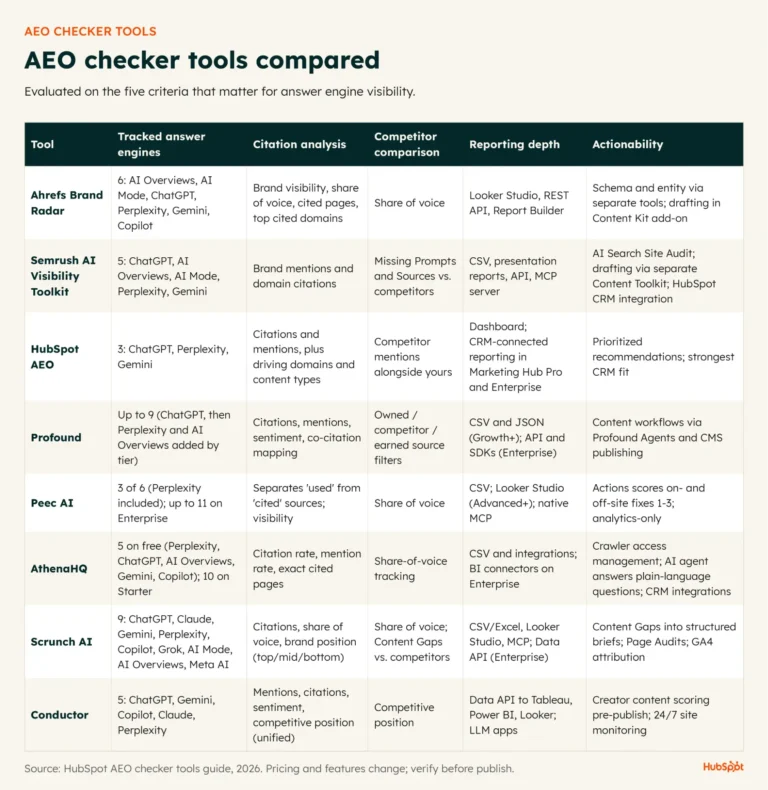
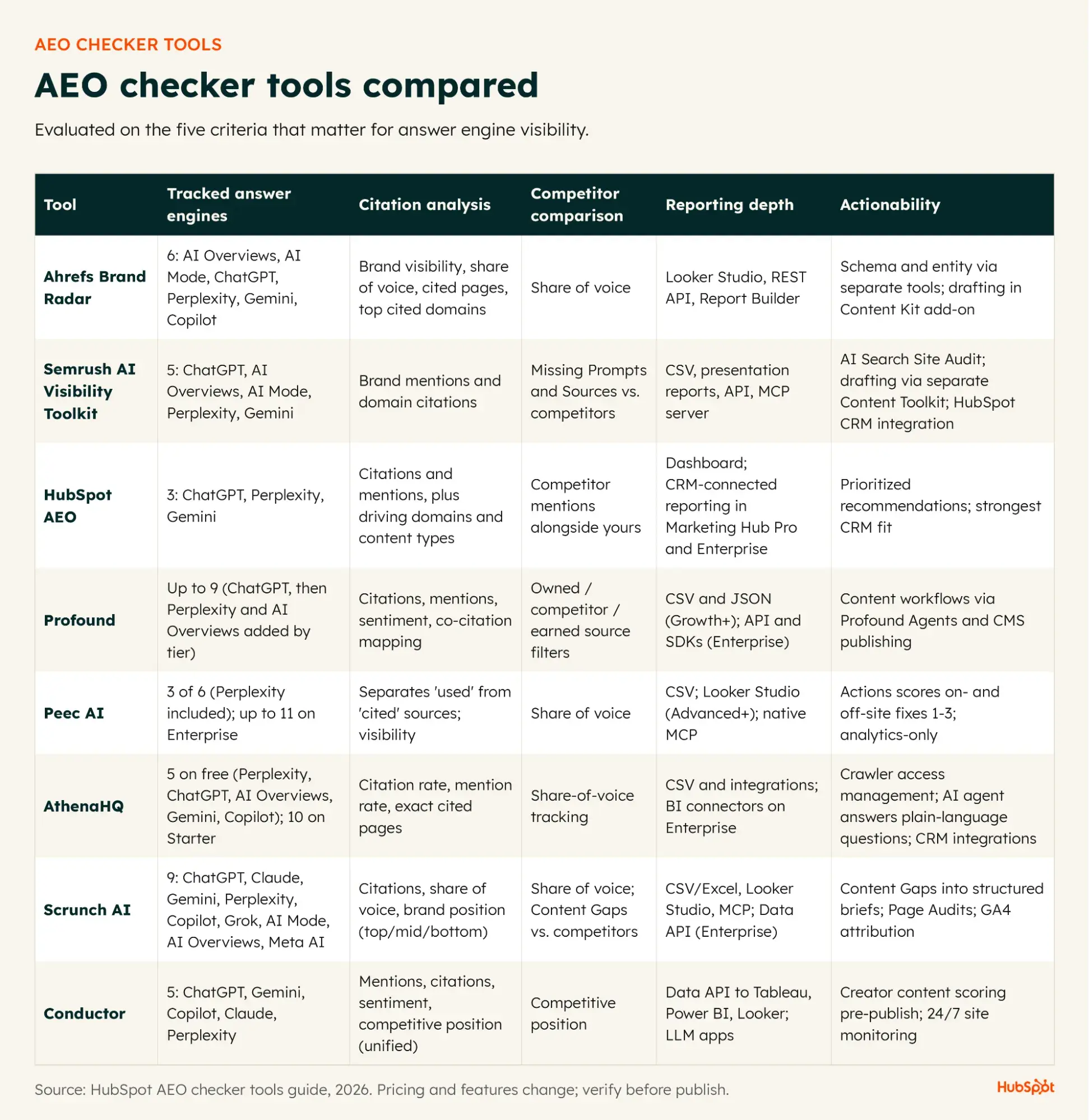
The Best AEO Checker Tools: A Comparative Overview
The market for AEO checkers is evolving rapidly. Here’s a look at some leading tools, categorized by their core strengths:
Tools with AI Overviews Tracking:
- Ahrefs Brand Radar: This tool leverages real search queries, not synthetic prompts, and boasts one of the most extensive indexes for AI Overviews. It monitors AI Overviews for branded and non-branded queries, identifying your brand’s presence and sentiment.
- Semrush AI Visibility Toolkit: Semrush’s Organic Research feature can flag ranking keywords that already trigger AI Overviews, allowing for prioritization of optimization efforts on content that is close to appearing in AI responses. It tracks AI Overviews for your domain and competitors.
Tools with ChatGPT Citation Detection:
- HubSpot AEO: Beyond just citations, HubSpot AEO tracks brand mentions (where the brand is named but not linked) and analyzes the content types and domains that drive visibility for both your brand and competitors. It offers CRM-connected reporting in Marketing Hub Professional and Enterprise.
- Profound: This platform goes deeper, analyzing citation context, including sentiment scoring, flagging uncited prompts, and breaking down citations by source type (owned, competitor, earned).
Tools with Perplexity Monitoring:
- Peec AI: A specialized analytics tool focusing on providing clean, detailed data specifically for Perplexity citations.
- AthenaHQ: Offers Perplexity monitoring across all its plans, including a free tier, and features a conversational assistant to help interpret data.
Tools for Schema and Entity Readiness:
![AEO checker tools that measure answer engine visibility [2026]](https://53.fs1.hubspotusercontent-na1.net/hubfs/53/aeo-checker-4-20260903-6212698.webp)
- Scrunch AI: Focuses on technical aspects, checking whether AI crawlers can access and effectively render your web pages, a crucial step for AI consumption of content.
- Conductor: Combines 24/7 technical monitoring with a content scoring system designed to assess readiness for AI consumption and citation.
Key AEO Metrics That Matter for Performance Tracking
Once an AEO checker is implemented, tracking specific metrics is vital to gauge the effectiveness of optimization efforts. These metrics should be viewed as trends over time rather than isolated data points.
- Brand Visibility Score: A composite score indicating how often and how accurately your brand appears in AI answers.
- Citation Coverage: The percentage of AI responses that include a direct link to your website.
- Mention Volume: The total number of times your brand is named in AI answers, regardless of whether a link is provided.
- Share of Voice (SOV) in AI: Your brand’s percentage of total mentions and citations within a given set of AI responses, compared to competitors.
- AI-Referred Traffic: While direct clicks from AI answers can be challenging to isolate, tracking traffic that originates from AI platforms provides a proxy for engagement.
- Branded Search Lift: An increase in direct or branded searches can indicate that AI visibility is driving awareness, even without direct clicks.
- Sentiment Analysis: For tools that offer it, understanding the tone of AI mentions is critical.
HubSpot AEO, for instance, tracks visibility scores week over week across major AI platforms and, within Marketing Hub Professional and Enterprise, connects this data to CRM contacts and deals.
From Measurement to Action: Integrating AEO with HubSpot
Many AEO checkers provide diagnoses, leaving the execution of fixes to the user. HubSpot aims to bridge this gap by integrating AEO capabilities directly into its platform. HubSpot AEO, available as a standalone product or within Marketing Hub Professional and Enterprise, transforms visibility data into actionable recommendations. It advises on what content to create, update, or promote, and crucially, explains why.
The standalone HubSpot AEO offers tracking, prompt suggestions, citation analysis, and recommendations for $50/month. For a more integrated experience, Marketing Hub Professional and Enterprise provide advanced features. The Content Agent, for example, can generate a research-backed first draft of a blog post based on a recommendation, directly within HubSpot’s content editor. This draft can then be refined and published through Content Hub and Marketing Hub. This generative capability, currently in public beta and utilizing HubSpot Credits, aims to streamline the content creation workflow.
![AEO checker tools that measure answer engine visibility [2026]](https://53.fs1.hubspotusercontent-na1.net/hubfs/53/aeo-checker-5-20260903-8938354.webp)
Crucially, by leveraging HubSpot’s Smart CRM, traffic referred from AI tools is tracked as its own source, linked to contacts and deals. This allows AEO reporting to be viewed alongside the broader marketing and sales funnel. It’s important to acknowledge a limitation: answer engines often resolve queries without generating a click. While HubSpot can attribute AI-referred traffic that does click through, visibility that never translates into a session cannot be directly measured as pipeline revenue. Therefore, visibility scores and referral revenue should be considered related but distinct performance indicators.
HubSpot AEO represents a practical next step for businesses that have outgrown manual checks and require a continuous loop of measurement and action.
Frequently Asked Questions About AEO Checkers
- How often should you run an AEO check?
The frequency depends on the method. For manual spot-checks, sample several sessions per query due to AI variability. Automated checkers allow for daily or weekly refreshes to capture volatility, while monthly snapshots can obscure important shifts. - Is AEO the same as AI search optimization?
While often used interchangeably, AEO is the more precise term. It specifically addresses improving a brand’s presence in AI-generated answers from tools like ChatGPT, Perplexity, and Gemini. - Can you reliably track citations in ChatGPT and Perplexity?
Yes, within limits. Both platforms surface sources, making individual responses auditable. However, reliability is achieved through repetition. Running each prompt multiple times across fresh sessions and tracking patterns is key. - Do AEO checkers replace traditional SEO tools?
No, they serve different purposes. AEO checkers monitor AI citations and mentions, while SEO tools track rankings, keywords, and backlinks. Strong SEO fundamentals continue to be essential for AI crawlability and authority, making both types of tools complementary.
As AI continues to reshape how users seek information, AEO and the tools that support it will become increasingly vital for businesses aiming to thrive in the digital landscape. Proactive monitoring and strategic optimization within AI answer engines are no longer optional, but essential for sustained brand visibility and customer engagement.
About the Author