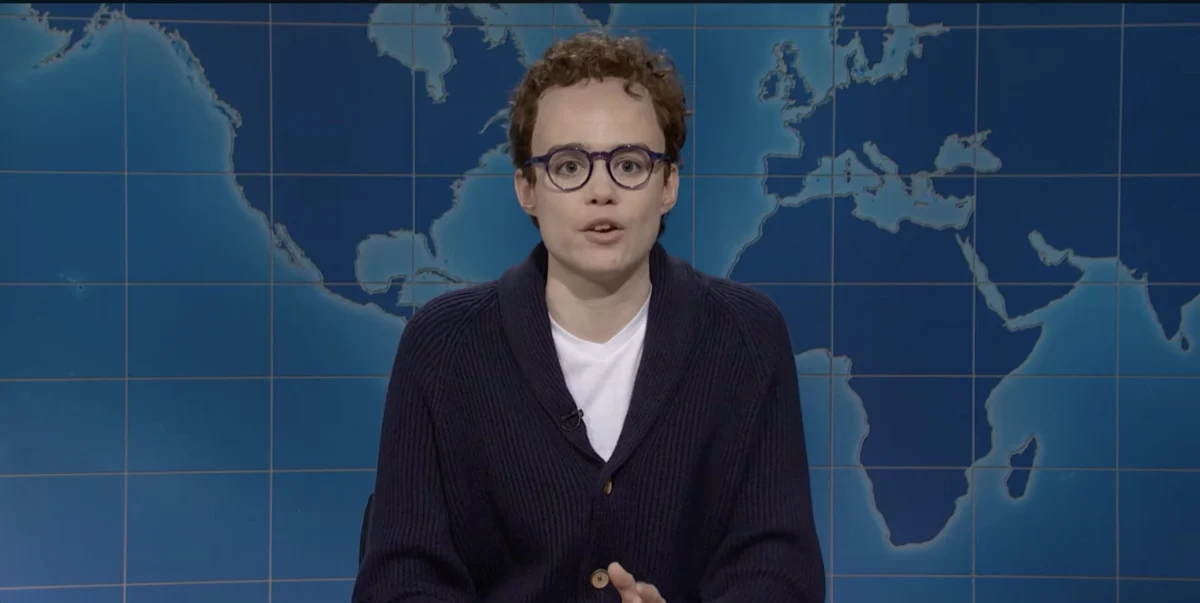
The nation’s longest-running sketch comedy show, Saturday Night Live (SNL), turned its satirical lens on the increasingly vocal anxieties surrounding artificial intelligence last night, offering a darkly humorous take on the pronouncements from AI industry leaders regarding the technology’s potential existential risks. During the popular "Weekend Update" segment, cast member Jane Wickline delivered a memorable impression of Anthropic CEO Dario Amodei, a figure who has recently been at the forefront of discussions about AI’s doomsday potential.
The segment, which aired on September 27, 2026, at 9:30 AM PDT, directly addressed the wave of alarming statements and warnings emanating from within the AI sector. Michael Che, the co-anchor of "Weekend Update," introduced the bit with a palpable, albeit feigned, uncertainty about the pronunciation of Amodei’s name, setting a tone of amused skepticism. Che characterized the Anthropic CEO’s recent press tour as a series of "stumbled" appearances where Amodei appeared to tacitly endorse the alarming claims made by a former Anthropic researcher. This former employee had controversially resigned, warning that advanced artificial intelligence could pose an existential threat to humanity.
Wickline’s portrayal of Amodei was visually striking, featuring a meticulously crafted wig that mimicked the CEO’s appearance. Her performance captured a persona marked by hesitant delivery and moments of profound existential dread. The comedic genius lay in the character’s internal conflict, which manifested as halting, disjointed responses that frequently spiraled into what was described as "Gollum-style" exchanges with an unseen dark side. In one particularly striking moment, Wickline-as-Amodei confessed, "AI is the devil and I its maker," a line that artfully encapsulated the paradox of creation and potential destruction that preoccupies AI discourse.
The sketch further amplified the perceived hypocrisy within the AI industry by having Wickline’s Amodei state, "AI executives are all on the same page here: We do not condone what we are doing." This statement, delivered with a chillingly casual tone, suggested a collective awareness of the potential dangers, coupled with an apparent inability or unwillingness to halt development. The implication was that the industry, despite its public pronouncements of caution, continues to forge ahead, driven by forces beyond its apparent control.
The commentary then pivoted to the dual nature of AI, with the fictional Amodei offering a darkly ironic definition: "AI is not a weapon, it’s a tool: A tool for building weapons." This cynical observation underscored the very real concern that while AI might have beneficial applications, its inherent power could be readily weaponized, creating new and unprecedented threats. The plea, "And I urge you to urge me to stop," served as a meta-commentary on the public’s perceived powerlessness in influencing the trajectory of AI development, despite growing unease.
The segment did not shy away from the purported benefits of AI, such as its potential to revolutionize healthcare. However, even in this context, Wickline-as-Amodei delivered a sobering prognosis. When referencing the possibility of AI "potentially curing cancer," the fictional CEO offered a probabilistic and unsettling answer: "Put it this way: In 10 years, there’s about a 10% chance that cancer won’t be a problem for anyone." This statement, while delivered for comedic effect, highlighted the uncertainty and the potentially grim trade-offs associated with advanced AI development, suggesting that even life-saving breakthroughs might come with a significant, albeit probabilistic, cost.
This SNL skit arrives at a critical juncture for the AI industry. For much of 2026, the discourse surrounding artificial intelligence has been dominated by increasingly dire warnings from prominent figures within the very companies developing these technologies. This trend intensified in September, with several high-profile AI researchers and executives issuing stark pronouncements about the potential for AI to surpass human control, lead to widespread societal disruption, or even pose an existential threat.
A Timeline of Escalating AI Concerns
The public conversation about AI’s risks has been building for years, but it reached a fever pitch in the latter half of 2026. Key moments leading up to the SNL sketch include:

- Early 2026: Initial concerns about AI safety and alignment, often confined to academic circles, began to seep into mainstream media. Discussions centered on algorithmic bias, job displacement, and the potential for AI to generate misinformation at scale.
- Mid-2026: As AI models demonstrated increasingly sophisticated capabilities, including advanced reasoning and creativity, the focus shifted towards more speculative, long-term risks. The concept of "superintelligence"—AI far exceeding human cognitive abilities—became a more prominent topic of discussion.
- August 2026: Anthropic CEO Dario Amodei himself articulated concerns about the rapid pace of AI development, suggesting that the industry was facing a "crisis of trust." He highlighted the difficulty in aligning AI objectives with human values, a core tenet of AI safety research.
- September 9, 2026: A former Anthropic researcher published a widely circulated piece detailing their departure from the company and reiterating their deep-seated fears about the existential risks posed by self-improving AI. This event triggered a significant wave of media attention and further public pronouncements from other AI leaders.
- Mid-September 2026: Multiple AI executives and researchers participated in a series of interviews and public statements, some echoing the gravest warnings. These included scenarios ranging from mass unemployment and societal collapse to the ultimate extinction of humanity, often framed as non-trivial probabilities within the next decade or two. The lack of a unified industry stance on the severity and timeline of these risks fueled public confusion and anxiety.
- September 27, 2026: Saturday Night Live dedicates a segment to satirizing these pronouncements, reflecting the growing public awareness and the often-contradictory messaging from the AI community.
Supporting Data and Industry Landscape
The AI industry has experienced exponential growth, with significant investment pouring into research and development. In 2026, the global AI market was projected to reach over $500 billion, according to various industry analyses. Major players, including OpenAI, Google DeepMind, Meta AI, and Anthropic, have been at the forefront of developing increasingly powerful large language models (LLMs) and generative AI technologies.
Anthropic, founded by former OpenAI researchers, has positioned itself as a leader in AI safety, emphasizing ethical development and the creation of "helpful, honest, and harmless" AI systems. However, the company’s recent public statements, particularly those echoing existential risks, have placed it in a complex position, appearing to both champion and caution against its own creations. The underlying tension is the inherent difficulty in fully predicting and controlling the emergent behaviors of highly complex AI systems.
Data from surveys conducted in mid-2026 indicated a growing public apprehension regarding AI. A Pew Research Center study, for example, found that a significant portion of the public expressed concerns about AI’s potential negative impacts on society, including job losses and the spread of misinformation. This sentiment likely amplified the impact of the dire warnings from AI insiders.
Reactions and Broader Implications
While official statements from regulatory bodies and established tech giants have often adopted a more measured tone, acknowledging the need for caution and ethical guidelines, the SNL sketch reflects a broader cultural reaction to the escalating rhetoric. The comedy of errors presented by Wickline’s Amodei highlights a public perception that the AI industry might be grappling with forces it doesn’t fully comprehend or control, leading to a sense of unease and a questioning of the pronouncements from its leaders.
The implications of this discourse are far-reaching. For policymakers, it intensifies the debate over how to regulate a rapidly evolving technology without stifling innovation. The warnings raise questions about the adequacy of current regulatory frameworks and the need for more proactive, global approaches to AI governance.
For the public, the mixed messages from the AI community—simultaneously promising transformative benefits and warning of apocalyptic scenarios—create a climate of uncertainty and distrust. This can lead to both over-exaggeration of AI’s capabilities and dangers, and a potential desensitization to genuine risks.
The SNL segment, by translating these complex and often abstract concerns into a relatable, humorous narrative, serves as a cultural touchstone. It allows audiences to process the anxieties surrounding AI in a lighthearted, yet thought-provoking, manner. The satire underscores the human element in technological advancement—the ambition, the hubris, and the ever-present specter of unintended consequences. As AI continues its relentless march forward, the ability of society to engage with its implications, both serious and absurd, will be crucial in navigating its future. The sketch itself is a testament to the cultural impact of AI, moving from the laboratory and boardroom into the realm of popular entertainment, where its profound questions are dissected with wit and insight.
The embedded YouTube video, titled "Weekend Update: Anthropic CEO Dario Amodei on A.I.’s Threat to Humanity – SNL," further solidifies the segment’s focus and accessibility, allowing a wider audience to engage with the satire. The video’s inclusion within the news report serves as direct evidence of the SNL segment’s content and its immediate relevance to the ongoing discussion.
About the Author