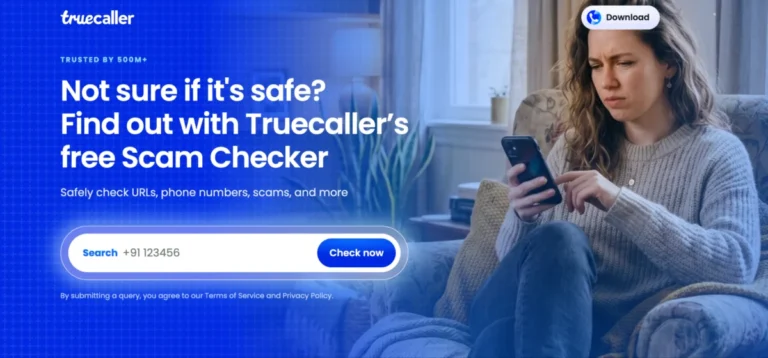
Truecaller, a company that has spent over a decade building a powerful caller identification service utilized by more than 500 million users globally, is now extending its expertise in combating scams to the open web. The Swedish firm has launched "Scam Checker," a new, free-to-access web and Android service that allows individuals to verify the legitimacy of suspicious phone numbers, links, or messages without requiring an app download or sign-in. This strategic move marks a significant evolution for Truecaller, pushing its protective services beyond its traditional caller ID domain and into the increasingly complex landscape of digital fraud.
The Scam Checker service operates by tapping into the immense wealth of scam intelligence Truecaller has meticulously gathered from its extensive user base. When a user inputs a suspicious phone number, link, or message into the Scam Checker, the platform cross-references this information with its vast, crowdsourced database, known as ScamFeed. This feed comprises real-time reports and discussions from Truecaller’s community, offering insights into emerging fraudulent activities. While Scam Checker provides an immediate assessment of potential threats, more granular details, such as the name associated with a phone number, remain accessible exclusively through the company’s existing app-based service, which necessitates user sign-in.
This innovative tool is initially being rolled out in India, a market where Truecaller boasts over 350 million users, making it its largest operational base. The company has announced plans to progressively expand Scam Checker’s availability to other key regions, including Latin America, the Middle East and Africa, and Southeast Asia. This global expansion strategy underscores Truecaller’s commitment to providing widespread access to its anti-scam capabilities in areas where digital fraud poses a significant threat to consumers.
The launch of Scam Checker serves a dual purpose for Truecaller. Firstly, it acts as a powerful lead generation tool, driving new users to download and sign up for its core app, thereby expanding its user base and data collection capabilities. Secondly, and perhaps more importantly, the continuous influx of community-generated reports on ScamFeed provides Truecaller with an unparalleled, real-time view of the evolving scam tactics being employed by malicious actors. This invaluable intelligence can then be leveraged to enhance its fraud and risk management products, which are offered to enterprises through its "Truecaller for Business" division. However, the company has emphasized that Scam Checker itself is primarily designed for individual consumers.
The Mechanics of Scam Detection
The operational framework of Truecaller’s Scam Checker is designed to be robust and multi-faceted. When a user submits a web link, the service first meticulously analyzes it. This process involves expanding any shortened URLs and meticulously following any redirects to pinpoint the ultimate destination of the link. This de-obfuscation is crucial in identifying the true nature of the web address, which often conceals malicious intent. Once the final destination is identified, the link is then rigorously checked against Truecaller’s proprietary risk database, which is continuously updated with known fraudulent domains and phishing sites. Furthermore, the service scrutinizes various other fraud signals, encompassing patterns of malicious activity and known scam methodologies.
For suspicious text messages, the Scam Checker employs sophisticated natural language processing techniques to identify and extract embedded phone numbers or links. These extracted elements are then processed using the same link analysis and risk assessment protocols described above. Crucially, the service then surfaces any relevant reports or discussions from the Truecaller community associated with these extracted components, providing users with collective insights and warnings.
A Growing Threat Landscape
The introduction of Scam Checker comes at a critical juncture, as the nature and reach of scams have dramatically expanded beyond traditional voice calls. Scammers are increasingly leveraging text messages, instant messaging applications, and deceptive web links to perpetrate their schemes. This shift in modus operandi is clearly reflected in recent research. A 2025 GSMA survey of Indian adults, for instance, revealed a significant prevalence of scams originating from digital channels. The report indicated that 46% of individuals who reported being scammed were initially approached via messaging apps, followed by 37% through SMS, and 32% through voice calls. This data underscores the urgent need for accessible and effective tools to combat these evolving threats.

Truecaller’s strategic decision to develop Scam Checker was informed by an analysis of user behavior. The company estimates that approximately 14 million web searches are performed monthly by individuals attempting to verify suspicious links and phone numbers. This estimation is derived from an in-depth analysis of search engine volumes and traffic patterns to existing verification services. Rishit Jhunjhunwala, CEO of Truecaller, highlighted the impetus behind the service’s design: "When you need it, you’re usually somewhere else. The link shows up on WhatsApp. Your mum gets a message about a traffic fine. A friend forwards you a screenshot and asks, ‘Is this real?’ What people do in that moment is search." This observation points to a clear consumer need for an immediate, low-friction solution to verify potential scams in real-time, often while engaged in other communication platforms.
The Power of Community Intelligence
The Truecaller community is emerging as an indispensable asset in the company’s ongoing battle against fraud. ScamFeed, its crowdsourced platform for reporting and discussing scams, is a testament to this collaborative approach. In India alone, the company reports that approximately 20,000 scam reports are currently active on ScamFeed, with an additional 1,300 new reports being submitted each week. This constant stream of user-generated data provides an unparalleled real-time pulse on the prevalence and nature of scams.
The scale of Truecaller’s operations in combating fraudulent communications is staggering. Between September 14 and September 20 of the current year, the company revealed that it processed an astounding 12.9 billion messages globally. During this same period, an estimated 20.3 million of these messages were flagged as fraudulent, showcasing the sheer volume of malicious content circulating across digital platforms. This data not only validates the need for services like Scam Checker but also highlights Truecaller’s significant role in the global effort to mitigate online fraud.
Looking ahead, Truecaller has ambitious plans to enhance Scam Checker’s capabilities. The company intends to broaden the spectrum of scam types that the service can detect, moving beyond just links and phone numbers. A significant planned enhancement includes the introduction of screenshot uploads, allowing users to submit visual evidence of suspicious communications for further analysis. This feature could prove particularly valuable in identifying scams that rely on visual deception, such as fake invoices or fabricated support messages.
Navigating a Shifting Regulatory and Competitive Landscape
Truecaller’s strategic pivot towards broader scam detection services is occurring against a backdrop of evolving market dynamics and increasing regulatory scrutiny in its core Indian market. The company’s primary caller ID business, which has been its bedrock for years, is facing mounting pressures. Telecom operators are actively deploying the federal government-backed Calling Name Presentation (CNAP) service, which natively displays the caller’s name on phone screens, potentially diminishing the reliance on third-party caller ID apps. Furthermore, both Apple and Google have integrated their own caller identification and spam-protection features into their mobile operating systems, directly competing with Truecaller’s established offerings.
Adding to these challenges, India’s telecom regulator recently issued an order mandating caller-ID applications to share user-submitted spam reports with telecom operators. Truecaller publicly criticized this directive, describing it as a "one-way exchange" that could compromise user privacy and data security without providing reciprocal benefits. This regulatory development highlights the complex interplay between technology companies, government bodies, and consumer protection in the rapidly evolving telecommunications sector.
In response to these pressures and the changing threat landscape, Truecaller’s strategic focus is demonstrably shifting. "Caller ID was the first problem we solved, and it’s still how most people find us," stated CEO Rishit Jhunjhunwala. "But scams moved to a more multi-channel approach with links and messages, and increasingly to voice and video. Our protection has to follow the scammer." This strategic recalibration signifies Truecaller’s recognition that its future growth and relevance depend on its ability to adapt and provide comprehensive security solutions that extend far beyond simply identifying incoming calls. By leveraging its extensive user data and community intelligence, Truecaller aims to become a more holistic guardian against digital deception, adapting its protective shield to match the ever-evolving tactics of fraudsters. The success of Scam Checker will likely be a key indicator of Truecaller’s ability to navigate this new frontier and maintain its position as a vital player in the digital security ecosystem.
About the Author