The digital marketing and search landscape is undergoing a significant transformation with the rise of AI-powered answer engines like ChatGPT, Perplexity, and Google’s Gemini. These platforms are fundamentally altering how users seek information, moving away from traditional lists of links towards synthesized, direct answers. This shift necessitates a new approach to online visibility, known as Answer Engine Optimization (AEO), and specialized tools called AEO checkers are emerging to help businesses adapt.
The core challenge lies in the fact that users increasingly rely on the direct answers provided by these AI models without necessarily clicking through to source websites. This means that visibility, once primarily measured by search engine rankings (SEO), can now vanish into an AI-generated response that may or may not attribute the information to its original source. An AEO checker is designed to address this by identifying whether a brand’s content is mentioned or cited within these AI-generated answers, and critically, to assess the accuracy and context of those mentions.
The Emergence of Answer Engine Optimization (AEO)
Answer Engine Optimization (AEO) is the strategic practice of enhancing a brand’s presence and accuracy within the AI-generated responses delivered by conversational AI models and AI-powered search features. This paradigm shift in user behavior, where direct answers are prioritized over clickable links, was notably accelerated by Google’s integration of AI Overviews (formerly Search Generative Experience or SGE) in May 2024. These AI Overviews aim to provide immediate, synthesized answers to user queries, often summarizing information from multiple sources.
![AEO checker tools that measure answer engine visibility [2026]](https://53.fs1.hubspotusercontent-na1.net/hubfs/53/aeo-checker-1-20260903-3858273.webp)
AEO and SEO are not mutually exclusive but rather complementary strategies. While SEO continues to focus on improving a website’s ranking in traditional search engine results pages (SERPs) to ensure crawlability and authority, AEO aims to secure a brand’s mention and citation within the synthesized answers themselves. The effectiveness of both strategies is intertwined, as robust SEO practices provide the foundational authority and structured content that AI answer engines rely upon when selecting sources for their responses.
The type of content that AI answer engines favor for citation includes clearly structured web pages, content that directly addresses user questions, and claims that are supported by verifiable primary sources. This emphasizes the ongoing importance of high-quality, authoritative content in the new AI-driven search environment.
What an AEO Checker Delivers
An AEO checker serves as a crucial diagnostic tool, measuring a brand’s visibility across various answer engines and translating these findings into actionable recommendations for improvement. These tools typically assess several key areas:
- Brand Mentions: Identifying instances where a brand name is explicitly mentioned within an AI-generated answer, even if no direct link is provided.
- Citations: Detecting when an AI answer directly links to or attributes information to a brand’s website or content.
- Competitor Visibility: Analyzing which competitors are being cited or mentioned in AI responses for similar queries.
- Accuracy of Information: Evaluating whether the AI accurately represents the brand’s information or makes erroneous claims.
- Content Gaps: Pinpointing areas where a brand should be appearing in AI answers but is currently absent.
Based on this analysis, AEO checkers prioritize optimization efforts, highlighting specific content updates, schema markup corrections, and entity improvements that are most likely to increase brand citations and mentions.
![AEO checker tools that measure answer engine visibility [2026]](https://no-cache.hubspot.com/cta/default/53/9dd5e54b-fbef-4dd0-bc44-1689feb1ea18.png)
Manual Checks: A Starting Point in the AI Era
While sophisticated AEO checkers offer automated solutions, understanding the manual process of checking visibility in AI-generated answers is essential, particularly when starting or for smaller query sets.
Checking Google AI Overviews (AIOs):
Google’s AI Overviews are designed to appear only when the system determines they offer a valuable summary beyond traditional search results. This means they don’t trigger for every query and can vary from one search session to another. A manual check involves:
- Defining Priority Queries: Compiling a list of critical search terms, including brand names, branded product terms, and informational queries that potential buyers frequently use.
- Performing Live Searches: Conducting searches for these queries in a signed-out or incognito browser session to simulate a neutral user experience.
- Analyzing AI Overviews: For each query, observing:
- Whether an AI Overview appears.
- If the brand’s domain is listed among the inline source links within the overview.
- The specific claims made within the AI Overview.
- Interpreting Results: Comparing queries where AI Overviews appear and cite the brand against those where competitors are cited instead. This helps identify content gaps. It’s important to note that variations between sessions mean a single absence shouldn’t be treated as a definitive loss.
- Building Reports: Documenting each result with the query, date, and location. Standard Google Search Console reports do not isolate AI Overview activity, often rolling it into the broader "Web" search type. While Google has begun rolling out dedicated generative AI performance reports, these have limitations in scope and data granularity.
The manual approach, while informative, is not scalable. The dynamic nature of AI Overviews and the sheer volume of potential queries make consistent manual tracking unreliable for larger businesses.
![AEO checker tools that measure answer engine visibility [2026]](https://53.fs1.hubspotusercontent-na1.net/hubfs/53/aeo-checker-2-20260903-852936.webp)
Checking ChatGPT and Perplexity Citations:
Both ChatGPT and Perplexity provide mechanisms for users to review the sources that inform their answers.
- Perplexity: By default, Perplexity attaches citations directly to its answers, linking to the source material. It also features a dedicated panel listing all sources used for a given response.
- ChatGPT: When using its web browsing capabilities, ChatGPT also displays inline citations and a "Sources" panel beneath its generated replies.
To manually check citations in these platforms:
- Run Practical Citation Checks: Use the defined priority queries and examine whether the brand’s domain appears among the cited sources and if the brand is mentioned in the answer text. A citation and a mention are distinct forms of visibility.
- Optimize Prompt Phrasing: To ensure ChatGPT accesses current information, users should ask direct, up-to-date questions (e.g., "best [category] tools for [use case]"). This encourages the AI to perform web searches.
- Log Results Systematically: Given that sources can vary between query runs, it’s crucial to execute each prompt multiple times across fresh sessions. Each log entry should include the engine, prompt, date, whether the brand was cited or mentioned, and any competitors that appeared. This comprehensive logging helps identify inconsistencies and provides a basis for action. Each instance where a brand is absent or a competitor is cited represents an opportunity for content or structural optimization.
The Role of AEO Checkers in Automating Visibility
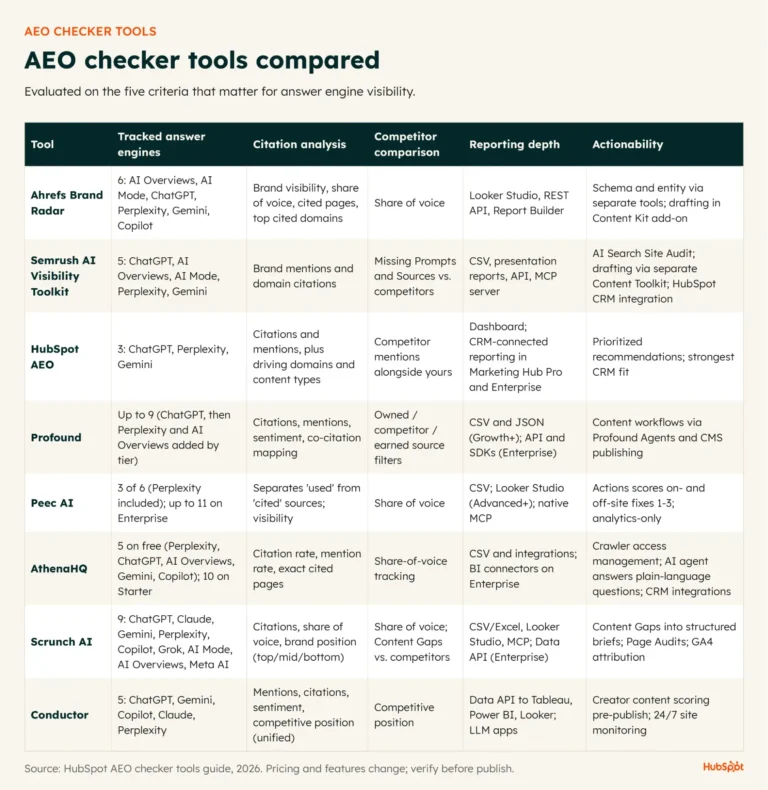
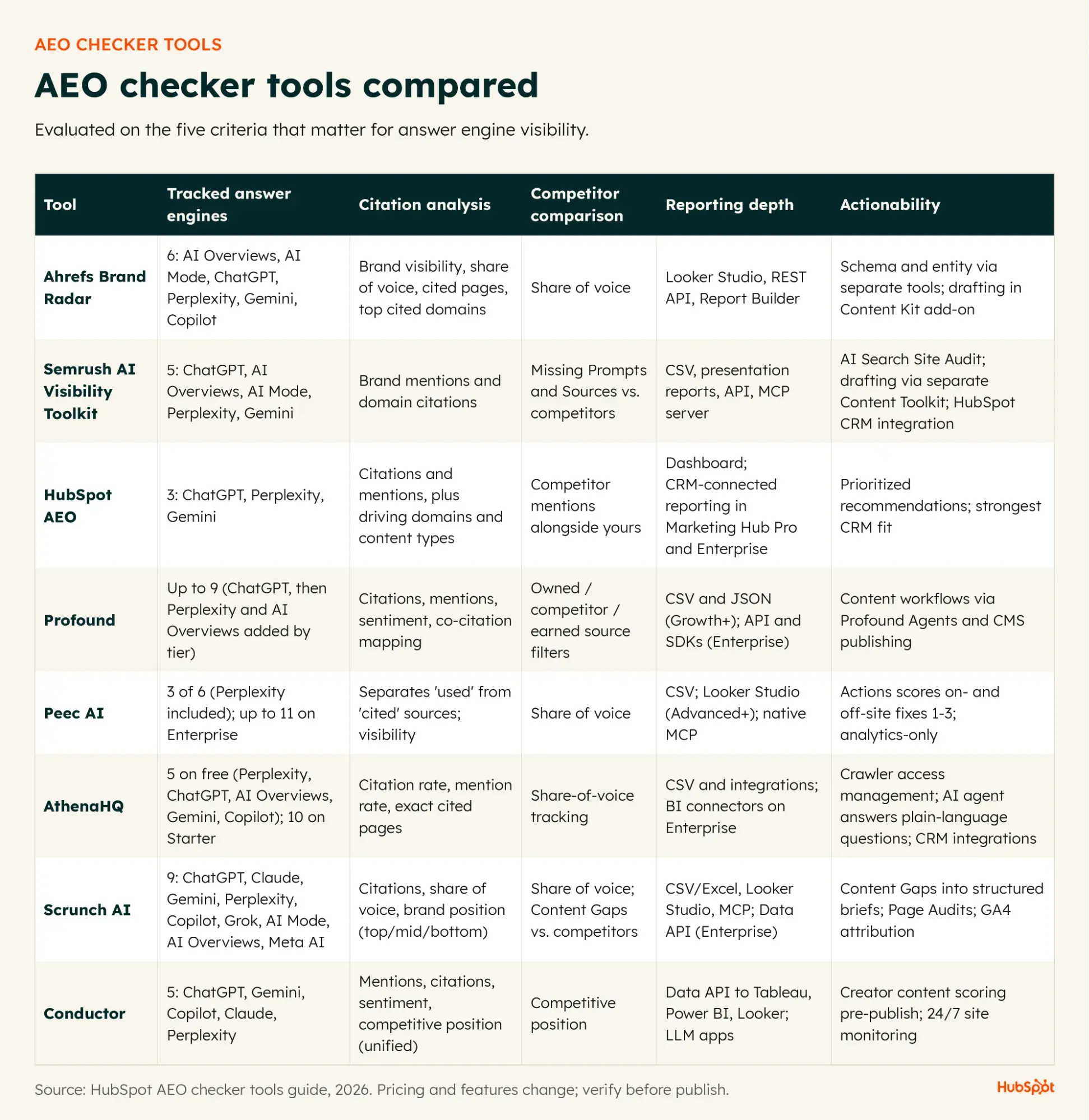
As manual checks become impractical, AEO checking software becomes indispensable. When selecting such tools, several criteria are paramount:
![AEO checker tools that measure answer engine visibility [2026]](https://53.fs1.hubspotusercontent-na1.net/hubfs/53/aeo-checker-3-20260903-8904553.webp)
- Answer Engine Coverage: The tool should monitor the AI platforms most relevant to the target audience, including ChatGPT, Perplexity, Gemini, and AI Overviews.
- Citation and Mention Tracking: The ability to accurately detect both direct citations (links) and indirect mentions (brand name presence) is crucial.
- Competitor Analysis: Understanding how competitors are performing in AI answers provides valuable benchmarking and competitive intelligence.
- Data Accuracy and Freshness: The tool must provide reliable, up-to-date data to reflect the dynamic nature of AI responses.
- Actionable Recommendations: Beyond just data, the software should offer clear, prioritized guidance on how to improve AI visibility.
- Integration Capabilities: Seamless integration with existing marketing technology stacks, such as CRMs, can enhance the utility of AEO data.
- Reporting and Dashboards: Intuitive reporting features that provide a clear overview of performance and trends are essential for ongoing strategy.
Leading AEO Checker Tools and Their Capabilities
A variety of AEO checker tools are available, each with distinct strengths:
- HubSpot AEO: This tool offers comprehensive tracking across ChatGPT, Perplexity, and Gemini, providing prioritized recommendations. When integrated with Marketing Hub Professional and Enterprise, it delivers CRM-connected reporting, linking AIO performance to contacts and deals. For a preliminary assessment, HubSpot’s AI Search Grader offers a free snapshot of brand representation in answer engines.
- Ahrefs Brand Radar: Leveraging real search queries rather than synthetic prompts, Brand Radar offers an extensive index of AI Overviews, making it a strong option for monitoring Google’s AI features.
- Semrush AI Visibility Toolkit: Semrush’s Organic Research feature can identify which ranking keywords already trigger AI Overviews, allowing businesses to prioritize content optimization for those terms.
- Profound: This platform goes beyond basic citation detection by analyzing citation context, including sentiment scoring, flagging uncited prompts, and categorizing citations by source type (owned, competitor, earned).
- Peec AI: A specialized analytics tool focused purely on providing clean data from Perplexity.
- AthenaHQ: Tracks Perplexity across all plans, including a free tier, and offers a conversational assistant for data interaction.
- Scrunch AI: Focuses on the technical readiness of web pages, checking if AI crawlers can access and render them.
- Conductor: Combines continuous technical monitoring with a content scoring mechanism to assess AI readiness.
Key Metrics for Measuring AEO Success
Once an AEO checker is in place, tracking specific metrics is vital for evaluating progress:
- Brand Visibility Score: A composite score reflecting the overall presence and accuracy of a brand in AI answers.
- Citation Coverage: The percentage of AI answers that directly cite the brand’s content.
- Mention Volume: The total number of times a brand is mentioned in AI-generated responses.
- Competitor Share of Voice: The proportion of AI answers that feature a specific competitor.
- Sentiment Analysis: For advanced tools, assessing the tone and context of brand mentions.
- AI-Referred Traffic: While direct clicks are diminishing, tracking any traffic that originates from AI platforms.
- Branded Search Lift: Monitoring increases in direct or branded searches that may be influenced by AI visibility.
These metrics should be viewed as trends over time rather than isolated data points. Consistent improvement in citation coverage and brand mentions, coupled with a decrease in competitor dominance, indicates successful AEO efforts.
![AEO checker tools that measure answer engine visibility [2026]](https://53.fs1.hubspotusercontent-na1.net/hubfs/53/aeo-checker-4-20260903-6212698.webp)
Bridging the Gap: From Measurement to Action with HubSpot
While many AEO checkers provide diagnostic data, the implementation of fixes often requires separate workflows. HubSpot aims to bridge this gap by integrating measurement and action. Its AEO tool provides prioritized recommendations, guiding users on what content to create or update.
For a more comprehensive solution, HubSpot Marketing Hub Professional and Enterprise offer advanced AEO capabilities. These include CRM integration, allowing businesses to connect AI visibility data to specific contacts and deals. The "Content Agent" feature can even generate AI-drafted content based on recommendations, which teams can then refine and publish through HubSpot’s Content Hub and Marketing Hub. This integrated approach streamlines the AEO process, from initial diagnosis to content creation and publication, all within a single platform.
A significant challenge in the AI search era is that many queries are resolved without generating a click-through. While HubSpot can attribute AI-referred traffic that does occur, the broader impact of AI visibility—where users gain awareness or make decisions without visiting a website—is harder to quantify directly in terms of pipeline. Therefore, visibility scores and referral revenue should be considered as related but distinct measures of success.
Frequently Asked Questions About AEO Checkers
![AEO checker tools that measure answer engine visibility [2026]](https://53.fs1.hubspotusercontent-na1.net/hubfs/53/aeo-checker-5-20260903-8938354.webp)
-
How often should an AEO check be performed?
The frequency depends on the method. Manual checks require multiple sessions per query due to AI variability. Automated checkers, however, can provide daily or weekly refreshes to capture this volatility, while monthly snapshots may obscure important fluctuations. -
Is AEO synonymous with AI search optimization?
While often used interchangeably, AEO is the more precise term. It specifically refers to optimizing for brand presence within AI-generated answers from platforms like ChatGPT, Perplexity, and Gemini. -
Can citations in ChatGPT and Perplexity be reliably tracked?
Yes, to a degree. Both platforms surface sources, but results can vary between sessions. Reliability is achieved through repeated testing and tracking patterns rather than relying on single instances. -
Do AEO checkers replace traditional SEO tools?
No. AEO and SEO address different aspects of online visibility. SEO tools focus on rankings, keywords, and backlinks, while AEO checkers monitor brand presence within AI answers. Strong SEO remains a foundational element that supports AI answer engine performance.
In conclusion, the rise of AI-powered answer engines marks a pivotal moment for digital visibility. Businesses must embrace Answer Engine Optimization and leverage AEO checkers to understand and adapt to this evolving search paradigm. By strategically monitoring and optimizing their presence within AI-generated responses, brands can ensure they remain visible and relevant in the new era of search.
About the Author